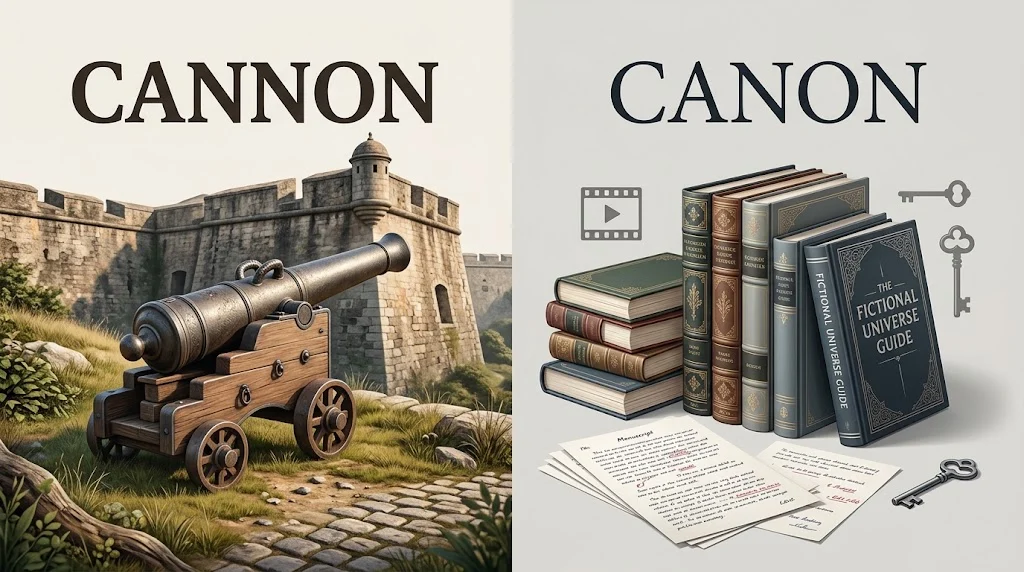
Cannon or canon refers to two completely different words that sound alike but have different meanings and spellings. Cannon is a noun for a large gun or artillery weapon, while canon commonly refers to an accepted collection of works, an established rule, or an official body of texts. Confusing them can change your meaning completely.
Cannon vs Canon | What’s the Difference?
The easiest way to understand these words is to separate their meanings before thinking about pronunciation. Although cannon and canon are pronounced alike in most varieties of English, they belong to different vocabulary categories and describe unrelated concepts.
Cannon is primarily a noun. It refers to a large, powerful gun, especially one designed to fire a projectile over a considerable distance. The word is strongly associated with military history, artillery, naval warfare, and historical weapons.
Canon is also primarily a noun, but its meanings are much broader. It can describe an accepted collection of literary, artistic, musical, religious, or fictional works. It can also mean an established principle, rule, or standard. In discussions of books, films, television, and popular culture, canon often identifies events or characters officially recognized as part of a fictional universe.
| Word | Part of Speech | Primary Meaning | Typical Context | Example |
|---|---|---|---|---|
| cannon | Noun | A large gun or artillery weapon | Military history, warfare, ships | The cannon was displayed beside the old fort. |
| canon | Noun | An accepted collection, rule, or official body of works | Literature, religion, film, television, scholarship | The novel became part of the literary canon. |
The spelling difference is small, but the semantic difference is enormous.
Use cannon when you are talking about a large firearm or artillery piece.
Use canon when you are talking about an accepted body of works, an established standard, or official fictional material.
They are homophones in many English accents, which explains why people often confuse them when writing.
Is Cannon vs Canon a Grammar, Vocabulary or Usage Issue?
The confusion between cannon and canon is primarily a vocabulary and usage issue rather than a grammar problem. Both words can function grammatically as nouns, but their meanings are not interchangeable.
For example, the sentence “The author is part of the literary cannon” is incorrect if the intended meaning is an accepted body of literature. The correct word is canon.
Likewise, “The soldiers fired the canon” is incorrect when referring to an artillery weapon. The correct spelling is cannon.
Neither word is simply a formal or informal alternative to the other. You cannot choose between them based on your writing is academic, professional, or conversational. The correct choice depends entirely on meaning.
In academic writing, canon is common when scholars discuss influential works, recognized texts, or established traditions. In historical writing, cannon frequently appears when discussing weapons, battles, forts, ships, and military technology.
The key lesson is simple: pronunciation does not determine spelling. Meaning does.
Cannon: Meaning, Usage and Examples
A cannon is a large gun designed to fire a projectile. Historically, cannons were important military technologies used on land and at sea. They appeared in warfare for centuries and played a major role in the development of artillery.
The word can refer to historical weapons as well as large guns in broader contexts. You might encounter it in descriptions of castles, forts, warships, battlefields, museums, or historical fiction.
Workplace Example
A museum curator might write:
“The restored cannon is now displayed in the entrance hall.”
Here, cannon clearly identifies a physical historical object.
A historian preparing a workplace presentation could also say:
“The report examines how cannon technology affected naval warfare.”
The word remains appropriate because the subject is artillery.
Academic Example
A history student might write:
“The fort contained several cannon positioned along the defensive wall.”
In an academic context, the word refers directly to artillery.
A research paper could also discuss “the development of cannon manufacturing during the early modern period.”
Technology Example
In a technology or engineering discussion, cannon can appear when examining historical weapons engineering, mechanical design, simulation software, or virtual environments.
For example:
“The simulation models the force generated when the cannon fires.”
The context makes the intended meaning unmistakable.
Usage Recap
Cannon means a large gun or artillery weapon. Think of forts, ships, battlefields, artillery, and historical weapons. If the object can fire a projectile as a large gun, cannon is the appropriate spelling.
Canon: Meaning, Usage and Examples
Canon has several related meanings, but they all involve the idea of an accepted body, standard, or collection.
In literature, the canon can refer to works considered especially important or influential. In religious studies, canon can describe texts officially accepted as authoritative within a religious tradition. In popular culture, canon often refers to material officially recognized as part of a fictional universe.
The word can also describe an accepted rule or principle.
Workplace Example
An editor might write:
“The novel is now widely regarded as part of the modern literary canon.”
Here, canon means an accepted or influential body of literature.
A company working in publishing could also use the word when discussing historically significant books, authors, or genres.
Academic Example
A university professor might say:
“Students will study several texts from the Western literary canon.”
The word refers to a recognized collection of influential literary works.
In religious studies, scholars may discuss the formation of a scriptural canon and the processes through which certain texts became accepted as authoritative.
Technology Example
Technology provides another common modern use of canon, particularly in entertainment.
A fan might ask:
“Is this character part of the official canon?”
That question means the character or story is officially recognized as belonging to the fictional universe.
Writers, game developers, film studios, and fan communities often use canon to distinguish official story material from unofficial interpretations, adaptations, speculation, or fan created content.
Usage Recap
Canon refers to an accepted collection, standard, or official body of material. Think of literature, religion, scholarship, film, television, games, and established fictional history.
When You Should NOT Use Cannon or Canon
Understanding when not to use each word can prevent many spelling mistakes.
- Do not use cannon when discussing a collection of books. Use canon.
- Do not use canon when describing an artillery weapon. Use cannon.
- Do not use cannon when discussing official events in a fictional universe. Use canon.
- Do not use canon for a large historical gun. Use cannon.
- Do not assume that the shorter spelling is automatically correct because both words sound alike.
- Do not choose the spelling based on pronunciation alone.
- Do not use cannon for an established academic or artistic tradition.
- Do not use canon for a physical weapon simply because the surrounding text is historical or literary.
The safest approach is to identify the object or concept first and choose the spelling afterward.
Common Mistakes and Decision Rules
The following examples show how one extra letter changes the meaning.
| Correct sentence | Incorrect sentence | Explanation |
|---|---|---|
| The soldiers fired the cannon. | The soldiers fired the canon. | The sentence refers to a large gun or artillery weapon. |
| The novel became part of the literary canon. | The novel became part of the literary cannon. | The sentence refers to an accepted collection of literature. |
| The film is considered part of the official canon. | The film is considered part of the official cannon. | The sentence concerns officially recognized fictional material. |
| The museum restored an eighteenth century cannon. | The museum restored an eighteenth century canon. | The object is a historical artillery weapon. |
| Scholars continue to debate the literary canon. | Scholars continue to debate the literary cannon. | The discussion concerns recognized or influential literature. |
| The game added a character who is now canon. | The game added a character who is now cannon. | The character is officially part of the fictional universe. |
Decision Rule
If you mean a large gun or artillery weapon, use cannon.
If you mean an accepted collection, established standard, or official fictional material, use canon.
This rule is more reliable than trying to remember pronunciation.
Cannon and Canon in Modern Technology and AI Tools
Modern technology has created new contexts in which canon appears frequently. Artificial intelligence tools, search systems, digital libraries, entertainment databases, and online communities often distinguish between authoritative material and unofficial information.
For example, an AI system discussing a fictional franchise may need to determine a story belongs to the official canon. The term can therefore appear in discussions about continuity, official releases, character histories, and established fictional events.
Cannon, meanwhile, remains relevant in historical simulations, military museums, educational software, video games, engineering discussions, and digital reconstructions of historical environments.
The distinction matters in AI generated text as well. An AI tool that produces “the official cannon of the franchise” when it means “the official canon of the franchise” has selected the wrong word despite producing a sentence that sounds natural when spoken aloud.
This illustrates an important lesson about language technology: spelling depends on semantic context, not pronunciation alone.
Etymology: Why Do Cannon and Canon Look So Similar?
The similarity between these words is partly historical, but their modern meanings developed through different linguistic paths.
Cannon ultimately traces back through European languages to terms associated with a tube or large weapon. Its history is closely connected with the development of artillery.
Canon comes through Latin and Greek traditions associated with a rule, measuring standard, or authoritative collection. Over time, the word developed important meanings in religious studies, literature, scholarship, and artistic criticism.
Their spellings and meanings therefore reflect different histories, even though English pronunciation brings them together.
An editor might summarize the distinction this way:
“When two words sound identical, meaning becomes the strongest spelling guide.”
That principle is useful far beyond this particular pair. English contains many homophones whose correct spelling can only be determined from context.
Two Practical Case Studies
Case Study One: Historical Museum Description
Imagine a museum preparing a public display about a coastal fort. The original draft states:
“The restored canon was positioned near the eastern wall.”
The museum editor changes canon to cannon because the object is a large artillery weapon.
The corrected sentence becomes:
“The restored cannon was positioned near the eastern wall.”
The concrete result is greater factual accuracy. Visitors immediately understand that the display contains a weapon rather than a collection of authoritative texts.
Case Study Two: Fictional Universe Database
Now consider an entertainment website documenting a long running fictional series. A contributor writes:
“This episode is not considered part of the official cannon.”
An editor changes cannon to canon.
The corrected statement makes clear that the episode is not recognized as official story material.
The concrete result is improved clarity for readers researching continuity, character history, and official storylines.
These examples show why a single letter can have a meaningful effect on professional communication.
Authoritative Usage and Editorial Trust
Spelling accuracy matters because readers often judge expertise through small details. A historical article that repeatedly uses canon for artillery may undermine confidence in the writer. Likewise, a literary article that repeatedly uses cannon for a body of recognized works may appear poorly edited.
A strong editor does not simply check a word sounds right. The editor checks the spelling matches the intended meaning, grammatical role, and context.
For writers, this is especially important when producing educational, academic, historical, or technical content. Contextual proofreading is often more valuable than relying entirely on automatic spell checkers because both words are correctly spelled English words.
Error Prevention Checklist
Always use cannon when
- You mean a large gun.
- You are describing artillery.
- You are discussing a historical weapon.
- You are referring to a large gun mounted on a ship or fortification.
Never use canon when
- You mean an artillery weapon.
- You are identifying a physical gun.
- You are describing a historical cannon on a battlefield.
- You are discussing the firing or restoration of a large gun.
Always use canon when
- You mean an accepted body of literature.
- You mean an established collection of works.
- You mean official material in a fictional universe.
- You mean an authoritative standard or body of texts.
Related Grammar Confusions You Should Master
Once you understand cannon or canon, several other commonly confused words become easier to recognize.
- affect or effect concerns different grammatical functions and meanings.
- compliment or complement separates praise from something that completes or enhances another thing.
- principal or principle distinguishes a person or main thing from a fundamental rule.
- stationary or stationery separates lack of movement from writing materials.
- cite or site distinguishes referencing a source from a location.
- weather or whether separates atmospheric conditions from a conditional conjunction.
- their or there distinguishes possession from location or existence.
- your or you’re separates possession from the contraction meaning you are.
- its or it’s distinguishes possession from the contraction meaning it is or it has.
- complement or compliment is another classic example where one letter changes the meaning substantially.
Learning these pairs builds a broader understanding of contextual spelling and helps prevent mistakes that ordinary spell checking may not catch.
FAQs
What is the difference between cannon and canon?
Cannon means a large gun or artillery weapon, while canon means an accepted collection, standard, or official body of works.
Is cannon or canon correct for a gun?
Cannon is correct when you mean a large gun or artillery weapon. Canon is not the correct spelling for a weapon.
Is cannon or canon correct in literature?
Canon is correct when referring to an accepted collection of literary works or influential texts.
Why do cannon and canon sound the same?
They are homophones in many English accents, meaning they have the same or very similar pronunciation despite having different meanings and spellings.
What does canon mean in movies and television?
Canon refers to story material, characters, events, or information officially recognized as part of a fictional universe.
What does cannon mean in history?
Cannon refers to a large artillery weapon historically used in warfare, including weapons mounted on ships and fortifications.
Can canon be used as a verb?
In standard modern English, canon is overwhelmingly used as a noun. In specialized contexts, related forms may appear, but the common meaning remains a noun.
How can I remember cannon versus canon?
Remember that a cannon is a physical weapon and has an extra letter. Canon is the shorter spelling for an accepted body of works, rules, or official fictional material.
Is literary canon the correct phrase?
Yes. Literary canon refers to a recognized collection of important or influential literary works.
Conclusion
The difference between cannon or canon becomes straightforward once you connect each spelling with its meaning. Cannon refers to a large gun or artillery weapon, while canon refers to an accepted collection, established standard, authoritative body of texts, or official fictional material.
Because the words sound alike in many accents, pronunciation cannot reliably guide your spelling. Instead, ask what you actually mean. If you are discussing a weapon, choose cannon. If you are discussing literature, religion, scholarship, or official fictional continuity, choose canon.
For writers, students, editors, and content creators, this simple meaning based approach is the most dependable way to avoid the mistake.
Discover More Related Articles:
- Dumby or Dummy | Which Form Belongs in Your Sentence In 2026
- Tomato or Tomatoe | Everything You Need to Know In 2026
- Cord or Chord | Meaning, Spelling, Usage & Easy Ways to Remember In 2026