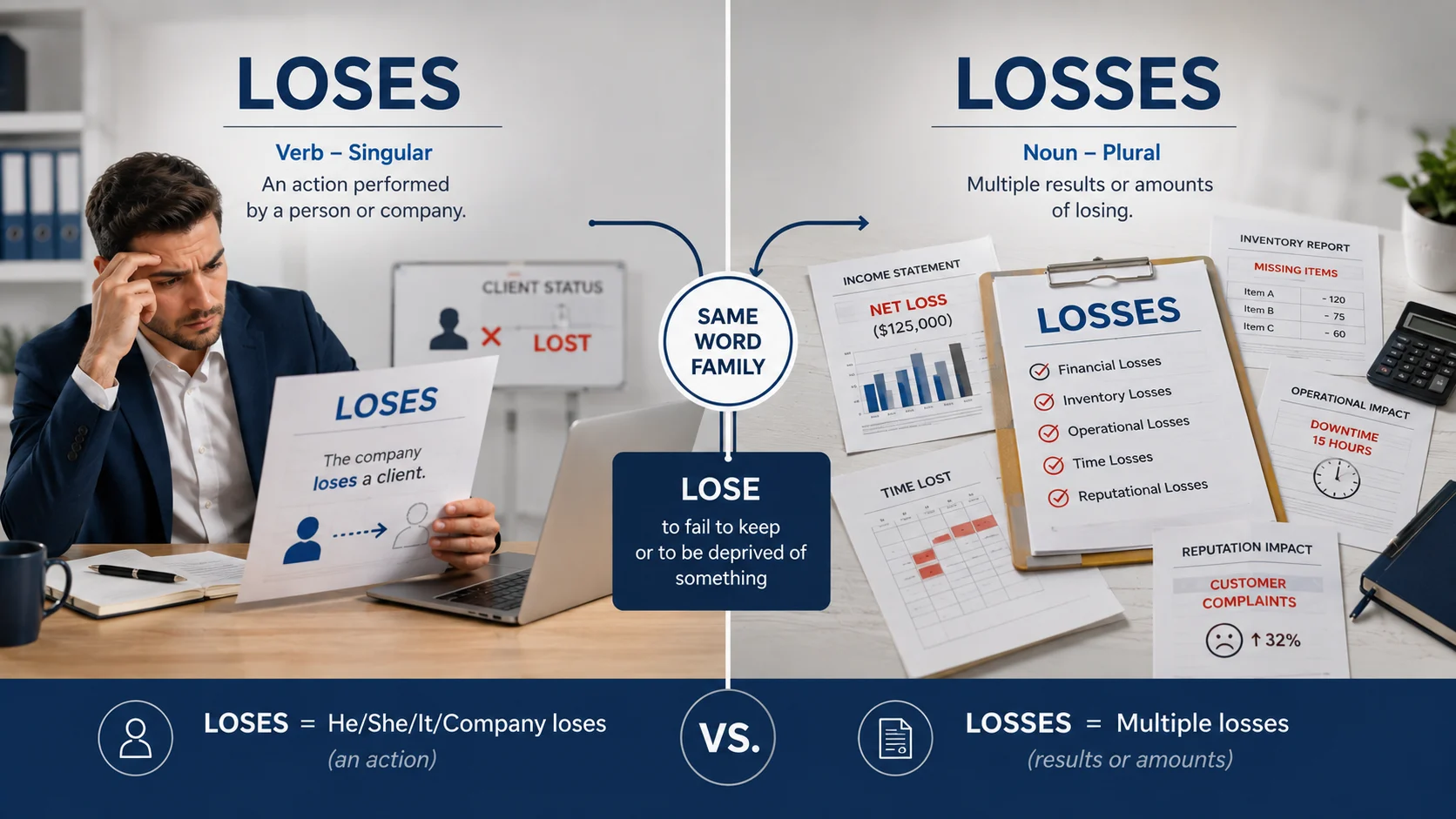
Loses or losses can be confusing because both words relate to losing, but they serve different grammatical roles. Loses is a verb meaning that someone or something fails to keep, win, or retain something, while losses is a plural noun referring to things that have been lost, especially money, opportunities, or resources. Choosing the wrong form can change the meaning of a sentence.
Loses or Losses | What’s the Difference?
The easiest way to understand these words is to identify their parts of speech. Although both words come from the same basic idea of losing something, they perform different jobs in a sentence.
Loses is a verb. It is the third person singular present tense of the verb “lose.” We use it with subjects such as he, she, it, a company, a team, or another singular noun.
For example:
“She loses her keys frequently.”
“The company loses customers when service quality declines.”
“The team loses the match.”
In each sentence, loses describes an action or result involving a singular subject.
Losses is a plural noun. It refers to multiple instances or amounts of loss. It can describe financial damage, lost opportunities, unsuccessful outcomes, missing resources, or other things that have been lost.
For example:
“The company reported significant losses.”
“The business suffered losses during the difficult quarter.”
“The losses included money, time, and valuable customers.”
The distinction becomes especially important in professional writing because changing a verb into a noun can affect the entire structure of a sentence.
Comparison Table
| Word | Part of Speech | Basic Meaning | Example |
|---|---|---|---|
| Loses | Verb | Fails to keep, win, find, or retain something | She loses her phone often. |
| Losses | Plural noun | Multiple amounts or instances of loss | The company reported losses. |
| Lose | Verb | To fail to keep, win, or retain something | They may lose the contract. |
| Loss | Noun | The result or experience of losing something | The loss was unexpected. |
The key difference is grammatical.
Loses describes what a singular subject does or experiences.
Losses names the results or amounts of losing.
If you can replace the word with an action such as “fails to keep,” you probably need loses. If you are talking about several results, amounts, or instances of loss, losses is usually correct.
Is Loses or Losses a Grammar, Vocabulary or Usage Issue?
The distinction between loses and losses is primarily a grammar and usage issue, although vocabulary also plays a role.
The two words are not interchangeable. Their meanings are related, but their grammatical functions are different. Loses functions as a verb, while losses functions as a plural noun.
Consider these examples:
“Michael loses money.”
“Michael experienced financial losses.”
The first sentence tells us what Michael does or experiences. The second sentence identifies the negative financial results.
In formal writing, especially business reports, academic papers, financial documents, and professional communication, selecting the correct form is essential. A sentence containing the wrong word may still look understandable, but it can sound grammatically incorrect or confuse the reader.
In casual conversation, people sometimes overlook these distinctions because context makes the intended meaning obvious. However, professional readers expect grammatical accuracy.
Academic writing also benefits from precise word selection. For example, “The study loses valuable data” and “The study reports data losses” communicate different ideas. The first describes an action. The second identifies a result.
When to Use Loses
Use loses when the word describes an action involving a singular subject.
The subject can be a person, organization, object, system, team, or abstract idea.
Workplace Example
“The department loses productivity when employees lack the necessary tools.”
Here, the department is the singular subject, and loses describes what happens to its productivity.
Another example is:
“The company loses revenue when customers cancel their subscriptions.”
The company performs or experiences the action represented by the verb loses.
Academic Example
“A student loses marks when an answer does not address the question.”
The singular noun “student” requires the third person singular form loses.
Compare this with:
“Students lose marks when answers do not address the question.”
The subject is now plural, so the correct verb is lose rather than loses.
Technology Example
“A computer loses connection when the network becomes unstable.”
The singular subject “computer” takes loses.
Another example is:
“The application loses user data when the backup process fails.”
Again, loses functions as the verb describing what happens.
Usage Recap
Use loses when a singular person, organization, object, or system is performing or experiencing the action.
The simple pattern is:
Singular subject + loses + object or result
For example:
“She loses patience.”
“The company loses revenue.”
“The device loses power.”
“The team loses confidence.”
When to Use Losses
Use losses when you are talking about multiple results, amounts, incidents, or consequences of losing something.
Because losses is a noun, it usually appears after a determiner or descriptive word such as “the,” “financial,” “major,” “significant,” or “unexpected.”
Workplace Example
“The company experienced significant losses after the market declined.”
Here, losses refers to the financial damage experienced by the company.
Another example is:
“Annual losses forced the organization to reconsider its strategy.”
The word losses identifies the negative financial results rather than describing an action.
Academic Example
“The researchers documented losses of biodiversity over several decades.”
In this sentence, losses refers to multiple instances of biodiversity being reduced or disappearing.
Another example is:
“The study examines learning losses among students affected by interruptions.”
Here, losses is a noun describing a measurable decline.
Technology Example
“Data losses can occur when a storage device fails.”
The word losses refers to instances in which data disappears or becomes unavailable.
Another example is:
“Network losses increased during the severe outage.”
Here, losses describes a measurable problem or consequence.
Usage Recap
Use losses when the word names multiple results, amounts, or instances of loss.
The common pattern is:
Subject + verb + losses
For example:
“The company reported losses.”
“The study measured learning losses.”
“The system experienced data losses.”
When You Should NOT Use Loses or Losses
Knowing when not to use these forms is one of the fastest ways to eliminate common grammar mistakes.
1. Do not use loses when the subject is plural
Incorrect:
“They loses customers quickly.”
Correct:
“They lose customers quickly.”
The subject “they” is plural, so the verb should be lose.
2. Do not use losses when you need an action verb
Incorrect:
“The company losses customers every month.”
Correct:
“The company loses customers every month.”
The sentence describes an action performed by the company, so loses is required.
3. Do not use loses as a plural noun
Incorrect:
“The business reported several loses.”
Correct:
“The business reported several losses.”
After “several,” a plural noun is required.
4. Do not use losses after a singular subject when describing an action
Incorrect:
“She losses her phone.”
Correct:
“She loses her phone.”
The sentence needs a verb, not a noun.
5. Do not use losses when referring to one result
Incorrect:
“The company reported one losses.”
Correct:
“The company reported one loss.”
Loss is singular, while losses is plural.
6. Do not use loses after modal verbs
Incorrect:
“The company may loses customers.”
Correct:
“The company may lose customers.”
After modal verbs such as may, might, can, could, and will, use the base verb lose.
7. Do not use loses after “to”
Incorrect:
“The business needs to loses money less often.”
Correct:
“The business needs to lose money less often.”
An infinitive requires the base form lose.
8. Do not confuse losses with loss
Incorrect:
“The accident caused several loss.”
Correct:
“The accident caused several losses.”
When discussing multiple separate results, losses is the appropriate plural noun.
Common Mistakes and Decision Rules
| Correct sentence | Incorrect sentence | Explanation |
|---|---|---|
| She loses her keys. | She losses her keys. | Loses is the verb needed after a singular subject. |
| The company reports losses. | The company reports loses. | Losses is the plural noun. |
| They lose customers. | They loses customers. | Plural subjects take lose, not loses. |
| The business suffered losses. | The business suffered loses. | The noun form is losses. |
| He may lose money. | He may loses money. | Modal verbs require the base verb lose. |
| One loss was recorded. | One losses was recorded. | One requires the singular noun loss. |
Decision Rule Box
If you mean an action performed or experienced by a singular subject, use loses.
If you mean multiple results, amounts, or instances of losing, use losses.
A useful mental test is to ask, “Is this word doing something in the sentence, or is it naming something?”
If it describes the action, choose loses.
If it names multiple consequences or results, choose losses.
Loses or Losses in Modern Technology and AI Tools
Modern technology provides many practical examples of this distinction.
A software system loses information when an error causes data to disappear. A technology company may report losses after a failed product launch.
An AI application loses context when important information is removed from a conversation. Developers may later document losses in accuracy, performance, or data quality.
This difference also matters in technical documentation. Technical writers frequently describe what a system does using verbs, while reports and analytics documents often describe outcomes using nouns.
For example:
“The model loses accuracy when the input data becomes inconsistent.”
“The researchers recorded accuracy losses under inconsistent conditions.”
The first sentence focuses on an action or change. The second focuses on the resulting decline.
Understanding this distinction helps writers produce clearer software documentation, research reports, product descriptions, and AI related explanations.
Etymology and Word History
Both loses and losses are connected to the long history of the English words lose and loss.
Lose comes from Old English roots associated with being deprived of something or failing to keep something. Loss developed from the same broad linguistic family and became established as a noun describing the result or experience of losing.
Over time, English developed different grammatical forms from these related words. Lose functions as the base verb, loses is its third person singular present form, loss is the singular noun, and losses is the plural noun.
The connection between the words explains why they look similar. Their different grammatical roles explain why they cannot normally replace one another.
An Expert Style Explanation
A useful way to remember the distinction is this:
“Grammar becomes clearer when you identify a word describes an action or names a result.”
In practical editing, this means looking at the surrounding sentence rather than judging a word by appearance alone. A short grammatical check can often reveal the correct choice immediately.
Case Study 1: Business Reporting
Imagine a retail company preparing a quarterly financial report.
A writer might say:
“The company loses revenue when customers abandon their purchases.”
This sentence explains a recurring business action or outcome. The singular subject “company” takes loses.
Later, the financial report might state:
“The company recorded substantial losses during the quarter.”
Here, losses is a noun because the report is naming the financial results.
The practical result is greater precision. Investors, managers, and analysts can immediately distinguish between the process causing the problem and the financial outcome being reported.
Case Study 2: Technology Documentation
Consider a cloud storage service.
A technical explanation might say:
“The system loses unsaved information when the connection fails unexpectedly.”
A separate incident report could state:
“The outage resulted in significant data losses.”
The first sentence explains what the system does under a particular condition. The second summarizes the consequences of the incident.
This distinction improves technical communication because users can understand both the event and its measurable consequences.
Error Prevention Checklist
Always Use Loses When
• A singular subject performs or experiences the action.
• You can replace the word with “fails to keep” or another action phrase.
• You are describing what a person, company, team, device, or system does.
• The sentence requires a third person singular present tense verb.
Never Use Losses When
• The sentence needs an action verb.
• The subject is singular and the sentence describes an action.
• You are writing directly after a modal verb such as can, may, might, or will.
• You are using an infinitive construction with “to.”
Instead, use the correct form of lose.
Related Grammar Confusions You Should Master
Learning loses and losses becomes easier when you understand similar word pairs.
- Lose or loose: Lose is a verb meaning to no longer have something, while loose describes something that is not tight.
- Loss or lost: Loss is a noun, while lost can function as the past tense or past participle of lose.
- Choose or chose: Choose is present tense, while chose is the past tense.
- Advice or advise: Advice is a noun, while advise is a verb.
- Affect or effect: Affect is commonly used as a verb, while effect is commonly used as a noun.
- Practice or practise: Practice is the standard noun form, while British English commonly uses practise as the verb.
- Then or than: Then usually relates to time or sequence, while than introduces comparisons.
- There, their, or they’re: These words sound similar but have different grammatical functions.
- Your or you’re: Your indicates possession, while you’re is short for “you are.”
- Its or it’s: Its shows possession, while it’s is short for “it is” or “it has.”
Mastering these distinctions strengthens general writing accuracy and makes professional communication more polished.
FAQs
Is loses a verb or a noun?
Loses is a verb and is the third person singular present form of lose.
Is losses a verb or a noun?
Losses is a plural noun referring to multiple results, amounts, or instances of loss.
What is the difference between loses and losses?
Loses describes an action or condition involving a singular subject, while losses names multiple results or instances of losing.
Is it correct to say the company loses money?
Yes. “The company loses money” is grammatically correct because loses functions as the verb for the singular subject company.
Is it correct to say the company reported losses?
Yes. Losses is correct because it functions as a plural noun describing financial results.
Should I use lose or loses after may?
Use lose after may because modal verbs are followed by the base form of the verb.
What is the plural of loss?
The plural of loss is losses.
Why do people confuse loses and losses?
People often confuse them because both words come from the same word family and are closely connected in meaning, but their grammatical functions are different.
Which is correct, she loses or she losses?
“She loses” is correct because a singular subject such as she requires the third person singular verb loses.
Conclusion
The difference between loses or losses becomes straightforward once you identify the grammatical role of the word.
Use loses when you need a verb describing what a singular person, organization, team, object, or system does or experiences. Use losses when you need a plural noun describing multiple results, amounts, or instances of loss.
A quick sentence check can prevent most errors. Ask the word describes an action or names a result. If it describes an action performed by a singular subject, choose loses. If it identifies multiple consequences or amounts, choose losses.
Understanding this distinction is useful far beyond grammar exercises. Accurate word choice improves business writing, academic communication, technical documentation, reports, emails, and everyday English.
Discover More Related Articles:
- Neighbor or Neighbour | Which Version Is Right for Your Audience In 2026
- Plandid or Candid | Meaning, Differences, Usage & Examples In 2026
- Cowlick or Balding | How to Tell the Difference & When to Worry In 2026