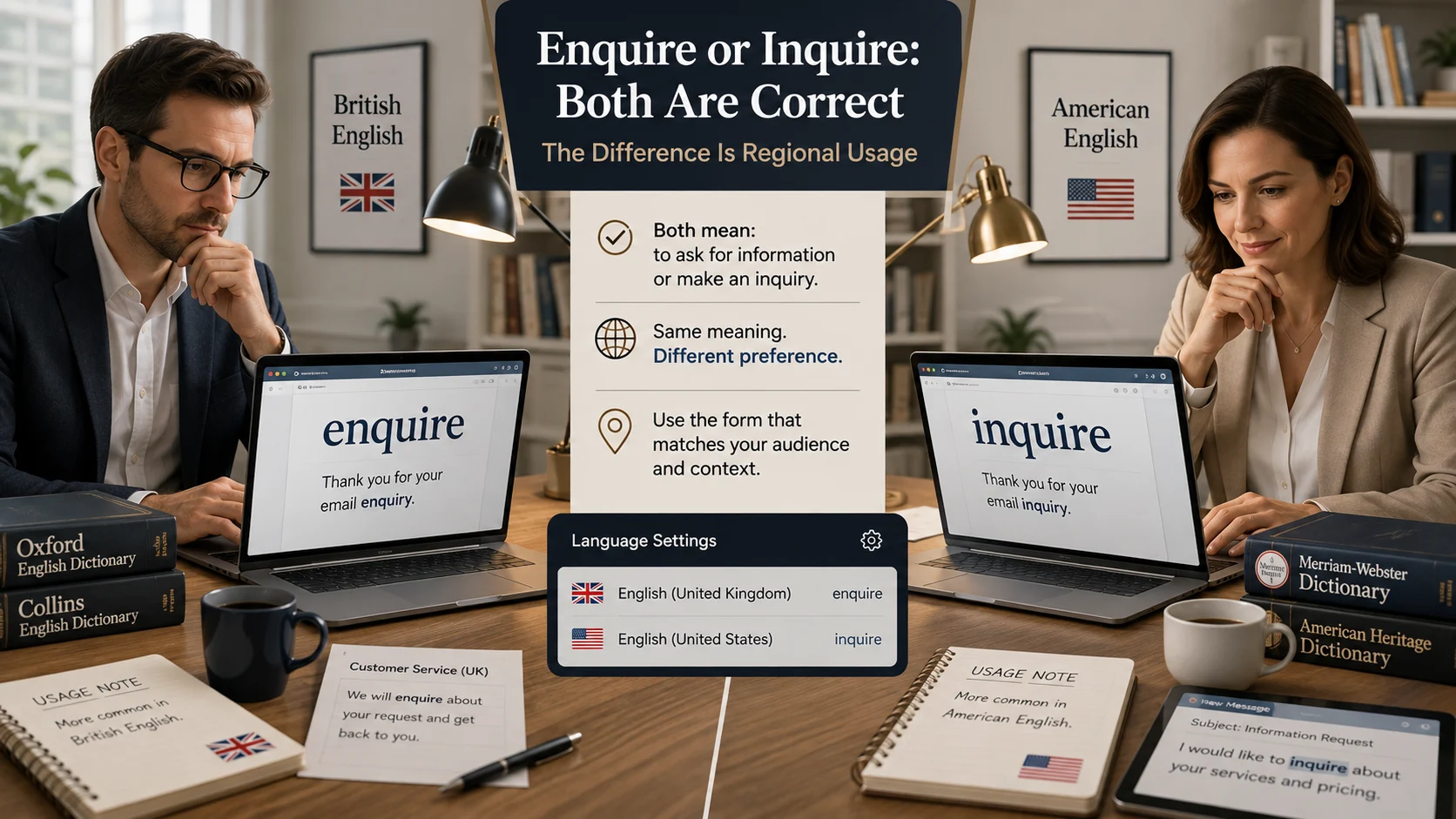
Enquire or inquire are both correct English verbs meaning to ask for information, but their preferred use depends largely on regional convention. British English commonly uses enquire for general questions and inquire in more formal contexts, while American English generally prefers inquire for both meanings.
English has several spelling differences that can make a simple word choice surprisingly confusing. Enquire and inquire are a good example. Both verbs mean to ask for information, investigate something, or seek an answer. The main difference is often connected to regional English and usage tradition rather than basic meaning.
This distinction matters in real situations. Choosing the less familiar form in a business email, university application, customer service message, or official document can make your writing look inconsistent with the English variety you are using.
For most readers, the easiest approach is to identify your preferred variety of English first. British English generally allows both forms with slightly different usage patterns, while American English strongly favors inquire.
Understanding the distinction also helps writers maintain consistency. If your website follows British spelling throughout, for example, your choice of vocabulary should reflect that same editorial style. The same principle applies to academic writing, workplace communication, digital products, and professional correspondence.
Enquire or Inquire: What’s the Difference?
Enquire and inquire are both verbs. They describe the act of asking for information, requesting clarification, or seeking knowledge. In modern English, however, their distribution differs according to region and context.
| Feature | Enquire | Inquire |
|---|---|---|
| Part of speech | Verb | Verb |
| Basic meaning | To ask for information | To ask for information or investigate |
| British English | Common | Also used, especially in formal contexts |
| American English | Less common | Standard choice |
| General questions | Common in British usage | Common in American usage |
| Formal investigation | Sometimes used | Strongly associated with investigation |
| Related noun | Enquiry | Inquiry |
| Best regional choice | British English | American English |
The important point is that neither spelling is simply an incorrect version of the other.
In British English, enquire is often associated with ordinary requests for information. For example, someone might enquire about course fees, opening hours, or availability.
Inquire can also appear in British English, particularly when the meaning involves a formal investigation. A government body may inquire into an incident, for example.
American English generally makes the distinction much simpler. Inquire is the normal spelling for both ordinary questions and formal investigations.
Quick recap: Enquire is especially common in British English for ordinary requests. Inquire is the standard American form. British English can use both forms. Context and regional spelling determine the most natural choice.
Is Enquire or Inquire a Grammar, Vocabulary or Usage Issue?
This is primarily a usage and regional spelling issue, rather than a basic grammar problem.
Both words function as verbs and can occupy the same grammatical positions in a sentence. You can enquire about something, or you can inquire about something. The grammatical construction is essentially the same.
The difference becomes more noticeable when regional English conventions enter the picture.
British English traditionally permits a distinction between enquire and inquire. Enquire commonly refers to asking for information, while inquire can suggest conducting an investigation. That distinction is not absolute, however, and real British usage contains considerable overlap.
American English generally does not maintain the distinction as strongly. Inquire is the established spelling in ordinary and formal contexts.
Academic writing follows the same regional principle. A British university publication may use enquiry and enquire, while an American academic institution will generally use inquiry and inquire.
The same applies to professional communication. A British company can naturally write, “Please enquire at reception,” whereas an American company would normally write, “Please inquire at reception.”
The safest strategy is consistency. Don’t alternate between British and American conventions without a reason.
How to Use Enquire Correctly
Enquire is especially natural in British English when someone is simply asking for information.
Imagine a customer contacting a hotel about room availability. A British style message might say:
I am writing to enquire about room availability for next month.
The meaning is straightforward. The person wants information and is not conducting a formal investigation.
Workplace example
A professional email might say:
I am writing to enquire about the status of my application.
This sounds natural in British English. It politely communicates a request for information.
Academic example
A student could write:
I would like to enquire about the admission requirements for the postgraduate programme.
This construction works well in British academic communication, particularly when the institution itself follows British English conventions.
Technology example
A software company using British English might write:
Please enquire with our support team if you need assistance.
The word works perfectly well in digital interfaces, help centres, and customer service documentation when British spelling is being used.
Usage recap
Use enquire when your writing follows British English and you are referring to a general request for information. It is particularly natural in customer service, correspondence, education, and everyday professional communication.
How to Use Inquire Correctly
Inquire is the preferred form in American English. It can describe both a simple request for information and a formal investigation.
For example:
I would like to inquire about your services.
This is completely standard American English.
Inquire is also particularly useful when the subject is investigating an issue.
The committee will inquire into the circumstances surrounding the incident.
Here, the meaning goes beyond simply asking a question. It suggests a systematic investigation.
Workplace example
An American professional might write:
I am writing to inquire about the status of my application.
This is the normal American form and sounds appropriate in formal business correspondence.
Academic example
A university student might write:
I would like to inquire about the requirements for the research programme.
The wording is suitable for academic correspondence and formal enquiries.
Technology example
An American software company might use:
Contact support to inquire about account verification.
The spelling fits American English style and works naturally in websites, applications, help documentation, and automated systems.
Usage recap
Use inquire when writing American English. It is also appropriate in British English when referring to a formal investigation or when following an established style preference.
When You Should NOT Use Enquire or Inquire
Understanding when not to use a particular form can prevent awkward or inconsistent writing.
| Situation | Recommended approach | Reason |
|---|---|---|
| American business email | Use inquire | It is the standard American spelling |
| British general request | Use enquire | It is a common British convention |
| Formal investigation | Prefer inquire | The investigative sense is strongly associated with it |
| British company with a fixed style guide | Follow the company guide | Consistency matters more than personal preference |
| American academic writing | Use inquire | It matches American English conventions |
| British academic writing | Usually use enquire for general questions | It fits British spelling conventions |
| Mixed regional content | Choose one variety | Mixing conventions can make content inconsistent |
| Website targeting the United States | Use inquire | It matches the expected spelling of the audience |
The biggest mistake is not choosing one spelling over the other. The bigger problem is switching between regional conventions without realizing it.
For example, an American website that uses inquire in one paragraph but enquire in another may appear poorly edited. Likewise, a British publication that consistently uses British spelling may prefer enquire for ordinary questions.
Common Mistakes and Decision Rules
| Correct sentence | Incorrect or less suitable sentence | Explanation |
|---|---|---|
| I would like to enquire about the course. | I would like to enquiry about the course. | Enquiry is a noun, while enquire is a verb. |
| I would like to inquire about the course. | I would like to inquiry about the course. | Inquiry is a noun, while inquire is a verb. |
| The committee will inquire into the matter. | The committee will enquiry into the matter. | The verb is required after the subject. |
| Please enquire about availability. | Please enquiry about availability. | The action requires the verb enquire. |
| We received an enquiry from a customer. | We received an enquire from a customer. | The noun form is enquiry in British English. |
| We received an inquiry from a customer. | We received an inquire from a customer. | The noun form is inquiry in American English. |
Decision Rule: If you are writing British English and mean a general request for information, enquire is often the natural choice. If you are writing American English, or referring to a formal investigation, inquire is generally the safer choice.
Enquiry and Inquiry: The Noun Forms
One reason this topic becomes confusing is that the noun forms follow similar regional patterns.
British English commonly uses enquiry for a request for information.
We received an enquiry about the new course.
American English generally uses inquiry.
We received an inquiry about the new course.
Inquiry is also widely used in British English when referring to an official investigation.
The government launched an inquiry into the incident.
This distinction can be useful for professional writers because changing the verb without considering its noun form can produce inconsistent copy.
For example, writing “I would like to enquiry” is incorrect because enquiry is functioning as a noun. The verb must be enquire.
Likewise, “I would like to inquiry” is incorrect because inquiry is a noun. The verb is inquire.
British English vs American English
Regional spelling is one of the most useful ways to understand this pair.
| English variety | General question | Formal investigation |
|---|---|---|
| British English | Enquire is common | Inquire is often preferred |
| American English | Inquire | Inquire |
| International business English | Follow the target audience | Follow the established style |
There is no universal rule that says one spelling must replace the other everywhere.
A British newspaper, university, government department, or company may have its own editorial conventions. An American organization will normally use American spelling.
This is why dictionaries can show both words as correct while still identifying differences in usage.
Enquire and Inquire in Modern Technology and AI Tools
Digital communication has made regional consistency even more important.
Websites, chatbots, AI assistants, customer portals, grammar checkers, and software interfaces often generate language automatically. These systems may follow a selected language setting, a company style guide, or the regional conventions inferred from surrounding text.
For example, a British customer service chatbot might say:
Please enquire with our support department.
An American interface would more naturally say:
Please inquire with our support department.
AI writing tools can also produce either spelling depending on the requested language variety. If you’re preparing content for a specific country, tell the system you want British English or American English.
This prevents isolated spelling choices from appearing throughout otherwise consistent content.
Etymology and Historical Development
The history of these words helps explain why their meanings overlap.
Both forms ultimately trace back through French and Latin influences associated with asking questions and seeking information. English developed related spellings over time, and regional conventions gradually influenced how the words were used.
The modern distinction is therefore not simply a matter of one word being old and the other being new. Both have established histories in English.
The difference developed through usage patterns, editorial traditions, and regional language development.
An expert style perspective
A useful way to think about the distinction is this:
“Good usage begins with context, audience, and consistency rather than assuming that two regional forms must have identical functions.”
The practical lesson is simple. A professional writer should first identify the English variety being used and then apply its conventions consistently.
Two Practical Case Studies
Case Study 1: A British university website
Imagine a university creating an admissions page for students in the United Kingdom.
The page uses British spelling throughout, including programme, organisation, and enrolment. Using enquire for ordinary admissions questions keeps the terminology aligned with the site’s broader language style.
The concrete result is greater editorial consistency across the page and a clearer regional identity for its intended audience.
Case Study 2: An American software company
Now consider a software company targeting customers in the United States. Its support documentation uses American spellings such as color, center, and organization.
Using inquire in support instructions keeps the terminology consistent with the rest of the documentation.
The concrete result is fewer regional spelling inconsistencies and a more polished experience for the target audience.
These examples illustrate an important SEO lesson too. Search engines generally understand spelling variants and related meanings, but users notice a website appears professionally edited for their region.
Error Prevention Checklist
Always use enquire when
✓ You are writing British English and asking for general information.
✓ Your organization’s style guide specifies enquire.
✓ Your audience expects British spelling.
✓ You want your wording to align with other British forms throughout the document.
Never use enquire when
✓ You are required to follow American English.
✓ Your American style guide specifies inquire.
✓ Your document consistently uses American spelling.
Always use inquire when
✓ You are writing American English.
✓ You are describing a formal investigation.
✓ Your publication or organization specifies inquire.
Never use inquire when
✓ Your British style guide specifically requires enquire for general requests.
✓ You are deliberately maintaining a fixed British spelling system and have no contextual reason to change the form.
Related Grammar Confusions You Should Master
Learning regional spelling through related pairs can make English usage much easier.
- License and licence: American English generally uses license for both noun and verb, while British English distinguishes licence as the noun and license as the verb.
- Practice and practise: British English commonly uses practice as the noun and practise as the verb.
- Behavior and behaviour: The first is American English, while the second is British English.
- Color and colour: These are familiar American and British spelling differences.
- Center and centre: Both are correct, but regional preference determines the standard form.
- Program and programme: American English generally uses program, while British English often uses programme outside certain computing contexts.
- Traveler and traveller: American English commonly uses traveler, while British English commonly uses traveller.
- Canceled and cancelled: American English generally favors canceled, while British English often uses cancelled.
- Toward and towards: Both are accepted, with toward particularly common in American English.
- License and licence in professional writing: This distinction is especially important in legal, governmental, and business documents.
Mastering these patterns helps writers recognize that English spelling is often influenced by geography rather than correctness alone.
FAQs
Is enquire or inquire correct in English?
Both are correct. Enquire is common in British English for general requests, while inquire is standard in American English and common for formal investigations.
Is enquire British or American English?
Enquire is strongly associated with British English, although inquire is also used in Britain, particularly in formal or investigative contexts.
Is inquire American or British English?
Inquire is the standard American form and is also used in British English, especially when the meaning involves an official investigation.
What is the difference between enquire and inquire?
The basic meaning is the same, but British English often uses enquire for general questions and inquire for investigations, while American English usually uses inquire for both.
Should I use enquire in a formal email?
If you’re writing British English, enquire is perfectly appropriate for a general request. If you’re writing American English, use inquire.
Is enquiry or inquiry correct?
Both nouns are correct. Enquiry is common in British English for a request for information, while inquiry is standard in American English and widely used for investigations.
Which spelling should I use on an American website?
Use inquire and inquiry because they are the standard American forms and will keep the website’s regional spelling consistent.
Which spelling should I use for British readers?
Use enquire for ordinary requests when following British English conventions, and consider inquire when describing a formal investigation.
Can British English use inquire?
Yes. British English uses inquire, particularly in formal investigative contexts, so it isn’t an incorrect Americanism that must always be avoided.
Conclusion
The choice between the two forms becomes much easier once you stop treating it as a simple right or wrong spelling question. Both forms have legitimate places in English, but regional convention and meaning influence which one sounds most natural.
For British English, enquire is commonly used when someone is asking for information, while inquire often carries a more formal investigative sense. American English generally simplifies the choice by using inquire in both situations.
For professional writers, the most valuable rule is consistency. Decide your content follows British English or American English, identify the intended meaning, and maintain the same spelling throughout the document.
When writing for an international audience, consistency is particularly important. A polished article, website, academic paper, or business email should make its regional English choice deliberately rather than mixing conventions accidentally.
Understanding enquire or inquire therefore isn’t just about memorizing a spelling difference. It is about recognizing how English changes across regions, contexts, and professional settings. Once you understand that pattern, many other British and American English differences become easier to handle.
Discover More Related Articles:
- Comply or Die | Meaning, Usage, Origin & Modern Context In 2026
- Saw or Seen | Which Is Correct & How to Use Each Word In 2026
- Congradulations or Congratulations | Why These Spellings Are Confused In 2026