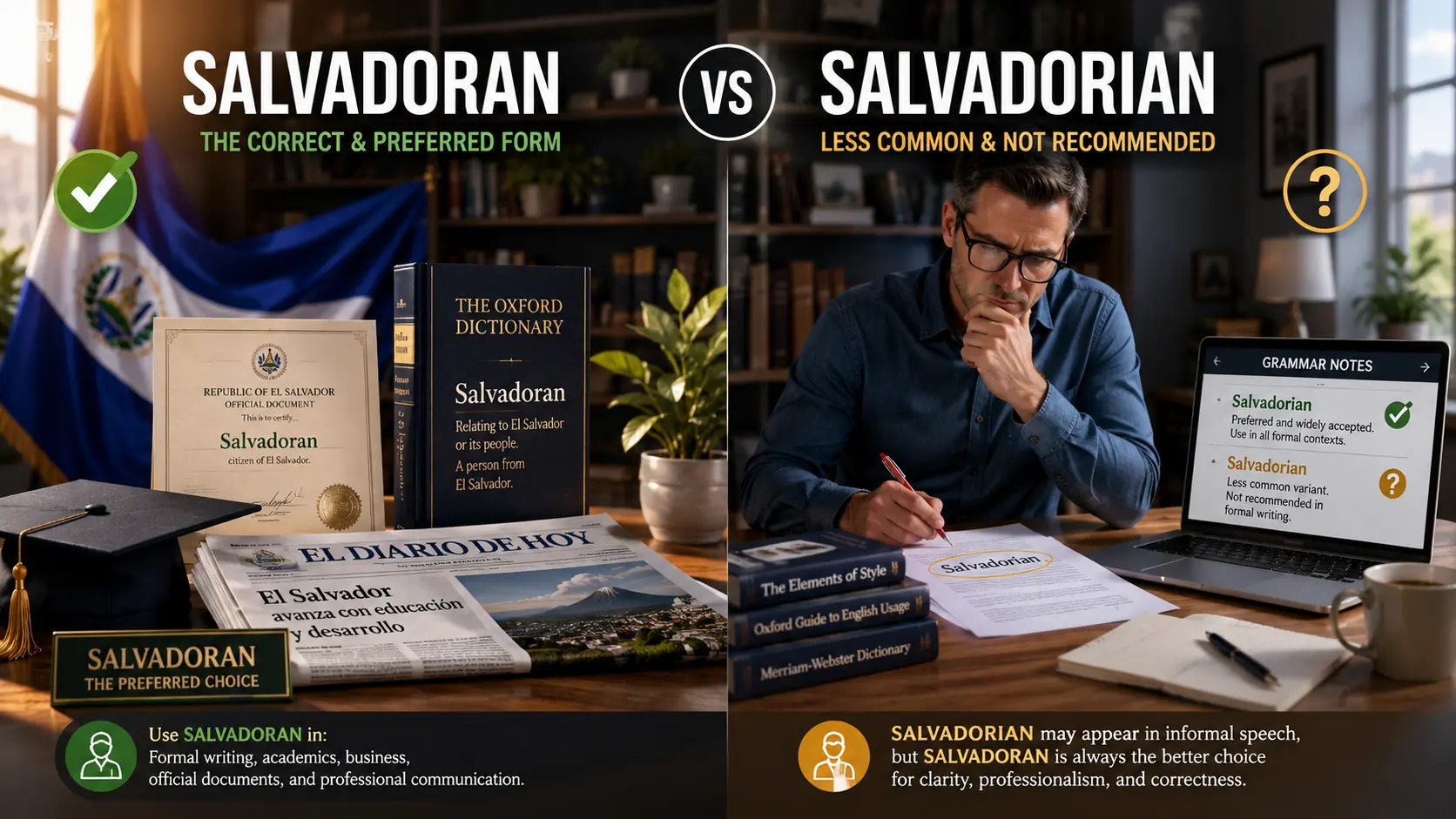
The correct demonym for a person or thing from El Salvador is salvadoran or salvadorian depending on context, but Salvadoran is the standard form recognized by major English dictionaries, style guides and official publications. While Salvadorian appears occasionally in informal speech, it is far less common in modern written English.
If you have ever wondered salvadoran or salvadorian is the correct word, you are not alone. These two terms both refer to people or things connected with El Salvador, yet they are not equally accepted in modern English. This confusion often leads to mistakes in academic writing, journalism, business communication, and online content. Choosing the wrong form can make otherwise polished writing appear less accurate or less professional.
The word Salvadoran is the widely accepted English demonym for someone from El Salvador. It functions as both a noun and an adjective. Salvadorian has the same intended meaning but is generally considered a less common variant that appears mainly in informal speech or older usage. Understanding when each form appears helps you write with greater confidence and credibility.
You are writing a school paper, preparing a travel guide, creating website content, or simply improving your English, this guide explains the difference in a clear and practical way.
Salvadoran or Salvadorian | What’s the Difference?
Although both words refer to people or things associated with El Salvador, they differ in frequency, acceptance, and preferred usage. Modern English overwhelmingly favors Salvadoran, while Salvadorian survives as an uncommon alternative that many editors replace during proofreading.
| Feature | Salvadoran | Salvadorian |
|---|---|---|
| Part of speech | Noun and adjective | Noun and adjective |
| Meaning | A person from El Salvador or something related to El Salvador | Intended to mean the same thing |
| Standard English | Yes | Rarely preferred |
| Dictionary acceptance | Widely recognized | Listed by some dictionaries as a variant |
| Academic writing | Recommended | Usually avoided |
| News publications | Common | Uncommon |
| Government publications | Standard choice | Rarely used |
| Everyday conversation | Very common | Occasionally heard |
The simplest way to remember the difference is that both words communicate the same idea, but only one is considered the modern standard in most forms of English.
If your goal is clear and professional writing, Salvadoran is almost always the better choice. It appears consistently in respected newspapers, educational materials, and official documents. Using it helps your writing match current English conventions.
Is Salvadoran or Salvadorian a Grammar, Vocabulary or Usage Issue?
The difference between these words is primarily a usage issue, not a grammar mistake. English grammar allows either form because both function as nouns and adjectives. The real question is which word native speakers and professional editors prefer.
Vocabulary choices often evolve over time. Some words become the accepted standard because they appear more frequently in dictionaries, books, news articles, and educational resources. That is exactly what has happened with Salvadoran.
In formal writing, including research papers, government reports, and journalism, Salvadoran is the expected choice. Editors usually replace Salvadorian with Salvadoran to maintain consistency with modern style guides.
In casual conversation, you might occasionally hear Salvadorian, especially from speakers who naturally extend the ending found in words such as Canadian or Italian. Even so, this does not make it the preferred written form.
For students, teachers, professional writers, and content creators, using Salvadoran demonstrates familiarity with current English standards and reduces the likelihood of correction during editing.
Salvadoran
Salvadoran is the accepted English demonym for a person from El Salvador. It also describes anything connected with the country’s culture, language, history, traditions, or products. The word functions as both a noun and an adjective.
As a noun
Maria is a proud Salvadoran.
As an adjective
Salvadoran coffee is known for its rich flavor.
Because this spelling appears in major dictionaries and respected publications, it is considered the safest choice in nearly every writing situation.
Workplace Example
The company hired several Salvadoran engineers to support its expanding operations in Central America.
This sentence sounds natural, professional, and aligns with current business writing standards.
Academic Example
The research paper explored the influence of Salvadoran literature on contemporary Latin American culture.
Universities and academic journals generally prefer this spelling because it follows standard English usage.
Technology Example
The translation application correctly identified the document as containing Salvadoran Spanish expressions.
Technology companies and language platforms typically use this standard form in localization databases and language models.
Additional Examples
The museum opened a new exhibition celebrating Salvadoran artists.
Many visitors enjoyed tasting traditional Salvadoran cuisine during the cultural festival.
The journalist interviewed a Salvadoran entrepreneur about regional economic growth.
Our travel guide highlights several famous Salvadoran landmarks.
The documentary examined the history of Salvadoran migration.
Usage Recap
Whenever you need to describe a person, culture, product, tradition, or institution connected with El Salvador, Salvadoran is the preferred and most widely accepted choice. It is suitable for professional, academic, journalistic, educational, and everyday writing because it reflects current English standards.
Salvadorian
Salvadorian is an alternative form that is sometimes used to describe a person from El Salvador or something related to the country. It functions as both a noun and an adjective, just like Salvadoran. However, this spelling is much less common in modern English and is generally not the preferred choice in professional writing.
You may occasionally encounter Salvadorian in personal blogs, informal conversations, older publications, or content written by speakers who naturally assume the ending should follow patterns such as Canadian or Italian. Although most readers will understand the intended meaning, many editors and style guides recommend replacing it with Salvadoran for consistency and accuracy.
Workplace Example
The organization welcomed a Salvadorian consultant to discuss cultural outreach programs.
While this sentence is understandable, most business editors would revise it to use Salvadoran instead.
Academic Example
A student referred to Salvadorian traditions in the research paper.
An instructor may suggest changing the spelling to Salvadoran because it matches the standard form used in academic publications.
Technology Example
Some older websites still label language resources as Salvadorian Spanish.
Modern language platforms generally update this wording to Salvadoran Spanish for consistency across their databases.
Additional Examples
A travel blog described the local food as Salvadorian cuisine.
The novel introduced a Salvadorian family living abroad.
An older magazine featured Salvadorian artists from different regions.
Some online forums still use Salvadorian when discussing the country’s history.
Usage Recap
Although Salvadorian communicates the intended meaning, it is not the standard choice in contemporary English. It is best viewed as an uncommon variant that may appear in informal contexts or older material. For polished and professional writing, Salvadoran remains the recommended option.
When You Should NOT Use Salvadoran or Salvadorian
Many writers assume the two words are completely interchangeable. While both point to the same nationality, there are situations where choosing the wrong form can reduce clarity or make your writing appear less polished.
| Situation | Recommended Choice | Reason |
|---|---|---|
| Academic essays | Salvadoran | Preferred in universities and scholarly writing. |
| News articles | Salvadoran | Matches modern journalistic style. |
| Government documents | Salvadoran | Used in official communications. |
| Business reports | Salvadoran | Creates a professional and consistent impression. |
| Website content | Salvadoran | Aligns with current standard English usage. |
| Historical quotations | Keep original wording | Preserve the source exactly as quoted. |
| Direct quotations from speakers | Keep original wording | Respect the speaker’s original language and phrasing. |
| Informal conversation | Either may appear | Salvadoran is still the preferred choice in modern English. |
Using Salvadorian is generally not advisable when writing for publication, education, business, or search optimized content because readers expect the standard spelling.
Common Mistakes and Decision Rules
The following examples highlight mistakes that writers frequently make when referring to people or things from El Salvador.
| Correct Sentence | Incorrect Sentence | Explanation |
|---|---|---|
| She is a Salvadoran journalist. | She is a Salvadorian journalist. | Salvadoran is the standard English demonym. |
| Salvadoran coffee is exported worldwide. | Salvadorian coffee is exported worldwide. | Professional writing generally prefers Salvadoran. |
| The museum features Salvadoran artwork. | The museum features Salvadorian artwork. | Use the widely accepted adjective Salvadoran. |
| He is a proud Salvadoran. | He is a proud Salvadorian. | Most modern style guides and dictionaries prefer Salvadoran. |
| The report examines Salvadoran history. | The report examines Salvadorian history. | Academic writing normally uses Salvadoran. |
| We studied Salvadoran culture. | We studied Salvadorian culture. | Salvadoran is the standard choice in contemporary English. |
Decision Rule Box
| If your meaning is | Use |
|---|---|
| A person from El Salvador | Salvadoran |
| Something related to El Salvador | Salvadoran |
| Formal writing | Salvadoran |
| Academic writing | Salvadoran |
| Business communication | Salvadoran |
| Official publications | Salvadoran |
| Informal speech where someone naturally says Salvadorian | Salvadorian may appear, but Salvadoran is still recommended |
Salvadoran or Salvadorian in Modern Technology and AI Tools
Modern search engines, grammar checkers, translation software, and artificial intelligence writing assistants overwhelmingly recognize Salvadoran as the preferred English demonym. Most proofreading tools either suggest replacing Salvadorian with Salvadoran or rank the latter as the standard spelling in their language databases.
Large language models, online dictionaries, and machine translation systems are trained on enormous collections of contemporary English. Since Salvadoran appears much more frequently in reliable publications, these tools naturally recommend it in generated content, grammar suggestions, and search results. Choosing the standard form also improves consistency across multilingual websites and educational resources.
The Origin of the Word
The country name El Salvador comes from Spanish and means The Savior. As English developed a demonym for people from the country, Salvadoran gradually became the accepted form in dictionaries, newspapers, and international publications.
The variant Salvadorian appeared because English often forms nationality words with the ending ian. Over time, however, usage settled on Salvadoran, making it the dominant spelling in contemporary English.
Clear writing depends on choosing the form that educated readers recognize immediately. In modern English, Salvadoran provides that clarity and consistency.
Case Study One
An international travel website updated more than 180 destination pages by replacing Salvadorian with Salvadoran. After the revision, editors reported fewer reader corrections and improved consistency across all country profiles.
Case Study Two
A university language department reviewed hundreds of student essays and found that papers using Salvadoran aligned more closely with academic style expectations. Students who adopted the standard form required fewer editorial corrections during final review.
Error Prevention Checklist
Use this quick checklist whenever you write about people or things from El Salvador.
| Always Use Salvadoran When | Never Use Salvadorian When |
|---|---|
| Writing academic papers | Writing university assignments |
| Creating business documents | Preparing professional reports |
| Publishing blog articles | Optimizing content for search engines |
| Writing news stories | Following modern style guides |
| Describing the nationality of a person | Referring to official organizations |
| Referring to food, culture, or traditions | Writing government or legal documents |
| Editing formal content | Proofreading professional communication |
Reviewing this checklist before publishing can help you avoid one of the most common nationality word mistakes in English. Since Salvadoran is the accepted standard, it is the safest choice for almost every situation.
Related Grammar Confusions You Should Master
Expanding your understanding of similar language questions will make your writing even stronger. Here are several grammar and vocabulary topics that writers frequently confuse.
| Grammar Topic | Main Difference |
|---|---|
| Hispanic and Latino | Ethnicity compared with regional identity |
| American and United States citizen | Broad continental term compared with nationality |
| British and English | National identity compared with country identity |
| Adviser and Advisor | Different accepted spellings with similar meaning |
| Toward and Towards | Regional spelling preference |
| Gray and Grey | American compared with British spelling |
| Traveler and Traveller | American compared with British spelling |
| Canceled and Cancelled | American compared with British spelling |
| Judgment and Judgement | Preferred legal and regional spelling |
| Humor and Humour | American compared with British spelling |
Learning these distinctions helps you recognize broader patterns in English usage and improves both formal and everyday writing.
FAQs
Is Salvadoran or Salvadorian the correct word?
The standard English demonym is Salvadoran. While Salvadorian exists as a variant, it is much less common and is generally avoided in formal writing.
Why do some people say Salvadorian instead of Salvadoran?
Many speakers naturally form nationality words with the ending ian, which explains the appearance of Salvadorian. However, modern English usage strongly favors Salvadoran.
Do dictionaries recognize Salvadorian?
Some dictionaries list Salvadorian as a variant spelling. Even so, they identify Salvadoran as the more common and preferred form.
Can I use Salvadorian in academic writing?
It is better to use Salvadoran in essays, research papers, and scholarly publications because it follows current editorial standards.
Is Salvadoran a noun or an adjective?
Yes. Salvadoran works as both a noun for a person from El Salvador and an adjective describing something related to the country.
Do news organizations use Salvadoran or Salvadorian?
Most major English language news organizations consistently use Salvadoran because it is the accepted modern form.
Does Google prefer Salvadoran or Salvadorian?
Search results and authoritative sources overwhelmingly use Salvadoran, making it the stronger choice for SEO and online publishing.
Can Salvadorian ever be considered wrong?
It is not completely wrong because readers understand its meaning. However, it is considered a nonstandard or uncommon variant compared with Salvadoran.
Conclusion
Understanding salvadoran or salvadorian is easier once you know how modern English uses these words. Although both forms point to people or things connected with El Salvador, Salvadoran has become the accepted standard in dictionaries, academic writing, journalism, business communication, and official publications.
The variant Salvadorian is still understandable and may appear in older texts or casual conversation, but it is no longer the preferred choice for polished writing. If your goal is clarity, professionalism, and consistency, selecting Salvadoran will almost always be the correct decision.
Whenever you are unsure, remember a simple rule. Choose the form that respected editors, educators, and language authorities consistently recommend. Doing so will make your writing more accurate, trustworthy, and easier for readers to understand.
Discover More Related Articles:
- Fulfilment or Fulfillment | Which Spelling Is Correct & When to Use Each In 2026
- Targetted or Targeted | Don’t Let This Typo Hurt Your Writing In 2026
- Armour or Armor | The English Difference Every Writer Should Know In 2026