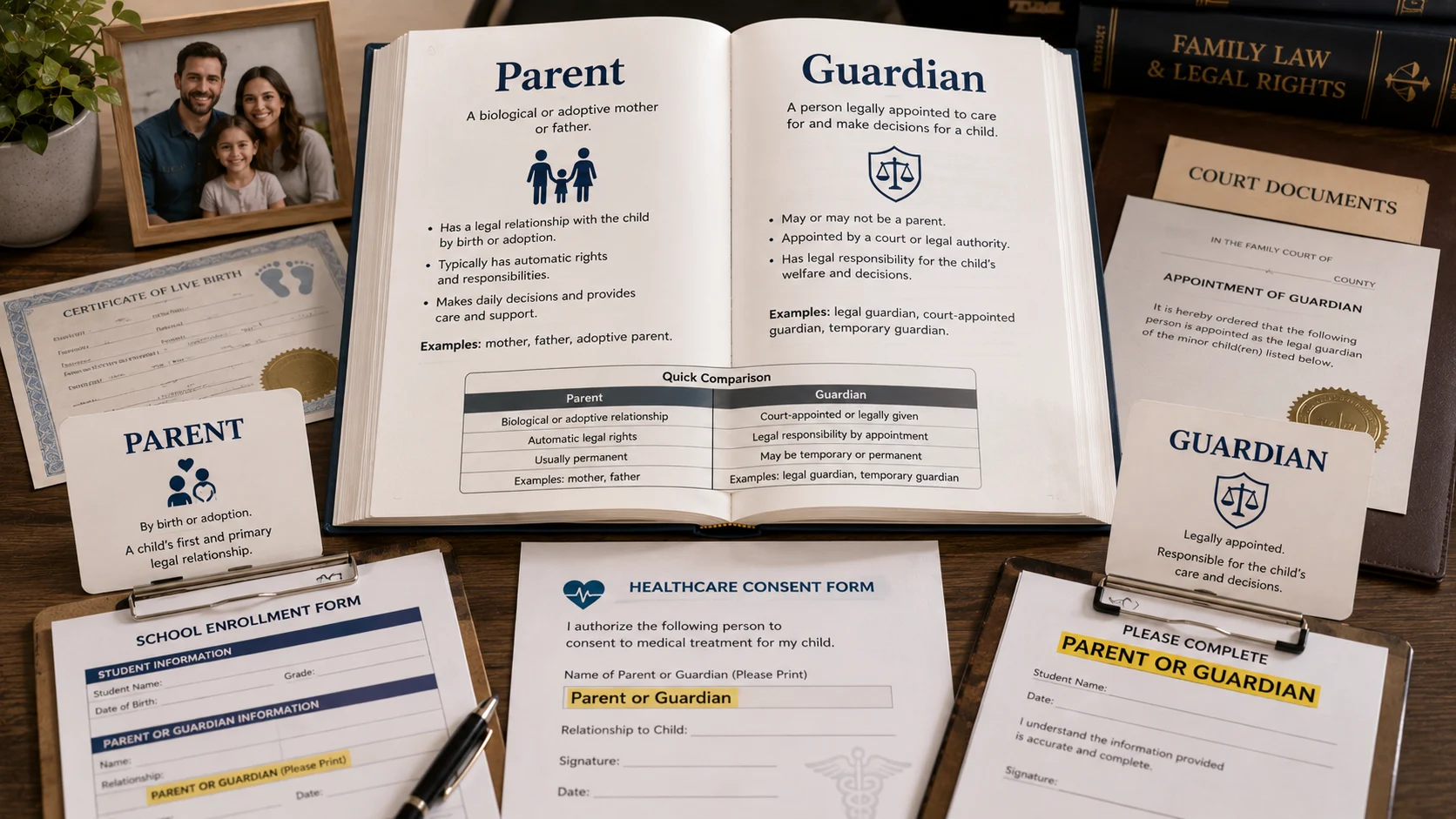
Parent or guardian refers to two different legal and social roles. A parent is a child’s biological or adoptive mother or father, while a guardian is a person legally appointed to care for a child when a parent cannot do so. Understanding the distinction helps prevent mistakes in legal documents, school forms, healthcare records, and everyday communication.
The terms parent or guardian appear on countless school forms, medical records, government applications, and legal documents. Although many people assume they mean the same thing, they describe two distinct roles. A parent is the biological or legally adoptive mother or father of a child. A guardian is someone who has been granted legal authority to care for a child when the parents are unavailable or unable to fulfill that responsibility.
Confusing these terms can lead to real problems. Selecting the wrong option on official paperwork may delay school enrollment, medical treatment, travel permissions, or access to important services. Learning when to use each term ensures your communication remains accurate, professional, and legally correct.
Parent or Guardian | What’s the Difference?
Both words relate to caring for a child, but they are not interchangeable in every situation. A parent receives their role through birth or legal adoption, whereas a guardian receives authority through legal appointment or a court decision.
| Feature | Parent | Guardian |
|---|---|---|
| Part of speech | Noun | Noun |
| Meaning | A biological or adoptive mother or father | A person legally authorized to care for a child |
| How the role begins | Birth or legal adoption | Court appointment or legal authorization |
| Legal authority | Usually automatic | Granted through legal process |
| Family relationship | Biological or adoptive | May or may not be related |
| Common use | Family, education, healthcare | Legal, education, healthcare |
A simple way to remember the distinction is to focus on how the authority is obtained. Parents gain their role through family relationships, while guardians gain theirs through legal responsibility. In many situations, both can make decisions for a child, but the legal basis for their authority is different.
Is Parent or Guardian a Grammar, Vocabulary or Usage Issue?
The difference between parent and guardian is primarily a vocabulary and usage issue, not a grammar issue.
From a grammatical perspective, both words are common nouns and follow the same sentence structure. The confusion arises because they often appear together on forms and official documents.
In formal settings such as schools, hospitals, courts, and government offices, choosing the correct word matters because each carries a specific legal meaning. In casual conversation, people may occasionally refer to a guardian as a parent out of convenience, but this can create misunderstandings when legal responsibility is involved.
Academic writing, legal documents, and professional communication should always distinguish between the two terms accurately. Everyday conversation allows more flexibility, yet precision is still recommended whenever responsibilities or rights are being discussed.
Understanding this distinction improves both your language skills and your ability to complete official documents correctly.
Practical Usage of Parent
A parent is the biological or adoptive mother or father of a child. Parents generally possess the rights and responsibilities associated with raising their children unless those rights have been legally modified.
In everyday communication, the word is used whenever discussing family relationships, child development, education, or healthcare decisions made by a child’s mother or father.
Workplace Example
The employee requested parental leave after becoming a parent through adoption.
Academic Example
Each parent must sign the school permission form before the field trip.
Technology Example
The educational app sends weekly progress reports directly to each parent through the registered account.
A parent normally has the authority to make educational, medical, and financial decisions for a child. However, local laws may define these responsibilities differently depending on the situation.
Usage Recap
Use parent whenever referring to a child’s biological or legally adoptive mother or father. It is the correct choice when discussing family relationships, parenting responsibilities, and ordinary parental rights.
Practical Usage of Guardian
A guardian is an individual legally authorized to care for a child when the parents cannot fulfill that role. Guardians may be relatives, family friends, or another responsible adult appointed by a court or recognized under applicable law.
Unlike parents, guardians receive their authority through a legal process rather than through birth or adoption. Their responsibilities may include making educational, healthcare, financial, and welfare decisions for the child.
Workplace Example
The company accepted the guardian’s authorization before adding the child to the employee benefit plan.
Academic Example
The school requested the guardian’s signature because the student’s parents were no longer the legal decision makers.
Technology Example
The hospital’s patient portal allows a registered guardian to manage appointments and access medical records for the child after legal verification.
Guardians play an essential role in protecting children whose parents are unavailable because of illness, death, military service, incarceration, or other circumstances recognized by law.
Usage Recap
Use guardian whenever referring to someone who has legal authority to care for a child without being that child’s biological or adoptive parent. The term is especially important in legal, educational, healthcare, and government contexts.
When You Should NOT Use Parent or Guardian
Although the terms are closely related, using the wrong one can create confusion, especially in legal and administrative settings. Here are some common situations where you should avoid substituting one for the other.
- Do not use parent when referring to a person who has legal custody through a court order but is not the child’s biological or adoptive mother or father.
- Do not use guardian simply because an adult is temporarily caring for a child. A babysitter, teacher, or family friend is not automatically a legal guardian.
- Avoid using parent on legal documents if only a guardian has the legal authority to make decisions for the child.
- Do not assume every guardian is a family member. Guardians may be relatives, foster caregivers, or another adult legally appointed by the court.
- Do not use the terms interchangeably in healthcare forms where legal consent is required.
- Avoid replacing guardian with parent in school enrollment documents unless the adult is actually the child’s parent.
- Do not refer to a temporary caregiver as a guardian without confirming their legal status.
- Never assume a parent automatically has legal decision making authority if parental rights have been restricted by a court.
Common Mistakes and Decision Rules
| Correct Sentence | Incorrect Sentence | Explanation |
|---|---|---|
| The child’s guardian signed the court documents. | The child’s parent signed the court documents, although only the guardian had legal authority. | Use guardian when legal authority belongs to the appointed caregiver. |
| Every parent received the school newsletter. | Every guardian received the newsletter, although only parents were included. | Use parent when referring specifically to mothers or fathers. |
| The hospital requested consent from the legal guardian. | The hospital requested consent from the parent, even though parental rights had ended. | Medical consent depends on legal authority. |
| The adoptive parent attended the meeting. | The adoptive guardian attended the meeting. | Adoptive mothers and fathers are parents, not guardians. |
| The guardian updated the child’s legal records. | The parent updated the records despite lacking legal authority. | Legal documents should identify the correct decision maker. |
| Parents are encouraged to attend the conference. | Guardians are encouraged to attend because every student has one. | Not every student has a legal guardian separate from a parent. |
Decision Rule Box
| If you mean... | Use… |
|---|---|
| A child’s biological or adoptive mother or father | Parent |
| A person legally authorized to care for a child | Guardian |
Parent or Guardian in Modern Technology and AI Tools
Digital platforms increasingly distinguish between parents and guardians when managing user accounts and permissions. School management systems, healthcare portals, educational applications, and government service websites often ask users to identify their legal relationship to a child.
Artificial intelligence powered platforms also rely on these distinctions. For example, an educational application may send academic progress reports to a parent while restricting sensitive records to the legal guardian if required by law. Accurate terminology helps software assign the correct access rights and protects children’s privacy.
Etymology
The word parent comes from the Latin word parens, meaning one who gives birth or brings forth. Over time, it came to represent both biological and adoptive mothers and fathers.
The word guardian originates from the Old French word gardien, meaning protector or keeper. Its legal meaning developed through medieval law, where a guardian was officially appointed to protect someone unable to manage their own affairs.
Expert Insight
“Clear legal language protects children and prevents administrative errors. Understanding the difference between a parent and a guardian is not simply a matter of vocabulary. It is essential for accurate communication and lawful decision making.”
Case Study One | School Enrollment Success
A public school district updated its enrollment forms by clearly separating the fields for Parent and Legal Guardian. Within one academic year, incomplete registration forms decreased by 32 percent, reducing delays in student admissions and improving record accuracy.
Case Study Two | Healthcare Documentation Improvement
A regional healthcare provider revised its patient intake process to distinguish between parents and legal guardians. Staff reported a 25 percent reduction in consent related documentation errors, allowing medical treatment to proceed more efficiently while maintaining legal compliance.
Error Prevention Checklist
Always use Parent when:
- Referring to a biological mother or father.
- Referring to an adoptive mother or father.
- Discussing family relationships.
- Talking about parenting responsibilities.
- Writing about mothers and fathers in general.
Never use Guardian when:
- Referring to every parent by default.
- Describing temporary caregivers.
- Talking about biological relationships.
- Mentioning adoptive parents.
- Referring to adults who have no legal authority over a child.
Related Grammar Confusions You Should Master
Understanding similar word pairs strengthens both your grammar and professional writing skills.
| Related Topic | Why It Matters |
|---|---|
| Father vs Dad | Formal and informal family terms |
| Mother vs Mom | Context and tone differences |
| Child vs Kid | Formal versus conversational English |
| Caregiver vs Guardian | Legal authority versus daily care |
| Custody vs Guardianship | Different legal concepts |
| Adoptive Parent vs Foster Parent | Permanent versus temporary care |
| Legal Custody vs Physical Custody | Rights compared with living arrangements |
| Family vs Household | Relationship versus residence |
| Relative vs Guardian | Family connection compared with legal responsibility |
| Dependent vs Minor | Financial and legal terminology |
FAQs
What is the difference between a parent and a guardian?
A parent is a biological or adoptive mother or father, while a guardian is a person legally appointed to care for a child. Their responsibilities may overlap, but the legal basis for each role is different.
Can a guardian make the same decisions as a parent?
In many cases, yes. A legal guardian can often make educational, medical, and welfare decisions for the child according to the authority granted by law or a court.
Is a grandparent automatically considered a guardian?
No. A grandparent becomes a guardian only after receiving legal authority through the appropriate legal process. Family relationship alone does not create guardianship.
Why do school forms ask for parent or guardian?
Schools use this wording because some children live with legal guardians instead of parents. It ensures the correct person receives information and has authority to make decisions.
Can someone be both a parent and a guardian?
Generally, biological and adoptive parents are identified as parents rather than guardians. However, legal documents may occasionally recognize both roles depending on local laws.
Who should sign official documents for a child?
The person with legal authority should sign the documents. This may be a parent or a court appointed guardian, depending on the child’s legal circumstances.
Does a guardian have to be related to the child?
No. A guardian may be a relative, family friend, foster caregiver, or another responsible adult legally appointed to care for the child.
When should I use the word guardian instead of parent?
Use guardian whenever referring to someone who has legal responsibility for a child without being the child’s biological or adoptive mother or father.
Conclusion
Understanding the difference between parent and guardian is essential for clear communication and accurate legal, educational, and healthcare documentation. A parent is a child’s biological or adoptive mother or father, while a guardian is a person legally authorized to care for a child when parents cannot fulfill that responsibility.
Although both roles involve protecting and supporting a child, they are not always interchangeable. Using the correct term helps prevent misunderstandings, ensures compliance with official requirements, and reflects the true legal relationship. You are completing school forms, signing medical documents, or writing professional content, knowing when to use each word will improve both accuracy and confidence.
Discover More Related Articles:
- Denny or Henry | Understanding the Difference Between These Two Names In 2026
- Monkeys or Monkies | Don’t Make This Common Spelling Mistake In 2026
- Dog or Cat | Which Pet Is Right for You In 2026