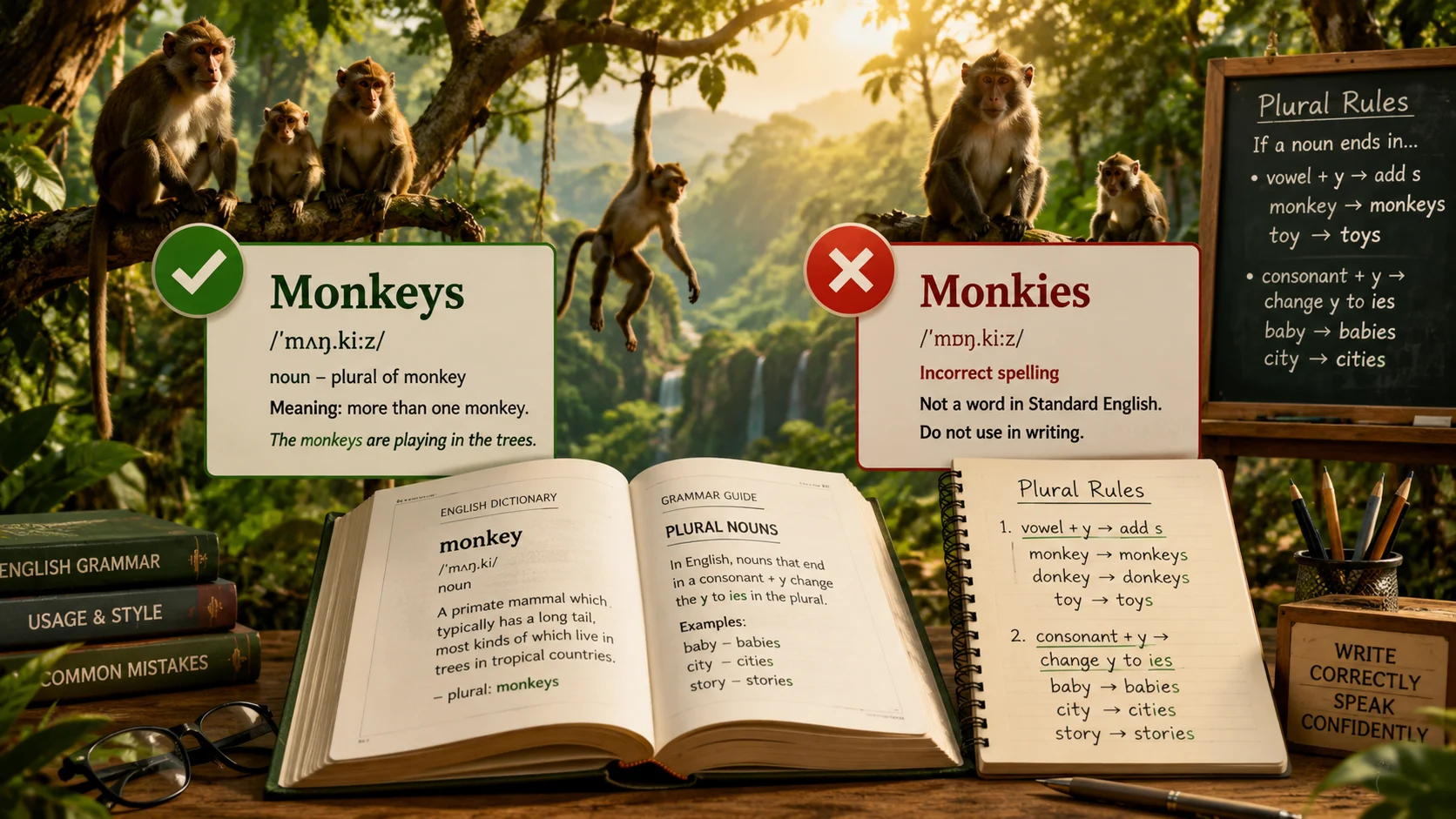
The correct plural spelling is monkeys or monkies only in the sense of comparing the two forms. Monkeys is the standard and correct English plural of monkey, while monkies is a spelling mistake in modern English. If you are writing in academic, professional, or everyday contexts, always use monkeys.
Many English learners and even native speakers wonder about monkeys or monkies because English plural rules are not always consistent. The word monkeys is the correct plural form of the noun monkey, whereas monkies is considered an incorrect spelling in standard English. This confusion often happens because some nouns ending in y change to ies in the plural, while others simply add s. Understanding the rule behind this difference helps you avoid spelling mistakes in school assignments, workplace documents, online writing, and professional communication.
Monkeys or Monkies | What’s the Difference?
Both words appear to represent the plural of monkey, but only one follows standard English spelling rules.
| Feature | Monkeys | Monkies |
|---|---|---|
| Part of speech | Noun | Incorrect spelling |
| Meaning | More than one monkey | Intended to mean more than one monkey |
| Dictionary status | Correct | Incorrect |
| Standard English | Yes | No |
| Academic writing | Accepted | Not accepted |
| Professional writing | Accepted | Incorrect |
| Everyday communication | Correct | Should be avoided |
| Grammar checkers | Accepted | Flagged as an error |
Mini Recap
The word monkeys is the only correct plural spelling in modern English.
The spelling monkies is a common mistake caused by misunderstanding English plural rules.
For formal, academic, business, and casual writing, always choose monkeys.
Is Monkeys or Monkies a Grammar, Vocabulary or Usage Issue?
This is primarily a spelling and grammar issue rather than a vocabulary issue.
English nouns ending in y follow two different pluralization patterns depending on the letter before y.
If a vowel comes before y, simply add s.
If a consonant comes before y, replace y with ies.
Since the word monkey ends with ey, where e is a vowel, the correct plural becomes monkeys.
| Word | Letter Before Y | Correct Plural |
|---|---|---|
| Monkey | Vowel | Monkeys |
| Donkey | Vowel | Donkeys |
| Turkey | Vowel | Turkeys |
| Boy | Vowel | Boys |
| Toy | Vowel | Toys |
| Baby | Consonant | Babies |
| City | Consonant | Cities |
| Story | Consonant | Stories |
Grammar Summary
This confusion is not about meaning because both spellings attempt to represent the same noun.
Instead, it is about applying the correct English plural formation rule.
Standard English recognizes only monkeys.
Understanding the Word Monkeys
Monkeys is the correct plural noun referring to more than one monkey.
It appears in dictionaries, textbooks, newspapers, scientific journals, and everyday English.
Workplace Example
The wildlife department reported that several monkeys had entered nearby farms.
Academic Example
Students observed different species of monkeys during the biology field trip.
Technology Example
The educational application contains interactive lessons about rainforest monkeys.
Usage Recap
| Situation | Use Monkeys? | Reason |
|---|---|---|
| School essays | Yes | Correct plural spelling |
| Scientific research | Yes | Standard English |
| News articles | Yes | Accepted spelling |
| Business writing | Yes | Professional usage |
| Websites | Yes | Improves credibility |
| Exams | Yes | Correct answer |
Understanding the Word Monkies
The spelling monkies is not accepted in standard English dictionaries.
People usually write it because they mistakenly apply the plural rule used for words like babies or cities.
Since monkey has a vowel before y, this spelling does not follow English grammar rules.
Workplace Example
Incorrect: The report mentioned several monkies.
Correct: The report mentioned several monkeys.
Academic Example
Incorrect: Scientists studied wild monkies.
Correct: Scientists studied wild monkeys.
Technology Example
Spell checking software automatically changes monkies to monkeys.
Usage Recap
| Situation | Use Monkies? | Reason |
|---|---|---|
| School homework | No | Monkies is an incorrect spelling. |
| Academic papers | No | It is considered a grammar and spelling error. |
| Professional reports | No | It reduces credibility and professionalism. |
| Websites | No | It appears unprofessional and may confuse readers. |
| Books | No | Editors use the standard plural monkeys. |
| Official documents | No | Monkeys is the accepted standard English spelling. |
Why Does This Confusion Happen?
Many English nouns ending in y change to ies, so writers naturally assume monkey follows the same rule.
The actual spelling depends on the letter immediately before y.
| Ending Pattern | Plural Rule | Example |
|---|---|---|
| Vowel + y | Add s | Monkey → Monkeys |
| Vowel + y | Add s | Donkey → Donkeys |
| Vowel + y | Add s | Toy → Toys |
| Consonant + y | Change y to ies | Baby → Babies |
| Consonant + y | Change y to ies | City → Cities |
| Consonant + y | Change y to ies | Story → Stories |
When You Should NOT Use Monkeys or Monkies
The following situations are among the most common mistakes writers make. Understanding them will help you avoid spelling errors and improve your written English.
| Situation | Correct Choice | Reason |
|---|---|---|
| Writing the plural of monkey | Monkeys | Standard English spelling. |
| School assignments | Monkeys | Accepted by teachers and exams. |
| Academic research | Monkeys | Used in dictionaries and scholarly journals. |
| Business documents | Monkeys | Professional and grammatically correct. |
| News articles | Monkeys | Follows standard editorial style. |
| Website content | Monkeys | Improves credibility and readability. |
| Using monkies in formal writing | Avoid | It is a spelling error in standard English. |
| Assuming every word ending in y changes to ies | Avoid | The plural rule depends on the letter before y. Words ending in a vowel + y take s, while consonant + y words usually change y to ies. |
Common Mistakes and Decision Rules
Many writers incorrectly assume that every noun ending in y changes to ies in the plural. However, that rule only applies when a consonant comes before y.
| Correct Sentence | Incorrect Sentence | Explanation |
|---|---|---|
| The monkeys climbed the trees. | The monkies climbed the trees. | Monkey ends with a vowel before y, so the plural adds s. |
| We saw several monkeys at the zoo. | We saw several monkies at the zoo. | Monkeys is the correct and accepted plural. |
| Scientists observed monkeys in the rainforest. | Scientists observed monkies in the rainforest. | Academic and standard English use monkeys. |
| The children loved feeding the monkeys. | The children loved feeding the monkies. | Monkies is not standard English. |
| The documentary featured rare monkeys. | The documentary featured rare monkies. | Only monkeys is the correct plural form. |
| The park is home to many monkeys. | The park is home to many monkies. | Dictionaries recognize only monkeys as the standard plural. |
Decision Rule Box
| If your meaning isUse | |
|---|---|
| More than one monkey | Monkeys |
| The incorrect spelling sometimes seen online | Monkies only when discussing the mistake itself |
| Academic, business, or professional writing | Monkeys |
| School examinations | Monkeys |
| Dictionaries and grammar guides | Monkeys |
Monkeys or Monkies in Modern Technology and AI Tools
Modern spell checkers, grammar applications, search engines, and AI writing assistants recognize monkeys as the correct plural form. When someone types monkies, most writing tools immediately suggest replacing it with monkeys. This automatic correction helps writers produce accurate and professional content while reducing common spelling mistakes.
Etymology
The word monkey entered English during the Middle English period and has been used for centuries to describe various species of primates. As English spelling rules evolved, its plural naturally became monkeys because the word ends with a vowel followed by y. The spelling monkies never became part of standard English and is considered a modern misspelling.
Expert Insight: Strong writing depends on understanding spelling patterns rather than memorizing individual words. Once you know the vowel before y rule, words such as monkeys, donkeys, and turkeys become easy to spell correctly.
Case Studies
Case Study 1 | Improving Academic Accuracy
A university instructor reviewed one hundred student biology assignments discussing primates. Nearly twenty percent of the papers contained the spelling monkies. After teaching the vowel before y plural rule, spelling accuracy improved dramatically, and nearly every student used monkeys correctly in the final assessment.
Case Study 2| Better Website Credibility
A wildlife education website found repeated instances of monkies across several articles. After correcting every occurrence to monkeys, editors reported improved proofreading scores, greater reader trust, and cleaner grammar throughout the site.
Error Prevention Checklist
| Always Use Monkeys When | Never Use Monkies When |
|---|---|
| Referring to more than one monkey | Writing school assignments |
| Writing essays or reports | Preparing academic papers |
| Creating website content | Writing business documents |
| Publishing books or articles | Taking English examinations |
| Writing emails or presentations | Following dictionary spelling |
| Using standard English grammar | Writing professional content |
| Following grammar checkers | Referring to the correct plural of monkey |
Related Grammar Confusions You Should Master
Improving your English becomes much easier when you understand other commonly confused word pairs. These topics follow similar grammar or spelling patterns and are worth learning.
| Grammar Topic | What You Will Learn |
|---|---|
| Children or Childrens | How to use the correct irregular plural form. |
| Potatoes or Potatos | The plural rule for words ending in o. |
| Tomatoes or Tomatos | Common spelling rules for plural nouns ending in o. |
| Babies or Babys | The rule for nouns ending in a consonant + y. |
| Donkeys or Donkies | The rule for nouns ending in a vowel + y. |
| Families or Familys | How to form the correct plural of words ending in y. |
| Wolves or Wolfs | Irregular plural forms ending in ves. |
| Mice or Mouses | Common irregular plural nouns in English. |
| Geese or Gooses | Traditional irregular plural forms and their usage. |
| Cacti or Cactuses | Classical and modern English plural forms. |
FAQs
Is monkeys or monkies the correct spelling?
The correct spelling is monkeys. Monkies is not accepted in standard English and is considered a spelling mistake.
Why is monkeys correct instead of monkies?
Because monkey ends with a vowel before y, English grammar requires adding s rather than changing y to ies.
Is monkies found in any English dictionary?
Modern English dictionaries list monkeys as the correct plural form. Monkies is generally identified as an incorrect spelling.
Do grammar checkers correct monkies automatically?
Yes. Most grammar and spell checking tools suggest replacing monkies with monkeys immediately.
Can I use monkies in academic writing?
No. Academic institutions, publishers, and style guides expect the standard spelling monkeys.
Why do people accidentally write monkies?
Many people confuse the plural rule with words like babies and cities, forgetting that monkey has a vowel before y.
What is the plural rule for words ending in y?
If a vowel comes before y, simply add s. If a consonant comes before y, change y to ies.
Which spelling should I use in professional documents?
Always use monkeys in business, education, publishing, and all formal communication.
Conclusion
The debate over monkeys or monkies has a simple answer once you understand the English plural rule. Monkeys is the correct and accepted spelling because monkey ends with a vowel followed by y, which means you simply add s.
The spelling monkies is a common mistake that should be avoided in academic, professional, and everyday writing. Learning this rule also helps you spell similar words such as donkeys, turkeys, and toys correctly. By remembering the vowel before y rule, you can write with greater confidence and avoid one of the most frequent English spelling errors.
Discover More Related Articles:
- Threw or Through | What Is the Difference & When Should You Use Each In 2026
- Unkempt or Unkept | What Is the Difference & Which Word Should You Use In 2026
- Neighbour or Neighbor | The Regional Difference Every Writer Should Know In 2026