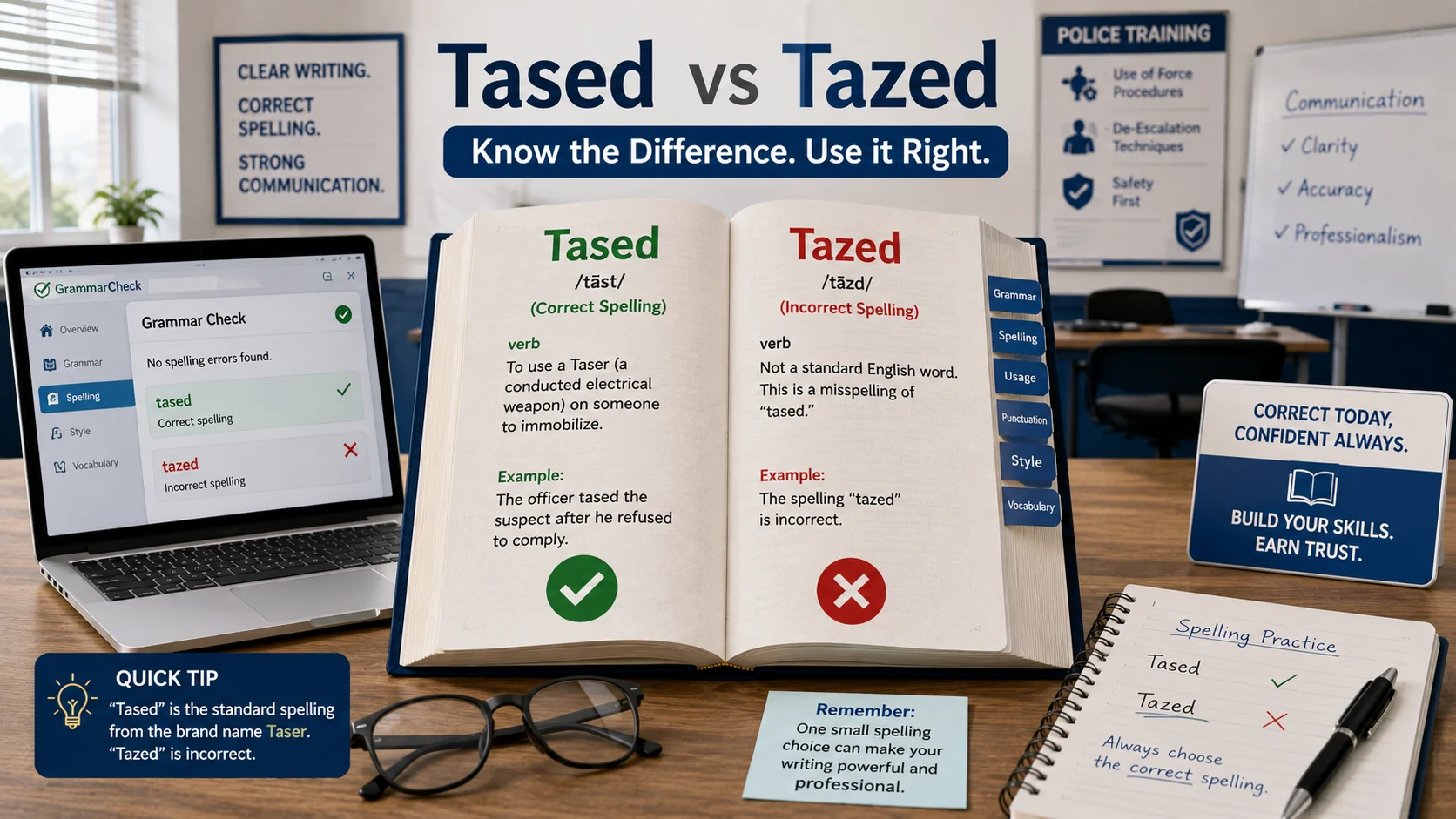
Tased or tazed is a common spelling question because both forms appear online. Tased is the standard and widely accepted past tense and past participle of the trademarked verb Tase, which refers to using a TASER device on someone. Tazed is an alternative spelling that appears in informal writing but is generally avoided in professional, academic and journalistic contexts.
The question tased or tazed often confuses writers because both spellings seem reasonable at first glance. Tased is the accepted past tense of the verb Tase, meaning to use a TASER device to temporarily incapacitate someone with an electric shock. Tazed represents the same action but is considered a nonstandard spelling by most style guides and professional editors.
This distinction matters because choosing the wrong form can weaken your credibility in news reports, academic writing, legal documents, and everyday communication. Understanding which spelling is preferred helps you write with greater accuracy and confidence.
Tased vs Tazed | What’s the Difference?
Although these words refer to the same action, they are not treated equally in standard English. One is widely recognized and recommended, while the other appears mainly in informal contexts.
Tased
Part of speech: Verb, past tense and past participle
Meaning: Refers to someone being struck with a TASER device or having a TASER used against them.
Example: The suspect was tased after refusing to comply with police instructions.
Tazed
Part of speech: Alternative spelling of the same verb
Meaning: Intended to describe the same action as tased, but considered a nonstandard or less accepted spelling.
Example: Some social media posts use tazed, but professional publications usually avoid it.
| Feature | Tased | Tazed |
|---|---|---|
| Standard English | Yes | No |
| Dictionary acceptance | Widely accepted | Rarely listed |
| Professional writing | Recommended | Generally avoided |
| News reporting | Preferred | Uncommon |
| Academic writing | Appropriate | Not recommended |
| Informal online writing | Sometimes seen | More commonly seen than in formal writing |
| Meaning | Shocked with a TASER device | Same intended meaning |
Mini Recap
The difference between these spellings is about standard usage rather than meaning. Both attempt to describe the same action, but tased is the recognized spelling in modern English. If you are writing for work, school, journalism, or any professional audience, tased is the safer and more credible choice.
Is Tased vs Tazed a Grammar, Vocabulary or Usage Issue?
This question is primarily a usage issue rather than a grammar problem. Both spellings are intended to represent the past tense of the same verb, but English convention strongly favors one over the other.
From a grammatical perspective, both words function as past tense verbs. The difference lies in accepted spelling standards. Since TASER is a trademark that gave rise to the verb Tase, the conventional past tense became tased, following the pattern of many English verbs ending with the letter e, such as bake becoming baked and close becoming closed.
In formal writing, tased is the preferred choice because it appears consistently in newspapers, legal reports, and edited publications. Editors and proofreaders typically replace tazed with tased to maintain consistency and accuracy.
In casual conversations, online forums, or social media posts, you may occasionally see tazed. While readers usually understand the intended meaning, the spelling can appear less polished and may distract from your message.
Academic writing almost always expects tased, especially when discussing law enforcement practices, criminal justice, or public safety research. Using tazed in scholarly work may be viewed as an avoidable spelling error rather than an accepted variation.
Understanding Tased
Tased is the standard past tense and past participle of the verb Tase. It describes the action of using a TASER device to temporarily disable or control a person through an electrical discharge. Because it follows established English spelling conventions, it is the form recommended by dictionaries, editors, and professional writers.
You will commonly encounter tased in news articles covering law enforcement, legal documents describing incidents, and public safety reports. It is also the preferred spelling in educational materials that discuss policing procedures or self defense equipment.
Workplace Example
The security report stated that the individual was tased after repeated attempts to enter a restricted area.
Academic Example
The research paper analyzed situations in which suspects were tased during law enforcement encounters.
Technology Example
The training simulator recorded that the virtual suspect was tased after failing to respond to verbal commands.
More Example Sentences
The officer tased the suspect only after several verbal warnings.
Witnesses said the individual was tased during the arrest.
The incident report confirmed that the suspect had been tased once.
News coverage explained why the person was tased according to department policy.
The documentary examined several cases in which individuals were tased during police operations.
Usage Recap
When writing in professional, academic, legal, or journalistic contexts, choose tased every time. It is the standard spelling recognized by editors and readers alike. Although you may encounter tazed online, it is not the preferred form for clear and authoritative writing.
Understanding Tazed
Tazed is an alternative spelling of the past tense of Tase, but it is not the standard form in modern English. Although many readers understand what it means, most dictionaries, editors, and major news organizations prefer tased because it follows established English spelling conventions.
The spelling tazed appears most often in social media posts, online discussions, personal blogs, and unedited content. It usually reflects how the word sounds rather than how it is conventionally spelled. While it communicates the intended meaning, it can reduce the professionalism and credibility of your writing.
If you are preparing a school assignment, legal document, news article, or business report, avoid tazed and replace it with tased. Doing so ensures your writing aligns with standard English usage.
Workplace Example
❌ The incident report stated that the suspect was tazed before being handcuffed.
✔ The incident report stated that the suspect was tased before being handcuffed.
Academic Example
❌ The study examined individuals who were tazed during police encounters.
✔ The study examined individuals who were tased during police encounters.
Technology Example
❌ The simulation showed the target being tazed after ignoring commands.
✔ The simulation showed the target being tased after ignoring commands.
More Example Sentences
Many online comments incorrectly say the suspect was tazed.
The article originally used tazed, but the editor corrected it to tased.
Some informal websites still publish tazed, even though it is not the preferred spelling.
Readers may recognize tazed, but professional publications almost always choose tased.
Writers should proofread carefully because spell checkers may not always flag tazed.
Usage Recap
You may see tazed in informal writing, but it is not considered the standard spelling. Whenever accuracy and professionalism matter, replace tazed with tased.
When You Should NOT Use Tased or Tazed
Choosing the correct word depends on what you are trying to describe. Although tased is the preferred spelling, there are situations where neither word is appropriate.
| Situation | What to Use Instead | Why |
|---|---|---|
| Referring to the device itself | TASER device | The action and the device are different. |
| Describing a person who carries the device | Officer with a TASER | The verb cannot describe the person. |
| Talking about future action | Will tase | Use the base verb instead of the past tense. |
| Describing a threat without action | Threatened to use a TASER | No electrical discharge occurred. |
| Writing formal reports with tazed | Tased | Use the accepted spelling. |
| Referring to stun guns in general | Stun gun if appropriate | Not every electrical weapon is a TASER. |
| Using the word as an adjective without context | Rewrite the sentence | The verb should describe an action. |
| Guessing the spelling from pronunciation | Check a reliable dictionary | Sound does not always match standard spelling. |
Common Mistakes and Decision Rules
Many spelling mistakes happen because writers rely on pronunciation instead of standard usage. The following examples show how to avoid the most common errors.
| Correct Sentence | Incorrect Sentence | Explanation |
|---|---|---|
| The suspect was tased after repeated warnings. | The suspect was tazed after repeated warnings. | Tased is the accepted spelling. |
| Police confirmed the individual had been tased once. | Police confirmed the individual had been tazed once. | Professional writing uses tased. |
| The report explained why the officer tased the suspect. | The report explained why the officer tazed the suspect. | Standard English favors tased. |
| The witness said someone was tased during the arrest. | The witness said someone was tazed during the arrest. | Editors normally correct tazed. |
| News organizations reported the man was tased. | News organizations reported the man was tazed. | Journalistic style guides recommend tased. |
Decision Rule Box
| If your meaning is… | Use |
|---|---|
| The action of using a TASER device | Tased |
| The person using the device | Officer, security guard, or another noun |
| The device itself | TASER device |
| An informal spelling you found online | Avoid tazed and use tased |
Tased and Tazed in Modern Technology and AI Tools
Modern grammar checkers, proofreading software, and AI writing assistants generally recognize tased as the correct spelling. Most advanced editing tools either flag tazed as a possible spelling mistake or recommend replacing it with tased to match standard English usage.
This preference is especially important in journalism, legal writing, public safety documentation, and educational content, where consistency and accuracy are essential. As AI powered writing tools become more common, following standard spelling conventions helps improve readability, search visibility, and overall credibility.
Etymology
The verb Tase developed from TASER, the well known brand name for an electronic control device. Over time, the brand name became widely used as a verb describing the act of deploying the device. Following normal English verb formation, the accepted past tense became tased, which mirrors verbs such as closed, saved, and hoped.
Expert Insight
“Clear writing depends on using accepted language conventions. Even when alternative spellings exist online, standard forms improve clarity, professionalism, and reader trust.”
Case Study One | Newsroom Editing Improves Credibility
A regional news website reviewed one hundred crime related articles before publication. Editors found that several freelance writers had used tazed instead of tased. After correcting every instance to the standard spelling, the publication reduced copy editing revisions and maintained a consistent editorial style across all law enforcement stories.
Result
The publication produced cleaner, more professional reporting while reducing editorial corrections in future articles.
Case Study Two | University Writing Assessment
A criminal justice instructor evaluated research papers discussing police use of electronic control devices. Students who consistently used tased demonstrated stronger adherence to academic writing conventions, while those using tazed often received corrections for spelling accuracy.
Result
Using the accepted spelling improved writing quality and reduced avoidable language errors in formal assignments.
Error Prevention Checklist
Use this simple checklist whenever you write about a TASER device or its use.
| Always Use Tased When | Never Use Tazed When |
|---|---|
| Writing news articles | Writing academic papers |
| Preparing legal documents | Creating business reports |
| Editing professional content | Publishing educational materials |
| Following standard English | Submitting school assignments |
| Quoting police reports | Writing formal emails |
| You mean the past tense of Tase | You want polished, credible writing |
| You want consistency with dictionaries | You are following professional style guides |
A quick review before publishing can prevent spelling mistakes and make your writing appear more accurate and trustworthy.
Related Grammar Confusions You Should Master
Improving your grammar goes beyond learning the difference between tased and tazed. These commonly confused words and spellings can also strengthen your writing skills.
| Topic | Why It Causes Confusion |
|---|---|
| Affect or Effect | Similar pronunciation but different meanings |
| Then or Than | Time versus comparison |
| Advice or Advise | Noun versus verb |
| Lose or Loose | One letter changes the meaning completely |
| Breath or Breathe | Noun versus verb |
| Principal or Principle | Person versus rule |
| Stationary or Stationery | Motion versus writing materials |
| Compliment or Complement | Praise versus something that completes another |
| Farther or Further | Physical distance versus broader extension |
| Who’s or Whose | Contraction versus possession |
Mastering these common distinctions will improve both your grammar and your confidence in everyday writing.
FAQs
Is tased or tazed the correct spelling?
Tased is the accepted standard spelling in modern English. Tazed is an alternative spelling that appears in informal writing but is generally avoided in professional contexts.
Why do some people write tazed instead of tased?
Many writers spell the word according to its pronunciation. However, standard English follows the established spelling tased, making it the preferred choice.
Is tazed considered a spelling mistake?
In formal writing, most editors and style guides treat tazed as a nonstandard spelling and recommend replacing it with tased.
Do dictionaries recognize tazed?
Most major dictionaries list tased as the accepted form. Tazed is either omitted or identified as a less common alternative.
Should I use tased in academic writing?
Yes. Academic papers, research articles, and university assignments should use tased because it follows accepted English conventions.
Do journalists use tased or tazed?
Professional journalists overwhelmingly use tased. News organizations aim for consistency, accuracy, and adherence to editorial style standards.
Does grammar checking software correct tazed?
Many modern grammar and spelling tools recommend changing tazed to tased, especially in formal or professional documents.
Can tazed ever be acceptable?
It may appear in casual online conversations or personal posts, but it is not recommended when writing for professional, educational, or public audiences.
Conclusion
Understanding the difference between tased or tazed is simpler than it first appears. Both spellings refer to the same action of using a TASER device, but only tased is widely accepted in standard English. It is the spelling preferred by dictionaries, editors, journalists, educators, and legal professionals.
Although tazed occasionally appears in blogs, forums, and social media, it lacks the authority and consistency expected in formal writing. Choosing tased helps your work appear polished, credible, and grammatically accurate.
Whenever you are unsure, remember this simple rule: if you are describing the past action of using a TASER device, write tased. Following this convention ensures your writing meets modern English standards and communicates your message clearly to every reader.
Discover More Related Articles:
- Elses or Else’s | The Grammar Confusion You Can Fix in Minutes In 2026
- iPhone or Samsung | Which Smartphone Is Better for Your Needs In 2026
- Label or Lable | Which Spelling Is Correct & When to Use It In 2026