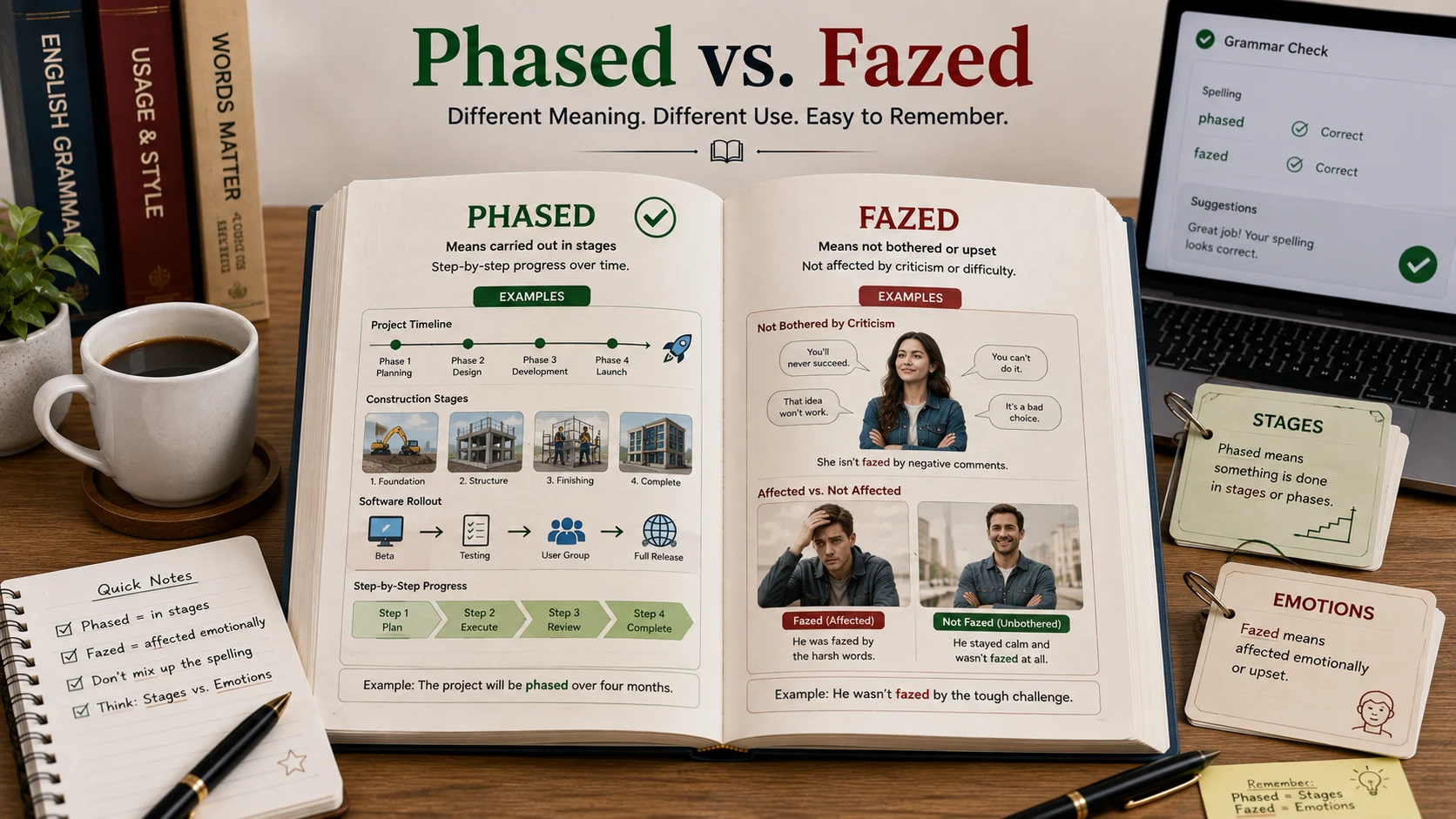
Phased or fazed are two commonly confused English words that sound alike but have completely different meanings. Phased refers to something carried out in stages or relates to a phase, while fazed means disturbed, bothered, or unsettled by something. Choosing the correct word ensures your writing remains accurate and professional.
The phased or fazed question often puzzles English learners, students, and even experienced writers because both words share the same pronunciation. Despite sounding identical, they belong to different parts of speech and express entirely different ideas. Phased describes something completed gradually or in stages, whereas fazed describes a person’s emotional reaction to an event. Confusing these terms can change the meaning of a sentence and create misunderstandings in academic, workplace, and everyday communication. Learning when to use each word will help you write with greater confidence and precision.
Phased or Fazed | What’s the Difference?
Although these words are pronounced the same, they serve very different purposes. One refers to a process, while the other describes an emotional response.
| Feature | Phased | Fazed |
|---|---|---|
| Part of speech | Verb and adjective | Verb |
| Meaning | Completed in stages or arranged by phases | Disturbed, bothered, or unsettled |
| Related word | Phase | Faze |
| Common context | Projects, plans, development, implementation | Feelings, reactions, confidence |
| Emotional meaning | No | Yes |
| Example | The company introduced a phased rollout. | She was not fazed by the criticism. |
In simple terms, phased focuses on progress through different stages, while fazed focuses on someone’s emotional reaction. Once you remember this distinction, choosing the correct word becomes much easier. The context of the sentence usually makes the right choice obvious.
Is Phased or Fazed a Grammar, Vocabulary or Usage Issue?
The confusion between phased and fazed is mainly a vocabulary and usage issue rather than a grammar problem.
| Aspect | Explanation |
|---|---|
| Grammar | Both words are grammatically correct when used in the right context. |
| Vocabulary | They have different meanings despite identical pronunciation. |
| Pronunciation | Both are pronounced the same, making them homophones. |
| Interchangeable | No. Replacing one with the other changes the meaning completely. |
| Formal writing | Both are accepted in Formal writing when used correctly. |
| Casual conversation | Both appear frequently depending on the intended meaning. |
In academic writing, using the wrong word may confuse readers because the sentence will no longer express the intended meaning. Professional documents also require careful word choice to maintain clarity.
The simplest way to remember the difference is this. If you are talking about stages, planning, or gradual implementation, use phased. If you are describing someone’s emotional reaction or ability to remain calm, use fazed.
Understanding Phased
Phased is the past tense and past participle of the verb phase. It can also function as an adjective. It means something is organized, introduced, or completed in separate stages rather than all at once.
Many organizations prefer a phased approach because it reduces risks and allows gradual improvement.
Workplace Example
The company adopted a phased hiring strategy to manage its budget more effectively.
Academic Example
The university introduced a phased curriculum update over three semesters.
Technology Example
The software developer announced a phased rollout of the latest application update.
More Examples of Phased
- The government approved a phased reopening plan.
- Construction followed a phased schedule.
- The migration to the new system happened in phased steps.
- A phased implementation reduced operational risks.
- The organization preferred a phased expansion strategy.
Common Expressions Using Phased
| Expression | Meaning |
|---|---|
| Phased rollout | Released gradually |
| Phased implementation | Introduced in stages |
| Phased approach | Step by step method |
| Phased development | Development completed over multiple stages |
| Phased transition | Gradual movement from one system to another |
Usage Recap
Use phased whenever you describe something happening gradually, step by step, or through planned stages. It commonly appears in business, education, government, engineering, healthcare, and technology writing.
Understanding Fazed
Fazed is the past tense and past participle of the verb faze. It means to disturb, unsettle, worry, or embarrass someone.
People often use this word to describe confidence, resilience, or emotional reactions.
Workplace Example
The manager was not fazed by the unexpected changes during the meeting.
Academic Example
The student remained unfazed by the difficult examination questions.
Technology Example
The cybersecurity team was not fazed after discovering a minor software issue because they already had a recovery plan.
More Examples of Fazed
- She was never fazed by public speaking.
- The athlete looked completely unfazed before the final match.
- He was not fazed by the criticism from his competitors.
- Experienced pilots are rarely fazed by turbulence.
- The presenter remained calm and unfazed throughout the conference.
Common Expressions Using Fazed
| Expression | Meaning |
|---|---|
| Not fazed | Not bothered or disturbed |
| Easily fazed | Easily upset or discouraged |
| Completely unfazed | Totally calm despite challenges |
| Barely fazed | Only slightly affected |
| Emotionally fazed | Mentally disturbed by an event |
Usage Recap
Choose fazed whenever you are describing a person’s emotional reaction to a challenge, criticism, surprise, or stressful situation. It almost always refers to feelings rather than actions or processes.
When You Should NOT Use Phased or Fazed
Although these words are easy to pronounce, they should never replace one another. Here are the most common situations where writers make mistakes.
| Situation | Correct Choice | Why |
|---|---|---|
| Talking about a gradual project rollout | Phased | It refers to stages or planned implementation. |
| Describing someone’s emotional reaction | Fazed | It means bothered or disturbed. |
| Discussing construction schedules | Phased | Construction is completed in stages. |
| Referring to confidence under pressure | Fazed | It describes emotional resilience. |
| Explaining software deployment | Phased | Updates are often released gradually. |
| Talking about criticism or stress | Fazed | The word relates to feelings and reactions. |
| Describing business planning | Phased | Business strategies often follow multiple phases. |
| Mentioning calm behavior | Fazed | It shows someone was emotionally affected. |
Remember that phased is about a process, while fazed is about a person’s feelings. If the sentence discusses progress or implementation, choose phased. If it describes someone’s emotional state, choose fazed.
Common Mistakes and Decision Rules
Writers often choose the wrong word because both sound exactly alike. Reading the sentence carefully usually reveals the intended meaning.
| Correct Sentence | Incorrect Sentence | Explanation |
|---|---|---|
| The company adopted a phased rollout. | The company adopted a fazed rollout. | Rollouts happen in stages, not emotions. |
| She was not fazed by the interview. | She was not phased by the interview. | The sentence describes her reaction. |
| The project followed a phased schedule. | The project followed a fazed schedule. | Schedules are planned in phases. |
| He remained unfazed during the debate. | He remained unphased during the debate. | Unfazed means calm and unaffected. |
| The migration was phased over six months. | The migration was fazed over six months. | Migration occurs gradually. |
| The athlete was barely fazed by the pressure. | The athlete was barely phased by the pressure. | Pressure affects emotions, not phases. |
Decision Rule Box
| If you mean | Use |
|---|---|
| Something happens gradually or in stages | Phased |
| Someone feels disturbed, worried, or unaffected | Fazed |
This simple rule solves almost every phased or fazed question.
Phased or Fazed in Modern Technology and AI Tools
Modern businesses frequently use the word phased when discussing software deployment, cloud migration, product launches, and digital transformation. Technology teams often release updates in several phases to reduce risks and monitor performance before reaching every user.
The word fazed appears more often in communication, leadership, and customer service discussions. AI writing assistants, grammar checkers, and proofreading tools can identify a sentence refers to a gradual process or an emotional reaction, helping writers avoid confusing these homophones.
Etymology
The word phase comes from the Greek word meaning appearance or stage. Over time, English adopted it to describe distinct periods within a process. This explains why phased always relates to gradual progression.
The word faze entered English much later and means to disturb or disconcert someone. Although its origin differs from phase, identical pronunciation has caused confusion for generations of English speakers.
“Strong writing depends on choosing words for their meaning, not simply their sound. Homophones demand careful attention to context.”
Case Study One
A software company planned to introduce a new mobile application across three countries. Early drafts of its documentation mistakenly described the release as a “fazed rollout.” Editors corrected every occurrence to “phased rollout,” improving clarity and preventing confusion among international teams. Internal documentation errors dropped significantly after introducing a style guide.
Case Study Two
A university writing center analyzed essays written by first year students. Many students wrote that they were “not phased” by difficult exams when they actually meant “not fazed.” After a short lesson on homophones and contextual meaning, correct usage increased dramatically in later assignments, improving grammar scores across multiple classes.
Error Prevention Checklist
| Always Use Phased When | Never Use Fazed When |
|---|---|
| Referring to stages | Talking about project planning |
| Describing gradual implementation | Discussing software rollout |
| Explaining scheduled development | Referring to business strategy |
| Talking about construction phases | Mentioning organized transitions |
| Describing systematic progress | Explaining step by step implementation |
| Always Use Fazed When | Never Use Phased When |
|---|---|
| Describing emotional reactions | Talking about confidence |
| Explaining someone’s feelings | Referring to stress or criticism |
| Discussing resilience | Describing emotional responses |
| Talking about being bothered | Referring to calm behavior |
| Explaining someone remained unaffected | Discussing personal reactions |
Related Grammar Confusions You Should Master
If you found phased or fazed confusing, you may also benefit from learning these commonly mixed word pairs.
- Accept or Except
- Affect or Effect
- Principal or Principle
- Compliment or Complement
- Stationary or Stationery
- Lose or Loose
- Then or Than
- Passed or Past
- Forego or Forgo
- Bought or Brought
FAQs
What is the difference between phased and fazed?
Phased refers to something completed in stages, while fazed means emotionally disturbed or bothered. The two words sound alike but have unrelated meanings.
Is it correct to say not phased or not fazed?
The correct expression is not fazed because it means someone was not bothered or affected by a situation.
Can phased describe a person’s emotions?
No. Phased relates to stages or gradual implementation. It should never be used to describe feelings or emotional reactions.
Why do people confuse phased and fazed?
They are homophones, meaning they have the same pronunciation but different spellings and meanings, making them easy to mix up.
How is phased used in business writing?
Business documents commonly use phased to describe rollouts, implementation plans, project schedules, and gradual transitions.
How is fazed used in everyday English?
Fazed usually appears when describing someone’s confidence, reactions to criticism, stressful events, or unexpected situations.
Is unfazed a real word?
Yes. Unfazed is a common adjective meaning calm, confident, and not disturbed despite challenges or pressure.
How can I remember the difference between phased and fazed?
Think of phase as a stage in a process and faze as affecting someone’s feelings. One describes progress, while the other describes emotion.
Conclusion
Understanding phased or fazed becomes simple once you focus on meaning instead of pronunciation. Phased refers to something completed gradually or organized into stages, making it common in business, education, construction, and technology.
Fazed, on the other hand, describes an emotional response, especially when someone feels disturbed or remains calm under pressure. Whenever you encounter these homophones, ask yourself the sentence is describing a process or a person’s feelings. That single question will help you choose the correct word every time and improve the clarity and professionalism of your writing.
Discover More Related Articles:
- Denny or Henry | Understanding the Difference Between These Two Names In 2026
- Monkeys or Monkies | Don’t Make This Common Spelling Mistake In 2026
- Dog or Cat | Which Pet Is Right for You In 2026