
Excited or exited have completely different meanings, even though they differ by only one letter. Excited describes a feeling of enthusiasm, anticipation, or happiness, while exited is the past tense of the verb exit, meaning someone left a place. Confusing them can change the meaning of a sentence entirely.
Have you ever typed “excited” when you actually meant “exited”? These two words look and sound surprisingly similar, but their meanings are completely different. Excited describes a feeling of enthusiasm, happiness, or eagerness, while exited is the past tense of the verb exit, meaning to leave a place or situation. A single letter can change the entire meaning of your sentence, which is why this common spelling and usage confusion deserves a closer look.
In this guide, we’ll break down excited vs exited with clear definitions, practical examples, and easy ways to remember the difference. you’re writing an email, school assignment, social media post, or professional document, understanding when to use each word can help you communicate more accurately and confidently. By the end, choosing between excited and exited will be much easier.
Excited vs Exited | What’s the Difference?
Excited is an adjective that describes a person who feels enthusiastic, eager, happy, or strongly interested in something. It commonly appears with the verb be, as in “She is excited about the concert.”
Exited is the simple past tense and past participle of the verb exit. It means that someone or something left a place, situation, system, or location.
| Word | Part of Speech | Meaning | Example |
|---|---|---|---|
| Excited | Adjective | Feeling enthusiastic, eager, or happy | I am excited about the new course. |
| Exited | Verb | Left a place, situation, or system | She exited the classroom quietly. |
The difference becomes much clearer when you focus on the meaning rather than the spelling.
Excited describes an emotional state.
Exited describes an action involving departure.
You can be excited before an event, but you can be exited from a building only if you have left it.
A Quick Recap
Use excited when someone feels enthusiastic or eager.
Use exited when someone has left somewhere.
The extra e in exited belongs to the verb exit.
The word excited is normally associated with emotions, anticipation, or enthusiasm.
Is Excited vs Exited a Grammar, Vocabulary or Usage Issue?
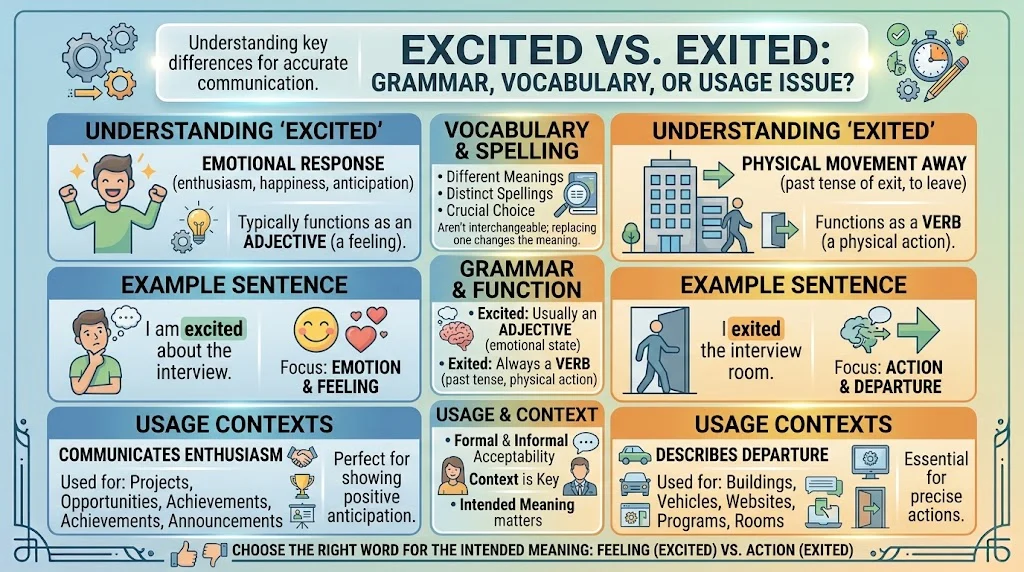
The confusion between these words is primarily a vocabulary and spelling issue, although grammar also matters because the two words function differently in sentences.
They aren’t interchangeable. Replacing one with the other can completely change the meaning of a sentence.
Consider these examples:
“I am excited about the interview.”
“I exited the interview room.”
The first sentence describes an emotional response. The second describes physical movement away from a location.
Formal and Informal Usage
Both words are perfectly acceptable in formal and informal English. The important issue is choosing the word that expresses the intended meaning.
In professional writing, excited can communicate enthusiasm about a project, opportunity, announcement, or achievement.
For example:
“I am excited to join the research team.”
In formal writing, exited is useful when describing departure from a building, vehicle, website, program, room, or situation.
For example:
“The participant exited the conference room at noon.”
Academic and Casual Usage
Students frequently use excited when discussing upcoming exams, presentations, trips, research opportunities, or academic achievements.
For example:
“I am excited to begin my research project.”
The word exited appears less often in ordinary academic conversation, but it can be appropriate in reports that describe movement or a sequence of events.
For example:
“The student exited the laboratory after completing the experiment.”
The distinction remains consistent regardless of how formal the context is.
Excited | Meaning and Correct Usage
Excited is an adjective that describes a strong feeling of enthusiasm, anticipation, eagerness, or happiness.
You might feel excited about a holiday, a promotion, a new job, a sports match, a birthday, a wedding, a new product, or an important personal achievement.
A common structure is:
Subject + be + excited + about + noun
For example:
“She is excited about the competition.”
Another common structure is:
Subject + be + excited + to + verb
For example:
“He is excited to start his new job.”
You can also use excited that before a clause.
For example:
“We are excited that you can attend the event.”
Workplace Example
“I am excited about joining the new marketing team.”
Here, excited communicates enthusiasm about a professional opportunity.
Another example is:
“The manager is excited to launch the new campaign.”
The manager isn’t leaving anything. The person is expressing enthusiasm.
Academic Example
“The students were excited to receive their examination results.”
The sentence describes the students’ emotional response to receiving their results.
Another example is:
“Maria is excited to begin her master’s research.”
Again, excited describes anticipation.
Technology Example
“We are excited to announce the latest software update.”
This construction is especially common in technology announcements, product launches, newsletters, and company communications.
Technology companies often use excited to communicate enthusiasm about a new feature, application, device, or service.
Usage Recap
Use excited when you mean enthusiastic, eager, happy, or full of anticipation.
It usually describes a person’s emotional state.
Common structures include excited about, excited to, and excited that.
Exited | Meaning and Correct Usage
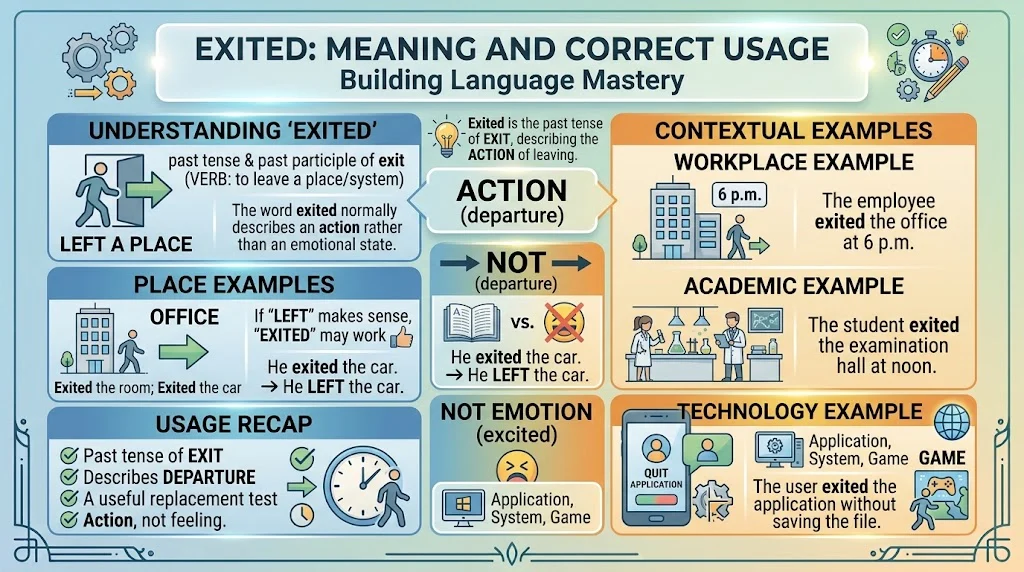
Exited is the past tense and past participle of exit.
The verb exit means to leave a place, building, vehicle, system, website, program, or situation.
For example:
“She exited the room.”
This means she left the room.
“He exited the car.”
This means he got out of the car.
“The customer exited the website.”
This means the customer left the website.
Unlike excited, exited normally describes an action rather than an emotional state.
Workplace Example
“The employee exited the office at 6 p.m.”
The sentence tells us when the employee left the office.
Another example is:
“The manager exited the meeting after the discussion ended.”
The focus is on departure.
Academic Example
“The researcher exited the laboratory after completing the procedure.”
Here, exited describes the researcher’s movement out of the laboratory.
Another example is:
“The student exited the examination hall at noon.”
Again, the word refers to leaving.
Technology Example
“The user exited the application without saving the file.”
In technology contexts, exited is particularly useful because software users can enter and leave applications, programs, menus, or digital environments.
For example:
“The player exited the game after completing the final level.”
Usage Recap
Use exited when you mean left.
It is the past tense of exit.
It normally describes an action rather than a feeling.
A useful replacement test is simple: if left makes sense, exited may be the correct choice.
When You Should NOT Use Excited or Exited
Understanding when not to use these words is just as important as knowing their definitions.
| Situation | Correct Word | Example |
|---|---|---|
| Feeling enthusiastic about a vacation | Excited | I am excited about my vacation. |
| Leaving a building | Exited | I exited the building. |
| Looking forward to an event | Excited | She is excited about the concert. |
| Leaving a vehicle | Exited | He exited the bus. |
| Feeling eager about a new job | Excited | They are excited about the new opportunity. |
| Leaving a website | Exited | The user exited the website. |
| Feeling happy about an announcement | Excited | We are excited about the announcement. |
| Leaving a meeting | Exited | The director exited the meeting. |
Avoid excited when the sentence is actually describing departure.
Incorrect:
“I excited the building.”
If you mean that you left the building, write:
“I exited the building.”
Likewise, avoid exited when you are describing enthusiasm.
Incorrect:
“I am exited about the results.”
Correct:
“I am excited about the results.”
Common Mistakes and Decision Rules
The most frequent mistake occurs because writers remember the pronunciation but not the meaning. Since the words are visually similar, typing quickly can easily result in one being substituted for the other.
| Correct Sentence | Incorrect Sentence | Explanation |
|---|---|---|
| I am excited about the trip. | I am exited about the trip. | Excited describes enthusiasm. |
| She exited the building. | She excited the building. | Exited means left the building. |
| We are excited to meet you. | We are exited to meet you. | The sentence expresses anticipation. |
| He exited the vehicle. | He excited the vehicle. | Exited describes leaving the vehicle. |
| They were excited about the results. | They were exited about the results. | Excited describes an emotional reaction. |
| The customer exited the store. | The customer excited the store. | Exited means the customer left. |
| I am excited for the event. | I am exited for the event. | Excited expresses eagerness. |
| The passenger exited the train. | The passenger excited the train. | Exited means left the train. |
Decision Rule Box
If you mean a feeling of enthusiasm, eagerness, or anticipation, use excited.
If you mean leaving a place, vehicle, system, website, or situation, use exited.
This rule is more accurate than trying to remember the spelling alone.
Excited and Exited in Modern Technology and AI Tools
Modern technology has created many situations where both words can appear close together.
A user can be excited about an AI application while also having exited the application.
For example:
“I was excited to try the new AI tool, but I exited the application after the connection failed.”
Both words are correct because they describe different events.
The first clause describes an emotional response. The second describes an action involving departure.
This distinction is particularly useful in software documentation, user experience writing, technical support, application instructions, and product announcements.
For example:
“Users were excited about the new feature.”
“The user exited the application before the upload finished.”
Understanding the difference prevents awkward technical writing and makes instructions easier to follow.
Etymology | Why the Words Look So Similar
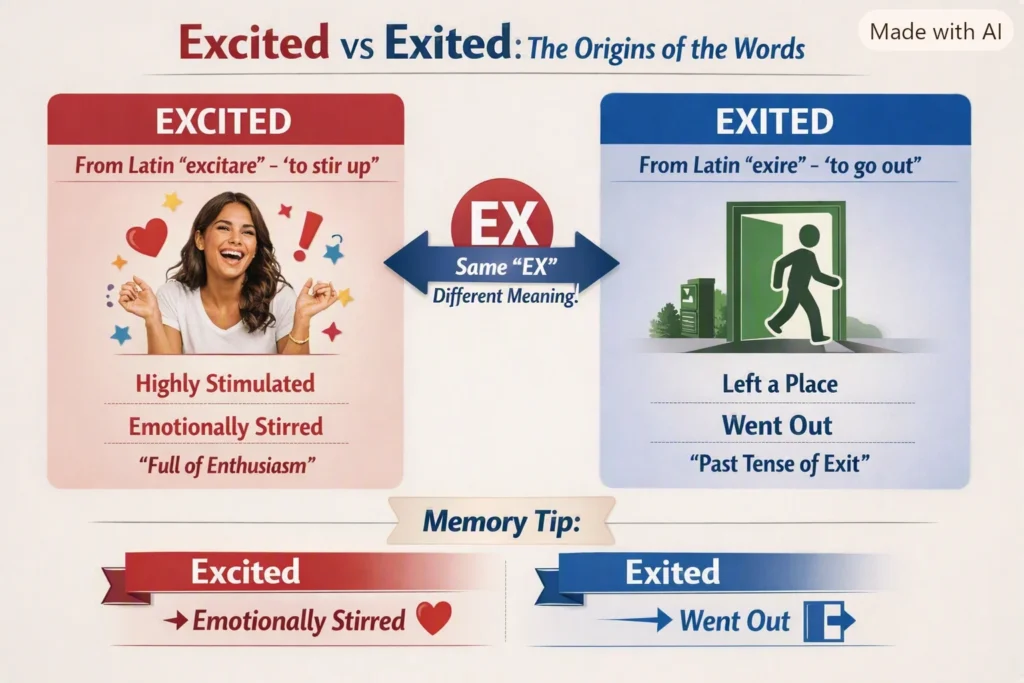
The visual similarity between excited and exited is not accidental.
Excited comes from the Latin root associated with moving or stirring something into activity. Over time, the word developed the emotional sense of being highly stimulated or enthusiastic.
Exit comes from Latin exire, meaning “to go out.” English adopted exit as a noun and verb for leaving a place. Exited is simply the past tense form of that verb.
Their spelling is therefore similar because both contain the letters ex, but their meanings developed along different paths.
A useful memory connection is:
Excited means emotionally stirred.
Exited means went out.
As a language learning principle, meaning is usually more reliable than visual similarity.
Two Practical Case Studies
Case Study One: Professional Email
Imagine an employee writing:
“I am exited to join the new department.”
The intended meaning is clearly enthusiasm, but the missing c creates a spelling and vocabulary error.
The corrected version is:
“I am excited to join the new department.”
The correction changes only one letter, but it restores the intended meaning and makes the email professionally appropriate.
Case Study Two: Technical Instructions
Consider this instruction:
“After saving the document, the user exited the application.”
Replacing exited with excited would create an entirely different and nonsensical meaning.
The correct word immediately tells the reader that the user left the application.
These examples show why context is more powerful than memorizing spelling in isolation.
An expert style rule is:
“Choose the word according to the action or feeling you intend to communicate, not according to how similar the spellings look.”
Author expertise: This guide applies practical English grammar, vocabulary distinction, contextual usage, and error prevention principles commonly used in professional language editing.
Error Prevention Checklist
Always Use Excited When
You are describing enthusiasm.
You are describing anticipation.
You are looking forward to something.
You are expressing eagerness about an opportunity.
You are announcing something enthusiastically.
You are discussing a positive emotional response.
Never Use Exited When
You mean enthusiastic.
You mean eager.
You mean happy about an upcoming event.
You mean looking forward to something.
You are describing an emotional response.
You are writing a phrase such as “excited about” or “excited to” and the meaning is enthusiasm.
A Simple Memory Trick
Think of excited as the word connected with excitement.
The spelling contains the c that also appears in exciting and excitement.
Think of exited as the past tense of exit.
If someone exits a building, they have exited the building.
This creates a simple mental connection:
Excited = emotion
Exited = departure
When you are unsure, ask yourself one question:
Am I describing a feeling or someone leaving?
If it is a feeling, choose excited.
If it is leaving, choose exited.
Related Grammar Confusions You Should Master
Learning the distinction between excited and exited can also help you recognize other commonly confused English words.
Affect vs Effect: Affect is usually a verb, while effect is usually a noun.
Advice vs Advise: Advice is a noun, while advise is a verb.
Accept vs Except: Accept means to receive or agree, while except means excluding something.
Lose vs Loose: Lose means to misplace or fail to win, while loose means not firmly attached.
Than vs Then: Than is mainly used for comparisons, while then relates to time or sequence.
Your vs You’re: Your shows possession, while you’re means you are.
Their vs There vs They’re: Their indicates possession, there refers to a place or situation, and they’re means they are.
Principal vs Principle: Principal can refer to a person or something important, while principle refers to a rule or belief.
Compliment vs Complement: Compliment expresses praise, while complement describes something that completes or enhances another thing.
Stationary vs Stationery: Stationary means not moving, while stationery refers to writing materials.
FAQs
Is excited or exited correct?
Both words are correct, but they have different meanings. Use excited for enthusiasm or anticipation and exited when someone or something has left a place, vehicle, system, or situation.
What is the difference between excited and exited?
Excited is an adjective describing a feeling of enthusiasm, while exited is the past tense of exit and means left or went out.
Is it correct to say I am exited about something?
No, not when you mean that you are enthusiastic. The correct expression is “I am excited about something.”
Is exited a real word?
Yes. Exited is the past tense and past participle of the verb exit, as in “She exited the building.”
How do you remember excited vs exited?
Connect excited with excitement and exited with exit. If you mean enthusiasm, choose excited. If you mean leaving, choose exited.
Is excited an adjective or a verb?
Excited is commonly used as an adjective when it describes someone’s emotional state, as in “He is excited about the opportunity.”
What does exited mean in a sentence?
Exited means left or went out, as in “The customer exited the store after making a purchase.”
Can excited and exited be used interchangeably?
No. They are not interchangeable because excited describes an emotional state while exited describes an action involving departure.
Why do people confuse excited and exited?
They are easily confused because they look and sound similar, especially when typed quickly, but their meanings and grammatical functions are different.
Conclusion
The difference between excited or exited becomes easy once you connect each word with its core meaning. Excited describes enthusiasm, eagerness, anticipation, or another strong positive feeling. Exited is the past tense of exit and means that someone or something left.
When writing, don’t rely only on how the words sound. Instead, identify what your sentence is communicating.
If you’re describing a feeling, use excited.
If you’re describing leaving, use exited.
For example, “I am excited about the vacation” describes anticipation, while “I exited the airport” describes departure. Keeping this simple distinction in mind will help you avoid one of the most common spelling and vocabulary mistakes in everyday English.
Discover More Related Articles:
- Outting or Outing | Which Version Belongs in Standard English In 2026
- Argentine or Argentinian | Which Word Is Correct & When Should You Use It In 2026
- Cacoon or Cocoon | The Quick Grammar Guide Every Writer Needs In 2026