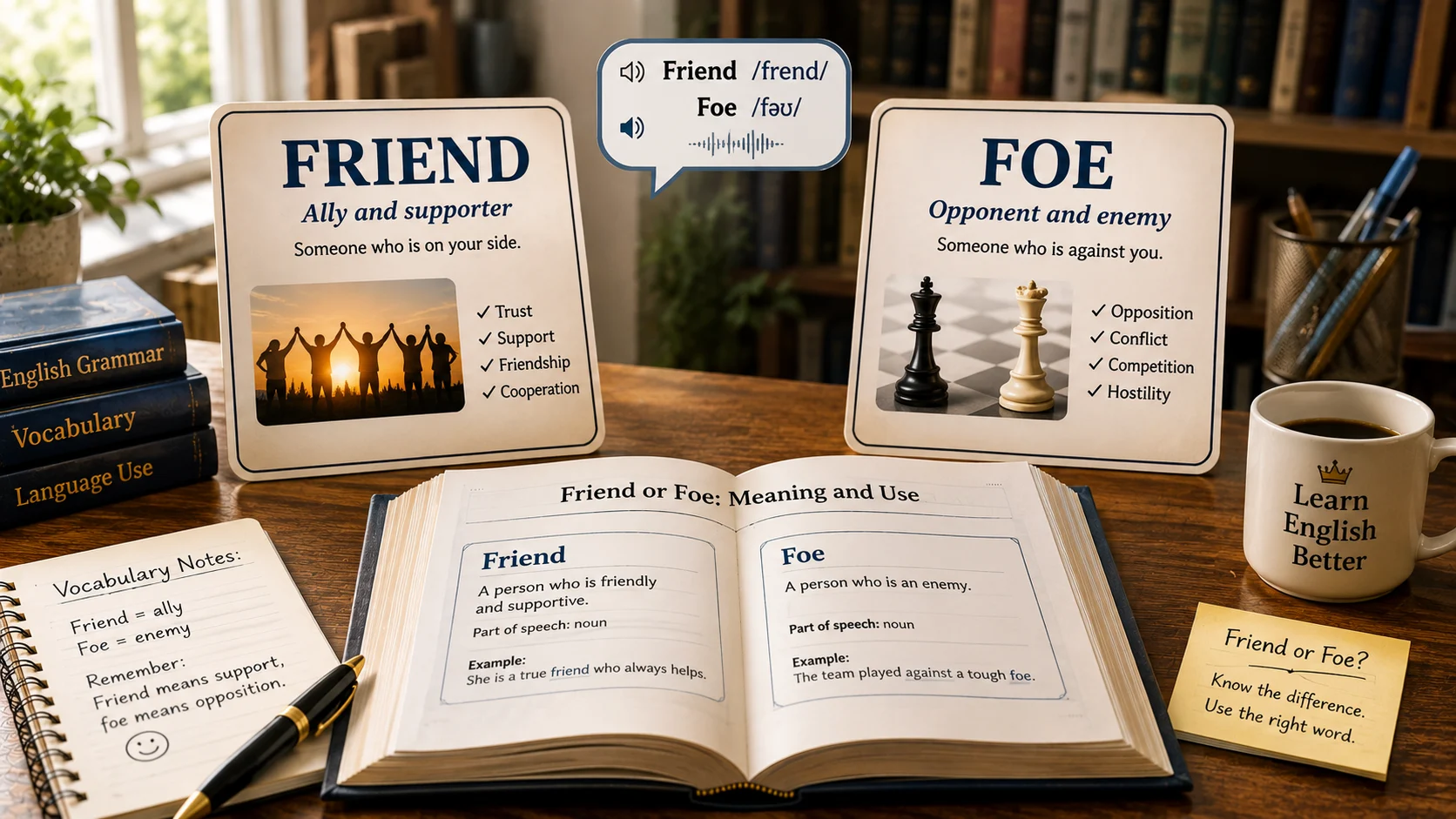
Friend or foe is a common English expression meaning “a friend or an enemy.” The word friend refers to someone who supports, likes or helps you, while foe means an enemy or opponent. The two words have very different pronunciations, so understanding their sounds and meanings can help English learners use this expression naturally and confidently.
Have you ever wondered someone is truly your friend or secretly your foe? These two words may seem simple, but they express opposite ideas about trust, loyalty, and relationships. “Friend” refers to someone who offers support, kindness, and companionship, while “foe” describes an enemy or opponent.
Although both words are commonly used in everyday conversations, literature, and storytelling, understanding their meanings helps you choose the right word for the situation. you are writing an essay, creating a story, or improving your English vocabulary, knowing the difference between friend and foe can make your communication clearer and more meaningful.
In this guide, we will explore the definitions, differences, examples, and correct usage of friend and foe. You will also learn how these words function in sentences and how to avoid common mistakes when using them. By the end, you will confidently understand when to use each term in both formal and informal writing.
Friend or Foe | What’s the Difference?
The expression friend or foe asks someone is on your side or against you. It is often used when a person’s intentions are uncertain.
A friend is a noun meaning a person you know and like, especially someone you trust, support, or enjoy spending time with.
A foe is also a noun. It means an enemy, opponent, or person who is opposed to someone or something.
The spelling and pronunciation are different, but the two words work together in the expression friend or foe because they represent opposite relationships.
| Word | Part of Speech | Meaning | Pronunciation | Example |
|---|---|---|---|---|
| Friend | Noun | A person who supports or likes you | /frend/ | Sarah is my friend. |
| Foe | Noun | An enemy or opponent | /foʊ/ | The soldier faced a dangerous foe. |
| Friend or foe | Expression | Someone who is either an ally or an enemy | /frend or foʊ/ | We need to know he is friend or foe. |
The key difference is simple.
Friend means someone on your side.
Foe means someone against you.
Together, friend or foe describes uncertainty about which side someone is on.
How Do You Pronounce Friend or Foe?
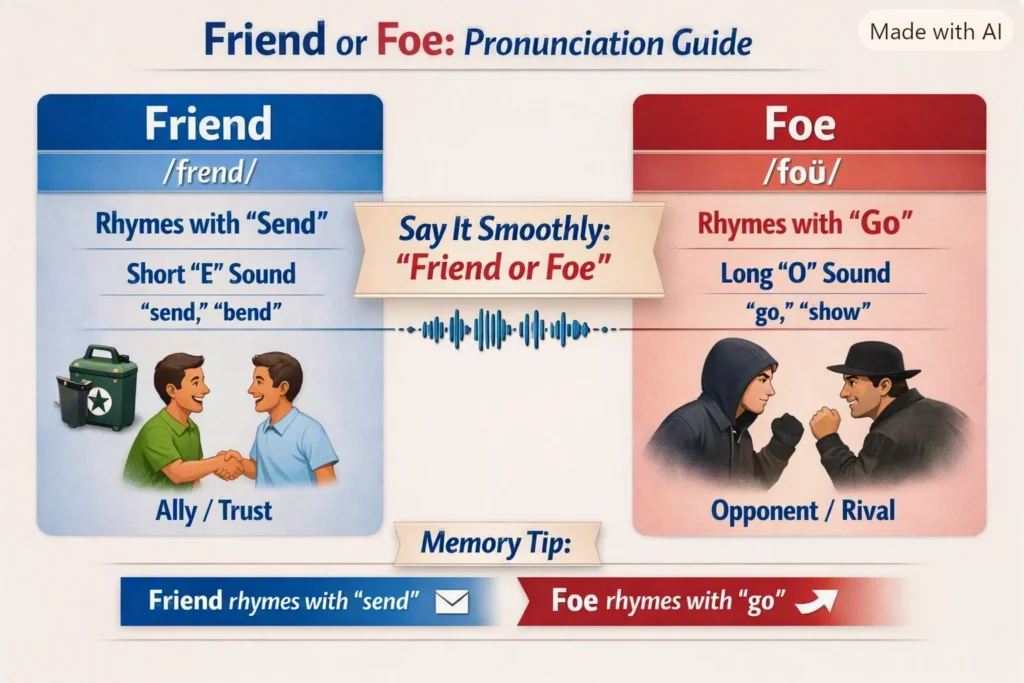
Pronunciation is one of the most useful things to learn about this expression because friend and foe do not sound alike.
Friend is pronounced like “frend.” The vowel sound is short, similar to the vowel sound in words such as “send” and “bend.”
Foe is pronounced like “foh.” It has a long vowel sound that is similar to the sound in “go,” “show,” and “know.”
When you say the complete expression naturally, the word or is often pronounced weakly in connected speech. Instead of stressing every word equally, a native speaker may say the phrase smoothly as “friend or foe.”
For English learners, the easiest pronunciation rule is:
Friend rhymes closely with “send.” Foe rhymes with “go.”
This difference is important because confusing the two sounds can change the meaning completely. If you call someone a friend, you are saying that the person is an ally or someone you trust. Calling someone a foe means the opposite.
Is Friend or Foe a Grammar, Vocabulary or Usage Issue?
The question of friend or foe is mainly a vocabulary and usage issue rather than a grammar problem.
Both friend and foe are standard English nouns. They are not alternative spellings of the same word, and they cannot normally be substituted for each other.
You would say:
“Tom is my friend.”
You would not replace “friend” with “foe” unless you intended to say that Tom is your enemy.
The expression itself is also flexible. It can appear in casual conversations, journalism, books, speeches, academic writing, and professional communication.
In casual English, someone might say:
“Is that person a friend or foe?”
In a more formal context, a writer might say:
“The organization must determine the new group is a potential ally or an opponent.”
The second version sounds more formal, but the basic idea is the same.
Formal and Informal Usage
Friend is extremely common in everyday English. It can describe a close personal relationship or simply someone who is friendly toward you.
Foe is less common in everyday conversation. It has a somewhat formal, literary, dramatic, or traditional feeling.
For example:
“My friend helped me move.”
This sounds completely natural in ordinary conversation.
“The hero defeated his ancient foe.”
This sounds more literary or dramatic.
That does not mean foe is outdated or incorrect. It simply appears less frequently in ordinary conversation than enemy or opponent.
Academic and Casual Usage
Academic writers may use foe when discussing historical conflicts, political opponents, military relationships, literature, or competing theories.
For example:
“The two nations were once foes but later became economic partners.”
In casual speech, however, people are more likely to say:
“Were they friends or enemies?”
So English learners should understand foe, but they do not need to use it constantly. In everyday situations, enemy or opponent may sound more natural.
Friend | Meaning, Pronunciation and Usage
The word friend is one of the most common relationship words in English.
It usually refers to someone you know, like, trust, or support. The relationship can be close or relatively casual.
For example:
“She is one of my closest friends.”
“He has been my friend since childhood.”
“We became friends at university.”
The pronunciation can be slightly surprising for English learners because the spelling does not perfectly predict the vowel sound.
The word is pronounced “frend,” not “freend.”
This is worth remembering because learners sometimes pronounce the vowel as a long sound because of the spelling.
Workplace Example
In a workplace context, friend can describe a personal relationship or a supportive person.
“For many employees, a trusted colleague can become a good friend.”
It can also be used figuratively:
“The new policy is a friend to small businesses.”
Here, friend does not mean a literal person. It means something beneficial or supportive.
Academic Example
In academic writing, friend may appear when discussing relationships, social networks, history, literature, or psychology.
“For many students, a close friend provides emotional and academic support.”
The word remains a straightforward noun, but the surrounding context determines exactly what kind of relationship is meant.
Technology Example
Technology has changed how people use the word friend.
On many social platforms, users can “friend” someone or have “friends” as part of their online network. In this context, the word may describe a digital connection rather than a close personal relationship.
This is a useful reminder that vocabulary can develop new meanings as technology changes.
Friend Usage Recap
Use friend when you mean someone who is supportive, friendly, connected to you, or on your side.
Its pronunciation is “frend.”
It is extremely common in everyday English and works naturally in casual, professional, and academic contexts.
Foe | Meaning, Pronunciation and Usage
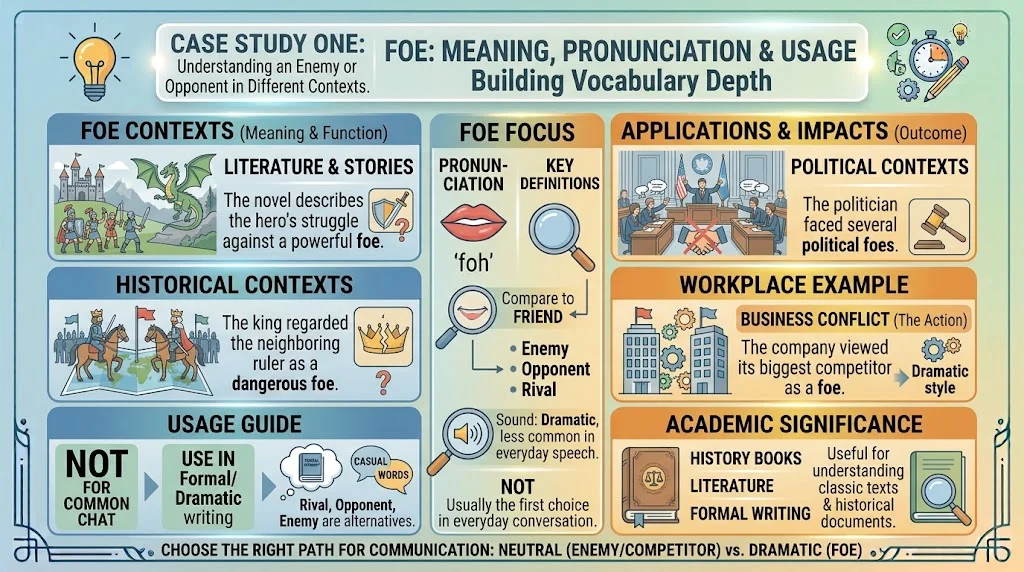
Foe means an enemy, opponent, or person who is against you.
It is pronounced “foh” and rhymes with words such as “go” and “show.”
Unlike friend, it is not usually the first choice in everyday conversation. Most people would normally say enemy, opponent, or rival, depending on the situation.
For example:
“The team defeated its strongest foe.”
“The novel describes the hero’s struggle against a powerful foe.”
“The politician faced several political foes.”
The word can sound dramatic, which is why it appears frequently in literature, historical writing, speeches, journalism, and descriptions of conflict.
Workplace Example
A business competitor can sometimes be described as a foe, especially in a dramatic or journalistic style.
“The company once viewed its biggest competitor as a foe.”
In ordinary workplace communication, however, competitor would usually sound more neutral.
Academic Example
Foe is particularly useful in historical and literary writing.
“The king regarded the neighboring ruler as a dangerous foe.”
“The novel presents the monster as the hero’s greatest foe.”
This makes foe a useful word for English learners who want to understand books, historical texts, and formal writing.
Technology Example
The word can also be used metaphorically in technology.
“Cybersecurity threats are a major foe for modern businesses.”
Here, foe does not necessarily mean a human enemy. It can represent anything that creates opposition or causes harm.
Foe Usage Recap
Use foe when you mean an enemy or opponent.
Pronounce it like “foh.”
It is correct in modern English, but it generally sounds more formal, literary, dramatic, or traditional than enemy.
When You Should NOT Use Friend or Foe
Understanding when not to use these words can prevent awkward sentences.
| Situation | Better Choice | Why |
|---|---|---|
| Talking about someone you trust | Friend | The person is supportive or close to you. |
| Talking about a person who attacks or opposes you | Enemy or foe | Both can describe opposition. |
| Talking about a business competing with yours | Competitor | This is more precise and neutral. |
| Talking about someone competing in a game | Opponent | This is the usual everyday term. |
| Talking about an unfamiliar person | Stranger | You do not yet know the person’s relationship to you. |
| Talking about a romantic relationship | Partner | Friend may not express the intended relationship. |
| Talking about a casual social connection | Acquaintance | The relationship may not be close enough for friend. |
| Talking about an online connection | Online friend or connection | The context makes the relationship clearer. |
Do not automatically call every competitor a foe. The word can sound stronger than you intend.
Likewise, do not call someone a friend simply because they are polite. Being friendly and being a friend are not always the same thing.
Common Mistakes and Decision Rules
English learners often understand the basic meanings but still struggle when choosing the most natural word.
| Correct Sentence | Incorrect Sentence | Explanation |
|---|---|---|
| She is my friend. | She is my foe. | Use friend for someone who supports or likes you. |
| The hero defeated his foe. | The hero defeated his friend. | Foe means enemy or opponent. |
| Are they friend or foe? | Are they friend or enemy? | The expression commonly contrasts friend with foe. |
| He became my friend. | He became my foe. | The intended meaning determines the word. |
| The army faced a powerful foe. | The army faced a powerful friend. | Foe fits a conflict situation. |
| We need to identify our competitors. | We need to identify our foes. | Foes is possible, but competitors is more neutral in business. |
Decision Rule
If you mean someone who supports, trusts, or likes you, use friend.
If you mean someone who opposes, attacks, or competes against you, use foe.
If the situation is neutral and you simply mean someone competing with you, opponent or competitor may be the better choice.
Friend or Foe in Modern Technology and AI Tools
The expression friend or foe has become especially useful when discussing technology because digital systems can be difficult to classify as helpful or harmful.
For example, artificial intelligence can be described as a friend when it helps people complete tasks, learn information, analyze data, or communicate more effectively.
The same technology may be described as a foe when people are concerned about misinformation, security threats, privacy problems, or misuse.
This does not mean AI is literally a friend or enemy. The expression is being used metaphorically to describe a technology is helping or harming someone.
Cybersecurity provides another common example. A computer system may need to determine an unfamiliar connection is safe or dangerous. In a simplified explanation, the system is trying to distinguish between a potential friend and a potential foe.
This metaphor makes the expression useful beyond personal relationships.
Friend or Foe | Etymology and Word History
The word friend has very old Germanic roots. It is related to Old English frēond, meaning a friend or one who loves or favors another person. Its history is connected with ideas of affection, friendship, and being favorably disposed toward someone.
Foe also has Old English roots and has long been associated with an enemy or hostile person.
The contrast between the two words is therefore deeply established in English.
Over time, friend became an extremely common everyday word, while foe developed a stronger literary and formal flavor.
That difference in frequency is one reason modern speakers often prefer friend and enemy in ordinary conversation while writers may choose the more compact and memorable expression friend or foe.
A useful way to remember the expression is this: a friend is on your side, while a foe stands against you.
This simple contrast captures the central meaning without requiring complicated grammar rules.
Two Practical Learning Case Studies

The following examples are illustrative learner scenarios rather than published research studies.
Case Study One: The Pronunciation Problem
Imagine an English learner who knows that friend means an ally but has learned the word mainly from reading.
The learner sees the spelling and pronounces it with a long vowel. A teacher corrects the pronunciation and connects friend with “send” and “bend.”
After practicing the short vowel several times, the learner can distinguish friend from words with longer vowel sounds more confidently.
The lesson is simple: English spelling does not always provide a perfect pronunciation guide.
Case Study Two: The Vocabulary Choice Problem
Consider a student writing about two competing organizations.
The student writes:
“The two companies are foes.”
The sentence is grammatically possible, but the teacher suggests:
“The two companies are competitors.”
The change makes the sentence more precise and neutral.
The student then learns that foe is useful when opposition is strong or when the writing has a dramatic or literary style.
The lesson is that knowing a word’s meaning is only part of vocabulary mastery. You also need to understand tone and context.
Error Prevention Checklist
Always Use Friend When
You mean a person you trust.
You mean someone who supports you.
You are describing a personal friendship.
You are talking about a friendly relationship.
You want an ordinary, natural word for a supportive person.
Never Use Foe When
You simply mean a friend.
You are describing a neutral colleague.
You mean a casual acquaintance.
You mean a business competitor and want completely neutral wording.
You are talking about someone whose relationship to you is unknown.
Remember that foe is not simply a fancy spelling of friend. The words have opposite meanings.
Related Grammar Confusions You Should Master
Learning friend or foe becomes easier when you also understand other commonly confused English words and expressions.
| Related Confusion | Main Difference |
|---|---|
| Enemy vs opponent | Enemy usually suggests stronger hostility. |
| Friend vs acquaintance | A friend has a closer relationship. |
| Friendly vs friend | Friendly describes behavior, while friend is a noun. |
| Rival vs competitor | Rival often suggests a continuing competition. |
| Ally vs enemy | Ally supports you, while enemy opposes you. |
| Affect vs effect | Affect is usually a verb, while effect is usually a noun. |
| Advice vs advise | Advice is a noun, while advise is a verb. |
| Your vs you’re | Your shows possession, while you’re means you are. |
| Than vs then | Than is used for comparison, while then relates to time or sequence. |
| Lose vs loose | Lose means fail to keep or win, while loose means not tight. |
These distinctions are valuable because strong English vocabulary is not only about memorizing definitions. It is also about recognizing how words behave in real sentences.
FAQs
What does friend or foe mean?
It means someone is either an ally or an enemy, especially when their intentions or relationship are uncertain.
How do you pronounce friend or foe?
Friend is pronounced “frend,” while foe is pronounced “foh,” which rhymes with “go.”
Is foe the opposite of friend?
Yes, in the basic contrast used by the expression, a friend supports you while a foe opposes you.
Is friend or foe grammatically correct?
Yes, it is a standard English expression used to ask someone is supportive or hostile.
Is foe commonly used in everyday English?
Foe is correct but less common in casual conversation, where enemy or opponent may sound more natural.
What is another word for foe?
Depending on context, alternatives include enemy, opponent, rival, adversary, or competitor.
What is another way to say friend or foe?
You can say “friend or enemy” or “ally or opponent,” depending on the context and level of formality.
Why is friend pronounced differently from its spelling?
English spelling reflects historical changes, so the letters in friend do not provide a simple one to one guide to its modern pronunciation.
Can foe be used for a business competitor?
Yes, but foe sounds stronger and more dramatic than competitor so competitor is usually better for neutral business writing.
Conclusion
The expression friend or foe is easy to understand once you separate the meanings and sounds of its two words.
A friend is someone who supports, likes, or trusts you. A foe is an enemy or opponent. The pronunciation is also easy to remember: friend sounds like “frend,” while foe sounds like “foh,” rhyming with “go.”
For everyday conversation, friend is extremely common, while foe is more formal, literary, or dramatic. When you ask someone is friend or foe, you are essentially asking that person is on your side or against you.
Once you remember that simple contrast, the expression becomes much easier to recognize, pronounce, and use naturally.
Discover More Related Articles:
- Artic or Arctic | What Is the Difference and Which Spelling Is Correct In 2026
- Hitmonlee or Hitmonchan | Which Pokémon Should You Choose In 2026
- Let’s or Lets | What’s the Difference & When to Use Each Correctly In 2026