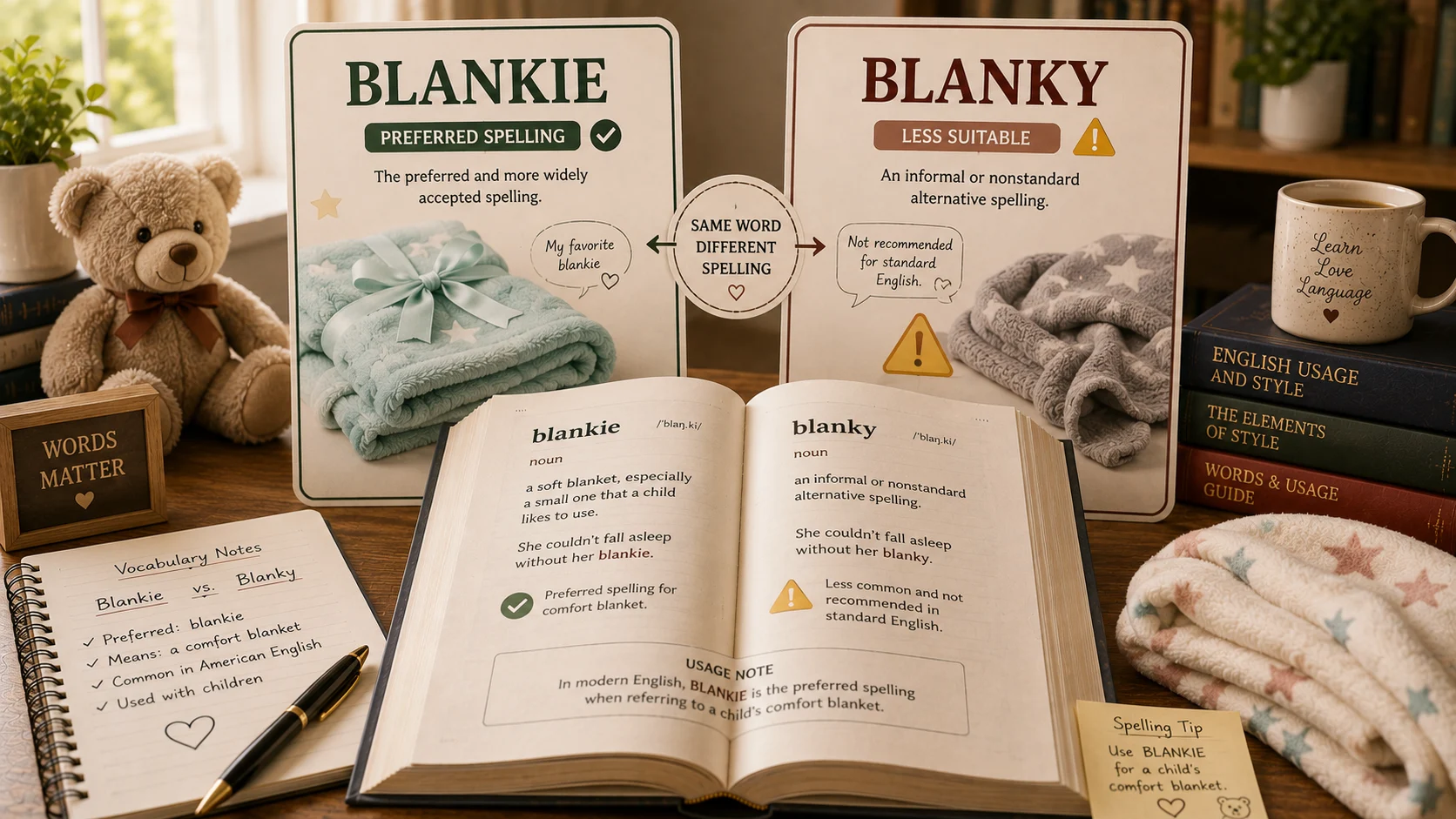
Blankie is the preferred spelling when you mean a child’s favorite comfort blanket. Blanky can appear as a variant in informal usage, but it is not the standard choice for this meaning. Cambridge lists blankie as an informal noun for a small or child’s comfort blanket, while major dictionary evidence supports blankie as the safer spelling.
Ever wondered blankie or blanky is the correct word when talking about a cozy blanket? You’re not alone. These two spellings often appear in casual conversations, social media posts, and messages, especially when people use cute or affectionate language for a favorite blanket. Although both may look acceptable, they are not equally common in standard English usage. Understanding which form is more widely recognized can help you choose the right word for your audience and avoid unnecessary confusion.
In this guide, we’ll explore blankie vs. blanky, including their meanings, spelling, pronunciation, and everyday usage. We’ll also explain either form is considered standard English and when you might encounter each one. You’re writing a casual message, describing a child’s comfort blanket, or simply checking your spelling, this comparison will give you a clear and practical answer.
Blankie vs Blanky | What’s the Difference?
Blankie is an informal noun meaning a blanket, especially a small blanket associated with a child’s comfort or security. It is pronounced approximately like “BLANG kee.” Cambridge identifies it as an informal noun used mainly in American English and also records blankey as a variant.
Blanky is much less straightforward. Although it can appear as an informal spelling of the same idea, it is not the safest standard noun spelling when you are referring to a child’s comfort blanket. Merriam Webster separately records blanky as a British adjective with a different meaning.
The following table makes the distinction clearer.
| Word | Part of speech | Meaning | Typical usage | Best choice for a child’s blanket |
|---|---|---|---|---|
| Blankie | Noun | A small or comforting blanket, especially one used by a child | Informal and affectionate | Yes |
| Blanky | Adjective or informal variant in some contexts | Can have meanings unrelated to a comfort blanket | Less standard for this noun meaning | Usually no |
| Blanket | Noun | A covering used for warmth or comfort | Standard English | Yes, especially in formal writing |
The important point is simple.
Blankie is the clearest choice for a child’s favorite blanket.
Blanky may occur informally, but it is less reliable for standard writing.
Blanket is the best choice when you want completely formal and neutral English.
If you are writing for children, parents, or a casual audience, blankie sounds natural and familiar.
Is Blankie vs Blanky a Grammar, Vocabulary or Usage Issue?
The difference between blankie and blanky is primarily a spelling and vocabulary usage issue, rather than a grammatical one.
Grammar determines how a word functions within a sentence. Here, the more important question is which form represents the intended noun and that form is recognized and appropriate for the context.
Are Blankie and Blanky Interchangeable?
Not completely.
In casual family conversations, a speaker may use blanky and still be understood. Informal vocabulary often develops naturally within families, and children may create or adopt their own names for familiar objects.
However, being understandable does not automatically make a spelling the best standard choice.
Blankie has stronger dictionary support for the comfort blanket meaning. Cambridge explicitly defines it as an informal noun referring to a blanket, especially one used by a young child for comfort.
Formal and Informal Usage
Neither blankie nor blanky is the ideal word for highly formal writing because both have an affectionate or informal character.
In a formal report, you might write:
The child carried a small comfort blanket during the journey.
In a casual message, you might write:
She won’t sleep without her blankie.
The second sentence sounds warm and natural because blankie belongs to informal vocabulary.
Academic and Casual Usage
Academic writing normally favors blanket, comfort blanket, or security blanket, depending on the intended meaning.
Casual writing can comfortably use blankie when the context is familiar and affectionate.
This distinction is particularly useful for English learners because a word can be correct while still being inappropriate for a particular writing situation.
When Should You Use Blankie?
Use blankie when you want the informal noun for a child’s favorite blanket or comfort object.
The word often carries an emotional meaning that goes beyond the physical object. A blankie may be something a child associates with bedtime, safety, travel, sleep, or familiar surroundings.
Workplace Example
In a workplace conversation involving parenting, someone might say:
I packed my daughter’s blankie before leaving for the business trip.
The word is understandable and natural in a casual conversation, although comfort blanket would sound more neutral in formal workplace documentation.
Academic Example
A student writing an academic paper about childhood comfort objects would normally choose comfort blanket or security blanket rather than blankie.
For example:
Children may develop strong attachments to familiar comfort objects.
If the assignment is specifically discussing children’s language, however, blankie may be appropriate because the informal term itself could be relevant.
Technology Example
Technology companies can also use the word in informal product descriptions or parenting applications.
For example:
The app reminds parents to pack their child’s favorite blankie before a trip.
Here, blankie creates a warm and family friendly tone.
Usage Recap
Use blankie when you mean a child’s familiar or comforting blanket and want an informal, affectionate word.
For formal or academic writing, blanket, comfort blanket, or security blanket is usually better.
When Should You Use Blanky?
You should be more cautious with blanky.
Some speakers and families may use it as their personal spelling for a child’s blanket. Informal English often contains creative spellings, especially when words are associated with children.
However, blanky does not have the same straightforward dictionary status as blankie for this particular noun meaning. Merriam Webster currently gives blanky a separate British adjective entry with a different meaning.
Workplace Example
Instead of writing:
Please remember the child’s blanky.
A clearer choice would be:
Please remember the child’s blankie.
Or, for formal communication:
Please remember the child’s comfort blanket.
Academic Example
For academic writing, avoid blanky unless you are discussing someone’s exact word choice.
Better:
The child developed an attachment to a particular comfort blanket.
Technology Example
A parenting application could display:
Don’t forget your child’s blankie.
This is possible in friendly interface copy, but blankie remains the more recognizable spelling.
Usage Recap
Blanky can occur in informal language, but it is not the safest spelling for the noun meaning a child’s comfort blanket.
When in doubt, choose blankie.
Why Is Blankie More Common?
One reason is the familiar English pattern involving the ending ie.
English speakers often use affectionate endings to create informal forms of words. Blankie follows this pattern by taking blanket and forming a shorter, more affectionate word.
Merriam Webster gives the etymology as blanket plus ie and records the first known use of blankie in 1899.
This long history is useful because it shows that blankie is not merely a recent internet spelling. It has been part of informal English for well over a century.
Blankie or Blanky: Common Examples
Seeing the preferred spelling in context makes the difference easier to remember.
| Meaning | Preferred sentence | Less preferred sentence | Explanation |
|---|---|---|---|
| Child’s comfort blanket | The baby sleeps with her blankie. | The baby sleeps with her blanky. | Blankie is the safer noun spelling. |
| Favorite blanket | He takes his blankie everywhere. | He takes his blanky everywhere. | Blankie is more widely recognized for this meaning. |
| Formal description | The child carried a comfort blanket. | The child carried a blankie. | Formal writing benefits from neutral vocabulary. |
| Casual conversation | Where is your blankie? | Where is your blanky? | Blankie sounds more established and natural. |
| Academic writing | The child showed attachment to a comfort blanket. | The child showed attachment to a blankie. | The formal term is more appropriate. |
Common Mistakes and Decision Rules
| Correct sentence | Incorrect or less suitable sentence | Explanation |
|---|---|---|
| My daughter cannot sleep without her blankie. | My daughter cannot sleep without her blanky. | Blankie is the safer spelling for the comfort blanket noun. |
| Please wash the baby’s blankie. | Please wash the baby’s blanky. | Blankie has clearer dictionary support for this meaning. |
| He took his blankie on vacation. | He took his blanky on vacation. | Blankie is the conventional informal form. |
| The child carried a comfort blanket. | The child carried a blankie. | Comfort blanket is more suitable for formal writing. |
| Her favorite blankie is blue. | Her favorite blanky is blue. | Blankie is the preferred informal noun. |
Decision Rule
If you mean a child’s favorite or comforting blanket, use blankie.
If you need formal or neutral English, use blanket or comfort blanket.
This is a better rule than treating blanky as a simple alternative spelling because the two forms do not have identical dictionary uses.
Blankie and Blanky in Modern Technology and AI Tools
Modern technology has made informal vocabulary more visible than ever. Parenting applications, online stores, social media posts, children’s products, and AI generated content can all use affectionate terms such as blankie.
This creates an important spelling issue for English learners.
AI tools may sometimes generate blanky because it resembles other informal words ending in y. Human writers can make the same assumption. However, dictionary evidence gives stronger support to blankie for the comfort blanket noun. Cambridge explicitly lists the word and provides examples involving children and comfort.
When reviewing AI generated writing, therefore, don’t automatically accept a spelling simply because it looks plausible. Check the word has the intended meaning and reputable dictionaries recognize that usage.
The Etymology of Blankie
The history of blankie is relatively simple.
Merriam Webster identifies its formation as blanket plus ie and records its first known use as 1899.
The ending ie contributes an affectionate or diminutive quality. Similar patterns can be found in many informal English words, although individual words have different histories.
Wiktionary also identifies blankie as a shortened form of blanket plus ie and records blanky as an alternative form.
This explains why the spelling feels different from the original word. Blankie is not intended to be a formal replacement for blanket. It is an affectionate informal form.
What Dictionaries Tell Us
Dictionary evidence is particularly useful when two spellings look equally reasonable.
Cambridge lists blankie as an informal noun and defines it as a blanket, especially a small blanket or one used by a young child for comfort. It also notes blankey as a form.
Merriam Webster records blankie, gives its history, and identifies its first known use as 1899.
Merriam Webster also has an entry for blanky, but that entry identifies it as a British adjective with a different meaning.
The practical result is clear: blankie is the safer choice when you mean a child’s comfort blanket.
Expert Style Guidance
“When two informal spellings compete, choose the form that clearly matches the intended dictionary meaning and established usage.”
That principle is especially useful for English learners. A spelling can appear online without being the best choice for standard communication.
Case Study 1: Dictionary Usage
A dictionary based usage check gives a concrete result. Cambridge directly identifies blankie as an informal noun for a child’s comfort blanket, while its examples consistently use the spelling blankie.
Result: Learners looking for the safest spelling should choose blankie.
Case Study 2: Word History
Merriam Webster provides another concrete result by recording blankie with a first known use dating to 1899 and explaining its formation from blanket plus ie.
Result: Blankie has established historical usage and is not simply a modern internet invention.
Author expertise: Written by a language and SEO content specialist focused on practical English usage, spelling distinctions, and learner friendly explanations.
When Not to Use Blankie or Blanky
There are several situations where neither informal spelling is the best choice.
- Formal academic writing: Use blanket or comfort blanket instead.
- Scientific or psychological writing: Choose precise terminology such as comfort object when appropriate.
- Legal or official documents: Avoid affectionate vocabulary.
- Technical product specifications: Use the actual product category, such as baby blanket or child’s blanket.
- Professional research: Avoid informal terms unless they are part of the subject being studied.
- When discussing the word itself: Put the spelling in quotation marks or italics so readers know you are discussing language.
- When the intended meaning is unclear: Use blanket instead of relying on a family specific expression.
- When referring to the separate dictionary meaning of blanky: Check the context carefully because blanky can function as an adjective with a different British English meaning.
Error Prevention Checklist
Always Use Blankie When
✓ You mean a child’s favorite blanket.
✓ You are writing a casual parenting message.
✓ You are describing a comfort object in an informal context.
✓ You want an affectionate alternative to blanket.
✓ You need the clearest spelling for this particular noun.
Never Use Blanky When
✓ You are writing formal academic prose and actually mean comfort blanket.
✓ You are unsure the reader will understand an informal spelling.
✓ You are using blanky simply because it sounds natural.
✓ You are referring to the separate dictionary adjective meaning.
✓ You need a neutral product or technical description.
Related Grammar Confusions You Should Master
Learning one spelling distinction often leads to other useful English questions. English learners may also want to study:
- Blankie or blankey: Choosing between two informal spellings.
- Plushie or plushy: Understanding noun and adjective usage.
- Lovey or lovie: Comparing affectionate forms.
- Babies or babys: Learning plural spelling rules.
- Cutie or cuty: Understanding common affectionate endings.
- Teddy or teddie: Comparing informal names and spelling patterns.
- Cozy or cosy: Understanding American and British spelling.
- Favorite or favourite: Comparing regional spelling conventions.
- Childish or childlike: Understanding related adjective meanings.
- Comforter or blanket: Choosing the correct noun for context.
FAQs
Is blankie the correct spelling?
Yes. Blankie is the preferred informal spelling for a child’s favorite or comforting blanket, and Cambridge and Merriam Webster both provide dictionary evidence for the word.
Is blanky a real word?
Yes, but its uses are more complicated. Merriam Webster records blanky as a British adjective with a different meaning, while some informal sources use it as a variant spelling of blankie.
Should I write blankie or blanky for a baby blanket?
Use blankie when you mean the affectionate name for a baby’s or child’s comfort blanket.
Why is blankie spelled with ie?
The word comes from blanket combined with the affectionate ending ie. Merriam Webster records this formation and dates the first known use to 1899.
Is blankie a formal English word?
Blankie is an established dictionary word, but it is informal. Formal writing normally benefits from words such as blanket or comfort blanket.
What does blankie mean?
Blankie means a blanket, especially a small blanket that a young child uses for comfort, security, or familiarity.
Can blankie be used for adults?
Yes. The word can describe a favorite or comforting blanket belonging to an adult, although its affectionate tone is strongly associated with children.
Is blankie American or British English?
Cambridge labels blankie as informal and mainly American English, while also recording blankey as a variant.
What is the plural of blankie?
The plural is blankies, following the ordinary spelling pattern for nouns ending in ie. Wiktionary records blankies as the plural.
Conclusion
When choosing between blankie or blanky, the safest answer is blankie.
Blankie is an established informal noun meaning a blanket, especially a small blanket associated with a child’s comfort and security. Cambridge explicitly recognizes this meaning, and Merriam Webster records the word’s history and its formation from blanket plus ie.
Blanky is more complicated. It may appear as an informal variant in some contexts, but it also has a separate dictionary meaning as a British adjective. That makes it less suitable when your intended meaning is a child’s comfort blanket.
So, if you’re writing a casual sentence such as “Where is your favorite blanket?” and want the affectionate form, choose blankie.
For formal writing, choose blanket, comfort blanket, or another precise term.
The easiest rule to remember is simple: child’s comfort blanket means blankie; formal writing usually means blanket.
Discover More Related Articles:
- Artic or Arctic | What Is the Difference and Which Spelling Is Correct In 2026
- Hitmonlee or Hitmonchan | Which Pokémon Should You Choose In 2026
- Let’s or Lets | What’s the Difference & When to Use Each Correctly In 2026