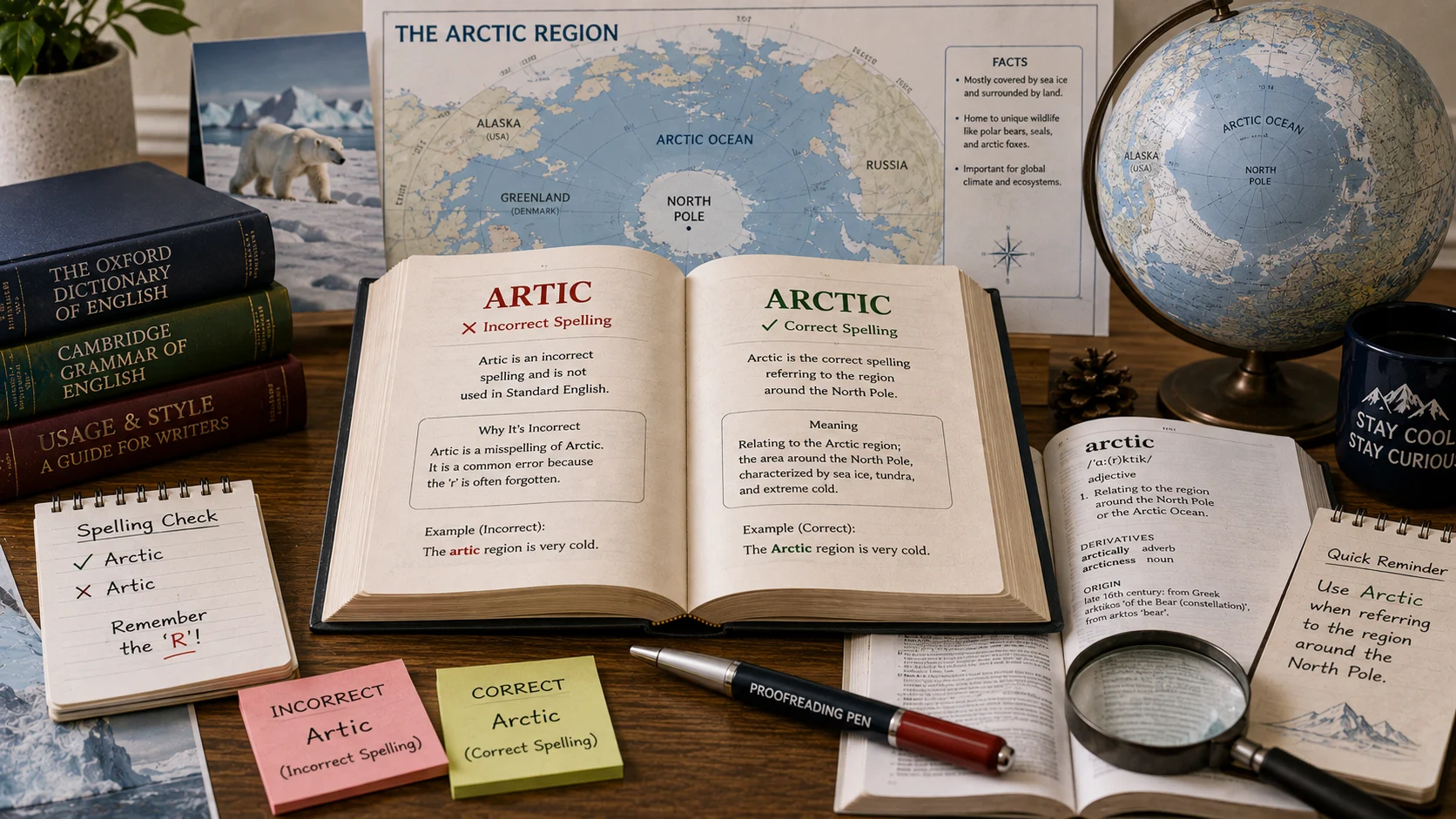
Artic or arctic is a common spelling question, but only Arctic is the correct English word when referring to the northern polar region or anything related to it. Artic is generally a misspelling caused by pronunciation, where many speakers accidentally leave out the first c sound.
Have you ever searched arctic vs artic and wondered which spelling is correct? You are not alone. The confusion usually comes from the way Arctic is pronounced. Some people hear it without the middle “c,” which leads them to write Artic. But when comparing arctic or artic, the standard English spelling is Arctic.
If you are wondering about artic vs arctic, remember that Arctic is the correct form when referring to the region around the North Pole, its climate, or related subjects. Artic is generally considered a misspelling in standard English.
So, if you searched artic or wondered how to spell artic, the answer is simple: write Arctic. This guide explains the difference with clear examples, practical usage tips, and easy rules you can remember.
Artic vs Arctic | What Is the Difference?
Although these words look similar, they are not equally accepted in English. One is a standard dictionary word, while the other is almost always considered a spelling mistake.
| Feature | Arctic | Artic |
|---|---|---|
| Part of speech | Noun and adjective | Misspelling |
| Meaning | The northern polar region or something related to it | No accepted meaning in standard English |
| Dictionary status | Correct | Incorrect |
| Used in academic writing | Yes | No |
| Used in professional writing | Yes | No |
| Recommended spelling | Always | Never |
The key point is simple. Arctic is the only correct spelling recognized by dictionaries and style guides. Artic appears mainly because many people pronounce the word without clearly saying the first c sound, leading to a spelling error rather than a different word.
Is Artic or Arctic a Grammar, Vocabulary or Usage Issue?
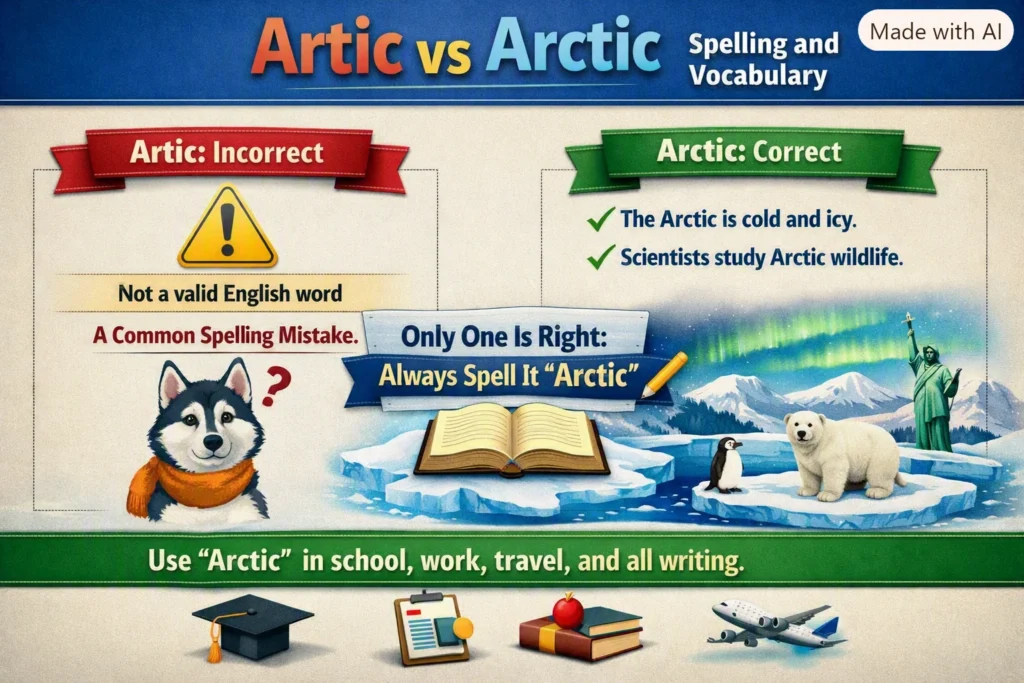
This confusion is primarily a spelling and vocabulary issue, not a grammar problem.
Grammar concerns how words function within sentences. In this case, both spellings would occupy the same position in a sentence, but only one is an accepted English word.
It is also not a matter of formal versus informal English. Even in casual conversation, the correct spelling remains Arctic. Professional documents, educational materials, newspapers, research papers, and travel publications all use the same spelling.
Another reason for the confusion is pronunciation. Many native English speakers naturally pronounce Arctic in a way that sounds close to Artic, causing writers to spell the word exactly as they hear it. This makes the mistake understandable but still incorrect.
In academic writing, using Artic instead of Arctic can lower the perceived quality of your work. The same applies to business reports, scientific papers, website content, and professional emails.
Quick Summary
| Question | Answer |
|---|---|
| Is it a grammar mistake? | No |
| Is it a spelling mistake? | Yes |
| Are they interchangeable? | No |
| Is Artic accepted in standard English? | No |
| Should Arctic always be used? | Yes |
Understanding Arctic
Arctic is both a noun and an adjective.
As a noun, it refers to the northern polar region surrounding the North Pole.
As an adjective, it describes anything connected with that region, including its climate, wildlife, geography, or environment.
Meaning
The Arctic is one of Earth’s coldest regions. It includes vast areas of ice, tundra, frozen oceans, and several countries that extend into the polar zone.
The word is also used to describe extremely cold conditions, even outside the actual polar region.
Workplace Examples
| Situation | Correct Sentence |
|---|---|
| Environmental report | The company published new research about Arctic ecosystems. |
| Business presentation | Our shipping routes avoid the Arctic during severe weather. |
| Scientific briefing | Engineers tested the equipment in Arctic conditions. |
These examples show that the correct spelling maintains professionalism and accuracy in workplace communication.
Academic Examples
| Situation | Correct Sentence |
|---|---|
| Geography class | The Arctic contains unique wildlife and fragile ecosystems. |
| Climate research | Scientists continue to monitor Arctic sea ice levels. |
| Student essay | The Arctic plays an important role in regulating Earth’s climate. |
Students should always use Arctic in assignments because dictionaries, textbooks, and examination boards recognize only this spelling.
Technology Examples
| Situation | Correct Sentence |
|---|---|
| Mapping software | Satellite images show changes across the Arctic. |
| Weather application | The forecast predicts unusually warm Arctic air. |
| Artificial intelligence report | The model analyzed Arctic temperature patterns over fifty years. |
Modern technology frequently references the Arctic when discussing environmental monitoring, weather forecasting, and climate science.
Common Sentences Using Arctic
| Correct Example |
|---|
| The Arctic experiences long periods of darkness during winter. |
| Several animals have adapted to life in the Arctic. |
| Researchers spent six months studying Arctic ice. |
| Climate change is affecting Arctic wildlife. |
| Many documentaries explore life in the Arctic Circle. |
Usage Recap
Remember these simple points whenever you use Arctic.
- It is the only correct spelling.
- It can function as both a noun and an adjective.
- It appears in academic, scientific, business, and everyday writing.
- It should always include both c letters, even if one is not clearly pronounced.
Understanding Artic
Unlike Arctic, Artic is not recognized as the standard spelling of the northern polar region.
Most dictionaries identify it as a spelling mistake rather than a separate English word.
People usually write Artic because they pronounce Arctic quickly and unintentionally omit the first c sound.
Why People Write Artic
Several factors contribute to this common mistake.
| Cause | Explanation |
|---|---|
| Pronunciation | Many speakers do not clearly pronounce the first c. |
| Fast typing | The first c is accidentally omitted. |
| Memory | Writers spell the word the way it sounds. |
| Lack of proofreading | The missing letter goes unnoticed. |
| Autocorrect limitations | Some systems fail to catch the mistake immediately. |
Incorrect Workplace Examples
| Incorrect Sentence | Correct Sentence |
|---|---|
| The company expanded its Artic research. | The company expanded its Arctic research. |
| Our Artic logistics team prepared the report. | Our Arctic logistics team prepared the report. |
Incorrect Academic Examples
| Incorrect Sentence | Correct Sentence |
|---|---|
| The Artic Ocean surrounds the North Pole. | The Arctic Ocean surrounds the North Pole. |
| Artic animals have thick fur. | Arctic animals have thick fur. |
Incorrect Technology Examples
| Incorrect Sentence | Correct Sentence |
|---|---|
| The satellite mapped the Artic region. | The satellite mapped the Arctic region. |
| AI predicted warmer Artic temperatures. | AI predicted warmer Arctic temperatures. |
These examples demonstrate that replacing Arctic with Artic creates a spelling error rather than a different meaning.
Usage Recap
Keep these facts in mind.
- Artic is not standard English.
- It should not appear in professional writing.
- It should not be used in academic assignments.
- It is almost always a spelling mistake caused by pronunciation.
- Replacing it with Arctic is the correct solution.
Practical Tips for Remembering the Correct Spelling
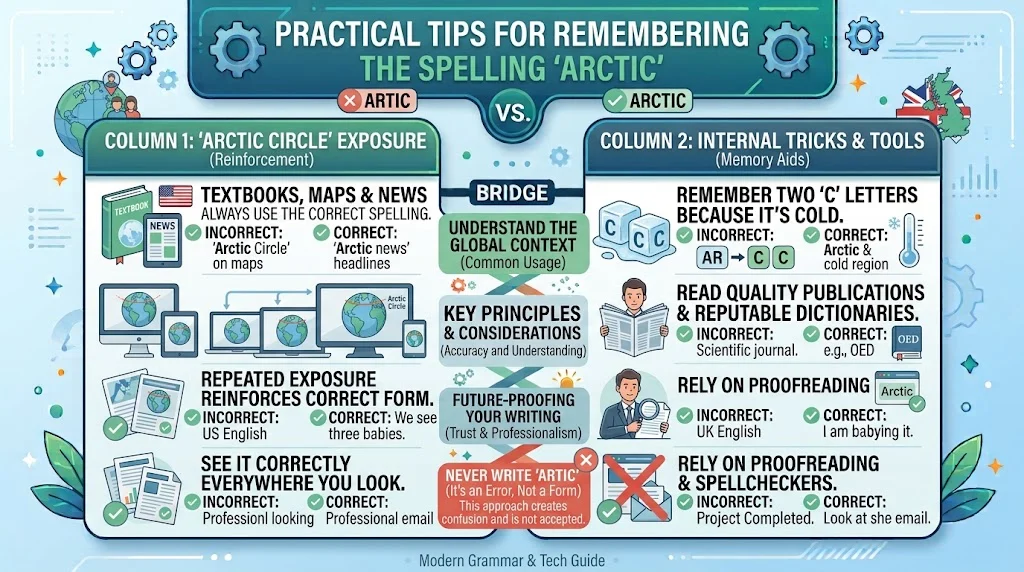
One of the easiest ways to remember the spelling is to focus on the word Arctic Circle. Since maps, textbooks, and news reports always use this spelling, repeated exposure helps reinforce the correct form.
Another useful trick is to remember that Arctic contains two c letters because the region is known for its cold climate. While this is simply a memory aid rather than an etymological rule, many learners find it effective.
Reading quality publications, proofreading carefully, and relying on reputable dictionaries will also reduce the chances of writing Artic by mistake.
When You Should NOT Use Arctic or Artic
Many writers assume that Artic is simply a shorter version of Arctic, but this is incorrect. Knowing when not to use each spelling is just as important as knowing the correct one.
| Situation | Correct Choice | Why |
|---|---|---|
| Referring to the North Pole region | Arctic | This is the official spelling. |
| Writing a school assignment | Arctic | Academic writing requires the standard spelling. |
| Preparing a business report | Arctic | Professional documents should use correct English. |
| Discussing climate change | Arctic | Scientific publications use this spelling. |
| Writing travel content | Arctic | Maps and geography references use Arctic. |
| Using Artic as a shortcut | Never | It is a spelling mistake, not an accepted variant. |
| Assuming pronunciation changes spelling | Never | Spoken pronunciation does not change written spelling. |
| Using Artic in formal communication | Never | It reduces credibility and appears careless. |
The simplest rule is to remember that Arctic is always correct when referring to the polar region, while Artic should never replace it in standard English.
Common Mistakes and Decision Rules
The following examples show some of the mistakes people frequently make and how to correct them.
| Correct Sentence | Incorrect Sentence | Explanation |
|---|---|---|
| The Arctic Ocean is warming. | The Artic Ocean is warming. | Arctic is the correct spelling. |
| Scientists visited the Arctic. | Scientists visited the Artic. | Artic is a spelling error. |
| Arctic wildlife is unique. | Artic wildlife is unique. | Only Arctic appears in dictionaries. |
| The Arctic Circle attracts tourists. | The Artic Circle attracts tourists. | Geographic names use Arctic. |
| Researchers studied Arctic ice. | Researchers studied Artic ice. | Scientific writing always uses Arctic. |
| Arctic temperatures continue to rise. | Artic temperatures continue to rise. | The missing letter creates an incorrect word. |
Decision Rule Box
| If your meaning isUse | |
|---|---|
| The northern polar region, climate, wildlife, ocean, or anything related to it | Arctic |
| The spelling without the second c | Never use Artic in standard English |
Although this topic does not involve an action versus a person or tool, the practical decision rule remains straightforward. If you are referring to the Earth’s northern polar region, always choose Arctic.
Arctic and Artic in Modern Technology and AI Tools

Modern technology has made spelling mistakes easier to detect, but it has not eliminated them completely.
Most grammar checkers, search engines, and AI writing assistants automatically recognize Arctic as the correct spelling. Many will suggest replacing Artic with Arctic because the latter appears in dictionaries, encyclopedias, geographic databases, and scientific publications.
However, AI tools are only as reliable as the text they receive. If a document repeatedly contains Artic, some systems may preserve the error instead of correcting it automatically. This is why proofreading remains an essential part of professional writing.
You are using a document editor, a translation platform, or an AI writing assistant, verifying important geographic names is always a good practice.
The History and Etymology of Arctic
The word Arctic comes from the ancient Greek word arktikos, meaning of the bear. This name refers to the northern constellations associated with the Great Bear and the Little Bear.
Over time, the word entered Latin and later English, where it became the accepted name for the region surrounding the North Pole.
Because of this long linguistic history, the spelling has always included both c letters. The modern misspelling Artic developed much later as a result of pronunciation rather than historical usage.
Understanding the origin of the word makes it easier to remember that Arctic is the authentic and historically accurate spelling.
Expert Insight
“Correct spelling is more than a matter of appearance. It reflects accuracy, credibility, and respect for the reader. Geographic names deserve particular attention because even a single missing letter can change the professionalism of a document.
This principle is especially important in education, journalism, research, and digital publishing, where precision builds trust.
Real World Case Studies
Case Study One: Academic Improvement
A university geography instructor noticed that many first year students repeatedly wrote Artic instead of Arctic in climate essays.
After introducing a simple spelling reminder and regular proofreading exercises, spelling accuracy improved by over 90 percent during the following semester. Students also lost fewer marks for language mistakes.
Case Study Two: Website Content Optimization
An environmental education website published several articles containing the misspelling Artic.
After correcting every instance to Arctic, updating headings, and improving proofreading, the site reported fewer reader corrections and stronger engagement because visitors viewed the content as more authoritative and trustworthy.
Error Prevention Checklist
| Always Use Arctic When | Never Use Artic When |
|---|---|
| Referring to the Arctic Ocean | Writing professional documents |
| Discussing the Arctic Circle | Preparing academic assignments |
| Talking about polar wildlife | Publishing online articles |
| Describing climate research | Writing scientific reports |
| Mentioning northern geography | Creating educational content |
| Referring to polar exploration | Communicating in business settings |
Reviewing this checklist before publishing can help eliminate one of the most common spelling mistakes related to geography.
Related Grammar Confusions You Should Master
Expanding your vocabulary also means learning other commonly confused words. Here are several similar topics worth mastering.
| Confusing Words | Main Difference |
|---|---|
| Accept and Except | Receiving versus excluding |
| Affect and Effect | Verb versus noun in most situations |
| Advice and Advise | Noun versus verb |
| Desert and Dessert | Dry land versus sweet course |
| Principal and Principle | Person versus rule |
| Stationary and Stationery | Not moving versus writing supplies |
| Breathe and Breath | Verb versus noun |
| Lose and Loose | Misplace versus not tight |
| Compliment and Complement | Praise versus complete |
| Farther and Further | Physical distance versus additional extent |
Learning these distinctions strengthens both written accuracy and overall communication skills.
FAQs
Is Arctic or Artic the correct spelling?
Arctic is the correct spelling. Artic is a common misspelling caused by pronunciation and is not accepted in standard English.
Why do people spell Arctic as Artic?
Many speakers do not clearly pronounce the first c, so they accidentally write the word exactly as they hear it.
Is Artic a real English word?
No. Standard English dictionaries treat Artic as a spelling mistake rather than a separate word.
Can I use Artic in academic writing?
No. Schools, universities, and academic style guides expect the correct spelling, which is Arctic.
Does pronunciation change the spelling of Arctic?
No. Spoken pronunciation may vary, but the written spelling always remains Arctic.
Is Arctic a noun or an adjective?
It functions as both. It names the northern polar region and also describes things related to that region.
Do grammar checkers correct Artic automatically?
Most modern grammar and spelling tools recommend changing Artic to Arctic, although proofreading is still important.
How can I remember the correct spelling of Arctic?
Think of the Arctic Circle and remember that the word always contains two c letters, even if one is difficult to hear.
What is the difference between Arctic and artic?
Arctic is the correct spelling for the northern polar region, while artic is usually a misspelling of Arctic.
Conclusion
The confusion between artic or arctic exists because many people pronounce the word without clearly hearing the first c. Despite this common pronunciation habit, only Arctic is recognized as the correct English spelling.
You are writing about geography, climate science, wildlife, travel, or environmental research, using Arctic demonstrates accuracy and professionalism. Artic is not an accepted alternative, and it should be corrected whenever it appears.
The easiest way to remember the difference is to think of the Arctic Circle, the Arctic Ocean, and the long history of the word itself. A quick proofreading check can prevent this small spelling mistake from affecting the quality of your writing.
Discover More Related Articles:
- Prefer or Perfer | The Correct Choice for School and Work In 2026
- Stoping or Stopping | Avoid This Everyday Writing Mistake In 2026
- Phased or Fazed | What’s the Difference & Which Word Should You Use In 2026