Master’s or masters can look almost identical, but they have different grammatical functions and meanings. Master’s normally refers to an academic qualification, while masters is the plural of master and can describe several experts, skilled people, or other individuals. Knowing the difference helps prevent errors in resumes, university applications, academic writing, and professional documents.
Master’s vs Masters | What’s the Difference?
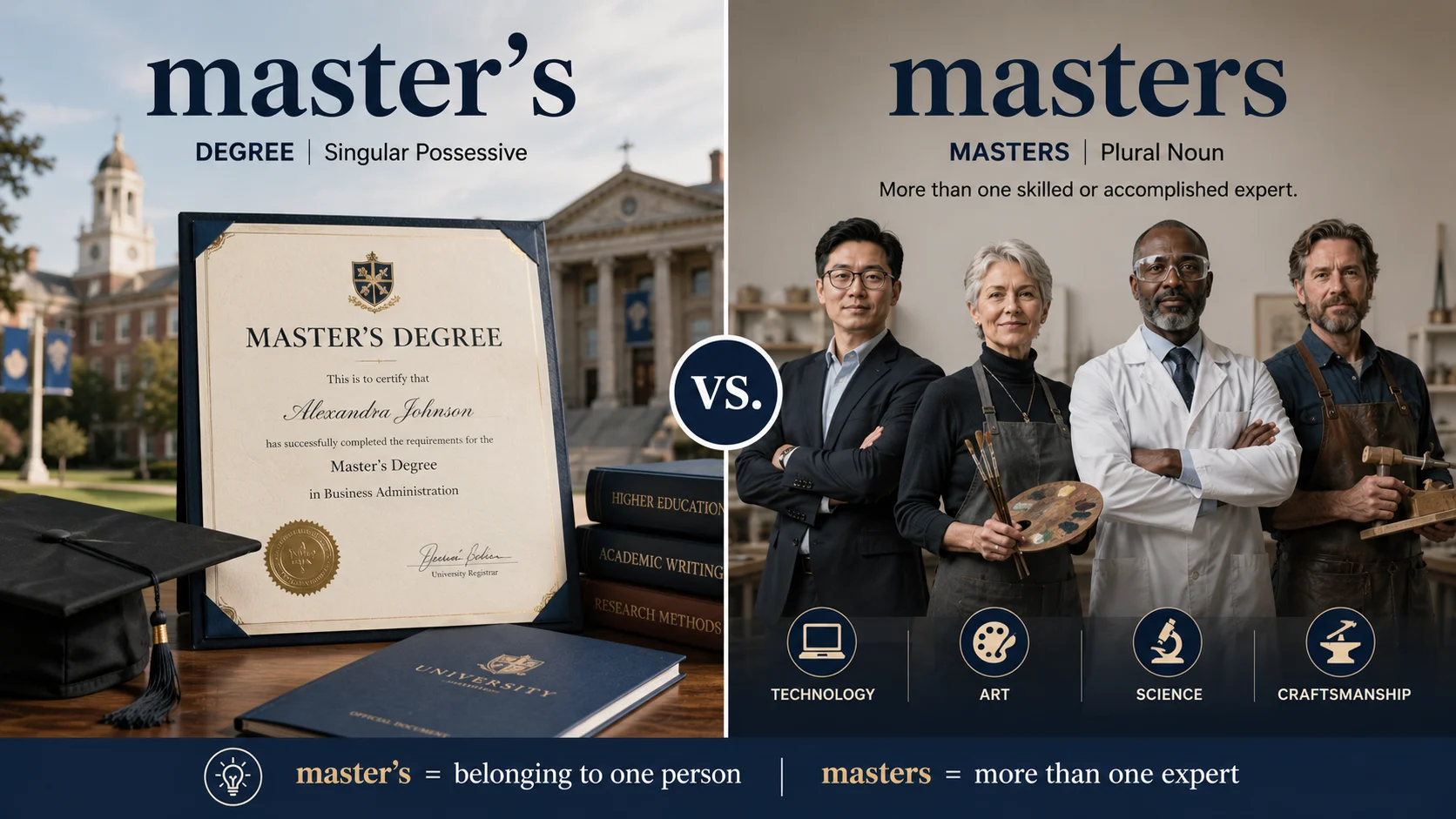
The main difference between master’s and masters is the apostrophe and what the word represents.
Master’s is a possessive singular form that is most commonly used in the established phrase master’s degree. It identifies an advanced academic qualification normally completed after undergraduate study. The word can also stand alone when the context makes the meaning clear, as in “She is studying for her master’s.”
Masters, without an apostrophe, is generally the plural of master. It refers to more than one master. Depending on context, a master can be an expert, skilled practitioner, authority figure, champion, or person with extensive knowledge.
The distinction becomes particularly important in formal writing. Writing masters degree instead of master’s degree is generally considered incorrect when referring to the academic qualification.
Master’s vs Masters Comparison
| Feature | Master’s | Masters |
|---|---|---|
| Grammatical form | Possessive singular | Plural noun |
| Main meaning | Usually an academic degree | More than one master |
| Common phrase | Master’s degree | Masters of a particular field |
| Apostrophe | Yes | No |
| Academic use | Very common | Not normally used for the degree |
| Professional use | Resumes, applications, biographies | Experts, skilled professionals |
| Example | She earned a master’s degree. | The masters shared their knowledge. |
| Meaning | One academic qualification | Several masters or experts |
Quick Recap
Use master’s when you mean an academic degree.
Use masters when you mean more than one master.
The apostrophe in master’s is important because it distinguishes the academic expression from the plural noun.
For formal academic writing, master’s degree is the standard form.
Is Master’s or Masters a Grammar, Vocabulary or Usage Issue?
The difference between master’s and masters involves grammar, punctuation, vocabulary, and usage, but grammar and usage are the most important factors.
The two forms are not normally interchangeable. The apostrophe in master’s indicates a possessive construction that has become established in the phrase master’s degree.
By contrast, masters is normally a plural noun. If a sentence refers to several experts, artists, teachers, craftsmen, or other people who can be called masters, the plural form is appropriate.
The distinction is especially important in formal English. A university application, resume, academic paper, professional biography, or official document should use master’s degree rather than masters degree.
Informal online writing sometimes removes apostrophes because people type quickly or follow casual spelling habits. However, informal usage does not make the spelling preferable in polished writing.
Grammar and Usage Comparison
| Question | Master’s | Masters |
|---|---|---|
| Is it singular? | Yes, in the possessive form | No, normally plural |
| Is it possessive? | Yes | No |
| Does it refer to a degree? | Yes, in master’s degree | No |
| Can it refer to people? | Occasionally in possessive constructions | Yes |
| Is it formal? | Yes | Yes, when correctly used |
| Is it interchangeable with the other form? | No | No |
| Does it require an apostrophe? | Yes | No |
How to Use Master’s Correctly
Use master’s when you are referring to a master’s degree.
The most common expression is master’s degree, such as:
“She earned a master’s degree in psychology.”
“He is pursuing a master’s degree in computer science.”
“Her master’s degree helped her qualify for the position.”
You can also use master’s without the word degree when the context is obvious:
“She completed her master’s last year.”
“I’m applying for a master’s in finance.”
In each case, the apostrophe remains part of the standard spelling.
Master’s Usage Examples
| Context | Correct Example | Why It Is Correct |
|---|---|---|
| Workplace | She has a master’s degree in marketing. | The sentence refers to an academic qualification. |
| Academic | He is pursuing a master’s in history. | Master’s is being used as a shortened form of master’s degree. |
| Technology | She earned a master’s degree in artificial intelligence. | The phrase identifies an advanced academic qualification. |
| Resume | Master’s degree in Computer Science | It identifies an educational credential. |
| University application | I plan to pursue a master’s degree in economics. | The phrase clearly identifies graduate study. |
| Professional biography | Sarah holds a master’s degree in education. | The qualification is being formally described. |
Master’s Usage Recap
Use master’s degree for the full academic expression.
Use master’s alone when the meaning is already clear.
Keep the apostrophe even when degree is omitted.
How to Use Masters Correctly
Use masters when you mean more than one master.
For example:
“The masters of the craft passed their skills to younger generations.”
“The students studied the techniques developed by the masters.”
“The competition brought together several masters of chess.”
In these examples, masters is plural. There is no apostrophe because the word simply refers to multiple people.
The word can describe experts, highly skilled individuals, authorities, or people recognized for exceptional ability.
Masters Usage Examples
| Context | Correct Example | Meaning |
|---|---|---|
| Workplace | The masters of negotiation led the workshop. | Several highly skilled experts |
| Academic | Students studied the works of the masters. | Several highly accomplished people |
| Technology | The masters of software engineering influenced the industry. | Multiple experts |
| Art | The museum displayed works by the masters. | Several celebrated artists |
| Chess | The tournament attracted several masters. | Multiple highly skilled chess players |
| Craft | The masters taught traditional techniques. | Several expert practitioners |
Masters Usage Recap
Use masters when you mean multiple masters.
It can describe several experts or highly accomplished people.
Do not use masters as a replacement for master’s degree.
Master’s Degree or Masters Degree?
One of the most common searches related to this topic is to write master’s degree or masters degree.
The standard form is master’s degree.
The apostrophe is required in careful, formal English because master’s is the established possessive form used in the academic expression.
| Form | Correct? | Explanation |
|---|---|---|
| Master’s degree | Yes | Standard academic expression |
| masters degree | No | Missing the apostrophe |
| Master’s degrees | Yes | Correct plural form |
| masters degrees | No | Missing the apostrophe |
| Master’s | Yes | Acceptable shortened form |
| Masters | Usually no | Not the standard shortened form for the degree |
Example
Correct:
“She earned a master’s degree in engineering.”
Incorrect:
“She earned a masters degree in engineering.”
The difference is only one punctuation mark, but that punctuation mark changes the grammatical form.
Master’s or Masters in Resumes and Applications
Academic qualifications frequently appear on resumes, CVs, university applications, LinkedIn profiles, professional biographies, and employment forms.
Because these documents represent your education and professional background, grammatical accuracy matters.
| Document Type | Recommended Form | Example |
|---|---|---|
| Resume | Master’s degree | Master’s degree in Finance |
| CV | Master’s degree | Master’s degree in English |
| University application | Master’s degree | I am applying for a master’s degree program. |
| Professional bio | Master’s degree | She holds a master’s degree in Psychology. |
| Cover letter | Master’s degree | My master’s degree prepared me for this role. |
| Academic profile | Master’s degree | He completed his master’s degree in 2025. |
A polished resume should therefore use master’s degree, not masters degree.
When You Should NOT Use Master’s or Masters
Understanding when not to use these forms can prevent many common mistakes.
| Misuse Scenario | Incorrect Choice | Better Choice | Reason |
|---|---|---|---|
| Referring to one graduate degree | Masters degree | Master’s degree | The academic expression requires the apostrophe. |
| Referring to several experts | Master’s | Masters | The plural noun has no apostrophe. |
| Referring to multiple degrees | Masters degrees | Master’s degrees | The noun degree becomes plural while master’s remains possessive. |
| Writing a resume qualification | Masters degree | Master’s degree | Formal academic writing requires the standard form. |
| Referring to several skilled people | Master’s | Masters | The meaning is plural. |
| Using the shortened degree form | Masters | Master’s | Master’s is the conventional shortened academic form. |
| Writing an academic application | Masters degree | Master’s degree | The standard spelling is more appropriate for formal documents. |
| Describing several masters | Master’s | Masters | A plural noun does not normally need an apostrophe. |
Common Mistakes and Decision Rules
Many mistakes occur because writers remember the word but forget the grammatical role it plays.
| Correct Sentence | Incorrect Sentence | Explanation |
|---|---|---|
| She earned a master’s degree in biology. | She earned a masters degree in biology. | The academic expression requires master’s. |
| He is pursuing a master’s in economics. | He is pursuing a masters in economics. | Master’s is the shortened form of master’s degree. |
| The masters shared their knowledge. | The master’s shared their knowledge. | Masters refers to several people. |
| She has two master’s degrees. | She has two masters degree. | Degree is plural, but master’s retains its standard form. |
| The masters of painting inspired the students. | The master’s of painting inspired the students. | The sentence refers to multiple masters. |
| He completed his master’s last year. | He completed his masters last year. | Master’s is the accepted shortened academic form. |
| Her master’s degree opened new career opportunities. | Her masters degree opened new career opportunities. | The apostrophe is required. |
Decision Rule
| What You Mean | Correct Form |
|---|---|
| One academic qualification | Master’s degree |
| A shortened reference to the degree | Master’s |
| Several academic qualifications | Master’s degrees |
| One master or expert | Master |
| Several masters or experts | Masters |
Simple rule: If you mean the academic qualification, use master’s. If you mean several masters or experts, use masters.
Master’s and Masters in Modern Technology and AI Tools
The distinction also matters in modern technology because professional profiles, AI generated resumes, educational platforms, and career websites frequently process academic information.
An AI writing tool might produce:
“She holds a master’s degree in data science.”
That is the appropriate form for an academic qualification.
Technology can also use masters correctly when discussing experts:
“The masters of cybersecurity developed advanced security methods.”
The important point is that artificial intelligence does not eliminate grammatical distinctions. AI tools can suggest language, but writers should still review punctuation and meaning before publishing professional or academic material.
Technology Usage Table
| Digital Context | Recommended Form | Example |
|---|---|---|
| AI resume | Master’s degree | Master’s degree in Data Science |
| LinkedIn profile | Master’s degree | Holds a master’s degree in Computer Science |
| University website | Master’s degree | Apply for a master’s degree program |
| AI article about experts | Masters | Masters of programming shared their techniques |
| Online course profile | Master’s degree | Pursuing a master’s degree in AI |
| Professional portfolio | Master’s degree | Master’s degree in Information Technology |
Master’s Degree Plural: Master’s Degrees
A frequent source of confusion is what happens when someone has more than one master’s degree.
The correct form is master’s degrees.
Notice that the apostrophe stays in master’s, while degree becomes plural.
| Meaning | Correct Form | Example |
|---|---|---|
| One degree | Master’s degree | She earned a master’s degree. |
| Two or more degrees | Master’s degrees | She earned two master’s degrees. |
| Several masters | Masters | The masters gathered together. |
This distinction is useful because writers sometimes assume that the plural of master’s degree should be masters degrees. That removes the apostrophe incorrectly.
Etymology of Master’s and Masters
The word master has a long history in English and is related to older words associated with authority, expertise, leadership, and skill.
The academic expression master’s degree developed from the possessive construction associated with the status or level of a master. Over time, the phrase became a standard term for an advanced university qualification.
The plural masters follows the ordinary English plural pattern in which an s is added to the singular noun.
Understanding this history is helpful because it explains why the two forms look so similar but function differently.
Expert Style Principle
“Punctuation is not merely decoration; it helps readers understand grammatical relationships.”
That principle is especially useful here. The apostrophe in master’s helps distinguish the academic expression from the plural noun masters.
Two Practical Case Studies
Case Study 1: University Application
Consider this sentence:
“I recently completed a masters degree in public health.”
The intended meaning is obvious, but the spelling is not standard for formal academic writing.
The corrected version is:
“I recently completed a master’s degree in public health.”
The change is small, but it improves grammatical accuracy and professional presentation.
Case Study 2: Professional Profile
Now consider:
“The masters of software development contributed to the project.”
Here, masters is correct because the sentence describes several highly skilled people.
If the writer instead wants to describe one person’s academic qualification, the sentence would be:
“She holds a master’s degree in software engineering.”
Case Study Comparison
| Case | Intended Meaning | Correct Form | Result |
|---|---|---|---|
| University application | One graduate qualification | Master’s degree | Grammatically appropriate |
| Professional profile | Several experts | Masters | Grammatically appropriate |
| Resume | One academic qualification | Master’s degree | Formal and clear |
| Article about experts | Multiple skilled people | Masters | Correct plural noun |
Error Prevention Checklist
Always use Master’s when
| Situation | Correct Form |
|---|---|
| Referring to one graduate qualification | Master’s degree |
| Using the shortened academic form | Master’s |
| Writing a resume qualification | Master’s degree |
| Writing a university application | Master’s degree |
| Describing postgraduate education | Master’s degree |
Always use Masters when
| Situation | Correct Form |
|---|---|
| Referring to several masters | Masters |
| Referring to several experts | Masters |
| Describing multiple highly skilled people | Masters |
| Using the plural noun master | Masters |
Master’s or Masters: Related Keywords and Semantic Terms
These related terms help cover the broader search intent surrounding this grammar question.
| Semantic Keyword | Search Intent |
|---|---|
| master’s degree | Main academic term |
| masters degree spelling | Spelling clarification |
| master’s or masters degree | Comparison query |
| master degree or master’s degree | Grammar clarification |
| master’s degree meaning | Definition query |
| masters plural | Plural usage |
| master’s degree grammar | Grammar intent |
| master’s degree apostrophe | Punctuation intent |
| plural of master | Vocabulary clarification |
| graduate degree | Related educational term |
| postgraduate degree | Related academic term |
| master’s degree abbreviation | Academic usage |
These semantic terms naturally support the primary topic without forcing repetitive keyword usage.
Related Grammar Confusions You Should Master
Several other English distinctions work in a similar way because punctuation, spelling, number, or grammatical function affects meaning.
| Grammar Confusion | Main Difference |
|---|---|
| Bachelor’s or bachelors | Academic degree versus plural noun |
| Teacher’s or teachers | Possessive versus plural |
| Student’s or students | Possessive versus plural |
| Its or it’s | Possessive versus contraction |
| Whose or who’s | Possessive versus contraction |
| Affect or effect | Verb and noun usage |
| Advice or advise | Noun versus verb |
| Practice or practise | Noun and verb distinction in some varieties |
| License or licence | Regional spelling and grammatical usage |
| Principal or principle | Person or rule versus concept |
Learning these distinctions can significantly improve accuracy in academic and professional English.
FAQs
Is it master’s degree or masters degree?
The standard form is master’s degree. The apostrophe should be retained when referring to the academic qualification.
What is the plural of master’s degree?
The standard plural is master’s degrees. The word degrees becomes plural while master’s keeps its apostrophe.
Can I say I have a master’s?
Yes. Master’s can stand alone when the context clearly indicates that you mean a master’s degree.
Is masters ever correct?
Yes. Masters is correct when it refers to multiple masters, experts, or highly skilled people.
Why does master’s have an apostrophe?
The apostrophe reflects the possessive form used in the established expression master’s degree.
Should master’s degree be capitalized?
Usually, master’s degree is written in lowercase unless it appears in a title or a specific style requires capitalization.
Should I write master’s degree on my resume?
Yes. Master’s degree is the standard and professional form for describing the qualification.
What is the difference between master’s and masters?
Master’s normally refers to an academic degree, while masters normally refers to multiple masters or experts.
Is master’s degree a postgraduate degree?
In many education systems, yes. A master’s degree is generally considered a postgraduate or graduate qualification completed after an undergraduate degree.
Conclusion
The difference between master’s or masters becomes straightforward once you focus on meaning. Use master’s when you mean a master’s degree or the shortened academic form master’s. Use masters when you mean multiple masters, experts, or highly skilled people.
For academic documents, resumes, university applications, and professional profiles, remember the standard expression master’s degree. If you are talking about several masters, remove the apostrophe and use masters.
The easiest memory trick is simple: master’s connects with education, while masters connects with plurality. Once you understand that distinction, this common punctuation problem becomes much easier to avoid.
Discover More Related Articles:
- Neighbor or Neighbour | Which Version Is Right for Your Audience In 2026
- Plandid or Candid | Meaning, Differences, Usage & Examples In 2026
- Cowlick or Balding | How to Tell the Difference & When to Worry In 2026