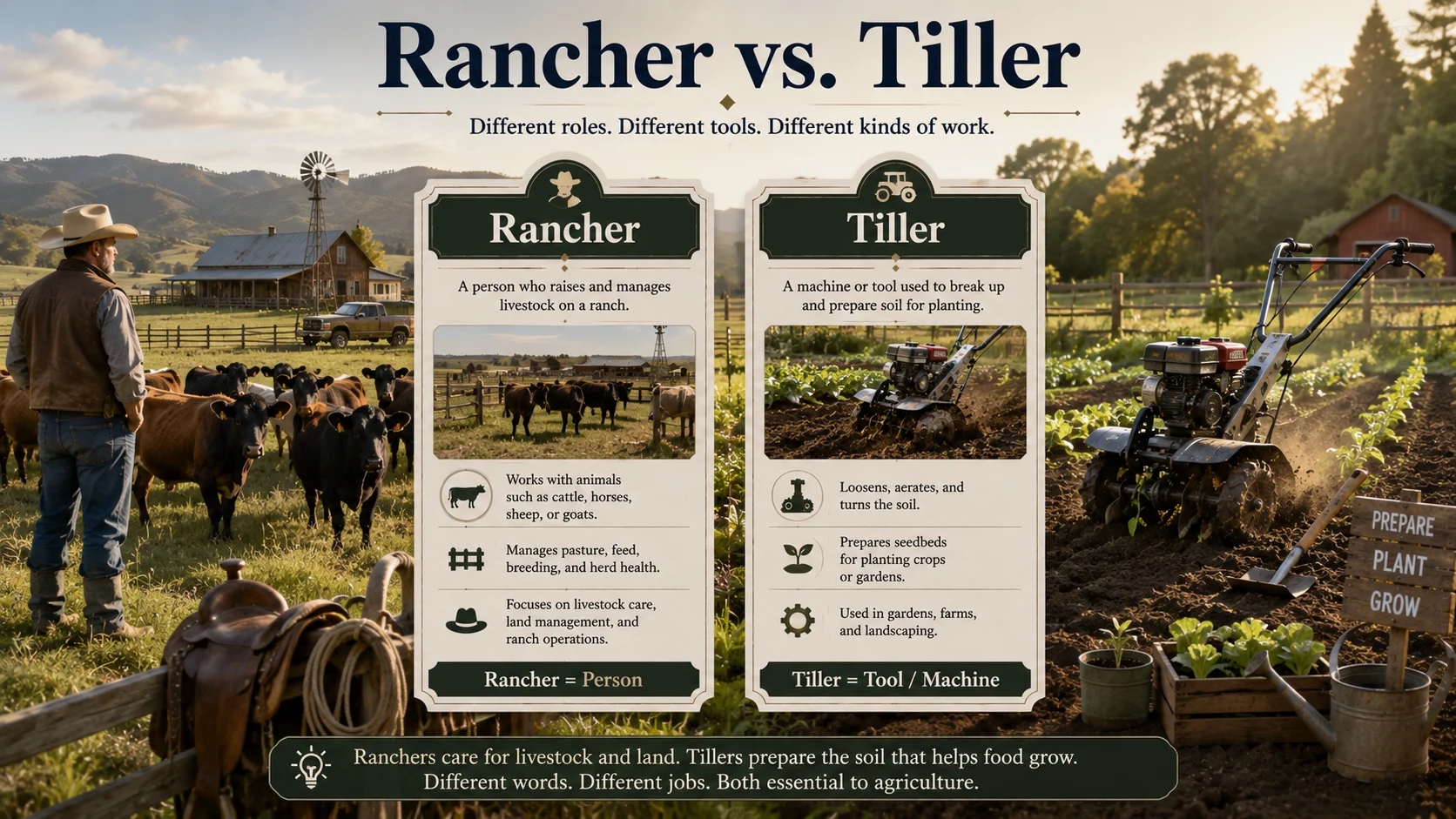
The terms rancher or tiller refer to completely different concepts. A rancher is a person who manages a ranch, usually raising livestock and overseeing land used for animal production. A tiller can be a person who cultivates soil or a machine used to prepare soil for planting. Confusing these words can lead to inaccurate descriptions of people, agricultural work and farm equipment.
Have you ever wondered a rancher or tiller is the right word when talking about farming, land, or agricultural work? Although both terms are connected to working with land, they describe different roles and activities. A rancher typically raises livestock, such as cattle, sheep, or horses, on a ranch, while a tiller is someone who cultivates or prepares soil for planting crops. Confusing these words can lead to misunderstandings, especially in educational writing, agricultural discussions, and everyday communication. Understanding their meanings makes it easier to describe farming activities accurately.
In this guide, you will explore the difference between rancher and tiller, including their definitions, practical examples, and common usage contexts. You will also learn how each word fits into agricultural vocabulary and when to use it appropriately. you are writing an assignment, improving your English vocabulary, or discussing farming practices, this clear comparison will help you choose the right term with confidence.
Rancher vs Tiller | What’s the Difference?
The simplest way to understand the distinction is to identify what each word normally refers to.
Rancher is a noun. It refers to a person who owns, operates, manages, or works on a ranch, particularly someone involved in raising livestock.
Tiller is also a noun, but it has more than one meaning. In agricultural contexts, it can describe a person who tills land. More commonly in modern gardening and farming discussions, it refers to a machine or implement used to cultivate, loosen, mix, or prepare soil.
| Term | Part of Speech | Primary Meaning | Common Context | Example |
|---|---|---|---|---|
| Rancher | Noun | A person who manages or works on a ranch | Livestock, ranching, land management | The rancher inspected the cattle. |
| Tiller | Noun | A person who tills soil or a machine used for soil cultivation | Gardening, farming, soil preparation | She used a tiller to prepare the garden. |
Mini Recap
A rancher is a person connected with ranch operations and livestock management.
A tiller may be a person who cultivates soil or a machine used to cultivate it.
The words are not interchangeable.
The correct choice depends on you are discussing ranch management, soil cultivation, or agricultural equipment.
Is Rancher vs Tiller a Grammar, Vocabulary, or Usage Issue?
This is primarily a vocabulary and usage issue, rather than a grammar problem.
Both words can function as nouns, so the grammatical structure of a sentence may be perfectly correct while the vocabulary is wrong. For example, saying, “The tiller checked the cattle,” is grammatically possible if tiller refers to a person who happens to be checking cattle. However, if you intend to identify someone whose occupation is managing a ranch, rancher is the much more precise term.
Likewise, “The rancher prepared the garden soil with a machine” is grammatically sound. But calling the machine itself a rancher would be incorrect.
The terms also differ in their typical level of specificity. Rancher is strongly associated with an occupation or role. Tiller is more closely connected with soil cultivation and agricultural machinery.
In academic writing, precision becomes especially important. A paper about livestock production should distinguish ranchers from farm workers, agricultural managers, and equipment operators. A paper about soil preparation should distinguish tillers from plows, cultivators, harrows, and other farm equipment.
In casual conversation, people sometimes use broad agricultural vocabulary loosely. Even then, choosing the accurate term makes communication clearer.
Rancher| Meaning and Practical Usage
A rancher is a person who manages or works on a ranch. Ranchers are often associated with livestock production, especially cattle, although ranching can involve horses, sheep, goats, and other animals.
Ranching may involve much more than caring for animals. A rancher can manage grazing areas, fences, water resources, animal health, breeding programs, feed, equipment, workers, transportation, and business operations.
Workplace Example
Consider this sentence:
“The rancher reviewed the grazing schedule before moving the cattle.”
Here, rancher identifies the person responsible for an aspect of ranch management. The word communicates an occupational role rather than a specific piece of machinery.
Another example is:
“The rancher hired additional workers during the calving season.”
The term naturally fits because the subject is a person responsible for ranch operations.
Academic Example
In an academic discussion of agriculture, you might write:
“Ranchers play an important role in livestock production and grassland management.”
This usage is appropriate because the sentence discusses people involved in a particular agricultural system.
Technology Example
Modern ranchers may use satellite mapping, livestock tracking systems, digital fencing tools, weather monitoring platforms, drones, automated water systems, and other technologies.
For example:
“The rancher used a livestock tracking system to monitor the location of the herd.”
The technology supports the rancher, but it does not change the meaning of the word rancher.
Usage Recap
Use rancher when you mean a person who manages or works on a ranch.
The word commonly relates to livestock, grazing land, and ranch operations.
It describes a human role, not a soil cultivation machine.
Tiller | Meaning and Practical Usage
The word tiller has a broader range of meanings, but agricultural English commonly uses it in connection with soil cultivation.
A tiller can refer to a person who tills the soil. However, when gardeners and farmers talk about buying, renting, operating, or repairing a tiller, they usually mean a machine designed to cultivate soil.
A garden tiller can loosen compacted earth, break up soil, incorporate organic material, and prepare a planting area. Different tillers vary in size, power, design, and intended use.
Workplace Example
“The groundskeeper used a tiller to prepare the planting beds.”
Here, tiller refers to equipment rather than a person.
Another example is:
“The farm worker cleaned the tiller after finishing the soil preparation.”
Again, the surrounding context clearly indicates agricultural machinery.
Academic Example
An agricultural science paper might state:
“Soil tillers can alter the physical structure of the upper soil layer.”
This is an appropriate technical use because the discussion concerns soil cultivation equipment.
Technology Example
Modern tillers can include electric models, battery powered models, and fuel powered machines. Some designs provide adjustable cultivation depths, interchangeable attachments, and improved controls.
For example:
“The gardener selected a compact electric tiller for a small planting area.”
The word tiller identifies the machine while the surrounding language explains its technological characteristics.
Usage Recap
Use tiller when referring to soil cultivation or equipment designed to cultivate soil.
In modern gardening discussions, tiller usually means a machine.
The exact meaning can be determined from context.
When You Should NOT Use Rancher or Tiller
Choosing the wrong word can make an otherwise clear sentence confusing. Here are several situations where careful word selection matters.
1. Do not call a livestock manager a tiller
If the person primarily manages cattle and ranch land, rancher is normally the appropriate term.
2. Do not call a soil cultivation machine a rancher
A machine that breaks up or prepares soil is a tiller, not a rancher.
3. Do not use rancher for every agricultural worker
A farmer, rancher, farm manager, gardener, and agricultural laborer can have different responsibilities.
4. Do not assume every person who uses a tiller is a tiller
Someone can operate a tiller without having tiller as an occupational title.
5. Do not use tiller when discussing livestock ownership
If your sentence concerns cattle, grazing management, or ranch operations, tiller may communicate the wrong idea.
6. Do not use rancher when discussing soil preparation
If the subject is cultivating, loosening, or preparing soil, tiller is usually more relevant.
7. Do not assume the words are interchangeable
They belong to related agricultural vocabulary but represent different concepts.
8. Do not rely only on the general idea of farming
Ranching and crop cultivation can overlap, but their terminology is not identical.
Common Mistakes and Decision Rules
The most frequent errors happen when writers focus on the broad agricultural setting rather than the exact meaning of the word.
| Correct sentence | Incorrect sentence | Explanation |
|---|---|---|
| The rancher checked the cattle before sunset. | The tiller checked the cattle before sunset. | Rancher identifies a person involved in ranch operations. |
| The gardener used a tiller to loosen the soil. | The gardener used a rancher to loosen the soil. | Tiller can refer to soil cultivation equipment. |
| The rancher managed the grazing land. | The tiller managed the grazing land. | Rancher is appropriate for ranch management. |
| The farmer repaired the tiller. | The farmer repaired the rancher. | A tiller can be agricultural machinery. |
| The rancher invested in better livestock tracking technology. | The tiller invested in better livestock tracking technology. | The sentence concerns a person responsible for ranch operations. |
Decision Rule
If you mean the person who manages or works on a ranch, use rancher.
If you mean soil cultivation or a machine used to cultivate soil, use tiller.
This rule is more accurate than treating the two terms as interchangeable. The distinction is based on meaning, not merely grammar.
Rancher and Tiller in Modern Technology and AI Tools
Agricultural technology has expanded the contexts in which these words appear.
A rancher may use artificial intelligence to analyze animal movement, identify unusual livestock behavior, monitor pasture conditions, predict weather patterns, and improve resource management. Digital tools can provide information that helps ranchers make decisions about grazing, water, animal health, and operational planning.
Tillers are also becoming part of discussions about agricultural automation. Modern soil cultivation equipment can include electronic controls, battery systems, sensors, and specialized attachments. Larger agricultural machinery can combine soil preparation with precision agriculture technologies.
AI systems can help distinguish these concepts when processing agricultural documents. For example, a language model analyzing a sentence about cattle management should recognize rancher as a person or occupational role. In a sentence concerning soil preparation equipment, it should recognize tiller as an implement or tool.
This distinction illustrates an important principle in language technology: context determines meaning.
Etymology of Rancher and Tiller
The history of these words helps explain their modern meanings.
Rancher comes from the word ranch, which entered English through Spanish. The Spanish word rancho referred to a small farm, settlement, or group of people working together. Over time, ranch developed a strong association with large agricultural properties, particularly those devoted to livestock.
The suffix “er” commonly forms nouns describing people associated with an activity or occupation. Thus, rancher developed as a word for someone involved in operating or managing a ranch.
Tiller comes from the verb till, meaning to work or cultivate land. The word has deep Germanic roots and has long been connected with agricultural labor. The ending “er” can also indicate someone or something performing an action, which helps explain why tiller can refer both to a person who tills and, in modern usage, a machine that performs cultivation.
An expert style summary would be:
“The clearest distinction is functional: rancher identifies a person associated with ranch management, while tiller identifies soil cultivation or equipment used for it.”
Case Study One | Ranch Management
Imagine an agricultural publication describing a cattle operation.
The article states that the owner manages livestock, supervises grazing areas, maintains fences, monitors animal health, and coordinates seasonal workers. Calling this individual a rancher gives readers an immediate understanding of the person’s role.
If the article instead called this person a tiller, readers could reasonably expect a discussion about soil cultivation. The terminology would therefore reduce clarity even if the surrounding facts were accurate.
The concrete result is improved precision. A single accurate occupational term can tell readers that the discussion concerns ranch management rather than garden or crop preparation.
Case Study Two | Soil Preparation
Now consider a gardening guide explaining how to prepare compacted soil before planting.
The guide recommends using a small machine to loosen the upper layer of soil and prepare a planting bed. Calling the machine a tiller immediately identifies its function.
Calling it a rancher would create an obvious semantic error because rancher identifies a person associated with ranching.
The concrete result is better equipment identification. Readers looking for gardening equipment can understand the recommendation without needing additional explanation.
Authoritative Usage Perspective
Precision in agricultural vocabulary is especially valuable because agriculture contains many specialized terms that overlap in everyday conversation. A professional writer should identify the actual role, action, or tool before selecting a term.
This principle also applies beyond these two words. Farming vocabulary often includes terms that appear similar because they belong to the same general subject area. Accuracy requires attention to function and context.
Error Prevention Checklist
Always use the following checks before publishing agricultural content.
- Use rancher when referring to a person who manages or works on a ranch.
- Use tiller when discussing soil cultivation or a soil cultivation machine.
- Check the surrounding sentence for contextual clues.
- Do not treat rancher and tiller as interchangeable synonyms.
- Identify the word refers to a person, activity, or tool.
- Review technical agricultural terminology before publishing academic content.
Related Grammar Confusions You Should Master
Understanding this distinction can lead naturally to several other vocabulary and usage topics.
- Farmer vs rancher
- Cultivator vs tiller
- Plow vs tiller
- Gardener vs farmer
- Agriculture vs horticulture
- Farming vs ranching
- Livestock vs crops
- Tractor vs cultivator
- Agricultural worker vs farm manager
- Soil cultivation vs soil preparation
These comparisons are useful because agricultural vocabulary often depends on the specific task, profession, or equipment being discussed.
FAQs
What is the difference between a rancher and a tiller?
A rancher is a person who manages or works on a ranch, while a tiller usually refers to soil cultivation or a machine used to cultivate soil.
Is a rancher a farmer?
A rancher can be considered an agricultural producer, but ranching traditionally focuses more on livestock and grazing land than conventional crop farming.
What does tiller mean in farming?
In farming and gardening, tiller commonly refers to a machine or implement used to loosen, break up, mix, or prepare soil.
Can tiller refer to a person?
Yes. Tiller can refer to someone who tills soil, although modern everyday agricultural usage often uses the word for a soil cultivation machine.
Is rancher a noun or a verb?
Rancher is a noun. It identifies a person involved in managing or working on a ranch.
Is tiller a noun or a verb?
Tiller is a noun. It can identify a person who tills or a machine used for tilling.
Are rancher and tiller synonyms?
No. They have different meanings and normally describe different people, activities, or things.
Which word should I use for someone who manages cattle?
Rancher is generally the appropriate term when the person manages cattle as part of ranch operations.
Which word should I use for a machine that prepares garden soil?
Tiller is the appropriate term for a machine designed to cultivate or prepare soil.
Conclusion
The distinction between these agricultural terms becomes simple once you focus on meaning rather than spelling or grammatical structure. A rancher is a person associated with managing or working on a ranch, especially in livestock production. A tiller is connected with cultivating soil and commonly refers to a machine used for that purpose.
The two words are therefore not interchangeable. If the sentence is about cattle, grazing land, livestock management, or ranch operations, rancher is usually the stronger choice. If the sentence concerns loosening, cultivating, or preparing soil, tiller is generally the correct term.
Understanding rancher or tiller is ultimately a matter of precise vocabulary. When you identify you are describing a person, a farming activity, or a piece of equipment, the correct word becomes much easier to select.
Discover More Related Articles:
- Presentor or Presenter | Which Spelling Is Correct & When Should You Use It In 2026
- Skied or Skiied | Which Past Tense Is Correct In 2026
- Sesamoiditis or Gout | How to Tell the Difference and Why Diagnosis Matters In 2026