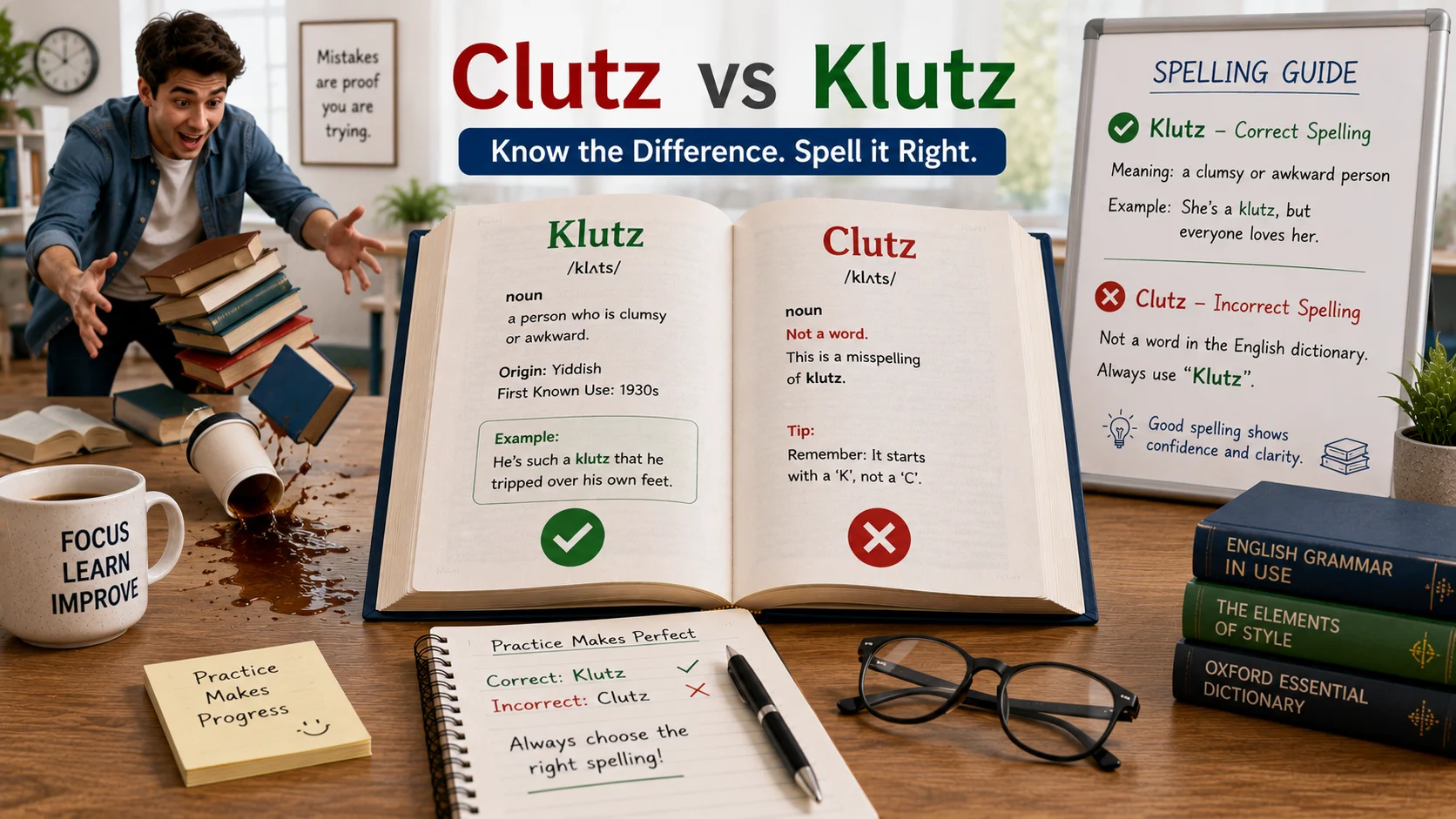
Clutz or klutz refers to a common spelling question about a word used for someone who is awkward or frequently drops, bumps into, or breaks things. Klutz is the correct English spelling recognized by major dictionaries, while clutz is an incorrect variant that occasionally appears because of pronunciation.
The question clutz or klutz confuses many English learners and even native speakers because both spellings sound exactly the same when spoken aloud. Klutz is a noun that describes a clumsy or awkward person, whereas clutz is considered a misspelling in standard English.
Since pronunciation offers no clue, people often replace the unusual beginning letter K with the more familiar C. Understanding the correct spelling helps you write accurately in school assignments, workplace communication, and everyday conversations.
Clutz or Klutz | What’s the Difference?
Although these words look similar, only one belongs in standard English.
Klutz is the accepted spelling found in major English dictionaries. It is an informal noun used to describe someone who is naturally clumsy or awkward.
Clutz is not recognized as a standard English word. It appears occasionally because many people assume the word should begin with the letter C, but professional writing and dictionaries use klutz instead.
| Feature | Klutz | Clutz |
|---|---|---|
| Part of speech | Noun | Incorrect spelling |
| Standard English | Yes | No |
| Dictionary recognition | Yes | No |
| Meaning | A clumsy or awkward person | Intended misspelling of klutz |
| Appropriate in formal writing | Acceptable in informal contexts | Should be avoided |
| Pronunciation | Kluhts | Same pronunciation |
Mini Recap
The difference is surprisingly simple once you know the rule. Klutz is the only correct spelling in modern English. Clutz is simply a spelling mistake that became common because it matches how the word sounds. Whenever you describe someone as clumsy, choose klutz with confidence.
Clutz or Klutz | Is It a Grammar, Vocabulary or Usage Issue?
This confusion is primarily a vocabulary and spelling issue, not a grammar problem.
Grammar deals with sentence structure and word relationships. In this case, the challenge lies in choosing the correct spelling of a single word.
Are They Interchangeable?
No.
Although readers usually understand what someone means when they write clutz, it is still considered incorrect. Replacing klutz with clutz creates a spelling error rather than an acceptable variation.
Formal Versus Informal Usage
The word klutz itself is informal because it describes a person’s clumsiness in a casual way. It is perfectly acceptable in conversations, blogs, magazines, novels, and light workplace communication.
In highly formal legal, academic, or scientific writing, it is usually better to describe the behavior more precisely using words such as clumsy, awkward, or physically uncoordinated.
Academic Versus Casual Writing
Students may use klutz in creative writing, narratives, or personal essays where an informal tone fits naturally.
In research papers or professional reports, writers generally prefer more neutral descriptions instead of humorous labels.
Why the Confusion Happens
English contains many words beginning with the letter C that produce a similar sound. Because of this pattern, writers often assume clutz must be correct. However, klutz is borrowed from another language and has retained its original spelling.
Practical Usage of Klutz
Since klutz is the accepted spelling, learning how to use it naturally can improve both spoken and written English.
Workplace Example
Everyone laughed when Daniel spilled coffee during the meeting, but he smiled and admitted he had always been a klutz.
In professional settings, the word works best when used humorously rather than as criticism.
Academic Example
The main character describes herself as a klutz, making her personality feel relatable and realistic throughout the novel.
Creative writing often uses the word to add humor and character development.
Technology Example
After dropping his new smartphone for the third time, Amir joked that being a klutz was becoming an expensive habit.
Technology related conversations frequently use klutz when discussing accidental damage to devices.
Everyday Conversation Examples
My brother is such a klutz that he trips over perfectly flat sidewalks.
She laughed and called herself a klutz after knocking over a glass of water.
Even careful people can feel like a klutz after a particularly awkward moment.
Usage Recap
Remember that klutz is always the correct spelling. It is an informal noun best suited for friendly conversation, storytelling, blogs, and lighthearted writing. Use it to describe a naturally clumsy person rather than a single isolated mistake.
Practical Usage of Clutz
Although many people search for clutz, it should not appear in polished English writing.
Workplace Example
❌ Our manager called himself a clutz after dropping the presentation remote.
✅ Our manager called himself a klutz after dropping the presentation remote.
Academic Example
❌ The story presents the hero as a lovable clutz.
✅ The story presents the hero as a lovable klutz.
Technology Example
❌ I am such a clutz that I cracked my tablet screen.
✅ I am such a klutz that I cracked my tablet screen.
Why People Still Write Clutz
Many spelling mistakes occur because English speakers rely on pronunciation instead of dictionary spelling. Since both versions sound identical, the incorrect form spreads easily across social media, online comments, and casual messages.
Spell checkers usually identify clutz as an error and recommend klutz as the correction.
Usage Recap
Avoid writing clutz in emails, essays, articles, reports, or published content. Whenever you want to describe a clumsy person, use klutz, which is the only standard spelling recognized in modern English.
When You Should NOT Use Clutz or Klutz
Even though klutz is the correct spelling, it is not suitable in every situation. Understanding when to avoid these words will make your writing more accurate and professional.
| Situation | Should You Use Klutz? | Better Choice | Reason |
|---|---|---|---|
| Formal business report | No | Clumsy or careless | Informal language is inappropriate. |
| Medical report | No | Poor coordination | Medical writing requires precise terminology. |
| Scientific research | No | Motor impairment or coordination issue | Informal labels reduce credibility. |
| Legal document | No | Descriptive wording | Legal writing should remain objective. |
| Academic research paper | Usually no | Awkward or uncoordinated | Neutral vocabulary is preferred. |
| Friendly conversation | Yes | Klutz | Casual speech welcomes informal words. |
| Creative writing | Yes | Klutz | Adds personality and humor to characters. |
| Social media post | Yes | Klutz | Fits an informal tone naturally. |
Common Misuse Scenarios
Many writers misuse these words without realizing it. Here are some situations where you should avoid them.
- Do not write clutz because it is not the standard English spelling.
- Do not describe someone with a medical condition as a klutz because it can sound insensitive.
- Do not use klutz in legal or scientific documents where objective language is expected.
- Do not assume a person is a klutz after one accidental mistake.
- Do not use the word to insult or embarrass someone in professional settings.
- Do not replace words such as careless, awkward, or uncoordinated when those descriptions are more accurate.
- Do not use klutz in formal academic writing unless you are directly quoting someone.
- Never spell the word as clutz in published or professional content.
Common Mistakes and Decision Rules
The following examples show how a small spelling difference can affect the quality of your writing.
| Correct Sentence | Incorrect Sentence | Explanation |
|---|---|---|
| She admitted she was a klutz after dropping the vase. | She admitted she was a clutz after dropping the vase. | Klutz is the correct spelling. |
| My brother is a lovable klutz. | My brother is a lovable clutz. | The version beginning with C is incorrect. |
| I feel like such a klutz today. | I feel like such a clutz today. | Always choose the dictionary spelling. |
| The novel describes the hero as a klutz. | The novel describes the hero as a clutz. | Published writing uses klutz. |
| He laughed because everyone called him a klutz. | He laughed because everyone called him a clutz. | Standard English recognizes only klutz. |
Decision Rule Box
| If you want to say | Use |
|---|---|
| A clumsy or awkward person | Klutz |
| The spelling beginning with the letter C | Never use it because it is incorrect. |
A simple way to remember the rule is this. If you are describing a clumsy person, always write klutz. If you are tempted to write clutz, correct the spelling before publishing or submitting your work.
Clutz or Klutz in Modern Technology and AI Tools
Modern spelling checkers, grammar software, and artificial intelligence writing assistants consistently recognize klutz as the correct spelling. Most tools automatically flag clutz as an error and recommend replacing it with klutz.
Search engines also understand that many users accidentally type clutz, so they often redirect results toward the correct spelling. Nevertheless, writers should use klutz from the beginning to maintain accuracy, improve credibility, and avoid unnecessary corrections.
Etymology
The word klutz entered English from Yiddish, where it referred to a clumsy or awkward person. Over time, English speakers adopted the word with its original spelling, including the unusual opening letter K. That spelling has remained unchanged and is now accepted by all major English dictionaries.
Expert Insight
“Good writing depends on choosing standard spellings because consistency builds clarity and reader confidence.”
This principle explains why professional editors and publishers always prefer klutz over the incorrect variant.
Case Study One | Student Essay Improvement
A university student repeatedly used clutz in an English composition. After proofreading and replacing every instance with klutz, the paper contained no spelling errors related to the word, and the instructor noted a noticeable improvement in language accuracy and professionalism.
Case Study Two | Business Blog Editing
A marketing team published a lifestyle article that mistakenly used clutz several times. During the editorial review, every occurrence was corrected to klutz before publication. The revised article appeared more polished, matched dictionary standards, and required fewer reader corrections after going live.
Error Prevention Checklist
| Always Do | Never Do |
|---|---|
| Use klutz when describing a clumsy person. | Never write clutz in standard English. |
| Check dictionary spelling before publishing. | Never rely only on pronunciation for spelling. |
| Use neutral vocabulary in formal documents. | Never use klutz in medical or legal writing unless quoting someone. |
| Reserve klutz for informal contexts. | Never assume one accident makes someone a klutz. |
| Proofread your writing before submission. | Never ignore spell checker suggestions. |
Related Grammar Confusions You Should Master
If you enjoyed learning the difference between clutz and klutz, you may also benefit from understanding these commonly confused word pairs and spelling questions.
| Common Confusion | Why It Matters |
|---|---|
| Affect or Effect | Distinguishes verb from noun usage. |
| Accept or Except | Prevents meaning related mistakes. |
| Loose or Lose | One describes fit while the other means to misplace. |
| Principal or Principle | A frequent academic writing confusion. |
| Compliment or Complement | Similar pronunciation but different meanings. |
| Stationary or Stationery | One relates to movement and the other to writing materials. |
| Adviser or Advisor | Both exist but style guides differ. |
| Discreet or Discrete | Different meanings despite similar spelling. |
| Farther or Further | Helps distinguish physical and figurative distance. |
| Then or Than | Essential for comparisons and time references. |
FAQs
Is klutz the correct spelling or is clutz also acceptable?
Klutz is the correct and dictionary approved spelling. Clutz is considered a misspelling and should not be used in standard English writing.
Why do people spell klutz as clutz?
Many people spell it as clutz because both versions have the same pronunciation. The unusual initial K often leads writers to assume the word begins with C.
What does the word klutz mean in English?
A klutz is an informal noun that describes someone who is naturally clumsy, awkward, or frequently drops and bumps into things.
Can I use klutz in formal writing?
Although klutz is correctly spelled, it is still an informal word. Formal documents usually sound better with words such as clumsy, awkward, or uncoordinated.
Is clutz found in English dictionaries?
Major English dictionaries recognize klutz as the standard spelling. Clutz is generally listed only as a common misspelling or may not appear at all.
Where did the word klutz come from?
The word entered English from Yiddish, where it described a clumsy or awkward person. English has preserved its original spelling with the letter K.
Is it rude to call someone a klutz?
It depends on the context. Friends often use it jokingly, but using it to criticize or embarrass someone may be considered impolite.
How can I remember the correct spelling of klutz?
Think of klutz as a unique borrowed word that keeps its original K. If you are about to write clutz, stop and replace it with klutz.
Conclusion
Understanding clutz or klutz becomes easy once you know the spelling rule. Klutz is the only correct word in standard English and is recognized by major dictionaries. It refers to a person who is naturally clumsy or awkward, usually in a lighthearted or humorous way. Clutz, although commonly searched online, is simply a misspelling that should be avoided in professional, academic, and published writing.
Whenever you are unsure, remember that pronunciation can be misleading. Trust the dictionary spelling rather than the way the word sounds. Using klutz correctly will make your writing more accurate, polished, and credible you are writing an email, a school assignment, a blog post, or social media content.
Discover More Related Articles:
- Starring or Staring | Why This Common Mistake Keeps Happening In 2026
- Send or Sent | The English Rule Made Surprisingly Easy In 2026
- Que or Queue | Why So Many People Get This Wrong In 2026