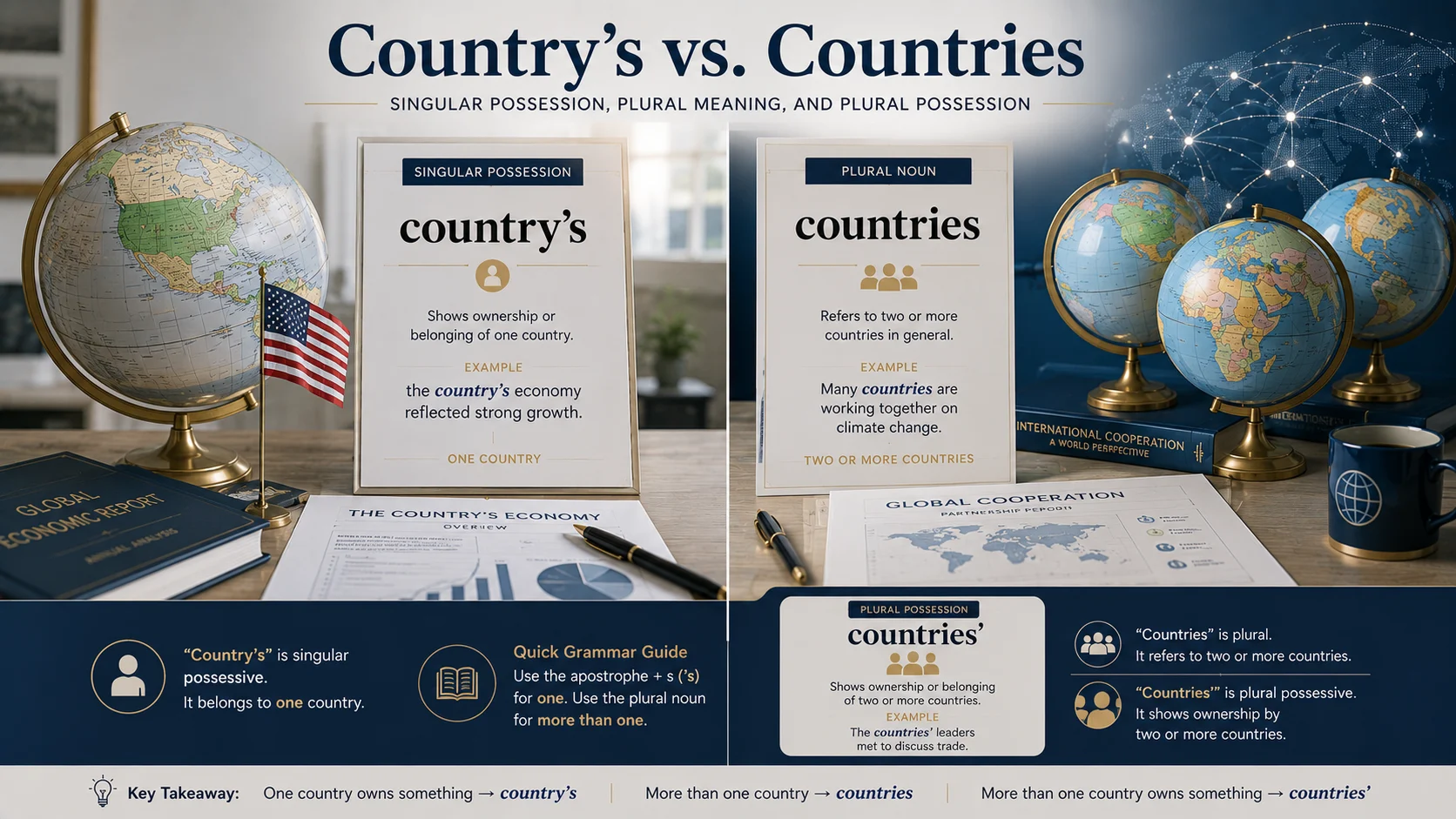
“Country’s” is the possessive form of the singular noun country, while “countries” is the plural form. Use “country’s” when something belongs to one country, and use “countries” when referring to more than one country.
The confusion between country’s or countries usually comes from the apostrophe. Country’s shows possession or can be a contraction of country is, while countries simply means more than one country. Understanding this small spelling difference prevents mistakes in academic writing, business communication, government documents, websites, and everyday English.
Country’s or Countries | What’s the Difference?
The key difference is possession versus plurality.
Country’s is the possessive form of the singular noun country. It tells readers that something belongs to, comes from, or is associated with one country. For example, “The country’s economy is growing” means the economy of one particular country is growing.
Countries is the plural form of country. It refers to two or more countries. For example, “Several countries attended the conference” means that multiple nations attended.
The spelling changes because country ends in y. When forming its plural, the y changes to ies, producing countries. When forming the singular possessive, an apostrophe and s are added, producing country’s.
| Form | Part of Speech | Meaning | Example |
|---|---|---|---|
| Country | Noun | One nation | The country is developing rapidly. |
| Country’s | Possessive noun | Belonging to one country | The country’s population is growing. |
| Countries | Plural noun | More than one nation | Many countries joined the agreement. |
| Countries’ | Plural possessive noun | Belonging to several countries | The countries’ leaders met yesterday. |
Quick Recap
Country’s means belonging to one country.
Countries means more than one country.
Countries’ means something belongs to several countries.
The apostrophe changes the grammatical function, so these forms shouldn’t be treated as interchangeable.
Is Country’s or Countries a Grammar, Vocabulary, or Usage Issue?
This is primarily a grammar and usage issue, rather than a vocabulary problem. The words come from the same noun, but their grammatical functions are different.
The distinction becomes easier when you ask what you are trying to express.
If you are talking about one nation, you may need country.
If you are talking about something belonging to one nation, you may need country’s.
If you are talking about two or more nations, you need countries.
If you are talking about something belonging to several nations, you need countries’.
These forms aren’t interchangeable in standard English.
Consider these examples:
“The country’s education system needs reform.”
Here, country’s expresses possession. The education system belongs to or is associated with one country.
“Countries are investing more in renewable energy.”
Here, countries is simply the plural noun. No possession is being expressed.
“The countries’ economies are closely connected.”
Here, the apostrophe comes after the s because the possession belongs to multiple countries.
Formal and Informal Usage
In formal English, the distinction is especially important. Academic papers, government reports, legal documents, business reports, news articles, and professional websites need accurate possessive and plural forms.
In casual conversation, people may overlook an apostrophe when speaking because pronunciation doesn’t always reveal the spelling. Writing makes the difference visible.
Academic and Casual Usage
Academic writing frequently discusses nations, international relations, demographics, economies, education systems, and cultural differences. Consequently, writers regularly need both countries and country’s.
For example:
“Developing countries face several economic challenges.”
“The country’s economic policy changed significantly.”
Both sentences are grammatically correct, but they communicate different ideas.
How to Use Country’s Correctly
Use country’s when you are referring to something connected with or belonging to one country.
The possessive form is especially common when the noun that follows describes an institution, characteristic, policy, resource, population, government, or condition.
Workplace Example
“The country’s labor regulations affect international companies.”
The phrase country’s labor regulations refers to the regulations of one country.
Another example is:
“The country’s tax policy has changed.”
The tax policy is associated with one country, so the singular possessive form is appropriate.
Academic Example
“The country’s literacy rate increased during the study period.”
Here, country’s indicates that the literacy rate belongs to or describes one particular country.
Technology Example
“The country’s digital infrastructure is expanding rapidly.”
The infrastructure is associated with one nation, making country’s the correct form.
Usage Recap
Use country’s when one country owns, possesses, controls, produces, or is associated with something.
A useful question is: Whose or which country’s?
If the answer is one country, the singular possessive form may be appropriate.
How to Use Countries Correctly
Use countries when you mean more than one country.
This is the standard plural form of country. It appears frequently in international news, geography, economics, politics, education, travel, business, and technology.
Workplace Example
“Several countries have adopted similar workplace regulations.”
Because the sentence refers to several nations, countries is correct.
Academic Example
“Researchers compared education systems across five countries.”
The number five clearly establishes plurality.
Technology Example
“Countries around the world are adopting artificial intelligence tools.”
The subject includes multiple nations, so countries is required.
Usage Recap
Use countries whenever you mean two or more nations.
Remember the spelling pattern:
country → countries
The y changes to ies because this is the regular plural pattern for nouns ending in consonant plus y.
When You Should NOT Use Country’s or Countries
Many errors become easy to avoid when you know when each form is inappropriate.
1. Don’t use country’s for simple plurality
Incorrect:
“Many country’s participated.”
Correct:
“Many countries participated.”
The sentence refers to multiple nations, not possession.
2. Don’t use countries when possession is intended
Incorrect:
“The countries economy is growing.”
Correct:
“The country’s economy is growing.”
An apostrophe is necessary because the economy is associated with one country.
3. Don’t use country’s when several countries possess something
Incorrect:
“The country’s leaders signed a joint statement.”
This sentence can mean the leaders of one country.
If leaders from multiple nations are intended, write:
“The countries’ leaders signed a joint statement.”
4. Don’t confuse countries with countries’
The plural form is countries.
The plural possessive form is countries’.
For example:
“Countries cooperate on climate policy.”
“The countries’ climate policies differ.”
5. Don’t add an apostrophe merely because a noun is plural
Apostrophes don’t normally make nouns plural.
Incorrect:
“Many country’s have different laws.”
Correct:
“Many countries have different laws.”
6. Don’t remove the apostrophe from a singular possessive
Incorrect:
“The country economy is changing.”
Correct:
“The country’s economy is changing.”
7. Don’t assume an apostrophe always means possession
In “The country’s changing,” country’s can be a contraction of country is. Context determines the meaning.
Common Mistakes and Decision Rules
| Correct sentence | Incorrect sentence | Explanation |
|---|---|---|
| Many countries signed the treaty. | Many country’s signed the treaty. | The sentence refers to several countries. |
| The country’s economy is growing. | The countries economy is growing. | One country’s economy is being discussed. |
| The countries’ economies are growing. | The country’s economies are growing. | Several countries each have economies being discussed. |
| Countries have different cultures. | Country’s have different cultures. | The plural noun needs no apostrophe. |
| The country’s culture is unique. | The countries culture is unique. | Possession belongs to one country. |
Decision Rule: If you mean more than one nation, use countries. If you mean something belonging to one nation, use country’s. If something belongs to several nations, use countries’.
This three way distinction solves most spelling and grammar errors involving these forms.
Country’s or Countries in Modern Technology and AI Tools
Modern technology has made accurate grammar more important, not less important.
Search engines, AI writing assistants, grammar checkers, translation systems, content management systems, and digital publishing platforms process enormous amounts of written language. A missing apostrophe can change grammatical meaning even when the sentence remains understandable.
For example, an AI system may interpret:
“Countries are developing new policies.”
as a statement about multiple nations.
But:
“The country’s policies are changing.”
refers to the policies of one nation.
For professional websites, accuracy also supports clarity and credibility. Search engines increasingly evaluate content through contextual understanding, meaning writers should use the form that accurately represents the intended relationship.
The Etymology Behind the Forms
The noun country entered English through Old French and ultimately traces back to Latin contra, meaning “against” or “opposite.” In Middle English, forms related to country developed to describe a region or land viewed in contrast to a city or another area.
The modern plural follows the familiar English spelling pattern in which a noun ending in consonant plus y changes the y to ies.
Thus:
country → countries
The possessive form works differently because the noun remains singular:
country → country’s
The plural possessive adds the apostrophe after the plural ending:
countries → countries’
Understanding the structure is more reliable than memorizing isolated spellings.
Expert Style Explanation
A useful principle from traditional English grammar is that apostrophes primarily signal possession or omitted letters, not ordinary plurality.
That principle explains the entire distinction. Countries is plural, while country’s is possessive or occasionally a contraction. Once this function is understood, the spelling becomes much easier to remember.
Two Practical Case Studies
Case Study One: Academic Research
Imagine a researcher writing about international education.
The original sentence says:
“Many country’s education systems were compared.”
The problem is grammatical because country’s indicates singular possession. The intended meaning involves multiple nations.
A corrected version is:
“Many countries’ education systems were compared.”
The correction communicates that the education systems belong to several countries.
If the researcher meant only one nation, the correct sentence would instead be:
“The country’s education system was compared.”
The grammatical correction therefore depends on meaning, not simply spelling.
Case Study Two: International Business
Consider a business report stating:
“Several country’s regulations affect the company.”
The writer intends to discuss regulations in several nations.
The correct form is:
“Several countries’ regulations affect the company.”
Here, countries’ is plural possessive because several countries have regulations that affect the company.
This distinction can prevent ambiguity in contracts, market research, compliance reports, and international business communication.
Error Prevention Checklist
Always use Country’s when
The sentence concerns one country.
You are expressing possession by one country.
You mean the government, economy, population, culture, policy, resources, or institutions of one country.
You can naturally replace the phrase with “of the country.”
Never use Countries when
You mean possession by one country.
You are describing something that belongs specifically to one nation.
You need a singular possessive form.
Always use Countries when
You mean two or more nations.
You are discussing nations as a group.
You are describing international comparisons involving multiple nations.
Never use Country’s when
You are simply making country plural.
The sentence has no possessive meaning and refers to multiple nations.
Related Grammar Confusions You Should Master
Understanding this distinction can also help you master several other common English problems.
- Its and it’s: possession versus contraction.
- Their and they’re: possession versus contraction.
- Whose and who’s: possessive form versus contraction.
- Apostrophe in plural nouns: understanding when an apostrophe is unnecessary.
- Plural versus possessive nouns: separating number from ownership.
- Company’s and companies: singular possession versus plural meaning.
- Companies and companies’: plural noun versus plural possessive.
- Child’s and children: singular possession versus irregular plural.
- Peoples and people’s: ordinary plural versus possessive meaning.
- Teachers and teacher’s: plural noun versus singular possessive.
These distinctions are valuable because apostrophe errors often arise from the same underlying misunderstanding: treating possession and plurality as if they were the same grammatical concept.
FAQs
Is country’s singular or plural?
Country’s is normally singular possessive, meaning something belongs to one country. It can also be a contraction of “country is” or “country has” in suitable contexts.
Is countries singular or plural?
Countries is the plural form of country. It refers to two or more nations and does not require an apostrophe when no possession is involved.
What is the difference between country’s and countries’?
Country’s shows possession by one country, while countries’ shows possession by several countries. The position of the apostrophe tells you the noun is singular or plural.
Should I write many countries or many country’s?
Write many countries. The word many requires a plural noun, and ordinary plural nouns do not take an apostrophe.
Is countries’ grammatically correct?
Yes. Countries’ is the plural possessive form. It means that something belongs to or is associated with multiple countries.
What is the possessive form of country?
The singular possessive is country’s. For example, “the country’s government” means the government of one country.
What is the plural of country?
The plural is countries. The spelling changes from y to ies because country ends in a consonant followed by y.
Can country’s mean country is?
Yes. In contractions, country’s can mean “country is” or, in some contexts, “country has.” For example, “The country’s changing” can mean “The country is changing.”
Which is correct, countries economy or country’s economy?
Country’s economy is correct when discussing the economy of one country. If discussing several countries, use countries’ economies when possession is intended.
Conclusion
The difference between country’s or countries becomes straightforward once you separate plurality from possession. Countries means more than one nation, while country’s normally shows that something belongs to one country. When several countries possess or are associated with something, use countries’.
The most reliable test is simple: ask you mean one country owning or being associated with something, or multiple countries. If it is one country’s possession, use the singular possessive. If it simply means several nations, use the plural. If several nations possess something, place the apostrophe after the plural s.
This small grammatical distinction matters in academic writing, business communication, government documents, journalism, technology content, and everyday English. Once you understand what the apostrophe is doing, these forms become much easier to choose accurately.
Discover More Related Articles:
- Pimple or Herpes | How to Tell the Difference & When to Get Medical Advice In 2026
- Cetaphil or CeraVe | Which Is Better for Your Skin Type In 2026
- Innie or Outie | Meaning, Difference & Usage Explained In 2026