Hinge or Bumble is a comparison between two major dating apps that both help people meet potential partners but use different approaches. Hinge emphasizes detailed profiles, prompts, comments and relationship focused connections, while Bumble has traditionally emphasized women making the first move and offers dating, friendship, and networking features. The better choice depends on your dating goals, communication style, and location.
When it comes to modern dating apps, Hinge or Bumble can seem like two sides of the same coin but they’re designed with different dating experiences in mind. you’re trying to find a serious relationship, meet new people, or simply understand which app fits your goals, choosing the right word matters when discussing these well-known platforms. Although both are dating apps, Hinge and Bumble are distinct brand names with different features, audiences, and approaches to online dating.
Understanding the difference between Hinge and Bumble helps you use each name accurately in conversations, reviews, articles, and searches. In this guide, we’ll clearly explain what Hinge and Bumble mean, how they differ, and when each term should be used. If you’ve ever wondered Hinge and Bumble can be used interchangeably, this comparison will give you a straightforward, reliable answer.
Hinge vs Bumble | What’s the Difference?
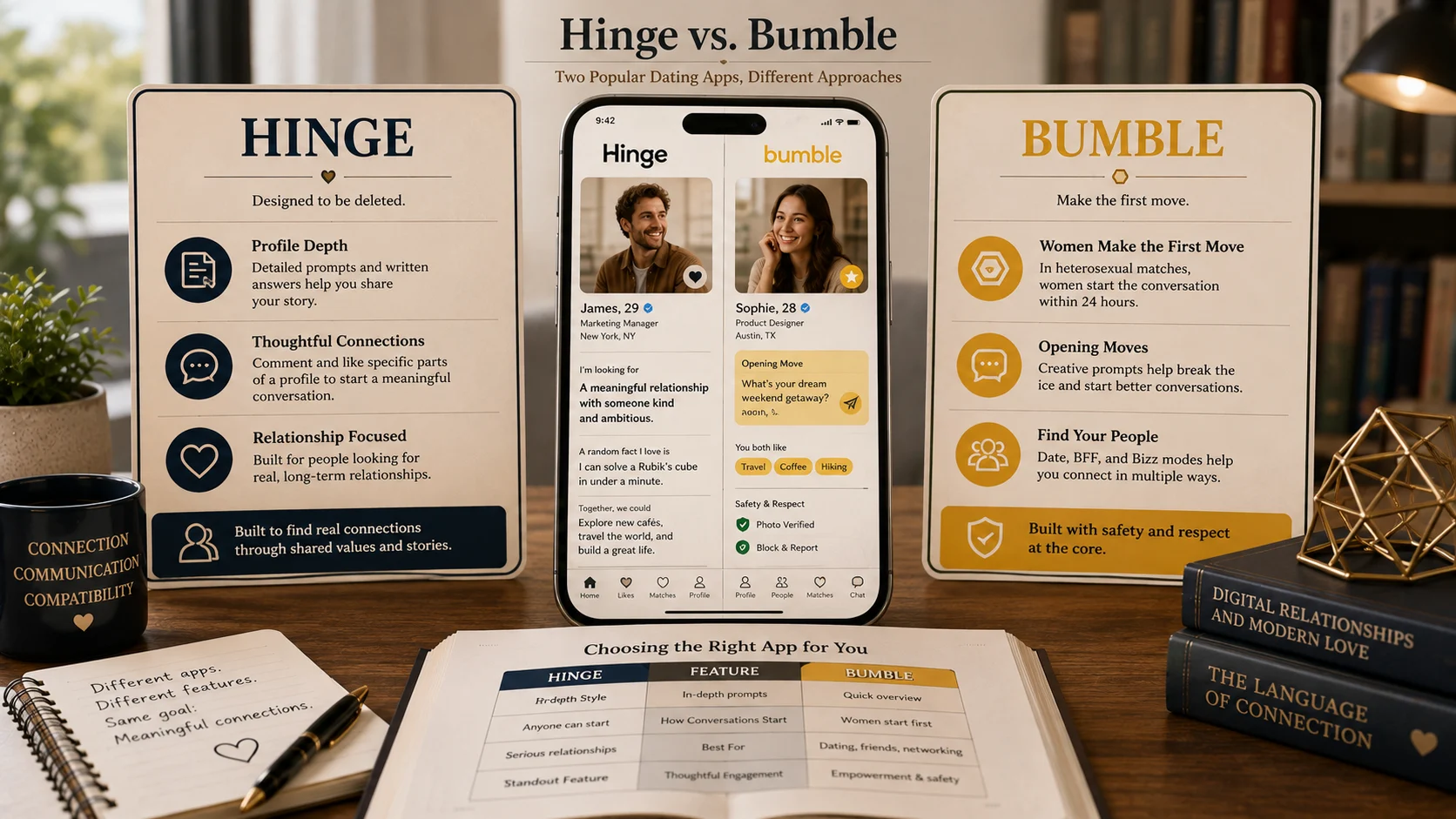
Hinge and Bumble are both dating platforms, but their core philosophies are different.
Hinge is a dating application and digital matchmaking platform. It uses detailed profiles, prompts, likes, comments, recommendations, and behavioral signals to help users discover potential partners. Hinge says that every match begins when someone likes or comments on a specific part of another person’s profile.
Bumble is a dating and social connection platform. Its dating service focuses on helping people meet potential partners, while Bumble also provides friendship and networking functions. Its traditional dating identity was built around women making the first move in heterosexual matches.
Here is the clearest comparison:
Quick recap
Hinge puts more emphasis on personality and profile details.
Bumble has a stronger identity around how conversations begin.
Hinge is especially attractive to people who enjoy responding to prompts.
Bumble can appeal to people who want dating alongside friendship and other social connections.
Neither app guarantees better dates. Your local user base, profile quality, activity level, preferences, and dating goals can have a major effect on your results.
Is Hinge vs Bumble a Grammar, Vocabulary or Usage Issue?
Unlike comparisons such as “affect vs effect,” Hinge vs Bumble is not a grammar or vocabulary issue. These are proper names of two different commercial platforms.
They are therefore not interchangeable.
You cannot use “Hinge” when you actually mean Bumble, just as you would not use the name of one social network when referring to another. The confusion comes from functional similarity rather than language rules.
The comparison is primarily a usage and technology question.
In casual conversation, someone might say, “I met her on Hinge,” or “We matched on Bumble.” In professional writing, an article about dating technology may compare the platforms more formally by discussing their matching systems, profile structures, safety tools, and user experience.
The distinction is especially important in research, journalism, marketing, and academic writing because inaccurate descriptions of a platform can change the meaning of a statement.
For example, saying that Bumble requires women to start every conversation without acknowledging the platform’s current Opening Moves feature can oversimplify the modern product experience. Bumble currently describes Opening Moves as a way to make starting conversations easier, allowing users to set a question that matches can respond to.
How Hinge Works for Dating
Hinge is designed around a deeper profile experience. Rather than relying only on a collection of photographs, users can present themselves through answers to prompts and other personal information.
The platform says that its matching experience is built around learning a user’s preferences and introducing people who may be a good fit. It also offers a Most Compatible recommendation, which Hinge says is based on mutual dealbreakers, recent activity, and patterns in whom users tend to like.
This structure can make Hinge particularly appealing to people who want to learn something about a potential match before starting a conversation.
Workplace example
Imagine someone who works in a demanding professional environment and has limited time for casual conversations. A detailed Hinge profile can help communicate interests, lifestyle preferences, humor, and values before a match develops.
A person might write a prompt about their ideal weekend, favorite travel experience, or unusual hobby. Someone who finds that answer interesting can respond directly to it.
Academic example
From a communication perspective, Hinge provides an interesting example of how interface design influences interpersonal communication.
A profile prompt acts as a conversation stimulus. Instead of beginning with a completely open question, the user can respond to information already supplied by another person.
That can reduce the uncertainty associated with opening a conversation with a stranger.
Technology example
Hinge also uses recommendation technology to personalize discovery. Its Most Compatible feature is designed to provide a recommendation based on behavioral and preference signals.
Hinge’s current technology direction also includes artificial intelligence and machine learning. The company describes recommendation engines, ranking models, and generative capabilities as important parts of its dating technology.
Hinge usage recap
Choose Hinge if you enjoy detailed profiles and conversation prompts.
It can be particularly suitable when personality and written interaction matter to you.
Its design is closely connected with the idea of moving from digital interaction toward an actual date.
How Bumble Works for Dating
Bumble approaches dating differently. The platform became well known for its women first conversation model in heterosexual matches.
Bumble explains that women in heterosexual matches can initiate the conversation, while in non heterosexual matches either person can make the first move.
However, Bumble has evolved beyond the feature that originally made it famous.
Its current dating experience includes Opening Moves, which Bumble describes as a way to make starting conversations easier. Users can select a suggested question or create their own, giving matches an easy way to respond.
Workplace example
Consider someone who wants more control over how a conversation begins. Bumble’s structured approach can provide a clearer starting point than an entirely open messaging system.
This can be useful for users who dislike receiving vague introductions and prefer a conversation to have an obvious opening.
Academic example
Bumble is also interesting from a sociological perspective because its original design challenged traditional expectations about who should initiate romantic communication.
The company says it was founded in 2014 with the idea of changing conventional dating dynamics by giving women the first move.
That design choice became part of the platform’s identity and helped distinguish Bumble from other dating services.
Technology example
Bumble now uses a wider collection of discovery and safety tools. Its current features include Discover, identity verification, Share Date, and Review Before You Send. Bumble says Discover uses information such as interests, dating intentions, and communities to present potentially compatible profiles.
Bumble also offers tools such as Incognito Mode, Snooze Mode, video calls, audio chats, Compliments, SuperSwipe, and Travel Mode.
Bumble usage recap
Choose Bumble if you appreciate a structured approach to starting conversations.
It may also appeal if you want dating alongside friendship or other social connection options.
Its current feature set is broader than the original women first concept alone.
When You Should NOT Use Hinge or Bumble
Neither platform is automatically the right choice for every situation.
You should reconsider Hinge when your main goal is simply maximizing the number of rapid interactions and you strongly dislike writing prompts or creating a detailed profile.
You should reconsider Bumble when the platform’s conversation structure does not fit your preferred communication style.
You should not choose either app solely because someone claims it is universally better. Dating app performance can vary significantly by city, age group, dating pool, activity level, and personal profile quality.
You should not assume that a large number of matches means a better dating experience.
You should not assume that a relationship focused platform guarantees a serious partner.
You should not copy the same profile blindly across both apps and expect identical results.
You should not ignore safety considerations simply because an app has verification or reporting tools.
You should not judge an entire platform based on a handful of matches.
Most importantly, you should not treat app recommendations as guarantees. A platform can provide useful tools, but the quality of your experience still depends heavily on the people available in your area and how you use the service.
Common Mistakes and Decision Rules
Decision Rule Box
If you want detailed profiles, prompts, and profile specific conversation starters, consider Hinge.
If you prefer Bumble’s structured conversation experience and broader connection ecosystem, consider Bumble.
The most useful rule is not “which app is best?” Instead, ask “which app’s design matches how I want to date?”
Hinge and Bumble in Modern Technology and AI Tools
Modern dating apps increasingly depend on recommendation technology, behavioral signals, personalization, safety systems, and artificial intelligence.
Hinge describes its recommendation engine and ranking models as central parts of the product. Its AI strategy is explicitly connected with improving dating outcomes rather than simply maximizing time spent inside the app.
Bumble has also introduced technology designed to improve compatibility and safety. Its Discover feature uses interests, dating intentions, and community information to help personalize profile discovery, while its safety tools include identity verification and message review features.
This matters because modern dating is no longer simply about browsing profiles manually. Algorithms influence which people users see, when they see them, and how interactions develop.
The broader dating industry is also experimenting with AI matchmakers and AI assisted communication. Recent reporting shows that artificial intelligence is increasingly being used to recommend compatible people and reduce friction during the dating process.
Authority and Trust | What the Evidence Shows
A brief history of Hinge
Hinge was redesigned around the idea of creating more meaningful connections rather than encouraging endless browsing. The company describes its central goal as helping people establish intimate, in person connections and ultimately leave the app.
The platform’s current identity therefore goes beyond simply being another matching service.
A brief history of Bumble
Bumble launched in 2014 with a distinctive approach that gave women the first move in heterosexual dating interactions. The company later expanded into friendship and professional networking.
Its product has continued evolving, including the introduction of Opening Moves and additional discovery and safety features.
Expert style takeaway
The strongest dating platform is not necessarily the one with the most features. It is the platform whose communication design reduces the distance between what a user wants and how that user actually interacts with potential partners.
Case study 1: Hinge’s recent growth
Hinge has shown strong recent business momentum. Match Group reported that Hinge delivered 28 percent year over year direct revenue growth in the first quarter of 2026, citing continued product momentum and international expansion.
More recently, Match Group reported that Hinge’s global monthly active users increased 13 percent in the second quarter of 2026.
These figures do not prove that Hinge will produce better dates for every individual. They do, however, show that the platform’s relationship focused positioning continues to attract substantial demand.
Case study 2: Bumble’s compatibility and safety approach
Bumble’s current product strategy provides another measurable example. In its research cited on its dating features page, Bumble reported that 91 percent of surveyed Gen Z respondents said shared interests were important, while nearly three quarters said feeling secure was crucial when choosing a dating app.
Bumble responded with features such as Discover and identity verification, designed to improve compatibility and user confidence.
Again, survey results should not be treated as proof that every Bumble user will have a better experience. They demonstrate how the company is responding to specific preferences reported by its audience.
Error Prevention Checklist
Always use Hinge when
You prefer detailed prompts and profile information.
You enjoy commenting on specific profile content.
You want a dating experience strongly positioned around meaningful relationships.
You prefer a profile that communicates personality through written answers.
You want recommendation features such as Most Compatible.
Never use Bumble when
You are actually referring to a Hinge interaction.
You describe a Bumble feature without checking the feature has changed.
You assume Bumble’s original women first identity explains every current conversation feature.
You treat Bumble as exclusively a dating service when discussing its broader product ecosystem.
Related Grammar Confusions You Should Master
Although Hinge and Bumble are brand names rather than grammar alternatives, they fit into a broader group of commonly confused technology and usage terms.
App vs application: Learn when the shorter form is natural and when the formal term is preferable.
Dating app vs dating site: Understand the difference between a mobile application and a web based service.
Match vs message: A match creates the opportunity for communication, while a message is an actual communication.
Like vs match: A like does not necessarily mean that two people have mutually expressed interest.
Profile vs account: A profile presents information about a user, while an account represents the broader user record.
Algorithm vs recommendation: An algorithm is a procedure or system, while a recommendation is an output produced by a system.
Privacy vs safety: Privacy concerns control over personal information, while safety concerns protection from harmful behavior.
Verify vs validate: Verification generally confirms identity or authenticity, while validation can refer to confirming that something meets a particular requirement.
Intent vs preference: Dating intent describes what someone is seeking, while preferences describe characteristics or conditions they favor.
Online connection vs in person connection: Digital communication happens through a platform, while an in person connection occurs physically.
FAQ
Is Hinge or Bumble better for serious relationships?
Hinge is strongly positioned around meaningful relationships, while Bumble also supports intentional dating. Your local dating pool and profile quality can matter as much as the platform itself.
Is Hinge or Bumble better for beginners?
Both can work for beginners, but Hinge may suit people who are comfortable answering prompts, while Bumble can appeal to users who prefer a structured conversation experience.
Is Hinge more serious than Bumble?
Hinge explicitly positions itself around meaningful connections and being designed to be deleted, but Bumble also markets its dating experience around meaningful connections. Neither platform guarantees relationship outcomes.
Do people get more matches on Hinge or Bumble?
There is no universal winner because match rates vary by location, age, preferences, profile quality, activity, and the people using each platform in a particular dating pool.
Is Hinge or Bumble better for conversations?
Hinge gives users opportunities to like or comment on specific profile content, while Bumble provides tools such as Opening Moves to make conversation easier.
Does Bumble still have the first move rule?
Bumble continues to describe women making the first move in heterosexual matches as part of its dating model, while its current Opening Moves feature provides another way to start conversations.
Does Hinge use artificial intelligence?
Yes. Hinge describes artificial intelligence and machine learning as important to recommendation, ranking, and other dating related product systems.
Which dating app should I choose, Hinge or Bumble?
Choose Hinge if detailed profiles and intentional conversations appeal to you, and consider Bumble if its conversation structure and broader connection features better match your preferences.
Conclusion
The Hinge or Bumble question does not have one universal answer. Hinge is built around detailed profiles, prompts, specific likes and comments, personalized recommendations, and a strong emphasis on moving meaningful connections into real life.
Bumble has a distinctive history built around women making the first move and has developed a broader ecosystem of dating, friendship, discovery, conversation, and safety features.
If your priority is profile depth and conversation based discovery, Hinge may be the stronger choice. If you prefer Bumble’s communication structure and broader social options, Bumble may fit better.
The most important factor, however, is your actual dating environment. A theoretically excellent app is less useful if few compatible people in your area use it. Try the platform that best matches your goals, create a genuine profile, use the available communication tools thoughtfully, and evaluate the quality of conversations rather than simply counting matches.
Discover More Related Articles:
- Grandad or Granddad | Which Word Is Correct & When Should You Use It In 2026
- Fazed or Phased | What Is the Difference & Which Word Should You Use In 2026
- Whiney or Whiny | Which Word Do Dictionaries Recommend In 2026