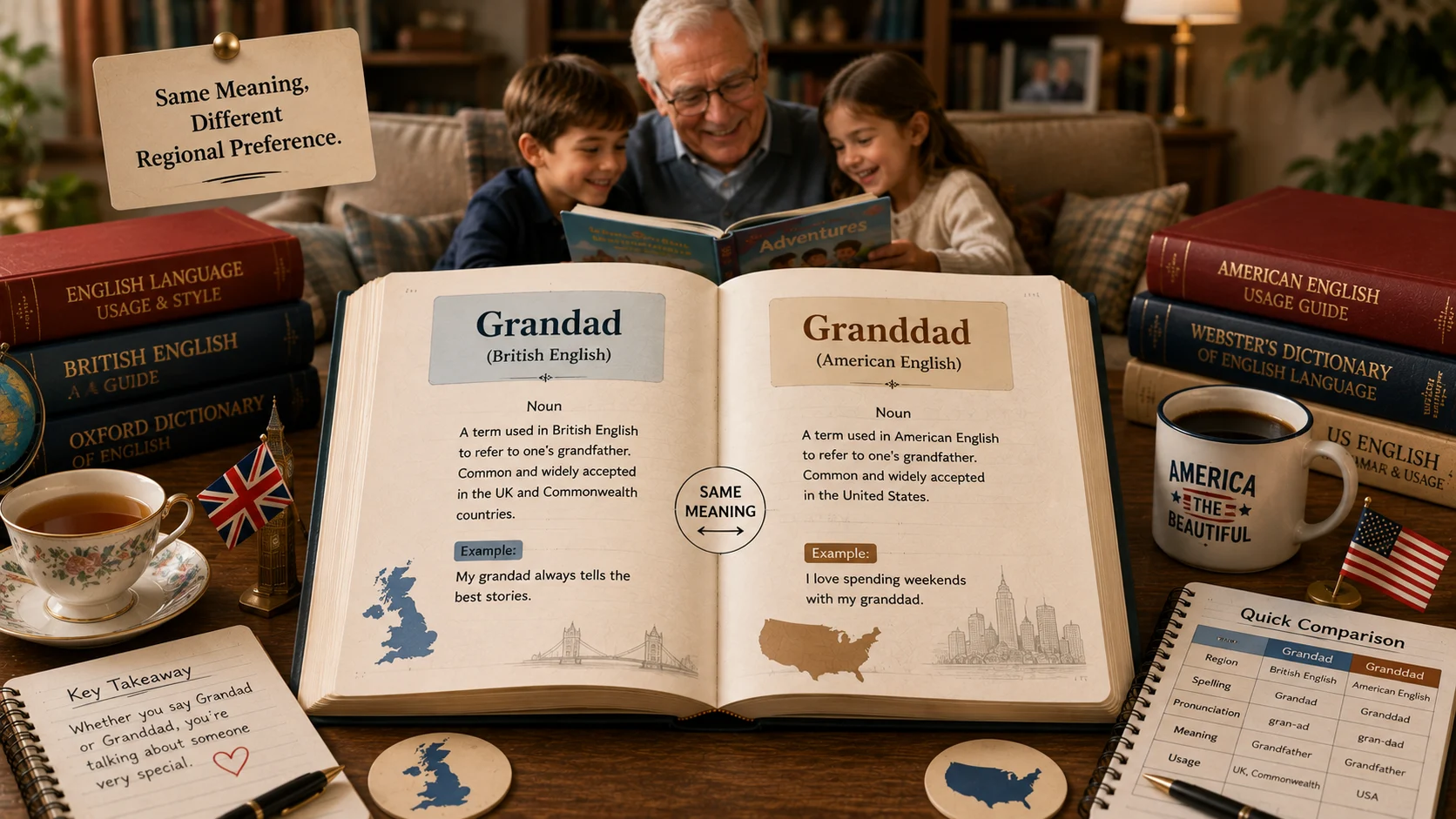
Grandad or granddad are both correct English nouns used to refer affectionately to a grandfather. The difference is not grammatical but based on regional preference, family tradition and personal style. Neither spelling changes the meaning, although one may be more common than the other depending on where English is spoken.
Choosing the right family term can seem simple until you notice different spellings in books, emails, greeting cards, and online conversations. The question grandad or granddad often appears because both words refer to the same person but are written differently across English speaking regions. Understanding these variations helps you write naturally, avoid unnecessary corrections, and match your audience’s expectations you are writing for school, work, or everyday communication.
Grandad or Granddad | What’s the Difference?
Both grandad and granddad are nouns. They are affectionate alternatives to the more formal word grandfather. The primary distinction lies in spelling preference rather than meaning.
| Feature | Grandad | Granddad |
|---|---|---|
| Part of speech | Noun | Noun |
| Meaning | Informal name for a grandfather | Informal name for a grandfather |
| Grammar | Correct | Correct |
| Meaning difference | None | None |
| Common in | British English and many Commonwealth regions | American English and also common in Britain |
| Formal writing | Less common than grandfather | Less common than grandfather |
| Everyday speech | Very common | Very common |
Both spellings express warmth and familiarity rather than formality. Neither is more correct from a grammatical perspective. The best choice depends on your audience, location, or even your family’s tradition. If consistency matters in a document, choose one spelling and use it throughout.
Is Grandad or Granddad a Grammar, Vocabulary or Usage Issue?
This is primarily a usage and vocabulary issue, not a grammar mistake.
Grammar rules do not require one spelling over the other because both words function in exactly the same way. They are interchangeable in meaning, although regional preference often influences which one readers expect.
In formal academic writing, many writers prefer grandfather because it sounds more neutral and professional. In personal writing, novels, letters, children’s books, and conversations, both grandad and granddad sound natural and friendly.
Writers should also think about consistency. Switching between the two spellings in the same article or story may confuse readers into thinking they refer to different people when they do not.
Understanding Grandad
Grandad is an affectionate noun used to refer to a grandfather. It is especially popular in British English and is widely recognized across many English speaking countries.
The spelling creates a shorter, smoother form of grandfather, making it feel warm and conversational. Families often pass this preference from one generation to another, so the spelling frequently reflects tradition rather than language rules.
Workplace Example
While writing a company newsletter celebrating employees’ family stories, an editor might write:
“James learned woodworking from his grandad, whose advice still inspires his projects today.”
The informal tone fits the personal nature of the article.
Academic Example
A student writing a reflective essay could say:
“My grandad encouraged me to develop strong reading habits from an early age.”
Although acceptable in a personal essay, a historical research paper would usually replace it with grandfather.
Technology Example
Someone posting on social media or sending a family message might write:
“My grandad finally learned how to make video calls today.”
The friendly wording suits informal digital communication.
More Everyday Examples
- My grandad taught me how to ride a bicycle.
- We visit our grandad every weekend.
- Her grandad enjoys gardening throughout the year.
- My grandad still writes handwritten letters.
- Everyone gathered to celebrate Grandad’s birthday.
Usage Recap
Grandad is an informal, affectionate, and completely correct word. It appears most frequently in British English, family conversations, personal writing, and storytelling. When your audience expects a warm and familiar tone, this spelling feels perfectly natural.
Understanding Granddad
Granddad is also an affectionate noun meaning grandfather. It carries exactly the same definition as grandad, but many speakers, especially in the United States, naturally prefer this spelling.
Some families feel that the extra d better reflects how they pronounce the word. Others simply continue using the spelling that has appeared in their family for generations.
Workplace Example
An employee profile might include:
“Sarah credits her granddad for teaching her the value of hard work and patience.”
The sentence sounds personal while remaining easy to understand.
Academic Example
A memoir or personal narrative may include:
“My granddad always reminded me that curiosity leads to lifelong learning.”
Again, grandfather would usually be preferred in highly formal academic research.
Technology Example
A text message or online post might say:
“My granddad just sent his very first email without any help.”
The casual tone matches the setting perfectly.
More Everyday Examples
- My granddad enjoys telling stories about his childhood.
- We surprised our granddad with a family picnic.
- Her granddad collects antique watches.
- My granddad loves watching football every weekend.
- Granddad never forgets anyone’s birthday.
Usage Recap
Granddad is every bit as correct as grandad. It is especially common in American English but is understood worldwide. If this spelling matches your family’s tradition or your audience’s expectations, you can use it confidently without worrying about grammatical correctness.
When You Should NOT Use Grandad or Granddad
Although both words are correct, there are situations where neither is the best choice. Selecting the appropriate term depends on the context, audience, and level of formality.
| Situation | What to Use Instead | Why |
|---|---|---|
| Formal legal documents | Grandfather | Formal documents require standard terminology. |
| Birth certificates | Grandfather | Official records avoid informal family names. |
| Academic research papers | Grandfather | Formal writing favors neutral language. |
| Genealogical records | Grandfather | Consistency is important in family history documentation. |
| Medical or government forms | Grandfather | Official paperwork should use the formal relationship. |
| Professional reports | Grandfather | Informal family terms may appear unprofessional. |
| When referring to someone else’s preferred title | Their chosen name | Respect the person’s preferred family title. |
| When consistency is required | One spelling only | Do not alternate between grandad and granddad in the same piece of writing. |
Using grandad or granddad in formal situations is not grammatically wrong, but it may sound too conversational. When writing official or academic documents, grandfather is usually the safest choice.
Common Mistakes and Decision Rules
Many writers accidentally create confusion by mixing spellings or assuming that one version is incorrect. The following examples show the most common errors.
| Correct Sentence | Incorrect Sentence | Explanation |
|---|---|---|
| My grandad taught me to swim. | My granddad taught me to swim, then later I called him grandad in the same story. | Choose one spelling and remain consistent. |
| Her granddad lives nearby. | Her Granddad lives nearby. | Capitalize only when it is used as a name. |
| We visited Grandad yesterday. | We visited grandad yesterday. | When used as a direct name, capitalization is appropriate. |
| My grandfather served in the navy. | My grandad served in the navy. | In formal historical writing, grandfather is more suitable. |
| My granddad enjoys fishing. | My grandfather enjoys fishing in a casual family text. | Informal family communication usually sounds warmer with granddad or grandad. |
| Grandad made dinner for everyone. | Grandfather made dinner for everyone in a children’s story. | The informal term often matches the tone better. |
Decision Rule
| If your meaning is | Use |
|---|---|
| An affectionate family name for your grandfather | Grandad or Granddad |
| A formal family relationship in official writing | Grandfather |
Unlike many confusing word pairs, this choice is not about different meanings. It is simply about style, audience, and consistency.
Grandad or Granddad in Modern Technology and AI Tools
Modern technology has made language differences more visible than ever. Search engines, grammar checkers, predictive keyboards, and AI writing assistants recognize both grandad and granddad as correct spellings.
However, these tools often suggest one spelling based on your language settings. A device set to British English may recommend grandad, while one using American English may suggest granddad.
Content creators should avoid changing spellings automatically without checking the intended audience. Maintaining consistency throughout an article improves readability and gives a more professional impression.
Where Did These Words Come From?
The word grandfather entered English centuries ago as the standard term for a parent’s father. Over time, families naturally shortened it into affectionate forms such as grandad, granddad, grandpa, gramps, and several regional variations.
The spellings grandad and granddad developed through everyday speech rather than formal grammar rules. As pronunciation changed across different English speaking communities, both spellings became accepted in dictionaries and modern usage.
This explains why no major grammar guide considers either version incorrect.
Language experts generally agree that family names evolve through usage rather than strict grammatical rules. Consistency and audience expectations matter more than choosing one accepted spelling over another.
Real World Case Studies
Case Study One: Publishing for a British Audience
A children’s publisher preparing a collection of family stories reviewed its manuscripts before publication. Editors noticed that the intended audience was primarily in the United Kingdom, where grandad appeared more naturally in children’s literature.
After standardizing every chapter to grandad, readers reported that the dialogue felt more authentic and familiar. The consistent spelling also reduced unnecessary editorial corrections during future editions.
Case Study Two: American Family History Website
A genealogy website serving readers across the United States analyzed thousands of family stories submitted by users. Most contributors naturally preferred granddad when writing personal memories.
The editorial team decided to preserve that spelling across articles aimed at American readers while keeping grandfather for official historical records. User engagement increased because the language reflected the audience’s everyday speech.
Error Prevention Checklist
| Always Do | Never Do |
|---|---|
| Use grandad consistently if you begin with that spelling. | Mix grandad and granddad randomly in the same article. |
| Use granddad consistently if that matches your audience. | Assume one spelling is grammatically wrong. |
| Choose grandfather for formal documents. | Use informal family names in official paperwork unless required. |
| Consider your readers’ regional expectations. | Change spellings halfway through a story. |
| Match the tone of your writing. | Ignore family preference when writing personal stories. |
| Proofread for consistency before publishing. | Let spell check change one version without reviewing it. |
Related Grammar Confusions You Should Master
Understanding similar language questions can strengthen your writing skills and reduce common mistakes.
| Grammar Topic | What You Will Learn |
|---|---|
| Grandma or Grandmother | Informal versus formal family titles. |
| Mum or Mom | Regional spelling differences in English. |
| Dad or Father | Choosing between conversational and formal language. |
| Granny or Grandma | Differences in affectionate family names. |
| Toward or Towards | Regional variation with identical meaning. |
| Color or Colour | American and British spelling differences. |
| Favorite or Favourite | Choosing spelling for your audience. |
| Theater or Theatre | Regional usage in published writing. |
| Grey or Gray | Which spelling fits different varieties of English. |
| Adviser or Advisor | Style preferences in professional writing. |
FAQs
Is grandad or granddad correct?
Both spellings are correct and mean the same thing. The preferred choice depends mainly on regional usage and your family’s personal preference.
Is grandad more British than granddad?
Yes. Grandad is generally more common in British English, although granddad is also widely understood and used in the United Kingdom.
Is granddad more common in American English?
Yes. Many American families naturally use granddad, while others prefer grandpa or simply grandfather depending on the situation.
Can I use grandad in formal writing?
You can, but grandfather is usually the better choice for academic papers, legal documents, and other formal writing because it sounds more professional.
Do grandad and granddad have different meanings?
No. Both words refer to a grandfather and carry exactly the same meaning. The only difference is spelling preference.
Should I capitalize Grandad or Granddad?
Capitalize the word only when it is used as a name, such as Grandad is coming over today. Keep it lowercase when referring to a grandfather in general.
Which spelling should I use in a book or article?
Choose the spelling that best matches your target audience and use it consistently throughout the entire piece to avoid confusing readers.
Do dictionaries accept both grandad and granddad?
Yes. Modern dictionaries recognize both spellings as standard English, making either one acceptable in everyday writing.
Conclusion
The debate over grandad or granddad is not about right or wrong but about audience, consistency, and personal preference. Both words are accepted English nouns that affectionately refer to a grandfather, and neither changes the meaning of your sentence.
If you are writing for a British audience, grandad may feel more natural, while granddad is often preferred in American English. In formal documents, grandfather remains the best choice. By understanding regional spelling, informal family titles, and the importance of maintaining consistent usage, you can write with confidence and avoid unnecessary corrections.
Discover More Related Articles:
- Yes or No | Meaning, Differences & When to Use Each Correctly In 2026
- Gopher or Gofer | What’s the Difference & Which One Should You Use In 2026
- Fishes or Fish | Which Form Do Dictionaries Recommend In 2026