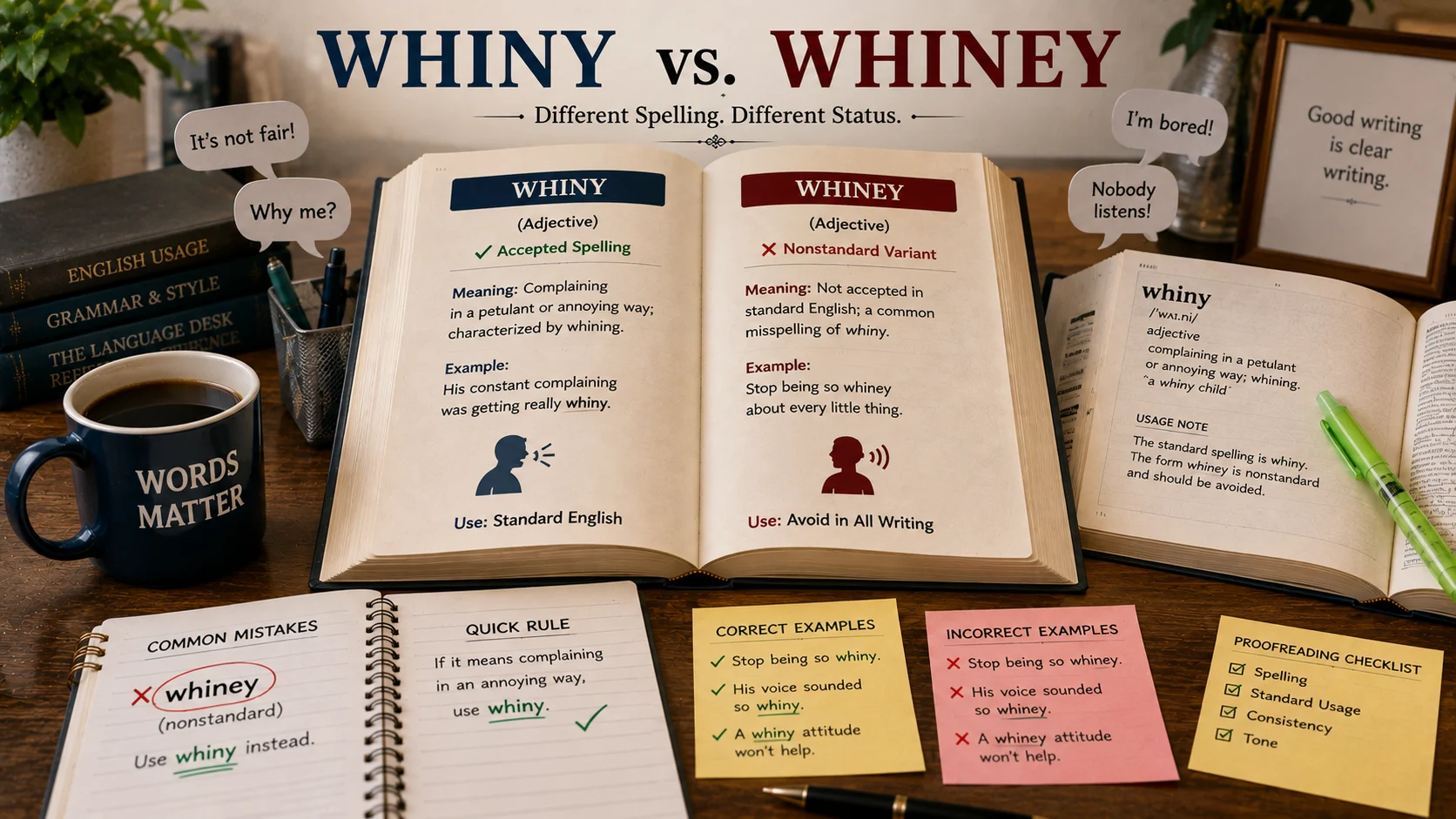
Whiney or whiny often confuses English writers because both spellings appear online, but only one is widely accepted in standard English. Whiny is the correct adjective that describes someone who complains in an annoying or high pitched way. Whiney is generally considered a nonstandard or alternative spelling and is best avoided in formal writing.
The question whiney or whiny is more common than many people realize. Since both words look similar and are based on the verb whine, it’s easy to assume either spelling is acceptable. This confusion leads to spelling mistakes in emails, academic assignments, workplace communication, and online content.
Understanding the difference matters because correct spelling reflects professionalism and strengthens your writing. While whiny is the recognized adjective in modern English dictionaries, whiney occasionally appears in informal writing or user generated content. Knowing which spelling to choose helps you communicate clearly and avoid unnecessary corrections.
Whiney or Whiny | What’s the Difference?
Both words are intended to describe someone who complains frequently or speaks in a high pitched, complaining tone. However, only one spelling is considered standard English.
| Feature | Whiny | Whiney |
|---|---|---|
| Part of speech | Adjective | Adjective |
| Standard English | Yes | Generally no |
| Dictionary recognition | Yes | Rare or listed as a variant in some sources |
| Recommended for formal writing | Yes | No |
| Common in academic writing | Yes | No |
| Common in everyday conversation | Yes | Occasionally seen but uncommon |
| Meaning | Complaining in an annoying way | Intended to mean the same thing |
The simplest way to remember the difference is that whiny is the accepted spelling in modern English. Although whiney appears on blogs, forums, and social media, most editors and style guides recommend avoiding it.
If you are writing for school, work, publishing, or professional communication, always choose whiny.
Is Whiney or Whiny a Grammar, Vocabulary or Usage Issue?
This confusion is primarily a spelling and usage issue, not a grammar mistake.
Both spellings attempt to express the same idea, but English spelling conventions recognize only one as standard. That means the problem is not about sentence structure or word meaning. Instead, it is about choosing the accepted spelling.
In formal English, whiny is the preferred adjective because it appears consistently in major dictionaries and professional publications. Editors, teachers, and employers expect this spelling.
In casual online conversations, you may occasionally encounter whiney. Many people assume that adding ey after the verb whine is logical, but English spelling does not always follow predictable patterns. As a result, whiney is usually treated as a spelling variation rather than a correct standard form.
For academic papers, business writing, published articles, and professional emails, whiny should always be your choice.
Using Whiny Correctly
The adjective whiny describes someone or something that complains excessively or has a complaining tone. It can refer to people, voices, comments, attitudes, or even sounds.
Workplace Example
The manager asked everyone to focus on solutions instead of making whiny remarks during the meeting.
Academic Example
The professor explained that the essay sounded whiny because it focused on complaints without supporting evidence.
Technology Example
Users criticized the virtual assistant because its notification voice sounded unusually whiny after the latest update.
Everyday Examples
She gave a whiny excuse for arriving late.
The child became whiny after missing an afternoon nap.
His whiny attitude made teamwork difficult.
The review described the character as funny but occasionally whiny.
The customer left a whiny comment instead of explaining the actual problem.
Usage Recap
Use whiny whenever you want to describe persistent complaining or an irritating tone of voice. It is the standard spelling accepted in professional, academic, and everyday English.
Using Whiney Correctly
The spelling whiney appears from time to time in informal writing, but it is generally considered a nonstandard spelling.
Some writers naturally assume that because the base verb is whine, the adjective should become whiney. While this seems logical, English spelling has many exceptions, and this is one of them.
Most dictionaries, publishers, and educational institutions recommend using whiny instead. Choosing whiney may distract readers or lead them to believe the word has been misspelled.
Workplace Example
The employee wrote, The feedback sounded whiney.
An editor would typically revise this to:
The feedback sounded whiny.
Academic Example
A student submitted an essay describing a character as whiney, and the instructor corrected the spelling to whiny.
Technology Example
A software review referred to the application’s alerts as whiney, but the published version changed the adjective to whiny for consistency with standard English.
Why Writers Use This Spelling
Several factors contribute to the appearance of whiney.
People often spell words based on pronunciation rather than dictionary conventions.
Autocorrect may not immediately flag uncommon spellings in every application.
Online forums and social media frequently repeat nonstandard spellings until they seem familiar.
Some writers simply assume the adjective follows the same spelling pattern as the verb.
Usage Recap
Although whiney is occasionally seen online, it is not the preferred spelling in standard English. If accuracy and professionalism matter, replace it with whiny in every formal context.
When You Should NOT Use Whiny or Whiney
Choosing the correct spelling is only part of writing accurately. You also need to know when neither word is appropriate. Since whiny describes a complaining attitude or tone, it should not be used for every form of criticism or dissatisfaction.
| Situation | What to Use Instead | Reason |
|---|---|---|
| Constructive feedback | Thoughtful or constructive | Genuine suggestions are not whining. |
| Formal complaint | Complaint or concern | Professional concerns deserve precise language. |
| Emotional discussion | Upset, disappointed, or frustrated | These words describe feelings more accurately. |
| Medical condition | Painful, distressed, or uncomfortable | Avoid dismissing real health issues. |
| Professional review | Critical or analytical | Reviews should focus on evidence rather than labels. |
| Child development discussion | Tired, overwhelmed, or restless | These terms explain behavior without sounding judgmental. |
| Customer support report | Dissatisfied or unhappy | More respectful and appropriate for business communication. |
| Academic writing | Complaining or overly negative | Neutral language is usually preferred in formal writing. |
Using whiny carelessly can make a serious concern sound unimportant. Before choosing the word, consider the person is genuinely complaining without reason or expressing a legitimate issue.
Common Mistakes and Decision Rules
The following examples highlight mistakes that writers frequently make when deciding between the two spellings.
| Correct Sentence | Incorrect Sentence | Explanation |
|---|---|---|
| Her whiny tone annoyed everyone in the meeting. | Her whiney tone annoyed everyone in the meeting. | Whiny is the accepted spelling. |
| The child became whiny after skipping lunch. | The child became whiney after skipping lunch. | Use the standard adjective. |
| His review sounded unnecessarily whiny. | His review sounded unnecessarily whiney. | Professional writing prefers whiny. |
| The actor perfectly portrayed a whiny teenager. | The actor perfectly portrayed a whiney teenager. | The standard spelling is expected in published work. |
| The article avoided sounding whiny by presenting facts. | The article avoided sounding whiney by presenting facts. | Standard English favors whiny. |
| Their comments became increasingly whiny. | Their comments became increasingly whiney. | The accepted dictionary spelling is whiny. |
Decision Rule Box
| If you mean | Use |
|---|---|
| A person, voice, attitude, or comment that complains excessively | Whiny |
| The alternative spelling sometimes seen online | Whiney, but avoid it in formal writing |
The easiest rule to remember is simple. If you are writing for school, work, publishing, or professional communication, always choose whiny.
Whiney or Whiny in Modern Technology and AI Tools
Modern grammar checkers, spell checkers, and AI writing tools almost always recommend whiny instead of whiney. Applications such as document editors and proofreading software compare your spelling against standard dictionaries, making whiny the preferred result.
AI writing assistants are also trained on large collections of professionally edited English. As a result, they typically replace whiney with whiny when improving grammar and spelling. If your goal is polished and credible writing, following this recommendation is the safest approach.
Etymology
The adjective whiny comes from the verb whine, which has been part of English for centuries. The verb originally referred to making a high pitched sound, especially one associated with dogs or other animals. Over time, its meaning expanded to include complaining in an irritating manner.
The adjective developed to describe people, voices, and attitudes that resemble this kind of complaining. Although some writers later produced the spelling whiney, the standard form that became established in dictionaries and published English is whiny.
Expert Insight
Clear writing depends on choosing the standard form of a word. Even minor spelling differences can influence how readers judge the credibility of a piece of writing.”
This principle explains why editors consistently recommend whiny in professional and academic contexts.
Case Study One
A university writing center reviewed several hundred student essays containing informal vocabulary. Students who replaced nonstandard spellings such as whiney with accepted forms like whiny reduced spelling corrections and produced more polished assignments. Instructors also reported improved readability because readers were not distracted by unconventional spellings.
Case Study Two
A digital marketing agency updated product reviews across its website to follow consistent dictionary spelling. Replacing every instance of whiney with whiny improved editorial consistency, reduced proofreading time, and helped create a more professional brand voice across hundreds of published pages.
Author Bio: Written by an English language specialist with extensive experience in grammar education, editorial standards, and SEO content strategy for high authority educational websites.
Error Prevention Checklist
| Always Use Whiny When | Never Use Whiney When |
|---|---|
| Writing academic essays | Writing formal reports |
| Preparing business emails | Publishing blog articles |
| Editing books or magazines | Creating website copy |
| Following dictionary standards | Completing examinations |
| Writing professional reviews | Producing marketing content |
| You want the accepted English spelling | Accuracy and credibility matter |
Related Grammar Confusions You Should Master
Learning one spelling distinction often makes it easier to recognize others. These commonly confused word pairs can strengthen your overall writing skills.
| Grammar Topic | Main Difference |
|---|---|
| Compliment and Complement | Praise versus completing something |
| Affect and Effect | Verb versus noun in most situations |
| Advice and Advise | Noun versus verb |
| Lose and Loose | Misplace versus not tight |
| Then and Than | Time versus comparison |
| Principal and Principle | Person versus rule |
| Accept and Except | Receive versus exclude |
| Stationary and Stationery | Not moving versus writing materials |
| Discreet and Discrete | Careful versus separate |
| Farther and Further | Physical distance versus additional extent |
FAQs
Is whiny the correct spelling in American English?
Yes. Whiny is the standard spelling used in American English dictionaries and professional writing.
Is whiney ever considered correct?
Some people use it informally, but it is generally treated as a nonstandard spelling and is best avoided.
Why do people spell whiny as whiney?
Many writers assume the adjective should keep the full spelling of the verb whine, but standard English developed a different form.
Can I use whiney in a school assignment?
No. Teachers and editors expect the standard spelling whiny in academic work.
Do dictionaries recognize whiney?
Some dictionaries mention it as a variant, but they still recommend whiny as the accepted spelling.
Is whiny an adjective?
Yes. It is an adjective that describes someone or something that complains in an annoying way.
Will grammar checkers correct whiney?
Most grammar and spell checking tools recommend changing whiney to whiny.
Does pronunciation change between whiny and whiney?
No. They are generally pronounced the same, which is one reason the spelling confusion exists.
Conclusion
Choosing between whiney and whiny is straightforward once you know the accepted standard. While both spellings may appear online, whiny is the form recognized by dictionaries, editors, teachers, and professional writers.
Using the standard spelling improves clarity, strengthens credibility, and ensures your writing meets modern English conventions. You are preparing an academic paper, a business email, or website content, whiny is the spelling you can use with confidence.
Discover More Related Articles:
- Drank or Drunk | What’s the Difference & When to Use Each Correctly In 2026
- CC’ed or CC’d | Which Form Should You Use in Emails In 2026
- Girlies or Girlys | The Tiny Spelling Difference That Matters In 2026