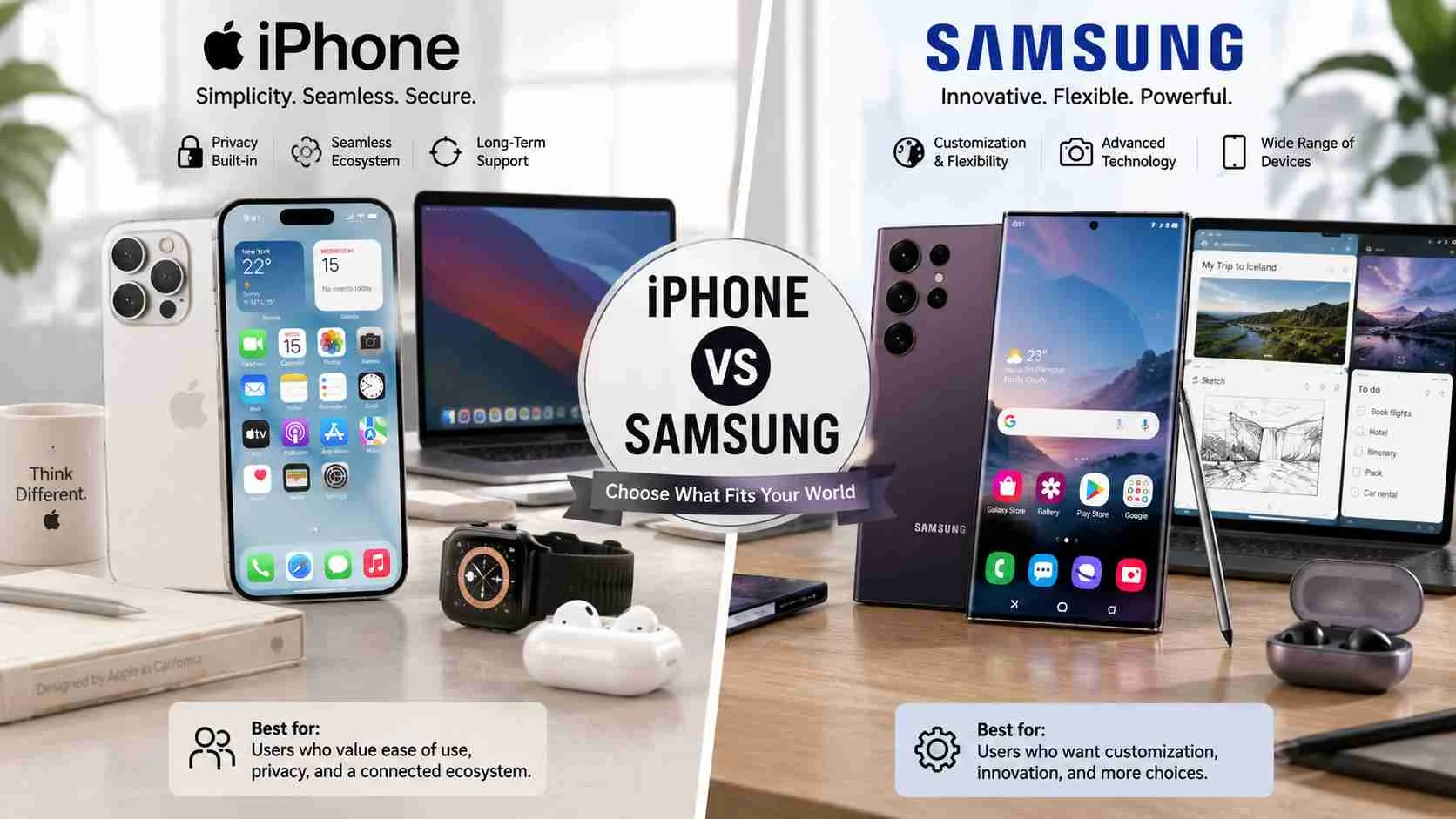
Choosing between iPhone and Samsung depends on your priorities. iPhone offers a seamless Apple ecosystem, long software support and a simple user experience, while Samsung provides greater customization, innovative hardware and a wide range of Android devices.
When people search for iphone or samsung, they are usually trying to decide which smartphone brand offers the better overall experience. Although both companies produce high quality devices, they take very different approaches to design, software, performance, and features.
Choosing the wrong one can lead to frustration if it does not match your daily habits, budget, or expectations. This guide explains the differences in clear language, compares their strengths, and helps you determine which brand is the right choice for your personal, academic, or professional needs.
iPhone vs Samsung | What’s the Difference?
Both iPhone and Samsung smartphones perform many of the same everyday tasks, including calling, messaging, browsing the internet, taking photos, and running applications. The biggest difference lies in their operating systems, hardware philosophy, ecosystem, and level of customization.
| Feature | iPhone | Samsung |
|---|---|---|
| Company | Apple | Samsung Electronics |
| Operating System | iOS | Android with One UI |
| Part of Speech | Proper noun | Proper noun |
| Customization | Limited but simple | Extensive and flexible |
| Software Updates | Long and consistent | Long support on flagship models |
| Device Variety | Small lineup | Wide range from budget to premium |
| Ecosystem | Apple devices work seamlessly together | Integrates with Android and Galaxy devices |
| App Store | Apple App Store | Google Play Store and Galaxy Store |
| File Management | Simple and controlled | Flexible with greater user control |
| Best For | Users wanting simplicity and reliability | Users wanting flexibility and choice |
Both brands rank among the world’s leading smartphone manufacturers, but they appeal to different types of users. iPhone focuses on consistency, security, and ecosystem integration. Samsung emphasizes innovation, customization, and variety. Neither is universally better because the ideal choice depends on your priorities.
Is iPhone or Samsung a Grammar, Vocabulary or Usage Issue?
Unlike commonly confused English words, iphone or samsung is not a grammar issue. Instead, it is a product comparison that often appears in buying guides, technology discussions, and online reviews.
People sometimes assume one brand is objectively better than the other. In reality, the answer depends on how you use your smartphone.
In formal technology publications, reviewers compare measurable factors such as processing speed, battery life, display quality, camera performance, and software support.
And in casual conversations, people often base their opinions on personal experience, favorite features, or familiarity with a particular operating system.
Academic research involving mobile technology usually compares usability, security, user satisfaction, and software ecosystems rather than declaring a universal winner.
Understanding this distinction helps readers avoid oversimplified conclusions and choose a device based on evidence rather than brand loyalty.
Understanding iPhone
Apple introduced the first iPhone in 2007, transforming the smartphone industry with its touch based interface and intuitive software. Since then, each generation has focused on refining performance, improving security, and strengthening the Apple ecosystem.
Features That Define iPhone
One of the biggest advantages of the iPhone is its smooth integration with other Apple products. If you already use a Mac, iPad, Apple Watch, or AirPods, your devices work together with minimal effort.
Apple also provides software updates for many years, allowing older devices to remain secure and functional long after purchase.
Privacy remains another major selling point. Apple places significant emphasis on protecting user data through permissions, secure hardware, and encrypted services.
Workplace Example
A marketing manager uses an iPhone together with a MacBook. Documents, messages, calendars, and video calls remain synchronized across every device, improving productivity throughout the workday.
Academic Example
A university student records lectures on an iPhone, edits notes on an iPad, and completes assignments on a MacBook while keeping files automatically synchronized through cloud services.
Technology Example
A software developer tests applications using the latest version of iOS because Apple devices receive operating system updates quickly and consistently.
iPhone Strengths
Excellent long term software support
Strong privacy protections
Smooth performance
Reliable application optimization
Premium build quality
Excellent video recording capabilities
Powerful ecosystem integration
Potential Limitations
Limited customization options
Higher purchase prices
Restricted file management compared with Android
Fewer hardware choices
Usage Recap
Choose an iPhone if you value simplicity, long software support, reliable performance, strong privacy, and seamless integration with other Apple products.
Understanding Samsung
Samsung has become one of the world’s largest smartphone manufacturers by offering devices for nearly every budget and user preference. From affordable models to premium flagship phones, Samsung provides extensive hardware options powered by Android.
Features That Define Samsung
Samsung smartphones are known for giving users greater control over their devices. You can personalize the interface, install different launchers, manage files more freely, and customize many aspects of the user experience.
Samsung also leads the industry in display technology, producing bright, vibrant screens with impressive refresh rates and color accuracy.
Many premium Galaxy models include advanced camera systems, large batteries, expandable productivity features, and support for multitasking.
Workplace Example
A project manager uses Samsung DeX to connect a Galaxy phone to a monitor, creating a desktop style workspace during business travel.
Academic Example
An engineering student uses split screen multitasking to view lecture notes while solving assignments on the same screen.
Technology Example
A mobile photographer captures high resolution images using Samsung’s advanced camera modes before editing them directly on the device.
Samsung Strengths
Wide variety of models
Excellent display technology
High level of customization
Competitive camera systems
Flexible file management
Powerful multitasking capabilities
Available across many price ranges
Potential Limitations
Software experience varies between models
Some budget devices receive fewer years of updates
Preinstalled applications may be unnecessary for some users
Usage Recap
Choose Samsung if you prefer flexibility, customization, advanced hardware options, and a smartphone lineup that fits almost any budget.
When You Should NOT Use iPhone or Samsung
There is no universally correct answer because every user has different priorities. Avoid choosing either brand based solely on popularity or advertising.
| Situation | Better Approach |
|---|---|
| You only follow brand popularity | Compare your actual needs first |
| You ignore your budget | Select a device within your financial comfort |
| You already own several devices from another ecosystem | Consider compatibility before switching |
| You need specialized Android features | Avoid choosing iPhone without checking feature availability |
| You require Apple exclusive applications | Avoid Samsung if those applications are essential |
| You upgrade very frequently | Compare trade in value and long term costs |
| You rely heavily on customization | Avoid iPhone if extensive personalization is important |
| You prefer a simple user experience | Avoid Samsung if too many customization options feel overwhelming |
The smartest purchase is the one that matches your daily habits rather than internet debates. Before buying any smartphone, consider your budget, software preference, work requirements, photography needs, and you already use products from Apple or the Android ecosystem.
Common Mistakes People Make When Choosing Between iPhone and Samsung
Many buyers focus only on a single feature, such as the camera or processor, without considering how they actually use their phones every day. A balanced comparison leads to a better long term purchase.
| Correct Decision | Incorrect Decision | Explanation |
|---|---|---|
| Buy an iPhone because you already own a Mac and iPad. | Buy Samsung without considering ecosystem compatibility. | Staying within one ecosystem often improves productivity. |
| Choose Samsung if you want extensive customization. | Expect iPhone to offer the same level of personalization. | iOS is intentionally more controlled than Android. |
| Compare devices within your budget. | Compare only flagship models if you plan to buy a midrange phone. | Price category greatly affects performance expectations. |
| Consider software support before buying. | Focus only on hardware specifications. | Long software support extends the useful life of a device. |
| Compare battery life using trusted reviews. | Judge battery performance only by battery capacity. | Software optimization also affects endurance. |
| Test the operating system before switching brands. | Switch based only on advertisements. | Personal experience matters more than marketing. |
| Consider repair costs and availability. | Ignore long term ownership expenses. | Total ownership cost includes repairs and accessories. |
| Choose the phone that fits your daily workflow. | Buy the most expensive model assuming it is automatically the best. | The best phone is the one that matches your needs. |
Decision Guide
Choose iPhone if you want
- A simple and consistent user experience
- Long software support
- Strong privacy features
- Excellent integration with Apple products
- Reliable performance with minimal setup
Choose Samsung if you want
- Greater customization
- More hardware choices
- Advanced multitasking
- Flexible file management
- A wider range of prices and features
iPhone and Samsung in Modern Technology and AI Tools
Artificial intelligence has become one of the biggest differences between modern smartphones.
Apple has introduced intelligent features that improve writing, photo organization, voice assistance, and on device processing while maintaining a strong focus on user privacy. Many AI tasks are performed directly on the device, reducing the need to send personal information to external servers.
Samsung has embraced AI across its Galaxy lineup with tools that enhance photography, language translation, document summarization, image editing, and productivity. Many flagship Galaxy devices include features designed to simplify everyday tasks through machine learning.
Both companies continue investing heavily in AI, but they emphasize different priorities. Apple focuses on privacy and seamless integration, while Samsung emphasizes productivity, creativity, and feature variety.
The Origins of iPhone and Samsung
The iPhone was introduced by Apple in 2007 and quickly changed how people interacted with mobile technology. It popularized the modern touchscreen smartphone and established a design philosophy centered on simplicity and user experience.
Samsung Electronics, founded decades earlier, entered the smartphone market with Android devices and rapidly became Apple’s largest global competitor. Through continuous innovation in displays, cameras, and hardware engineering, Samsung built one of the most diverse smartphone portfolios in the world.
Today, both brands influence smartphone design, software development, and consumer expectations across the entire technology industry.
Expert Perspective
“The best smartphone is rarely the one with the highest specifications. It is the one that fits the user’s daily habits, existing devices and long term expectations.”
This principle reflects how technology professionals evaluate smartphones. Rather than focusing only on benchmark scores, experts examine software reliability, ecosystem compatibility, usability, and long term value.
Case Study One | Business Productivity
A financial consulting firm equipped employees with iPhones because most staff already used Mac computers. File synchronization, shared calendars, secure messaging, and video conferencing became more efficient, reducing the time spent managing devices.
After six months, the company reported smoother collaboration and fewer technical support requests related to mobile devices.
Case Study Two | Creative Content Production
A digital media agency selected Samsung flagship phones for its photography and video production team.
Employees benefited from advanced camera controls, flexible multitasking, and high quality displays for editing content while traveling.
The agency reported faster mobile content creation and greater flexibility during field assignments because team members could edit, review, and share projects directly from their phones.
Error Prevention Checklist
Use this checklist before deciding between the two brands.
| Always Choose iPhone When | Never Choose iPhone When |
|---|---|
| You already use several Apple devices. | You expect unlimited customization. |
| Privacy is your highest priority. | You need features available only on Android. |
| You want long software support. | You frequently transfer files like a traditional computer. |
| You prefer a simple interface. | You dislike Apple’s closed ecosystem. |
| Always Choose Samsung When | Never Choose Samsung When |
|---|---|
| You enjoy customizing your device. | You want the Apple ecosystem experience. |
| You need many price options. | You prefer a highly controlled interface. |
| You use multitasking frequently. | You expect every model to receive identical software support. |
| You want advanced hardware features. | You dislike adjusting settings and personalization options. |
Following these guidelines will help you select the smartphone that aligns with your daily routine instead of simply following market trends.
Related Technology Comparisons You Should Master
If you are researching smartphones, these comparisons can also help you make a better buying decision.
| Comparison | Why It Matters |
|---|---|
| Android vs iOS | Understand the differences between the two operating systems. |
| iPhone Pro vs iPhone Standard | Compare premium and standard Apple models. |
| Samsung Galaxy S vs Galaxy A | Learn the difference between flagship and midrange Samsung devices. |
| OLED vs AMOLED | Understand smartphone display technology. |
| Snapdragon vs Exynos | Compare two major smartphone processors. |
| Apple Silicon vs Qualcomm | Explore modern mobile chip performance. |
| Face ID vs Fingerprint Unlock | Compare biometric security options. |
| iCloud vs Google Drive | Understand cloud storage ecosystems. |
| App Store vs Google Play Store | Learn how mobile applications are distributed. |
| Apple Watch vs Galaxy Watch | Compare wearable ecosystems before choosing a smartphone. |
FAQs
Is iPhone or Samsung better for everyday use?
The answer depends on your personal needs rather than the brand name. If you value a simple interface, long software support, and seamless integration with other Apple devices, an iPhone is an excellent choice. If you prefer customization, a wider variety of devices, and advanced multitasking features, Samsung may be the better option.
Which phone has the better camera, iPhone or Samsung?
Both brands produce outstanding cameras, but they excel in different areas. iPhone is widely praised for natural color reproduction and exceptional video recording quality. Samsung often offers higher resolution sensors, more zoom capabilities, and additional photography features. The better camera depends on how you plan to use it.
Is Samsung cheaper than iPhone?
In many cases, yes. Samsung offers smartphones across multiple price ranges, from entry level devices to premium flagship models. Apple mainly focuses on premium products, although older iPhone models can become more affordable over time. Buyers looking for more budget options generally have a wider selection with Samsung.
Which phone lasts longer, iPhone or Samsung?
Both brands manufacture durable smartphones, but software support plays an important role in longevity. Apple has traditionally provided software updates for many years, helping older iPhones remain secure and functional. Samsung has also significantly improved its update policy, especially for its flagship Galaxy devices, making both brands strong long term investments.
Is iPhone more secure than Samsung?
Both companies invest heavily in security, but they use different approaches. Apple emphasizes privacy, secure hardware, and tightly controlled software. Samsung combines Android security with its own Knox security platform, offering enterprise grade protection for many business users. Both provide strong security when devices are kept updated.
Should students buy an iPhone or Samsung?
Students should choose the phone that best matches their academic needs and budget. An iPhone works particularly well for students already using MacBooks or iPads because of the integrated ecosystem. Samsung is an excellent choice for students who want flexibility, multitasking, expandable storage on some models, and a broader range of price options.
Which phone is better for business professionals?
Business professionals often benefit from both brands in different ways. iPhone offers excellent reliability, secure communication, and smooth integration with Apple productivity tools. Samsung provides powerful multitasking features, desktop style functionality on supported devices, and strong enterprise security, making it attractive for many corporate environments.
Can I easily switch from iPhone to Samsung or from Samsung to iPhone?
Yes. Both companies provide migration tools that simplify the transfer of contacts, photos, messages, calendars, and many other types of data. Although some applications and settings may need to be configured again, switching between the two ecosystems is much easier today than it was in the past.
Conclusion
Choosing between iphone or samsung is not about identifying a single winner. It is about selecting the smartphone that best fits your lifestyle, budget, and expectations.
If you value simplicity, privacy, consistent software updates, and a connected ecosystem, an iPhone is a compelling choice. If you prefer customization, hardware variety, advanced multitasking, and a wider selection of devices across different price ranges, Samsung offers exceptional flexibility.
Rather than relying on brand loyalty or online debates, compare the features that matter most to your daily routine. A thoughtful decision will provide greater satisfaction and better long term value than simply choosing the most popular device.
Discover More Related Articles:
- Feet or Foot | The Grammar Rule Everyone Should Know In 2026
- Light or Lite | The Branding Trick Most People Miss In 2026
- Planning or Planing | The Tiny Spelling Difference That Matters In 2026