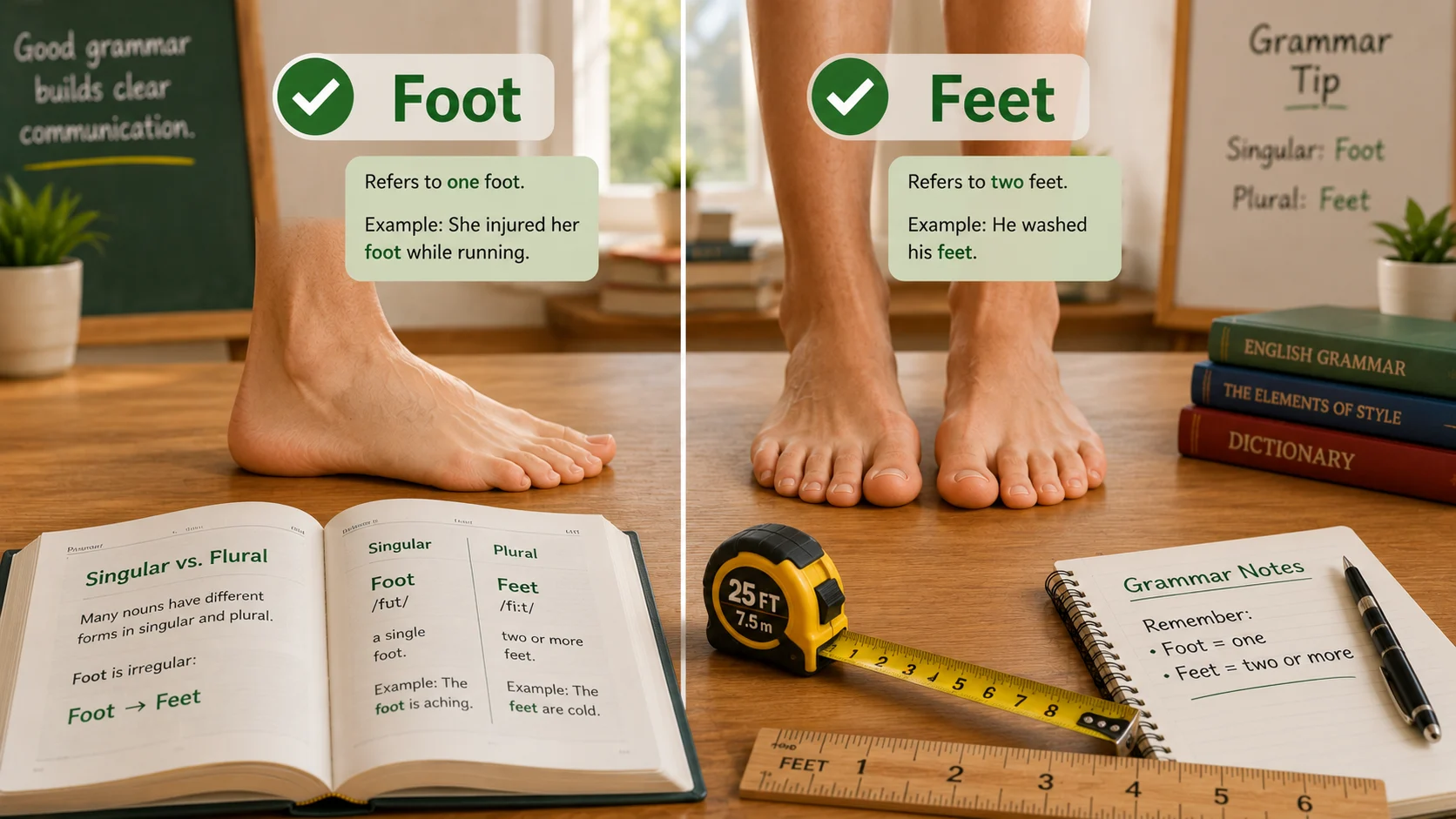
Feet or foot refers to the correct singular and plural forms of the same noun. Foot means one unit of the body or one unit of measurement, while feet is the irregular plural form used for two or more. Choosing the correct word helps your writing remain accurate, professional and grammatically correct.
Choosing between feet or foot seems simple at first, yet many writers pause before deciding which form belongs in a sentence. A foot is the singular noun that refers to one body part or one unit of length. Feet is its irregular plural form and is used whenever you are talking about two or more.
Confusion often happens because English contains many irregular plurals that do not simply add the letter s. Understanding when each form applies prevents grammar mistakes in academic writing, workplace communication, and everyday conversations.
Feet or Foot | What’s the Difference?
Both words are nouns, but they serve different grammatical purposes.
| Feature | Foot | Feet |
|---|---|---|
| Part of speech | Singular noun | Plural noun |
| Meaning | One body part or one unit of measurement | Two or more body parts or measurement units |
| Number | Singular | Plural |
| Example | My left foot hurts. | My feet are cold. |
| Measurement example | The table is one foot wide. | The wall is eight feet tall. |
The difference is straightforward once you focus on number. Use foot whenever you mean one. Use feet whenever you mean more than one. Although the meanings stay the same, the grammar changes according to the noun is singular or plural. This pattern applies both to the human body and to measurements.
Is Feet or Foot a Grammar, Vocabulary or Usage Issue?
The confusion between these words is primarily a grammar and usage issue rather than a vocabulary problem. Most English speakers understand what both words mean, but selecting the wrong form creates grammatical errors.
English nouns usually become plural by adding the letter s. For example, book becomes books, and chair becomes chairs. However, foot belongs to a group of irregular nouns whose plural forms change completely instead of following the usual pattern.
Because of this irregular pattern, the two words cannot be used interchangeably.
In formal writing, such as business reports, academic papers, or professional emails, using the wrong form immediately stands out as a grammar mistake. The same rule applies in casual conversations, although people may overlook the error more easily.
You are writing an essay, preparing a presentation, or asking an AI writing assistant to generate text, the distinction remains exactly the same. Grammar rules do not change with context.
How to Use Foot Correctly
The word foot always refers to one foot or one unit of measurement.
Whenever the noun is singular, foot is the correct choice.
Foot as a Body Part
If you are talking about one human or animal foot, use the singular form.
Examples
- She injured her foot during the basketball game.
- His left foot was covered with mud.
- The dog lifted one foot before crossing the stream.
Foot as a Unit of Measurement
The word foot is also the singular measurement unit.
Examples
- The plant grew one foot in a month.
- The package is exactly one foot long.
- The shelf measures one foot in depth.
Notice that numbers such as one, a, each, and every usually indicate that the singular form should follow.
Workplace Example
The safety officer inspected one foot of damaged cable before approving the repair.
Academic Example
The science experiment required a ruler that measured one foot.
Technology Example
The design software displays the object as one foot wide before scaling begins.
Common Expressions Using Foot
English also includes many idiomatic expressions that use the singular form.
Examples include
- Put your best foot forward.
- Get your foot in the door.
- Stand on one foot.
- Set foot inside.
Although these expressions may describe more than one person, the noun itself remains singular because the phrase has become a fixed expression.
Usage Recap
Remember one simple rule. If the sentence refers to exactly one body part or one unit of measurement, foot is always correct.
How to Use Feet Correctly
The word feet is the plural form of foot. Use it whenever you refer to two or more feet, you are discussing body parts or measurements.
Feet as Body Parts
Most people naturally talk about two feet, making this the form you will encounter most often.
Examples
- My feet are tired after the long walk.
- Her feet were soaked by the rain.
- The baby kicked his feet with excitement.
Feet as a Measurement
The plural form is also used for measurements greater than one.
Examples
- The ceiling is ten feet high.
- The river is fifteen feet deep.
- The rope is twenty feet long.
This rule applies regardless of how large the number becomes.
Workplace Example
The warehouse requires workers to stay six feet away from heavy machinery during maintenance.
Academic Example
The classroom model measured four feet in height.
Technology Example
The mapping application estimated the tower at three hundred feet tall.
Measurements With Decimal Numbers
One area that causes confusion is decimal measurements.
In standard English, measurements greater than one take the plural form.
Correct examples include
- One point five feet
- Two point two feet
- Three point seven feet
Only the exact number one takes the singular form.
Compare these examples.
- One foot
- One point one feet
- Five feet
This small rule prevents many common writing mistakes.
Everyday Examples
Here are a few additional examples that show how naturally the plural form appears.
- The children washed their feet before entering the house.
- The ladder stands eight feet tall.
- Cold weather often makes my feet feel numb.
- The painting hangs five feet above the floor.
- The athlete landed on both feet.
Usage Recap
Choose feet whenever the quantity is more than one. You are referring to body parts or measurements, the plural form remains the correct grammatical choice.
When You Should NOT Use Foot or Feet
Even though the distinction is simple, writers frequently make mistakes because they focus on the object rather than the number. The easiest way to avoid errors is to identify you are referring to one or more than one before choosing the noun.
Here are the most common situations where the wrong word appears.
| Situation | Correct Choice | Why |
|---|---|---|
| Referring to one body part | Foot | The noun is singular. |
| Referring to two body parts | Feet | The noun is plural. |
| Saying one unit of length | Foot | One always takes the singular form. |
| Saying any number greater than one | Feet | The plural form is required. |
| Using decimals greater than one | Feet | Decimal values greater than one are treated as plural. |
| Using fixed idioms such as put your best foot forward | Foot | The expression is grammatically fixed. |
| Talking about both human feet | Feet | Two body parts require the plural form. |
| Describing height or distance above one | Feet | Measurements greater than one are plural. |
A helpful habit is to pause for a second and ask yourself a simple question. Am I talking about one or more than one? The answer almost always tells you which word belongs in the sentence.
Common Mistakes and Decision Rules
Many learners understand the meanings of both words but still use the wrong form in everyday writing. The following examples highlight mistakes that appear frequently in emails, assignments, and online discussions.
| Correct Sentence | Incorrect Sentence | Explanation |
|---|---|---|
| My foot hurts today. | My feet hurts today. | Foot is singular, so it is correct when referring to one foot. |
| Her feet are cold. | Her foot are cold. | Feet is the plural form used for two feet. |
| The table is one foot wide. | The table is one feet wide. | Use foot after the number one. |
| The room is twelve feet long. | The room is twelve foot long. | Use feet for measurements greater than one. |
| He stood on one foot. | He stood on one feet. | A singular quantity requires foot. |
| The bridge is fifty feet high. | The bridge is fifty foot high. | Measurements above one always take feet. |
Decision Rule Box
Keep this simple rule in mind whenever you write.
If you mean exactly one, use foot.
If you mean two or more, use feet.
If you are expressing one unit of measurement, use foot.
If the measurement is greater than one, use feet.
If you are writing a common expression such as put your best foot forward, keep the singular form because it is part of the idiom.
Feet and Foot in Modern Technology and AI Tools
Modern grammar checkers, writing assistants, and artificial intelligence tools are generally excellent at recognizing the difference between foot and feet. They automatically examine the surrounding words to determine the noun should be singular or plural.
However, AI tools are not perfect. If a sentence is incomplete or lacks context, they may occasionally suggest the wrong form. For example, typing only five foot without additional context may confuse some systems before grammar correction occurs.
Voice assistants also rely on these grammar rules. When dictating measurements, saying one foot or five feet produces more accurate transcriptions.
You use document editors, grammar software, or AI writing platforms, understanding the rule yourself is still the safest approach.
The History of Foot and Feet
The word foot comes from Old English fot, while feet developed from the Old English plural fet. These forms existed long before Modern English took shape.
Many of today’s irregular plural nouns follow the same historical pattern. Words such as tooth and teeth, goose and geese, and man and men evolved through similar sound changes over hundreds of years.
Although the spellings look unusual today, they preserve an important part of the language’s history.
What Language Experts Say
Grammar experts consistently emphasize that subject number determines noun form.
“English irregular plurals must agree with the quantity being described. Accuracy begins with recognizing the noun is singular or plural.”
This principle appears in educational style guides, grammar textbooks, and professional writing manuals around the world.
Case Study One
A university writing center reviewed more than one thousand first year student essays. One recurring mistake involved irregular plural nouns such as foot and feet.
After instructors provided a short lesson explaining singular and plural agreement, grammar accuracy improved significantly during the following semester. Students also made fewer subject agreement errors across other irregular nouns.
Case Study Two
A customer service department noticed repeated measurement mistakes in installation manuals prepared by new employees. Instructions often mixed foot and feet, creating confusion for customers assembling equipment.
The company introduced a one page grammar reference for measurement units. Customer complaints related to unclear measurements dropped noticeably over the next several months, and editing time decreased because writers applied the correct form consistently.
Error Prevention Checklist
Use this quick checklist before publishing your writing.
✔ Always use foot when referring to one body part.
✔ Always use foot when the measurement is exactly one.
✔ Always use feet when referring to two body parts.
✔ Always use feet for measurements greater than one.
✔ Check numbers before choosing the noun.
✔ Remember that common idioms usually keep foot.
✔ Proofread measurements in technical writing carefully.
✔ Read the sentence aloud if you are unsure.
Related Grammar Confusions You Should Master
Expanding your understanding of similar grammar topics will improve both accuracy and confidence.
- Affect and effect
- Farther and further
- Less and fewer
- Much and many
- Then and than
- Bring and take
- Who and whom
- Lay and lie
- Its and it’s
- Amount and number
FAQs
Is it correct to say one foot or one feet?
The correct expression is one foot because the quantity is singular. The word feet is only used when referring to two or more body parts or measurement units.
Why is the plural of foot not foots?
English contains several irregular plural nouns that developed from older forms of the language. Instead of adding the letter s, the word changes internally, producing feet.
Should I write six foot or six feet?
Use six feet because any whole number greater than one requires the plural noun.
Why do people say six foot tall?
In some spoken expressions, especially before another noun, speakers sometimes use foot as part of a compound adjective. However, standard grammar for measurements is six feet tall.
Can foot refer to a unit of measurement?
Yes. Besides referring to a body part, foot is also a standard unit of length. When there is exactly one unit, use foot.
Is feet always plural?
Yes. Feet is the irregular plural form of foot and always refers to two or more.
How can I remember the difference easily?
Think of the number first. One equals foot. More than one equals feet. This simple habit prevents almost every mistake.
Do grammar checking tools always correct foot and feet correctly?
Most modern grammar tools identify the correct form based on context, but proofreading remains important because unusual sentence structures can occasionally confuse automated systems.
Conclusion
Understanding the difference between feet and foot is easier than many learners expect. The rule depends entirely on number. Use foot whenever you mean one body part or one unit of measurement. Use feet whenever the quantity is greater than one. Although English irregular plurals can seem challenging at first, this distinction quickly becomes natural with practice.
You are writing an academic paper, preparing a business report, creating online content, or simply sending a message to a friend, choosing the correct form improves clarity and professionalism. Once you remember that one means foot and more than one means feet, you will rarely make this grammar mistake again.
Discover More Related Articles:
- Input or Imput | One Letter Can Cost You Credibility In 2026
- Latter or Ladder | Why This Pair Confuses So Many Writers In 2026
- Niece or Neice | Never Get This Spelling Wrong Again In 2026