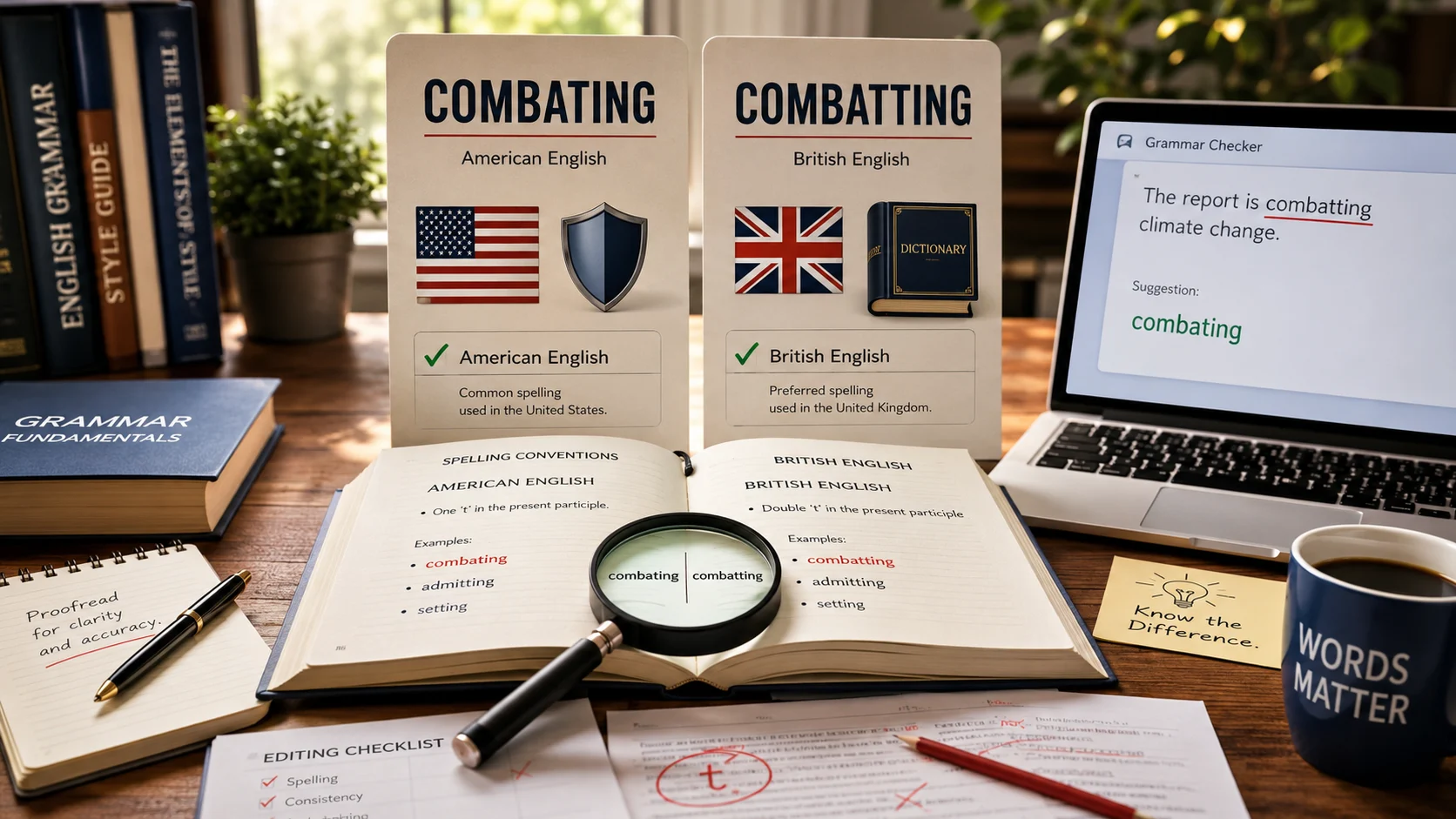
Combating or combatting are both accepted spellings of the present participle of the verb combat. Combating is the preferred spelling in American English, while combatting is more common in British English. Both forms mean fighting against, resisting, or working to eliminate something, but the preferred spelling depends on the variety of English you are using.
The question combating or combatting often confuses writers because both spellings appear in dictionaries, newspapers, and academic publications. At first glance, they seem interchangeable, yet choosing the wrong form for your audience can make your writing look inconsistent. Both words are present participles of the verb combat, which means to fight against, oppose, or prevent something harmful. The difference lies in spelling conventions rather than meaning.
American English generally prefers combating, while British English often accepts combatting by doubling the final consonant before adding ing. Understanding this distinction helps students, professionals, researchers, and content creators maintain consistency and credibility in their writing.
Combating or Combatting | What’s the Difference?
Although both spellings express the same action, they follow different spelling conventions.
Combating follows the standard American English practice of adding ing without doubling the final consonant.
Combatting follows a British English pattern in which the final consonant is doubled before adding ing.
Both forms are grammatically correct, but they should not be mixed within the same document.
| Feature | Combating | Combatting |
|---|---|---|
| Part of speech | Present participle and gerund | Present participle and gerund |
| Meaning | Fighting against or resisting something | Fighting against or resisting something |
| Preferred English | American English | British English |
| Dictionary acceptance | Accepted by major dictionaries | Accepted by major dictionaries |
| Formal writing | Preferred in American publications and style guides | Preferred in many British publications and style guides |
| Pronunciation | Same pronunciation as combatting | Same pronunciation as combating |
| Common usage | More common worldwide because of American English influence | More common in British English contexts |
| Recommended audience | Readers using American English | Readers using British English |
Both spellings represent exactly the same action and carry the same meaning. The only real distinction is regional spelling preference. If you are writing for an American audience, choose combating. If your readers primarily use British English, combatting may be more appropriate. Consistency throughout your document is more important than the choice itself.
Is Combating or Combatting a Grammar, Vocabulary or Usage Issue?
The difference between these two spellings is a usage issue, not a grammar issue.
From a grammatical perspective, both words function identically. They are present participles and can also serve as gerunds.
Vocabulary is not the source of confusion either because both words come from the same verb and share the same definition.
Instead, the variation results from regional spelling conventions. American English usually avoids doubling the final consonant in this word, whereas British English often doubles it.
In formal academic writing, publishers generally follow the spelling style required by their chosen style guide. A university in the United States will usually expect combating, while a British institution may accept or prefer combatting.
In casual writing, either form is understandable, provided the spelling remains consistent throughout the text.
Quick Comparison
| Question | Answer |
|---|---|
| Is it a grammar mistake? | No. Both combating and combatting are grammatically correct spellings. |
| Is it a vocabulary difference? | No. They are different spellings of the same word and have the same meaning. |
| Is it a usage difference? | Yes. The difference is based on American and British English spelling conventions. |
| Can both be correct? | Yes. Both spellings are accepted by major dictionaries and style guides. |
| Should both appear in one document? | No. Choose either American or British English and use that spelling consistently throughout the document. |
Practical Usage of Combating
The spelling combating is the standard choice in American English. It appears frequently in newspapers, government reports, business communication, educational resources, and online publications intended for American readers.
Workplace Example
The company is combating cyber threats through continuous employee training and stronger security measures.
Academic Example
Researchers are combating antibiotic resistance by developing innovative treatment strategies.
Technology Example
Artificial intelligence is combating online fraud by identifying suspicious activity in real time.
Additional Everyday Examples
The community is combating air pollution by planting thousands of new trees.
Doctors are combating seasonal illnesses through expanded vaccination programs.
Schools are combating bullying by introducing awareness campaigns.
Volunteers are combating food waste by distributing surplus meals to local families.
Environmental groups are combating plastic pollution through recycling initiatives.
Usage Recap
American English writers should generally choose combating for professional, academic, and everyday writing. It is widely recognized, easy to read, and consistent with American spelling conventions.
Practical Usage of Combatting
The spelling combatting is commonly found in British English publications. While its meaning is identical to combating, it reflects a different spelling convention that doubles the final consonant before adding ing.
Workplace Example
The organisation is combatting workplace discrimination through updated employment policies.
Academic Example
Scientists are combatting climate related challenges with sustainable agricultural research.
Technology Example
Cybersecurity experts are combatting ransomware attacks using advanced detection systems.
Additional Everyday Examples
Local charities are combatting homelessness through expanded housing support.
Healthcare workers are combatting infectious diseases with improved preventive care.
Teachers are combatting misinformation by promoting critical thinking skills.
Governments are combatting illegal trafficking through international cooperation.
Communities are combatting water shortages by encouraging responsible conservation.
Usage Recap
British English writers may prefer combatting, especially when following regional spelling conventions. Although it is less common in American publications, it is still grammatically correct and carries exactly the same meaning as combating. Consistency with your chosen variety of English remains the most important rule.
When You Should NOT Use Combating or Combatting
Even though both spellings are correct, there are situations where neither is the right choice. Understanding these common mistakes will improve the clarity and professionalism of your writing.
| Situation | What to Use Instead | Reason |
|---|---|---|
| Referring to a person who fights | Combatant | The word refers to a person, not an action. |
| Referring to military conflict as a noun | Combat | The base noun is needed rather than the present participle. |
| Writing in one document with mixed spelling styles | Choose one spelling | Mixing American and British spellings looks inconsistent. |
| Describing a completed action | Combated | Use the past tense instead of the present participle. |
| Describing a future action | Will combat | The future tense is more appropriate. |
| Using it as an adjective without context | Rewrite the sentence | A different adjective may communicate the idea more clearly. |
| Writing for a publication with a style guide | Follow the required spelling | Publishers expect consistency with their preferred variety of English. |
| Using the word where preventing or reducing fits better | Use the more precise verb | Select the word that best matches the intended meaning. |
Common Mistakes and Decision Rules
Many writers know the meaning of the word but still make spelling mistakes because they switch between American and British English. Others incorrectly assume the double t changes pronunciation or meaning. The following examples highlight the most common errors.
| Correct Sentence | Incorrect Sentence | Explanation |
|---|---|---|
| The organization is combating online fraud. | The organization is combatting online fraud in an American English document. | American English generally prefers combating. |
| The charity is combatting poverty across the region. | The charity is combating poverty in a document written entirely in British English. | British English commonly prefers combatting. |
| The team is combating cyber attacks. | The team is combatting cyber attacks and combating misinformation in the same report. | Avoid mixing American and British spelling styles in one document. |
| Scientists are combating disease through research. | Scientists are combat disease through research. | The sentence requires the present participle combating, not the base verb combat. |
| Governments are combatting illegal trade. | Governments are combatant illegal trade. | Combatant is a noun referring to a person who fights, not a verb. |
| Volunteers are combating hunger every day. | Volunteers are combat every day. | The sentence needs the present participle to describe an ongoing action. |
| Healthcare workers are combating infectious diseases. | Healthcare workers are combatting infectious diseases in an American style guide. | Use combating when following American English conventions. |
| Environmental groups are combatting climate related challenges. | Environmental groups are combating climate related challenges in a British English publication. | Use combatting when following British English spelling conventions. |
Decision Rule Box
| If You Mean | Use |
|---|---|
| The action of fighting against something in American English | Combating |
| The action of fighting against something in British English | Combatting |
| A person involved in fighting | Combatant |
| The act or state of fighting as a noun | Combat |
Combating or Combatting in Modern Technology and AI Tools
Modern writing assistants, grammar checkers, and artificial intelligence tools usually recognize both spellings as correct. However, most applications automatically recommend the spelling that matches the selected language setting. For example, an editor configured for American English will normally suggest combating, while a British English setting may recommend combatting. Choosing the correct language before writing helps maintain consistency across documents.
Etymology
The verb combat comes from the Old French combatre, which originated from the Late Latin combattere, meaning to fight together. Over time, the word expanded beyond physical conflict and now commonly describes resisting diseases, crime, pollution, misinformation, poverty, and many other challenges.
Clear writing depends not only on correct grammar but also on consistent language conventions. Choosing one spelling system and following it throughout a document strengthens credibility.”
Case Study One
A United States health organization revised more than two hundred website articles to follow American English spelling. Replacing every instance of combatting with combating improved consistency across the site and reduced editorial corrections during future updates.
Case Study Two
A university in the United Kingdom standardized its publications using British English. Editors changed every occurrence of combating to combatting where appropriate. The revision created a uniform writing style that matched the institution’s official language policy and simplified proofreading.
Error Prevention Checklist
| Always Use | Never Do |
|---|---|
| Use combating when writing in American English. | Do not mix American and British spellings in the same document. |
| Use combatting when following British English conventions. | Do not assume the two spellings have different meanings. |
| Follow your publisher’s or organization’s style guide. | Do not use combatant when you mean the action of fighting against something. |
| Keep your spelling consistent from the beginning to the end of the document. | Do not switch between combating and combatting halfway through your writing. |
| Set your writing software to the correct English variant before editing. | Do not rely only on spell check without considering your target audience. |
| Choose the spelling that matches your readers’ regional English. | Do not change spellings randomly for variety or style. |
| Proofread for consistency before publishing. | Do not ignore your editor’s or publication’s preferred spelling convention. |
Related Grammar Confusions You Should Master
| Grammar Topic | What You Will Learn |
|---|---|
| Travelling or Traveling | British and American spelling differences |
| Labelled or Labeled | Double-consonant spelling rules |
| Cancelled or Canceled | Regional English spelling preferences |
| Modelled or Modeled | British and American verb-ending variations |
| Licence or License | Noun and verb distinction in British English |
| Practice or Practise | British English noun and verb usage |
| Toward or Towards | Regional preference without a change in meaning |
| Aging or Ageing | Accepted spelling conventions across English varieties |
| Focused or Focussed | Style guide and regional spelling differences |
| Program or Programme | American and British vocabulary and spelling differences |
FAQs
Is combating or combatting correct?
Both spellings are correct. American English usually prefers combating, while British English commonly accepts combatting.
Which spelling is used in American English?
American dictionaries and style guides generally recommend combating as the standard spelling.
Why does British English use combatting?
British spelling often doubles the final consonant before adding ing to certain verbs, making combatting an accepted form.
Do combating and combatting have different meanings?
No. Both words mean fighting against, resisting, or working to eliminate something harmful.
Can I use both spellings in one article?
No. Choose one spelling based on your target audience and use it consistently throughout the document.
Is combatting considered incorrect?
No. It is a correct spelling in British English and appears in respected dictionaries and publications.
Which spelling should students use?
Students should follow the spelling style required by their school, university, or publication guidelines.
Do grammar checkers recognize both spellings?
Yes. Most grammar tools recognize both forms and recommend one according to the selected language setting.
Conclusion
Choosing between combating and combatting is not about correctness but about consistency. Both spellings represent the same action of fighting against or resisting something harmful. American English generally prefers combating, while British English commonly accepts combatting. By following the language style expected by your audience and remaining consistent throughout your writing, you can produce polished, professional, and credible content every time.
Discover More Related Articles:
- Sowing or Sewing | What Is the Difference & When Should You Use Each In 2026
- Canon or Cannon | Understanding the Difference & Using Each Word Correctly In 2026
- Majorca or Mallorca | Why Does the Island Have Two Names In 2026