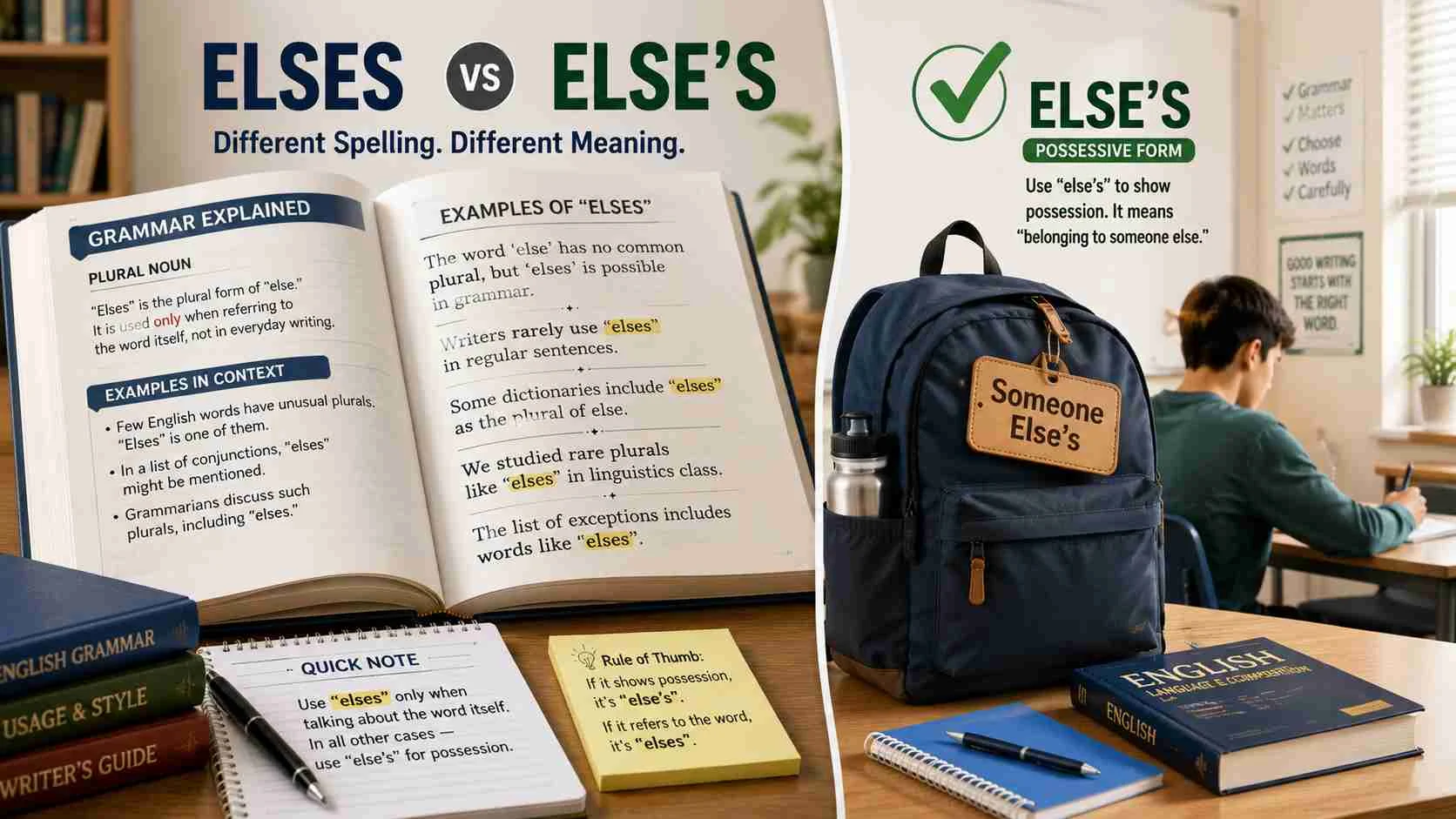
The confusion between elses or else’s comes from the apostrophe. Else’s is the correct possessive form of the word else, meaning something belongs to another person. Elses is rarely used and is only correct in very limited grammatical contexts when referring to multiple instances of the word else. For everyday writing, else’s is almost always the correct choice.
If you’ve ever paused while writing elses or else’s, you’re not alone. These two forms look nearly identical, yet they serve very different purposes. Else’s is the possessive form of else, while elses is an uncommon plural that appears only in specialized grammatical discussions.
Mixing them up can make your writing appear less polished, especially in academic, business, and professional communication. Understanding the difference will help you write with greater confidence and accuracy.
Elses or Else’s | What’s the Difference?
Although the two words differ by only one apostrophe, they have completely different grammatical functions.
| Feature | Else’s | Elses |
|---|---|---|
| Part of speech | Possessive form | Plural noun |
| Meaning | Belonging to someone else | Multiple occurrences of the word else |
| Common in everyday English | Yes | No |
| Used in formal writing | Frequently | Rarely |
| Grammatically correct in normal sentences | Yes | Almost always no |
| Example | That is someone else’s notebook. | The editor counted several elses in the manuscript. |
The easiest way to remember the difference is to focus on possession. Whenever you want to show that something belongs to another person, else’s is the correct form.
The plural elses almost never appears in ordinary writing. It is mainly found in dictionaries, grammar books, or linguistic discussions where people are talking about the word else itself rather than using it in a sentence.
For most writers, using else’s correctly will solve nearly every situation involving this grammar question.
Is Elses or Else’s a Grammar, Vocabulary or Usage Issue?
This is primarily a grammar and usage issue, not a vocabulary problem.
Most English learners already understand the meaning of else. The confusion begins when they need to change the word into another grammatical form.
The word else is an adverb or adjective that means other or different from the one already mentioned. When possession needs to be shown, English adds an apostrophe followed by the letter s, creating else’s.
For example:
- This is someone else’s umbrella.
- We parked in somebody else’s driveway.
- I accidentally opened someone else’s email.
In each sentence, the apostrophe clearly shows ownership.
The word elses, on the other hand, is a plural noun. It refers to more than one instance of the actual word else. Because ordinary conversations almost never require people to discuss multiple occurrences of the word itself, this form remains extremely uncommon.
Are They Interchangeable?
No.
Replacing else’s with elses changes the grammar and usually creates an incorrect sentence.
Correct:
Someone else’s opinion matters.
Incorrect:
Someone elses opinion matters.
Likewise, adding an apostrophe where a plural is intended would also be incorrect.
Correct:
The proofreader removed several elses from the draft.
Incorrect:
The proofreader removed several else’s from the draft.
Although this second situation is grammatically correct only in discussions about language, it demonstrates that each form has a unique purpose.
Formal Versus Informal Writing
The possessive else’s appears in every style of English.
It is perfectly acceptable in:
- academic papers
- workplace communication
- legal documents
- business emails
- newspapers
- books
- everyday conversation
For example:
The company cannot access anyone else’s confidential files.
This sentence is appropriate in both a legal policy and a casual office conversation.
The plural elses appears mostly in linguistic research, editing manuals, dictionaries, and grammar discussions.
Academic Versus Casual Usage
Students frequently encounter else’s in essays because ownership is discussed regularly.
For example:
The researcher relied on someone else’s findings.
Teachers also encourage students to use the possessive correctly to avoid ambiguity.
Meanwhile, elses might appear only in a linguistics textbook discussing word frequency.
Example:
The corpus contains twenty seven elses across the collected interviews.
Outside this context, most readers may never encounter the word.
Practical Usage of Else’s
Because else’s is the form most writers need, it deserves close attention.
Think of it as the possessive version of else. Whenever something belongs to another person, another group, or another source, else’s is the correct choice.
Here are several examples across different situations.
Everyday Conversation
People naturally use else’s when talking about possessions.
Examples:
That is someone else’s jacket.
Please do not sit in anybody else’s seat.
I accidentally picked up someone else’s phone.
Each sentence clearly indicates ownership without repeating a person’s name.
Workplace Example
Professional communication often involves documents, equipment, accounts, and responsibilities.
Example:
Please avoid editing someone else’s presentation without permission.
Another example:
Never access someone else’s confidential records.
Using the correct possessive form keeps workplace writing professional and grammatically accurate.
Academic Example
Students and researchers regularly refer to another person’s ideas and work.
Example:
You should never copy someone else’s research without proper citation.
Another example:
The professor encouraged students to evaluate someone else’s argument objectively.
These examples demonstrate why mastering else’s is especially important in academic writing.
Technology Example
Digital communication has made this expression even more common.
Example:
Do not log into someone else’s account.
Another example:
Never share someone else’s password online.
Cybersecurity advice frequently uses else’s because ownership is central to digital privacy.
Additional Examples
Consider how naturally the possessive fits into everyday English.
That belongs to somebody else’s family.
She borrowed someone else’s calculator.
He parked in someone else’s space.
We accidentally downloaded someone else’s files.
The children found someone else’s picnic basket.
None of these sentences would be correct if elses replaced else’s.
Why Native Speakers Prefer Else’s
Native speakers instinctively recognize possession through the apostrophe.
Without it, readers may hesitate or assume a grammatical mistake.
That is one reason editors often correct missing apostrophes before publication.
Modern style guides consistently recommend using else’s whenever possession is intended because it follows standard English possessive rules.
Common Expressions Using Else’s
Many everyday expressions rely on the possessive form.
Someone else’s opinion
Someone else’s mistake
Someone else’s responsibility
Someone else’s decision
Someone else’s property
Somebody else’s idea
Anybody else’s turn
Nobody else’s business
These phrases appear regularly in newspapers, books, websites, classrooms, and professional communication.
Usage Recap
Whenever ownership belongs to another person, else’s is the correct choice. It is accepted in formal writing, informal conversation, academic work, business communication, and digital content. For the overwhelming majority of English writers, else’s is the form you will use almost every time, while elses remains limited to discussions about the word itself.
Practical Usage of Elses
Unlike else’s, the word elses is extremely uncommon in everyday English. Many native speakers go years without ever seeing it in print. That does not mean it is incorrect. It simply serves a very different purpose.
Elses is the plural form of the word else when you are referring to the word itself rather than using it in a sentence. This type of usage belongs mainly to grammar books, dictionaries, editing guides, and linguistic research.
If you are writing about language, spelling, or grammar, you may occasionally need the plural form.
Workplace Example
Professional editors and proofreaders sometimes discuss repeated words during the editing process.
Example:
The editor found several elses that could be removed to improve sentence flow.
Another example:
The style review identified unnecessary elses throughout the report.
Here, the discussion is about the word else, not about ownership.
Academic Example
Linguists often analyze how words appear across different texts.
Example:
The researcher counted all the elses that appeared in the historical manuscripts.
Another example:
The corpus analysis showed fewer elses in modern English than in older writing.
These examples are appropriate because they examine the word as a language item.
Technology Example
Language processing software may analyze repeated vocabulary.
Example:
The grammar checker highlighted several elses for review during the editing process.
Another example:
The natural language processing model identified duplicate elses in the training dataset.
Again, the software is identifying occurrences of the word itself.
Additional Examples
The dictionary contains examples of several elses used in different contexts.
The textbook explains why multiple elses appear in historical documents.
The proofreader removed unnecessary elses before publication.
The grammar guide compares the use of elses across different writing styles.
These examples are rare because most people do not write about words themselves.
Why Elses Is Rare
English speakers almost always use else as part of a sentence instead of discussing the word itself.
For example, people naturally say:
Someone else’s coat
Anybody else’s opinion
Nobody else’s responsibility
These expressions require the possessive form rather than the plural.
As a result, elses appears almost exclusively in educational or linguistic writing.
Usage Recap
Use elses only when referring to more than one occurrence of the actual word else. It is a legitimate plural noun, but it has little place in ordinary communication. If your sentence is about ownership, else’s is almost certainly the correct choice.
When You Should NOT Use X or Y
Knowing when not to use each form is just as important as knowing when to use it. Many grammar mistakes occur because writers apply one form in situations where the other is required.
| Situation | Correct Choice | Reason |
|---|---|---|
| Showing ownership | Else’s | Possessive form is required |
| Talking about multiple occurrences of the word else | Elses | Plural noun is required |
| Writing business emails | Else’s | Ownership is being expressed |
| Writing essays about another person’s work | Else’s | Indicates possession |
| Discussing grammar terminology | Elses | Refers to the word itself |
| Writing social media captions | Else’s | Normal English usage |
| Writing legal documents | Else’s | Standard possessive form |
| Referring to repeated vocabulary items | Elses | Discusses language rather than ownership |
If you remember that else’s shows possession while elses names multiple instances of the word, most mistakes disappear immediately.
Common Mistakes and Decision Rules
Many writers omit the apostrophe because they assume every word ending in s follows the same pattern. Others add an apostrophe where only a plural is needed. The following examples show the difference.
| Correct Sentence | Incorrect Sentence | Explanation |
|---|---|---|
| That is someone else’s bag. | That is someone elses bag. | Possession requires an apostrophe. |
| Please respect somebody else’s opinion. | Please respect somebody elses opinion. | Ownership must be shown. |
| The editor found several elses. | The editor found several else’s. | This is a plural noun, not a possessive. |
| We borrowed someone else’s laptop. | We borrowed someone elses laptop. | Standard possessive grammar applies. |
| The textbook explains different elses. | The textbook explains different else’s. | Talking about the word itself requires the plural. |
| Nobody else’s account should be accessed. | Nobody elses account should be accessed. | Apostrophe indicates possession. |
Decision Rule Box
If you mean ownership, use else’s.
If you mean multiple occurrences of the word else, use elses.
This simple rule covers almost every situation you will encounter.
Elses and Else’s in Modern Technology and AI Tools
Modern grammar checking software has become remarkably good at identifying apostrophe mistakes.
Writing assistants powered by artificial intelligence can usually recognize when a possessive form is required and suggest else’s instead of elses. However, these tools occasionally struggle when editing linguistic or academic documents because elses is so uncommon.
Search engines, predictive keyboards, and autocorrect systems also tend to favor else’s because it appears far more frequently in published English.
Even advanced AI writing systems perform best when writers understand the grammar themselves. Reviewing apostrophes before publishing remains an important habit, especially in professional communication.
The Etymology of Else
The word else comes from Old English, where it referred to something different or additional. Over centuries, it evolved into the familiar adjective and adverb used today.
As English developed clear possessive rules, else’s naturally became the accepted possessive form. The plural elses appeared much later and remained limited to discussions about language itself rather than everyday communication.
Expert Insight
“Small punctuation marks often carry significant grammatical meaning. A single apostrophe can completely change how readers interpret a sentence, making precision essential in professional writing.”
This principle explains why editors pay close attention to possessive forms such as else’s.
Case Study One
A university writing center reviewed more than five hundred student essays and found that apostrophe errors ranked among the most common grammar mistakes. After introducing a short lesson on possessives, including words such as else’s, editing accuracy improved noticeably, and students produced clearer academic writing.
Case Study Two
A corporate communications team audited internal emails before launching a company style guide. They discovered repeated mistakes involving possessive words, particularly someone else’s and anyone else’s. After providing targeted grammar training, proofreading time decreased and document quality improved across departments.
Error Prevention Checklist
Use this quick checklist whenever you are unsure which form to choose.
Always use Else’s when
☑ You are showing ownership.
☑ Something belongs to another person.
☑ Writing business documents.
☑ Writing academic papers.
☑ Writing emails or reports.
☑ Referring to another person’s ideas, property, or responsibilities.
Never use Elses when
☑ You are trying to show possession.
☑ You mean another person’s belongings.
☑ You are writing ordinary conversation.
☑ You are writing professional communication.
☑ You simply forgot the apostrophe.
☑ The sentence is not discussing the word else itself.
Following this checklist will help you avoid one of the most common punctuation mistakes involving the word else.
Related Grammar Confusions You Should Master
Learning the difference between elses and else’s is just one step toward stronger grammar skills. English contains many word pairs that look or sound similar but have completely different meanings or grammatical functions. Mastering these common confusions will improve your writing in every setting.
Its or It’s involves possession versus a contraction. Its shows ownership, while it’s means it is or it has.
Your or You’re is one of the most common mistakes in English. Your is possessive, whereas you’re is short for you are.
Whose or Who’s follows the same pattern. Whose indicates possession, while who’s is the contraction of who is or who has.
Their, There, or They’re requires choosing between possession, location, and a contraction. Although they sound alike, they perform completely different grammatical roles.
Anyone or Any One depends on meaning. Anyone refers to any person, while any one emphasizes a single member of a group.
Everyone or Every One follows a similar distinction. One is an indefinite pronoun, and the other refers to each individual item within a group.
Who or Whom remains important in formal writing. Who functions as the subject of a sentence, while whom serves as the object.
Affect or Effect often causes confusion because one is usually a verb and the other is typically a noun.
Then or Than separates time from comparison. Choosing the wrong word can completely change the meaning of a sentence.
Lay or Lie challenges even experienced writers because the present and past tense forms differ significantly.
Understanding these grammar pairs alongside elses and else’s will strengthen your confidence and reduce common writing errors.
FAQs
Is else’s grammatically correct?
Yes. Else’s is the standard possessive form of else. Use it whenever you want to show that something belongs to another person. For example, That is someone else’s backpack is completely correct.
Is elses a real word in English?
Yes. Elses is a legitimate English word, but it is very rare. It is the plural form of the word else and is mainly used in grammar books, dictionaries, editing discussions, and linguistic research.
Should I write someone else’s or someone elses?
You should write someone else’s. The apostrophe shows possession. Writing someone elses without an apostrophe is considered a grammatical error in standard English.
Why does else’s need an apostrophe?
The apostrophe indicates possession. In the phrase someone else’s car, the car belongs to another person. Without the apostrophe, the sentence no longer follows standard English grammar.
Can I use elses in everyday writing?
Almost never. Unless you are discussing the word else itself, you will rarely have a reason to use elses. In ordinary conversation and professional writing, else’s is nearly always the correct choice.
How do grammar checkers treat else’s and elses?
Most grammar checkers recognize else’s as the correct possessive form and will often flag elses if it appears in a normal sentence. However, advanced editing tools usually accept elses when it is used correctly in discussions about language.
What is the easiest way to remember the difference between elses and else’s?
Think about ownership. If something belongs to another person, choose else’s. If you are talking about multiple occurrences of the actual word else, choose elses.
Can else’s be used in formal writing?
Absolutely. Else’s is appropriate in academic essays, business reports, legal documents, research papers, professional emails, and everyday communication.
Why do so many people confuse elses and else’s?
The confusion comes from the apostrophe. Many writers mistakenly assume that adding or removing an apostrophe creates a plural form. In reality, the apostrophe changes the word into a possessive, while the plural form is used only in very specialized contexts.
Conclusion
Understanding the difference between elses or else’s is much easier once you recognize their grammatical roles. Else’s is the possessive form used to show that something belongs to another person, making it the correct choice in almost every real world sentence. Elses, on the other hand, is a rare plural noun that refers only to multiple instances of the word else itself.
Whenever you are writing an email, preparing an academic assignment, creating business documents, or posting online, the possessive else’s is almost certainly the form you need. Keeping this simple distinction in mind will help you avoid punctuation mistakes, communicate more clearly, and produce polished, professional writing.
By remembering one straightforward rule, you can confidently choose the correct form every time. If the sentence expresses ownership, write else’s. If you are discussing the word else as a language item, write elses.
Discover More Related Articles:
- Feet or Foot | The Grammar Rule Everyone Should Know In 2026
- Light or Lite | The Branding Trick Most People Miss In 2026
- Planning or Planing | The Tiny Spelling Difference That Matters In 2026