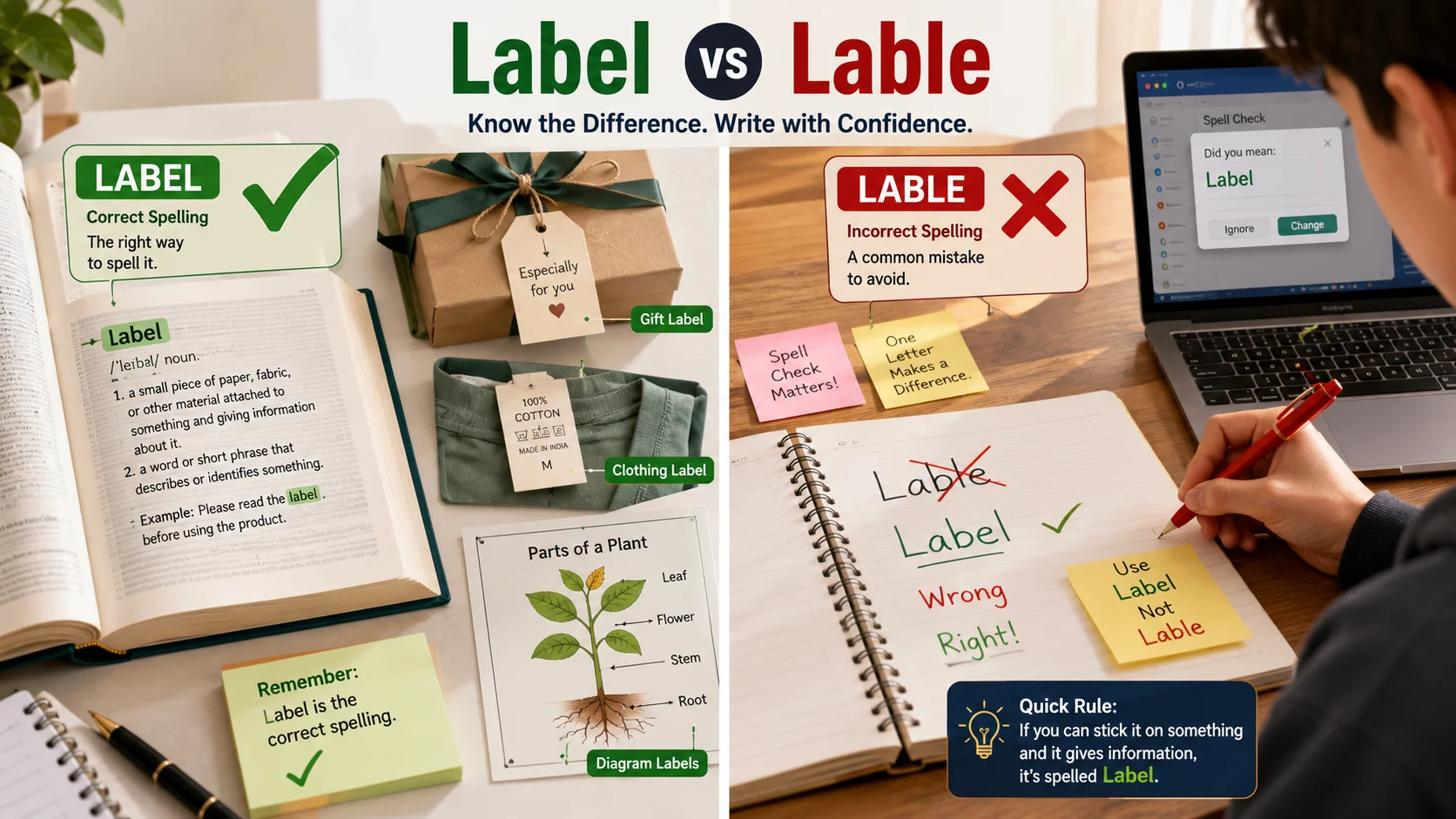
Label or lable is a common spelling confusion because both words look believable at first glance. Label is the correct English spelling, while lable is a misspelling that should never be used in standard writing. Knowing the difference helps you avoid spelling mistakes in academic, professional and everyday communication.
The confusion between label or lable affects students, professionals, writers, and even native English speakers. Since the letters appear in a slightly different order, many people accidentally type lable instead of label, especially when writing quickly. This simple mistake can reduce the credibility of emails, reports, presentations, and online content.
The word label is a noun and a verb. As a noun, it refers to a tag, sticker, or description attached to something. As a verb, it means to identify, classify, or mark something with a name or category. On the other hand, lable has no accepted meaning in English because it is simply a spelling error.
Learning the correct spelling is important because modern spell checkers do not always catch every mistake, especially when typing on mobile devices or using predictive text. Once you understand the spelling pattern, choosing the correct word becomes easy.
Label vs Lable | What’s the Difference?
Although these words look similar, only one belongs in the English language.
| Feature | Label | Lable |
|---|---|---|
| Part of speech | Noun and verb | Not a recognized word |
| Correct spelling | Yes | No |
| Meaning | A tag, description, or the act of identifying something | None |
| Accepted in dictionaries | Yes | No |
| Used in academic writing | Yes | Never |
| Used in professional writing | Yes | Never |
| Should you use it | Always when referring to identification or classification | Never |
The easiest way to remember the difference is that label is the only correct spelling recognized in English dictionaries. The spelling lable appears only because people accidentally switch the positions of the letters e and l. Whenever you need to describe, identify, organize, or classify something, label is always the correct choice.
Is Label or Lable a Grammar, Vocabulary or Usage Issue?
The confusion between label or lable is primarily a spelling issue rather than a grammar problem. The meaning never changes because only one version is accepted in standard English.
Grammar deals with sentence structure, vocabulary concerns word meaning, and usage explains how words fit different situations. In this case, the challenge comes from remembering the correct letter order.
Many English learners assume both spellings exist because other English words have similar letter arrangements. However, dictionaries, style guides, educational institutions, and publishers recognize only label.
In formal writing such as business reports, research papers, resumes, and official correspondence, using lable creates an obvious spelling mistake. In casual messages, readers may still understand your meaning, but the error can leave an unprofessional impression.
Academic institutions also expect students to use label consistently in essays, examinations, scientific diagrams, and presentations. Since spelling accuracy contributes to clarity, choosing the correct form strengthens your writing.
Modern writing tools such as grammar checkers, word processors, and proofreading software automatically suggest replacing lable with label, reflecting the accepted standard across English speaking countries.
You write American English or British English, the spelling remains exactly the same. Unlike words such as color and colour, there is no regional variation for label.
By remembering that only one spelling exists, you can avoid one of the most common typing errors in English.
Understanding the Word Label
The word label serves two important functions in English because it can act as both a noun and a verb.
As a noun, it refers to a piece of information attached to an object. This may be a sticker on a product, a tag on clothing, a file name on a computer, or a description used to identify something.
Examples include:
The product label lists all the ingredients.
Please read the warning label before opening the package.
The shipping label contains the delivery address.
As a verb, label means to identify, classify, or describe someone or something.
Examples include:
Please label each folder before storing it.
The teacher asked students to label every part of the diagram.
Researchers carefully labeled each sample before testing.
Because the same spelling works for both meanings, writers only need to remember one correct form regardless of how the word is used.
Why Do People Misspell Label as Lable?
The mistake happens because the human brain often rearranges letters while typing familiar words. This phenomenon is called letter transposition.
Several factors contribute to this spelling error.
People type quickly without checking each letter.
Mobile keyboards encourage accidental letter swaps.
Predictive text sometimes fails to correct uncommon typing patterns.
The pronunciation of label does not strongly emphasize the final letter order.
Many learners incorrectly assume the ending follows another spelling pattern.
Fortunately, the solution is simple. Remember that the word ends with el, not le.
A useful memory trick is to think of the sentence:
Every label ends with EL.
Repeating this phrase while writing helps reinforce the correct spelling until it becomes automatic.
Why Correct Spelling Matters
Some spelling mistakes seem minor, but they can affect how readers judge your writing. Using label correctly demonstrates attention to detail and professionalism.
Imagine submitting a job application that says:
“Please lable the attached documents.”
Although the intended meaning is clear, employers may notice the spelling error immediately.
Similarly, in education, a science teacher may ask students to label parts of a plant or diagram. Writing lable instead could result in lost marks because spelling is part of accurate communication.
Businesses also rely on correct labeling for packaging, product safety, shipping, and legal compliance. Even a small spelling error can create confusion or reduce customer trust.
You are writing emails, designing presentations, creating websites, organizing files, or publishing articles, using label instead of lable ensures your writing remains accurate, polished, and professional.
Practical Usage of Label
The word label appears in almost every type of writing because it helps identify, organize, classify, or describe people, objects, and information. Since it functions as both a noun and a verb, understanding its practical use makes your writing clearer and more professional.
In business communication, labels help employees organize documents, products, and digital files.
Workplace example
Please label every storage box before moving it to the warehouse.
The manager asked the team to label each customer file correctly.
In education, teachers frequently ask students to identify parts of diagrams or charts by adding labels.
Academic example
Students should label each part of the human heart in the biology diagram.
Remember to label every axis before submitting the graph.
Technology also relies heavily on labels to organize information and improve user experience.
Technology example
You can label your emails to find them more quickly.
The software automatically labels uploaded images using artificial intelligence.
Writers, researchers, designers, and developers also use labels every day to organize information efficiently. It is a clothing tag, a product description, a chart heading, or a digital folder, the word label always carries the idea of identification or classification.
Usage Recap
Always use label when referring to a tag, description, category, or the act of identifying something. It is the only correct spelling in every variety of English.
Practical Usage of Lable
Unlike label, the word lable has no accepted meaning in English. It does not appear as a standard word in reputable dictionaries and should never be used in formal or informal writing.
Most instances of lable happen because of fast typing or accidental letter reversal.
Consider these examples.
Incorrect workplace example
Please lable every package before shipping.
Correct version
Please label every package before shipping.
Incorrect academic example
Lable the diagram carefully.
Correct version
Label the diagram carefully.
Incorrect technology example
Click here to create a new lable.
Correct version
Click here to create a new label.
Spell checking software usually identifies lable as an error, but relying entirely on automatic correction is not a good habit. Developing the ability to recognize the correct spelling yourself improves your overall writing accuracy.
Usage Recap
Never write lable in essays, emails, presentations, reports, websites, or professional documents. Replace it with label every time.
When You Should NOT Use Label or Lable
Understanding when not to use these spellings can prevent unnecessary mistakes.
| Situation | Correct Choice | Reason |
|---|---|---|
| Referring to a product tag | Label | Correct English word |
| Naming folders or files | Label | Standard spelling |
| Identifying parts of a diagram | Label | Academically correct |
| Writing business documents | Label | Professional spelling |
| Using the spelling lable anywhere | Never | It is a spelling mistake |
| Completing school assignments | Label | Required by dictionaries |
| Publishing online content | Label | Improves credibility |
| Creating software interfaces | Label | Accepted technical term |
Whenever you hesitate, remember that only label belongs in standard English.
Common Mistakes and Decision Rules
Many writers accidentally switch the final letters because the pronunciation does not clearly reveal the spelling. Reviewing common mistakes makes the correct form easier to remember.
| Correct Sentence | Incorrect Sentence | Explanation |
|---|---|---|
| Please label the package. | Please lable the package. | Label is the correct spelling. |
| The clothing label is missing. | The clothing lable is missing. | Lable is not an English word. |
| Students must label the diagram. | Students must lable the diagram. | Academic writing requires the standard spelling. |
| Every folder has a label. | Every folder has a lable. | Only label appears in dictionaries. |
| The software lets you label photos. | The software lets you lable photos. | Label is the accepted verb. |
| Read the warning label carefully. | Read the warning lable carefully. | Product packaging uses the correct spelling. |
Decision Rule Box
If you mean a tag, description, category or the action of identifying something, use label.
If you have written lable, correct it immediately because it is always a spelling mistake.
This simple rule works in every context, you are writing an email, completing homework, publishing an article, or creating software documentation.
Label and Lable in Modern Technology and AI Tools
Digital technology has made accurate spelling more important than ever. Search engines, grammar checkers, artificial intelligence assistants, and document editors all recognize label as the standard English spelling.
Machine learning systems use labels to train models by identifying images, text, sounds, and other types of data. For example, thousands of photographs may be labeled to teach an AI system how to recognize animals, vehicles, or everyday objects.
Content management systems also depend on labels to organize articles, products, and categories. Email applications allow users to label messages for faster searching, while cloud storage platforms use labels to improve organization.
Because lable is not a valid English word, modern writing tools automatically suggest replacing it with label. Using the correct spelling improves readability, search engine optimization, and overall writing quality.
The Origin of the Word Label
The word label entered English through Old French, where it referred to a small strip or tag attached to an object. Over time, its meaning expanded to include written descriptions, classifications, and identifiers.
Today, the word appears in countless fields, including education, business, medicine, law, manufacturing, technology, and digital communication. Despite centuries of language change, its spelling has remained consistent.
“Correct spelling is more than accuracy. It reflects clarity, credibility, and respect for the reader.”
Language and editorial principle followed by professional style guides
Real World Case Studies
Case Study One | Academic Improvement
A secondary school noticed that many students repeatedly wrote lable in science examinations when identifying diagrams. Teachers introduced a simple spelling reminder and encouraged students to proofread before submitting assignments.
Within one academic term, spelling errors involving label decreased significantly, and students earned higher marks on diagram based questions because they avoided unnecessary mistakes.
Case Study Two | Better Business Communication
A retail company reviewed customer documentation before launching a new product line. Editors corrected every occurrence of lable in packaging, instruction manuals, and online product pages.
The updated materials appeared more professional, reduced customer confusion, and strengthened the company’s brand image by presenting polished, error free communication.
Error Prevention Checklist
Use this quick checklist whenever you write label.
☑ Always use label when referring to a tag attached to a product.
☑ Always use label when identifying parts of a chart, map, or diagram.
☑ Always use label when naming folders, files, or email categories.
☑ Always use label when classifying people, objects, or information.
☑ Always proofread documents before sending or publishing them.
☑ Never write lable because it is not a recognized English word.
☑ Never assume spell check will catch every typing mistake.
☑ Never use lable in academic, business, or professional writing.
Related Grammar Confusions You Should Master
Improving your spelling becomes much easier when you learn other commonly confused English words. Here are several similar topics worth exploring.
| Common Confusion | Why It Matters |
|---|---|
| Accept or Except | Similar pronunciation but different meanings |
| Advice or Advise | Noun versus verb confusion |
| Affect or Effect | Frequently confused in formal writing |
| Principal or Principle | Different meanings despite similar spelling |
| Stationary or Stationery | One relates to movement and the other to writing supplies |
| Compliment or Complement | Easy to confuse because of similar pronunciation |
| Lose or Loose | One is a verb and the other is an adjective |
| Then or Than | Common comparison and sequence mistake |
| Its or It’s | Possessive versus contraction |
| Led or Lead | Different pronunciation and grammatical roles |
Learning these word pairs alongside label helps build stronger writing habits and reduces common spelling errors.
FAQs
Is label or lable the correct spelling?
The correct spelling is label. The word lable is simply a misspelling and should not be used in standard English writing.
Why do people write lable instead of label?
Most people accidentally reverse the final letters while typing quickly. It is a common letter transposition error rather than a grammar mistake.
Is lable accepted in any English dictionary?
No reputable English dictionary recognizes lable as a correct word. Every major dictionary lists label as the standard spelling.
Can I use lable in formal writing?
No. Formal writing requires the correct spelling label in reports, essays, emails, presentations, and professional documents.
Is label a noun or a verb?
Yes. Label functions as both a noun and a verb. It can describe a tag or mean the action of identifying something.
Does British English spell label differently?
No. Both British English and American English use the spelling label without any variation.
Will spell check automatically fix lable?
Many writing tools suggest changing lable to label, but proofreading is still important because automatic corrections are not always perfect.
How can I remember the correct spelling of label?
Remember that the word ends with el. Practicing the correct spelling regularly will make it become second nature.
Conclusion
Understanding the difference between label or lable is easier than it first appears. Label is the only correct spelling recognized in English and is used as both a noun and a verb to identify, describe, or classify people and things. Lable is simply a spelling mistake caused by reversing the final letters.
You are writing an email, preparing a research paper, designing product packaging, organizing digital files, or creating online content, choosing label demonstrates accuracy and professionalism. Developing this habit will improve your writing, increase your credibility, and help you communicate with confidence in every situation.
Discover More Related Articles:
- Feet or Foot | The Grammar Rule Everyone Should Know In 2026
- Light or Lite | The Branding Trick Most People Miss In 2026
- Planning or Planing | The Tiny Spelling Difference That Matters In 2026