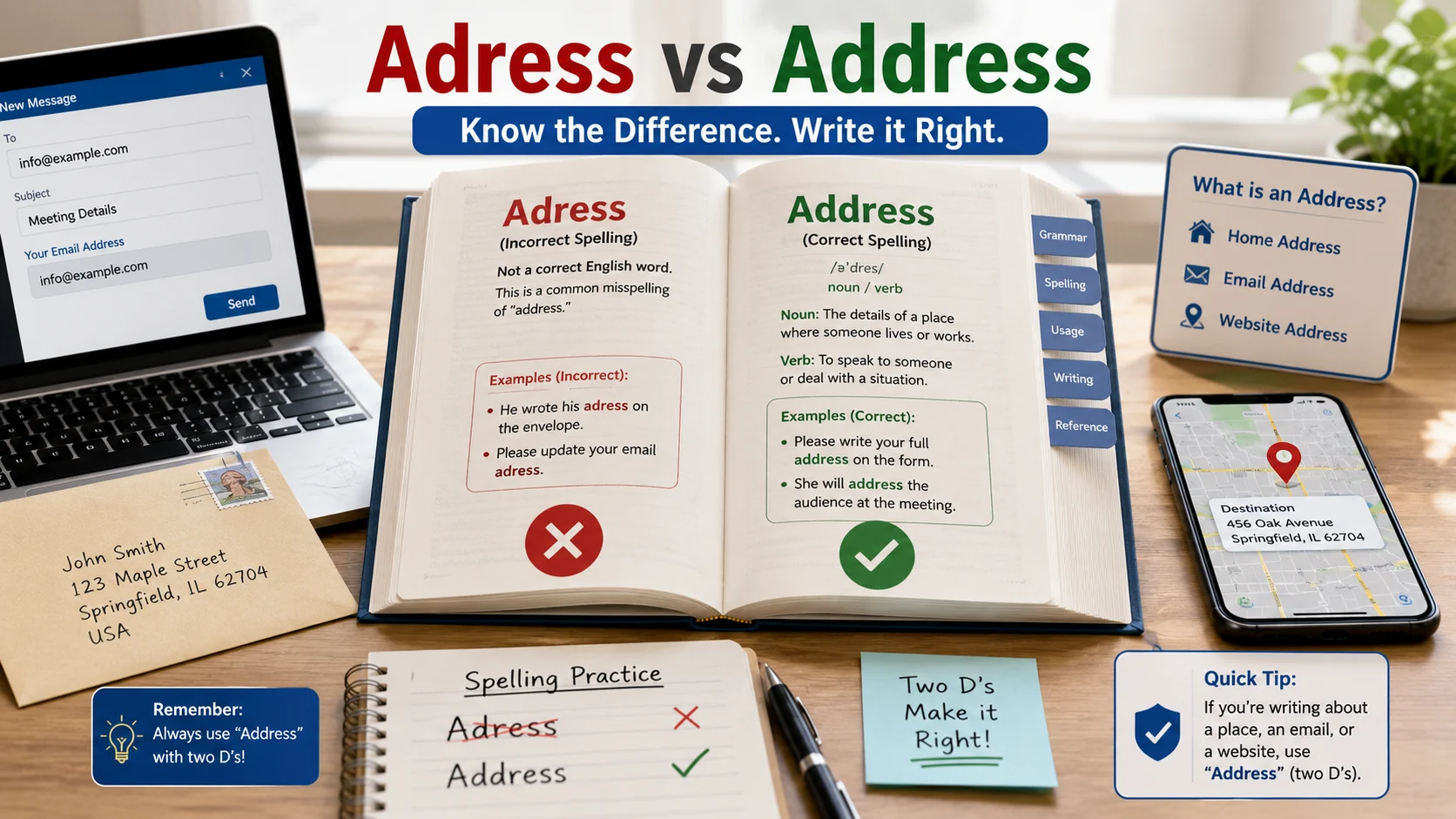
The correct spelling is address. Adress is a misspelling and is not accepted in standard English. The word address can refer to a location, a speech, or the act of speaking to someone or dealing with a problem. Always use address in formal, academic, and professional writing.
The phrase adress or address is one of the most common spelling questions in English. Although both words may look similar, only one is recognized as correct. Address is the proper English spelling used as both a noun and a verb, while adress is simply a spelling mistake that appears because many people accidentally leave out one of the letters.
This confusion creates real problems in emails, job applications, school assignments, websites, and official documents. Even a small spelling error can make writing appear less professional or cause readers to question its accuracy. Learning the difference helps you communicate clearly and confidently in every situation.
You are writing your home location, sending an email, giving a presentation, or discussing an issue that needs attention, knowing when and how to use address is essential. This guide explains the meaning, grammar, pronunciation, usage, and common mistakes in simple language with practical examples.
Spelling of Address
The correct spelling is address. It contains two d’s and two s’s: A D D R E S S. The spelling adress is incorrect in standard English.
| Spelling | Status | Meaning |
|---|---|---|
| address | ✅ Correct | A location, speech to someone, or a verb meaning to deal with something |
| adress | ❌ Incorrect | Not a standard English spelling |
Examples:
- Please send me your address.
- The president will address the audience.
- We need to address this issue quickly.
Adress or Address | What Is the Difference?
The difference is straightforward. Address is the correct English word. Adress is not a recognized English word and should never be used in standard writing.
Definition of Address
Part of speech: Noun and Verb
As a noun, address means the details of a place where someone lives or works. It can also mean a formal speech delivered to an audience.
As a verb, address means to speak to someone, deal with a problem, or write the name and location of a recipient on a letter or package.
Definition of Adress
Part of speech: None in standard English
Adress has no accepted meaning in modern English dictionaries. It is simply an incorrect spelling of address.
Comparison Table
| Feature | Address | Adress |
|---|---|---|
| Correct English spelling | Yes | No |
| Part of speech | Noun and Verb | None |
| Accepted in dictionaries | Yes | No |
| Suitable for formal writing | Yes | No |
| Suitable for academic writing | Yes | No |
| Suitable for business writing | Yes | No |
| Common appearance | Correct spelling | Typographical error |
Mini Recap
The English language recognizes only one correct spelling. Address appears in dictionaries, textbooks, newspapers, and professional writing. Adress is simply a spelling error caused by omitting one letter. Whenever you write this word, remember that it contains two d letters.
Is Adress or Address a Grammar, Vocabulary or Usage Issue?
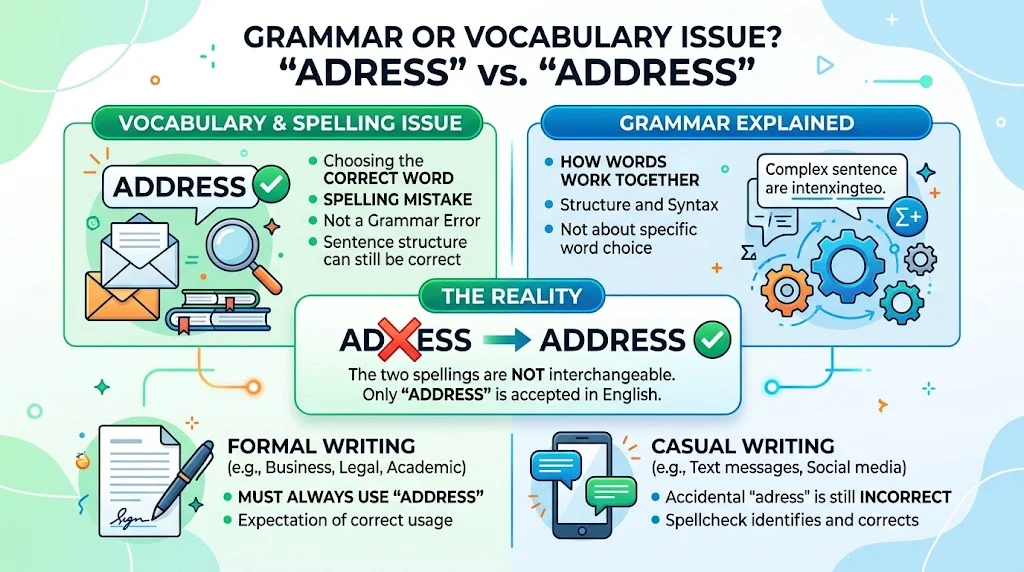
This confusion is primarily a spelling and vocabulary issue, not a grammar problem.
Grammar explains how words work together in sentences. Vocabulary focuses on choosing the correct word. In this case, the sentence structure may be perfect, but using adress instead of address still makes the sentence incorrect.
The two spellings are not interchangeable. Only address is accepted in English.
In formal writing, including business communication, legal documents, university assignments, and professional reports, address must always be used.
In casual writing, such as text messages or social media posts, some people accidentally type adress, but it remains incorrect. Spell checking tools usually identify and correct this mistake automatically.
Academic institutions also expect students to use address in essays, research papers, examinations, and presentations. Using adress can result in unnecessary spelling errors and lower writing quality.
Practical Usage of Address
Since address serves more than one purpose, understanding its different meanings makes it easier to use correctly.
Address as a Location
This is the meaning most people know.
Workplace example
Please update your office address before the company directory is published.
Academic example
Students must provide their permanent address during registration.
Technology example
Enter your email address to create your account.
Address as a Formal Speech
The word also refers to a speech delivered to an audience.
Workplace example
The chief executive delivered an inspiring address at the annual meeting.
Academic example
The university president gave a welcome address to new students.
Technology example
The keynote address was streamed live for viewers around the world.
Address as a Verb
The verb means to deal with a problem, speak directly to someone, or write recipient information.
Workplace example
The manager will address the customer complaints tomorrow.
Academic example
Your essay should address each research question clearly.
Technology example
The software update addresses several security concerns.
Usage Recap
Use address whenever you refer to a location, a speech, speaking to someone, solving a problem, or writing recipient details. It is the only correct spelling for every meaning.
Practical Usage of Adress
Unlike address, the word adress has no legitimate place in English writing.
People usually type it because they accidentally leave out one d. This often happens during fast typing or when relying on memory instead of checking the spelling.
Workplace example
❌ Please confirm your office adress.
✅ Please confirm your office address.
Academic example
❌ Write your home adress on the examination form.
✅ Write your home address on the examination form.
Technology example
❌ Enter your email adress.
✅ Enter your email address.
Usage Recap
Never intentionally write adress. If you see it in your own writing, correct it immediately to address before submitting or publishing your work.
When You Should NOT Use Adress or Address
Understanding incorrect situations can help you avoid common writing mistakes.
| Situation | Correct Choice | Reason |
|---|---|---|
| Writing your home location | Address | Official spelling |
| Entering an email location | Address | Required in online forms |
| Writing a business letter | Address | Professional standard |
| Giving a formal speech | Address | Correct noun |
| Discussing a problem to solve | Address | Correct verb |
| Writing school assignments | Address | Accepted academic spelling |
| Completing government documents | Address | Official English spelling |
| Typing quickly without checking | Never use Adress | It is always a spelling mistake |
Common Mistakes and Decision Rules
Many writers accidentally miss one of the two d letters. Others confuse the different meanings of address, assuming each meaning requires a different spelling. Fortunately, every meaning uses the same spelling.
Common Mistakes Table
| Correct Sentence | Incorrect Sentence | Explanation |
|---|---|---|
| Please confirm your address. | Please confirm your adress. | The correct spelling contains two d letters. |
| The president delivered an address. | The president delivered an adress. | Formal speech uses address. |
| We must address this issue today. | We must adress this issue today. | The verb is always address. |
| Enter your email address carefully. | Enter your email adress carefully. | Online forms require the correct spelling. |
| The package reached the correct address. | The package reached the correct adress. | Postal locations always use address. |
| Her address changed last month. | Her adress changed last month. | Only address is recognized in English. |
Decision Rule Box
| If you want to express | Use | Reason |
|---|---|---|
| A home, office, or mailing location | Address | The correct noun for a location |
| An email location | Address | The standard spelling in technology |
| A formal speech | Address | The correct noun for a speech |
| Speaking directly to someone | Address | The correct verb |
| Solving a problem or concern | Address | The accepted verb in all forms of English |
| Any formal, academic, or business writing | Address | The only correct spelling |
| Adress | Never | It is a spelling mistake |
In simple terms, if you are writing about a place, a speech, an email location, or dealing with an issue, always choose address. There is no situation in standard English where adress is considered correct.
Adress or Address in Modern Technology and AI Tools
Technology has made spelling mistakes easier to spot, and adress is a perfect example. Modern writing tools such as spell checkers, grammar assistants, search engines, and artificial intelligence writing platforms automatically recognize adress as an error and recommend address instead.
Email providers also expect users to enter an email address correctly before creating an account or sending messages. Likewise, navigation apps, online shopping websites, banking platforms, and government portals all use the word address when asking for location details. Using the wrong spelling can reduce professionalism and sometimes confuse readers, even if software later corrects the mistake.
Etymology

The word address entered English through French and can be traced back to the Old French word adresser, meaning to direct or to make straight. Over time, its meaning expanded to include directing words toward someone, indicating a physical location, and dealing with a matter or issue. The spelling has remained address throughout modern English, while adress has never been accepted as a standard form. Spell the word address.
Expert Insight
“Correct spelling is more than a writing habit. It reflects attention to detail, improves credibility, and helps readers trust the information they are receiving.”
This principle is especially true for commonly used words like address, which appear in business communication, education, technology, and everyday life.
Case Study One | Improved Business Communication
A small online company reviewed customer emails after noticing repeated spelling mistakes in automated messages. One recurring error was adress instead of address.
After correcting the templates and proofreading all customer communications, the business reported fewer customer questions about form accuracy and received more positive feedback regarding professionalism. Although the spelling change was small, it strengthened the company’s image and increased customer confidence.
Case Study Two | Better Student Writing Results
A university writing center analyzed common spelling mistakes in first year essays. Many students repeatedly wrote adress during examinations and assignments.
After introducing a simple proofreading checklist and encouraging students to remember the double d, the number of spelling errors dropped significantly during the following semester. Students also earned higher marks for language accuracy because they paid closer attention to commonly confused words..
Error Prevention Checklist
Use this quick checklist whenever you write.
| Always use Address when | Never use Adress when |
|---|---|
| Writing a home location | Writing emails |
| Writing an email address | Completing forms |
| Referring to a mailing location | Writing business documents |
| Giving or describing a speech | Preparing academic assignments |
| Talking about solving a problem | Publishing articles or websites |
| Writing official documents | Sending professional messages |
| Referring to a website or internet address | Writing any standard English text |
Reading your work aloud and using a reliable spell checker are simple ways to catch this mistake before sharing your writing.
Related Grammar Confusions You Should Master
Expanding your understanding of commonly confused words will improve both your writing and your confidence. Some useful topics include:
| Common Confusion | Why It Matters |
|---|---|
| Accept or Except | Different meanings despite similar pronunciation |
| Affect or Effect | Frequently confused in academic writing |
| Advice or Advise | Noun and verb distinction |
| Their There and They are | Common grammar challenge |
| Its or It’s | Possessive versus contraction |
| Then or Than | Time versus comparison |
| Lose or Loose | Very common spelling mistake |
| Principal or Principle | Different meanings and usage |
| Stationary or Stationery | Movement versus writing materials |
| Compliment or Complement | Praise versus completion |
Learning these word pairs alongside address helps build stronger writing habits and reduces avoidable errors.
FAQs
Is adress ever a correct spelling in English?
No. Adress is always considered a spelling mistake. Standard English dictionaries recognize only address.
Why do people spell address as adress?
Most people accidentally omit one d while typing quickly or writing from memory. It is a very common spelling error.
Is address a noun or a verb?
It can be both. As a noun, it refers to a location or speech. As a verb, it means to speak to someone or deal with a problem.
How do I remember the correct spelling of address?
Remember that address has two d letters and two s letters. Thinking of it as a complete mailing location often helps.
Is address correct for both email and home location?
Yes. The same spelling is used for an email address, home address, office address, and website address.
Do grammar checkers correct adress automatically?
Most modern grammar and spelling tools recognize adress as an error and recommend address immediately.
Can using adress affect professional writing?
Yes. Misspelling common words can make emails, resumes, reports, and applications appear less polished and less credible.
Should I use address in academic writing?
Absolutely. Schools, universities, publishers, and examination boards all expect the correct spelling address.
Conclusion
Understanding the difference between adress or address is surprisingly important because this word appears in everyday communication, professional documents, online forms, and academic writing. While the two spellings may look almost identical, only address is accepted in modern English. Adress is simply a spelling mistake that should always be corrected.
You are writing your home location, entering an email address, delivering a formal speech, or discussing an issue that needs attention, address is the correct choice every time. By remembering the double d and proofreading your work before publishing or submitting it, you can avoid one of the most common spelling mistakes in English and communicate with greater clarity and confidence.
Discover More Related Articles:
- Elses or Else’s | The Grammar Confusion You Can Fix in Minutes In 2026
- iPhone or Samsung | Which Smartphone Is Better for Your Needs In 2026
- Label or Lable | Which Spelling Is Correct & When to Use It In 2026