Unkempt or unkept can be confusing because both words seem related to the verb keep. However, unkempt is the correct adjective for describing someone or something that looks messy or untidy. Unkept is a real but uncommon word that usually means not maintained, not fulfilled or not kept in the expected sense.
The question unkempt or unkept often puzzles English learners, students, writers, and even native speakers. Since both words begin with un and appear connected to the verb keep, they seem interchangeable at first glance. In reality, they have different meanings and are used in different situations. Choosing the wrong one can make your writing sound awkward or inaccurate, especially in academic, professional, or published content. Understanding the distinction will help you communicate more clearly and confidently while avoiding one of the most common vocabulary mistakes in English.
Many dictionaries list both words, but they are not used in the same way. One describes appearance, while the other refers to something that has not been maintained, honored, or fulfilled. Once you understand this difference, selecting the correct word becomes much easier.
Unkempt or Unkept | What’s the Difference?
Both words exist in English, but they serve different purposes. One is commonly used in everyday writing, while the other appears much less frequently and only in specific contexts.
| Feature | Unkempt | Unkept |
|---|---|---|
| Part of speech | Adjective | Adjective |
| Primary meaning | Messy, untidy, or not well groomed | Not kept, not maintained, not fulfilled |
| Common usage | Very common | Rare |
| Refers to appearance | Yes | Usually no |
| Suitable for people | Yes | Rarely |
| Suitable for places or promises | No | Yes |
| Formal writing | Yes | Limited and context dependent |
Mini Recap
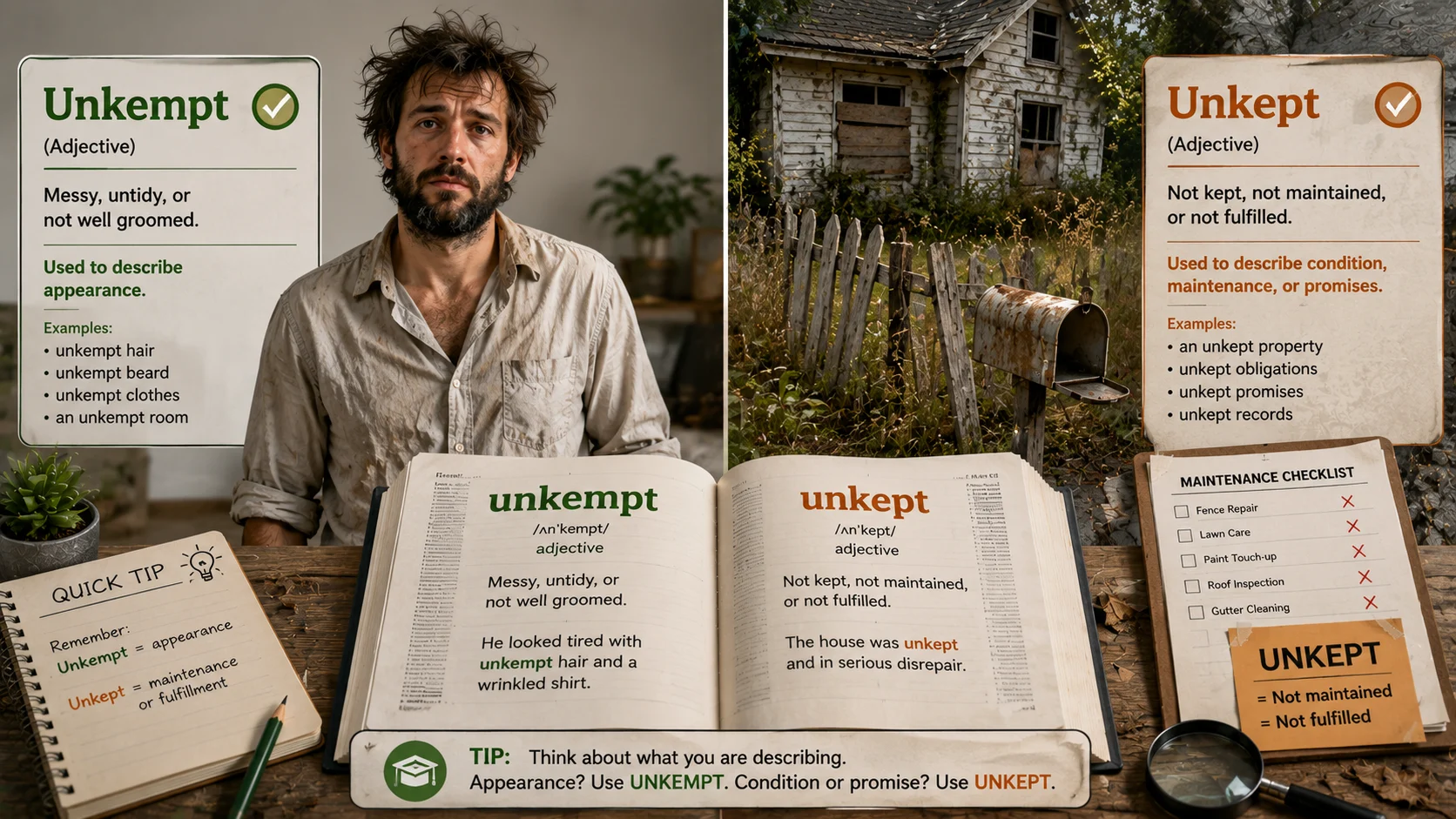
The easiest way to remember the difference is to think about what you are describing. If someone has messy hair or untidy clothes, unkempt is almost always the right choice. If you are talking about a promise that was not honored or property that was not maintained, unkept may fit the context. Although both words are correct English, unkempt is far more common in modern writing.
Core Definitions
What Does Unkempt Mean?
Unkempt is an adjective that describes someone or something with a messy, untidy, or neglected appearance. It is most often used for hair, clothing, gardens, rooms, or people who appear poorly groomed.
Examples include:
- The traveler arrived with unkempt hair after a long flight.
- The abandoned house had an unkempt garden filled with weeds.
- His unkempt beard suggested he had skipped shaving for several days.
The word often suggests neglect of appearance rather than intentional style. It does not necessarily imply poor hygiene, only that something looks untidy.
What Does Unkept Mean?
Unkept is also an adjective, but it has a different meaning. It describes something that has not been kept, maintained, fulfilled, or preserved.
Examples include:
- The old building remained unkept for many years.
- Their agreement became another unkept promise.
- Several historical records remained unkept after the archive closed.
Although grammatically correct, unkept appears much less often in everyday English because writers usually choose more natural alternatives such as neglected, unmaintained, broken, or unfulfilled depending on the situation.
Is Unkempt or Unkept a Grammar, Vocabulary or Usage Issue?
The confusion between these words is primarily a vocabulary and usage issue rather than a grammar problem. English grammar allows both words because each functions as an adjective. The challenge lies in choosing the word whose meaning matches the context.
Are They Interchangeable?
No. They are not interchangeable.
Using unkempt instead of unkept changes the meaning. Likewise, replacing unkempt with unkept often creates an unnatural sentence.
Consider these examples.
Correct:
- She walked into the meeting with unkempt hair.
Incorrect:
- She walked into the meeting with unkept hair.
In contrast:
Correct:
- The charity struggled because of several unkept commitments.
Incorrect:
- The charity struggled because of several unkempt commitments.
Each adjective belongs to a different semantic category, so switching them leads to confusion.
Formal Versus Informal Usage
Unkempt appears comfortably in both formal and informal English. Journalists, novelists, educators, and business writers all use it naturally.
Examples include:
- The witness appeared calm but slightly unkempt.
- The office looked unkempt after the renovation.
Unkept, on the other hand, is uncommon in modern usage. Formal writers often replace it with clearer alternatives such as unfulfilled, neglected, or unmaintained. While it is not incorrect, it can sound old fashioned or unnecessarily awkward.
Academic Versus Casual Usage
In academic writing, precision matters. Writers should use unkempt only when discussing physical appearance or visible condition.
Examples:
- Researchers noted the unkempt appearance of abandoned urban spaces.
- The novel portrays the character as deliberately unkempt to reflect emotional decline.
For ideas such as promises, responsibilities, records, or maintenance, academic writing usually prefers more precise vocabulary instead of unkept.
Examples:
- The study identified several unfulfilled obligations.
- The report discussed neglected infrastructure.
- The museum documented poorly maintained historical sites.
Choosing precise vocabulary improves clarity and makes writing more professional.
Why Do People Confuse Unkempt and Unkept?
The confusion comes from their similar spelling and shared connection to the verb keep. Many learners assume unkempt is simply another past form of keep, while others believe unkept should describe messy appearance because it literally means “not kept.”
English history explains why this assumption is misleading. Unkempt developed independently from an older English word related to combing and grooming rather than directly from the modern verb keep. Over time, it became the standard adjective for describing untidy appearance.
Meanwhile, unkept follows the normal pattern of adding un to the past participle kept, giving it the meaning of something that has not been maintained or fulfilled.
Understanding this historical difference helps explain why modern English treats these words as separate rather than interchangeable.
Practical Usage of Unkempt
The word unkempt is the standard choice when describing a person, place, or object that looks untidy or poorly groomed. It focuses on visible appearance rather than maintenance or responsibility. Because it is widely recognized, it sounds natural in both formal and everyday English.
Workplace Example
The employee arrived with unkempt hair after getting caught in a heavy rainstorm, but his presentation was excellent.
Here, the word describes physical appearance rather than work quality.
Academic Example
The novel introduces the main character as unkempt to symbolize years of isolation from society.
Literary analysis often uses this adjective because it paints a vivid picture of a character’s appearance.
Technology Example
The website looked unkempt because outdated graphics and inconsistent formatting made it appear disorganized.
Although unkempt traditionally describes physical appearance, modern writers sometimes use it figuratively for digital spaces that seem visually messy.
Everyday Examples
- His unkempt beard made him look much older.
- The children laughed at the dog’s unkempt fur after it rolled in the mud.
- An unkempt garden can reduce the appeal of an otherwise beautiful home.
- She quickly brushed her unkempt hair before joining the video meeting.
- The abandoned cabin had an unkempt path leading to its entrance.
Usage Recap
Use unkempt whenever you are describing something that appears messy, untidy, or poorly groomed. It is the preferred word for people, hair, clothing, gardens, rooms, and other visible objects.
Practical Usage of Unkept
Unlike unkempt, unkept refers to something that has not been maintained, fulfilled, preserved, or honored. While grammatically correct, it appears far less often in modern English because many writers prefer more specific alternatives.
Workplace Example
The company reviewed several unkept commitments before renewing the contract.
The emphasis is on promises that were not fulfilled.
Academic Example
The historian examined unkept records that revealed gaps in the archive.
This example refers to records that were not properly maintained.
Technology Example
An unkept software maintenance schedule can increase security risks over time.
The adjective describes neglected maintenance rather than visual appearance.
Everyday Examples
- The old farmhouse remained unkept for decades.
- Their friendship suffered because of repeated unkept promises.
- The community complained about unkept public parks.
- Several unkept agreements delayed the construction project.
- The property looked neglected because it had been unkept for years.
Usage Recap
Use unkept only when referring to something that has not been maintained, fulfilled, preserved, or honored. Avoid using it to describe messy hair, clothing, or personal appearance because unkempt is the accepted choice.
When You Should NOT Use Unkempt or Unkept
Choosing the wrong word can change the meaning of your sentence. These common situations show when each word should be avoided.
| Situation | Correct Choice | Reason |
|---|---|---|
| Messy hair | Unkempt | Refers to untidy appearance |
| Untidy beard | Unkempt | Describes grooming |
| Neglected garden because of appearance | Unkempt | Focuses on how it looks |
| Broken promise | Unkept | Refers to something not fulfilled |
| Missed commitment | Unkept | Means not honored |
| Poorly maintained records | Unkept | Refers to maintenance |
| Untidy office appearance | Unkempt | Describes visual condition |
| Delayed maintenance schedule | Unkept | Refers to neglected upkeep |
The easiest way to avoid mistakes is to ask yourself one question. Are you describing appearance or maintenance? If the answer is appearance, choose unkempt. If the answer is maintenance or fulfillment, unkept may be appropriate.
Common Mistakes and Decision Rules
Many writers accidentally substitute one word for the other because both look similar. These examples highlight the most frequent errors.
| Correct Sentence | Incorrect Sentence | Explanation |
|---|---|---|
| She had unkempt hair after the hike. | She had unkept hair after the hike. | Hair is described by appearance. |
| His unkempt beard needed trimming. | His unkept beard needed trimming. | Grooming requires unkempt. |
| The agreement became another unkept promise. | The agreement became another unkempt promise. | Promises are fulfilled or broken, not messy. |
| The building remained unkept for years. | The building remained unkempt for years when discussing maintenance. | Maintenance requires unkept. |
| The yard looked unkempt after weeks of rain. | The yard looked unkept after weeks of rain. | The focus is visual appearance. |
| Several unkept obligations delayed the project. | Several unkempt obligations delayed the project. | Obligations cannot be untidy. |
Decision Rule Box
| If your meaning is | Use |
|---|---|
| Messy appearance | Unkempt |
| Untidy hair or clothing | Unkempt |
| Poor grooming | Unkempt |
| Not maintained | Unkept |
| Not fulfilled | Unkept |
| Not preserved | Unkept |
Remember this simple rule.
If you mean appearance, use unkempt. If you mean something that has not been maintained or fulfilled, use unkept.
Unkempt and Unkept in Modern Technology and AI Tools
Modern grammar checkers and AI writing tools usually recognize unkempt without hesitation because it is common in books, newspapers, and professional writing.
Unkept, however, is often flagged with suggestions such as neglected, unmaintained, unfulfilled, or broken because these alternatives are more common in present day English.
When using AI writing assistants, always review the context instead of accepting automatic suggestions. Human judgment remains the best way to choose between these two words, especially when subtle meaning matters.
Etymology
The history of these words explains why they are often confused.
Unkempt comes from an older English word related to combing or grooming. Over centuries, it evolved into the adjective that describes someone or something with a messy appearance.
Unkept developed more directly from the verb keep. It simply means something has not been kept, maintained, preserved, or fulfilled. Although it follows normal English word formation, it never became as common as unkempt in everyday language.
Expert Insight: The best vocabulary choices are not simply correct. They are precise. Selecting the word that matches the intended meaning improves clarity, credibility, and reader confidence.
Case Study One | Improving Business Communication
A customer service department reviewed one hundred complaint emails before updating its communication guide. Employees frequently described neglected facilities as unkempt when they actually meant unkept maintenance schedules. After introducing a simple vocabulary guide, editing time dropped and customer responses became clearer because each report used the appropriate word in context.
Case Study Two | Better Academic Writing
A university writing center analyzed essays written by first year students. Many learners used unkept to describe characters with messy hair or untidy clothing. After a short lesson explaining the distinction, later assignments showed noticeably fewer vocabulary errors and stronger descriptive writing. Students also demonstrated greater confidence when choosing precise adjectives for formal essays.
Error Prevention Checklist
Use this quick checklist whenever you are deciding between unkempt and unkept.
| Always use Unkempt when | Never use Unkept when |
|---|---|
| Describing messy hair | Talking about personal appearance |
| Referring to untidy clothing | Describing an untidy beard |
| Explaining poor grooming | Referring to messy rooms or gardens because of appearance |
| Describing a person who looks untidy | Talking about someone who looks disheveled |
| Writing about visual appearance | You mean messy or poorly groomed |
| Describing an unorganized looking place | Appearance is the main focus |
Before choosing a word, ask yourself one simple question. Am I describing how something looks or something has been maintained or fulfilled? Your answer will usually tell you which word is correct.
Related Grammar Confusions You Should Master
Expanding your vocabulary means understanding other commonly confused word pairs as well. These comparisons can improve both your writing and your confidence.
| Word Pair | Common Confusion |
|---|---|
| Affect and Effect | Action versus result |
| Accept and Except | Receive versus exclude |
| Then and Than | Time versus comparison |
| Further and Farther | Figurative versus physical distance |
| Compliment and Complement | Praise versus complete |
| Loose and Lose | Adjective versus verb |
| Principal and Principle | Person versus rule |
| Stationary and Stationery | Not moving versus writing paper |
| Ensure and Insure | Make certain versus provide insurance |
| Historic and Historical | Important versus related to history |
Learning these distinctions strengthens your vocabulary and helps you avoid mistakes that commonly appear in both academic and professional writing.
FAQs
Is unkept a real English word?
Yes. Unkept is a real English adjective, but it is relatively uncommon. It usually means not maintained, not preserved, or not fulfilled rather than untidy in appearance.
Which is correct, unkempt or unkept hair?
Unkempt hair is the correct expression because it describes hair that looks messy or poorly groomed. Unkept hair sounds unnatural in modern English.
Can unkept describe a person?
Generally, no. When describing a person’s appearance, unkempt is the accepted choice. Unkept is better reserved for things such as promises, responsibilities, or maintenance.
Why do people confuse unkempt and unkept?
Both words resemble the verb keep, so many people assume they have the same meaning. Their histories and modern usage, however, are quite different.
Is unkempt formal or informal?
Unkempt works well in both formal and informal English. It appears regularly in books, journalism, academic writing, and everyday conversation.
Should I avoid using unkept in professional writing?
Not necessarily, but more precise alternatives such as unfulfilled, neglected, or unmaintained are often clearer and more natural in professional documents.
Do grammar checkers recognize both words?
Most grammar and spelling tools recognize both words. However, many writing assistants recommend alternatives for unkept because it is much less common in contemporary English.
What is the easiest way to remember the difference?
Think about your meaning first. If something looks messy, use unkempt. If something has not been maintained or fulfilled, use unkept.
Conclusion
The debate over unkempt or unkept becomes much simpler once you understand the difference in meaning. Unkempt describes someone or something that looks messy, untidy, or poorly groomed. It is the standard word for describing appearance and is widely accepted in modern English.
Unkept, by contrast, refers to something that has not been maintained, preserved, or fulfilled. Although it is a legitimate English word, it appears far less often because writers usually choose more specific alternatives such as neglected, unmaintained, or unfulfilled.
Whenever you are unsure, remember this simple rule. If the focus is on appearance, choose unkempt. If the focus is on maintenance or keeping a promise, unkept may be appropriate. Using the correct word will make your writing clearer, more precise, and more professional.
Discover More Related Articles:
- Hit or Miss | Meaning, Usage, Examples & When to Use It In 2026
- Or vs Nor | What Is the Difference & When Should You Use Each In 2026
- Seen or Saw | What’s the Difference & When Should You Use Each In 2026