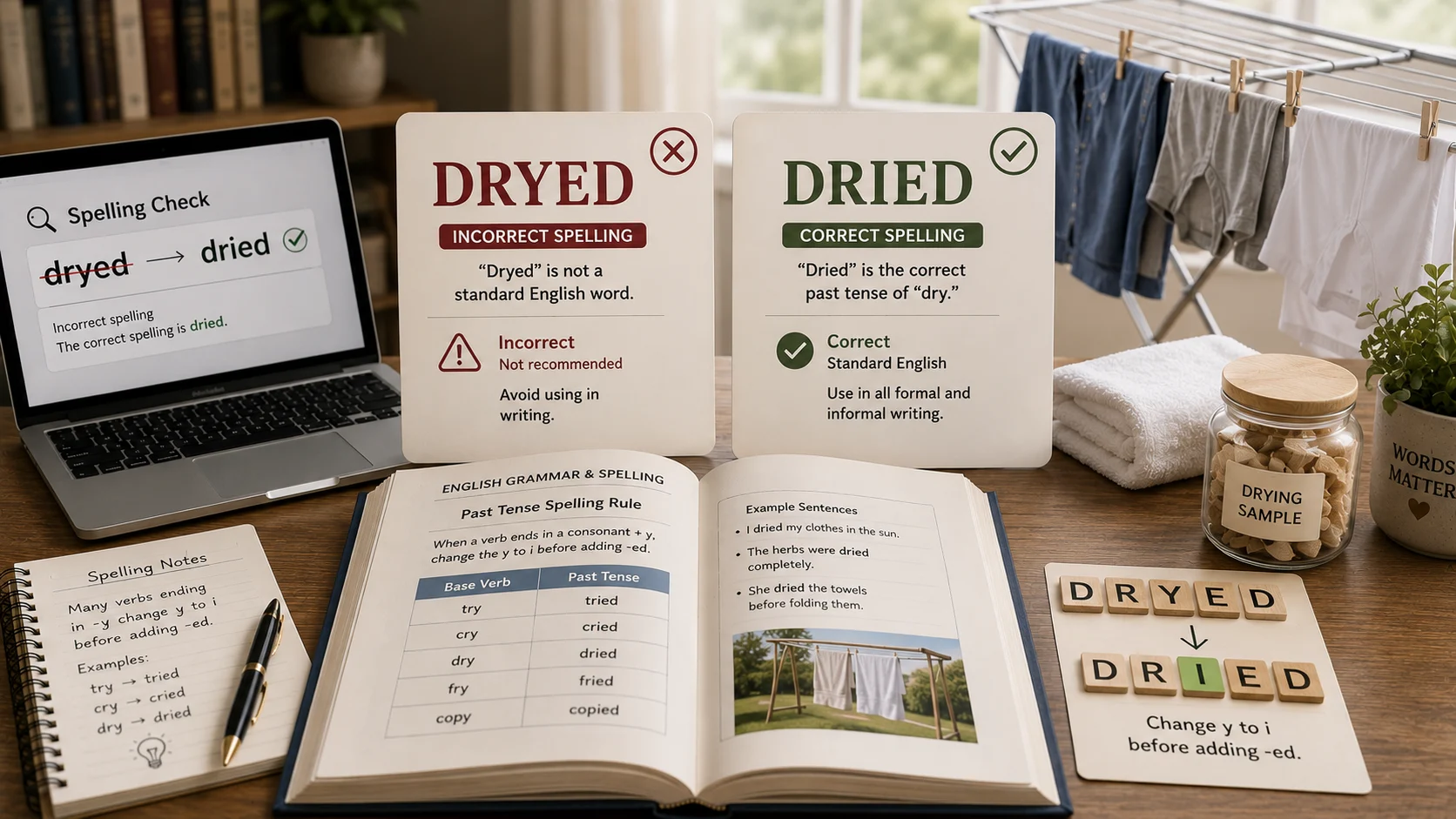
Dried is the correct past tense and past participle of dry, while dryed is a misspelling in standard English. The confusion happens because many verbs ending in y appear to follow different spelling patterns. When dry changes to a past form, the y changes to i before ed, producing dried.
Have you ever paused while writing a sentence because you were unsure to use dryed or dried? Although both spellings may look reasonable, only one is accepted in standard English. you are describing clothes left in the sun, paint that has hardened, or flowers that have lost their moisture, choosing the correct spelling helps make your writing clear, accurate, and professional. Understanding this common spelling mistake can improve your everyday communication and help you avoid errors in academic and professional writing.
The correct spelling is dried, which is the past tense and past participle of the verb dry. The spelling dryed is incorrect because dry follows a standard English spelling rule: when a verb ends in a consonant followed by y, the y changes to i before adding -ed. In this guide, you’ll learn the difference between dryed and dried, explore practical examples, and discover simple tips to remember the correct form confidently.
Dryed or Dried | What’s the Difference?
The short answer is simple: dried is correct, and dryed is incorrect in standard modern English.
The word dry is a verb, adjective, and sometimes a noun. As a verb, it means to remove moisture from something or to become free from moisture. Its past tense and past participle form is dried.
The spelling dryed is not the standard past tense of dry. Although it may look logical at first glance, English spelling rules require the final y to change to i before the ending ed when a verb ends in a consonant followed by y.
| Word | Part of Speech | Meaning | Correct Usage |
|---|---|---|---|
| dry | Verb, adjective, noun | To remove moisture or having little moisture | The clothes will dry soon. |
| dried | Past tense and past participle | Became dry or was made dry | She dried the clothes. |
| dryed | Nonstandard spelling | Intended to mean the past form of dry | Avoid this spelling in standard English. |
Consider these examples:
The clothes dried in the afternoon sun.
She dried her hands with a clean towel.
The paint had dried before we returned.
The flowers were carefully dried for decoration.
The incorrect form can appear understandable because the base word is dry. However, English does not normally create its past form by simply adding ed to the visible spelling of every verb.
The key point is this:
Dry is the base form.
Dried is the correct past form.
Dryed is not the standard spelling.
Once this pattern becomes familiar, the distinction becomes easy to remember.
Is Dryed or Dried a Grammar, Vocabulary or Usage Issue?
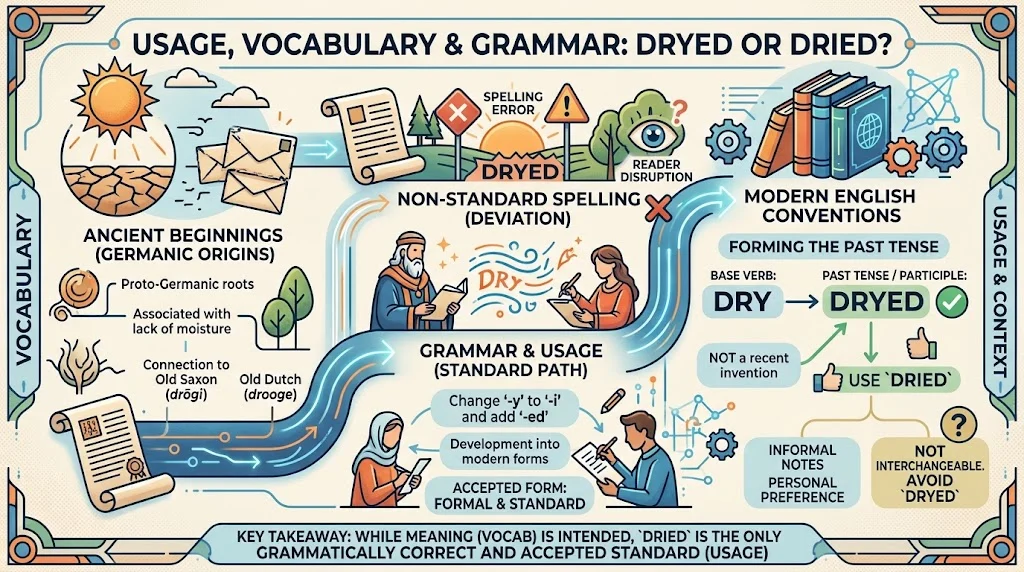
The difference between dryed and dried is primarily a spelling and verb formation issue rather than a difference in meaning.
Both forms may be intended to communicate the same idea, but only dried is accepted as the standard past tense and past participle of dry. In formal writing, academic work, professional communication, and edited publications, dried should always be used.
The two forms aren’t interchangeable.
For example:
Correct: The clothes dried quickly.
Incorrect: The clothes dryed quickly.
The problem becomes especially noticeable in writing because readers generally recognize dryed as a spelling mistake rather than as an alternative English form.
Formal and Informal Usage
There is no standard informal situation in which dryed becomes the preferred spelling. Casual writing, text messages, social media posts, and informal notes may contain dryed because of typing mistakes, pronunciation based spelling, or uncertainty about English spelling rules.
That doesn’t make dryed a legitimate alternative.
If you’re writing an email, report, essay, application, article, assignment, or business document, choose dried.
Academic Usage
Academic writing requires standard spelling and accurate verb forms. A sentence such as “The sample was dryed before testing” should be corrected to “The sample was dried before testing.”
The same principle applies to scientific descriptions, laboratory reports, research papers, and educational materials.
Why People Write Dryed
One reason people write dryed is that the spelling rule isn’t always obvious.
English contains many verbs ending in y, and their forms can appear confusing. For example, study becomes studied, carry becomes carried, and try becomes tried.
Because dry ends in y, some writers may incorrectly add ed without changing the y.
Understanding the pattern is more useful than memorizing the word alone.
How to Use Dried Correctly
Dried is the correct past tense and past participle of dry. It describes something that became dry or something that someone deliberately made dry.
Workplace Example
Imagine an employee preparing documents after a water spill.
“The employee dried the papers carefully before scanning them.”
Here, dried describes a completed action. The employee performed the action of removing moisture from the papers.
Another example is:
“The equipment was dried before it was stored.”
In this sentence, dried appears as part of a passive construction.
Academic Example
In scientific and academic writing, dried frequently describes materials that have had moisture removed.
“The researchers dried the plant samples before measuring their mass.”
The word dried clearly indicates that the action happened before the measurement.
Another example is:
“The solution was dried under controlled conditions.”
This usage is appropriate because dried identifies a completed process.
Technology Example
Technology documentation can also use dried when describing physical components or materials.
“The sensor was dried before installation.”
Another example is:
“The device should be completely dried before testing.”
In both cases, dried communicates a physical condition or completed action.
Usage Recap
Use dried whenever you need the past tense or past participle of dry. It can describe something that became dry naturally or something that a person or process caused to become dry.
How to Recognize Dryed as an Error
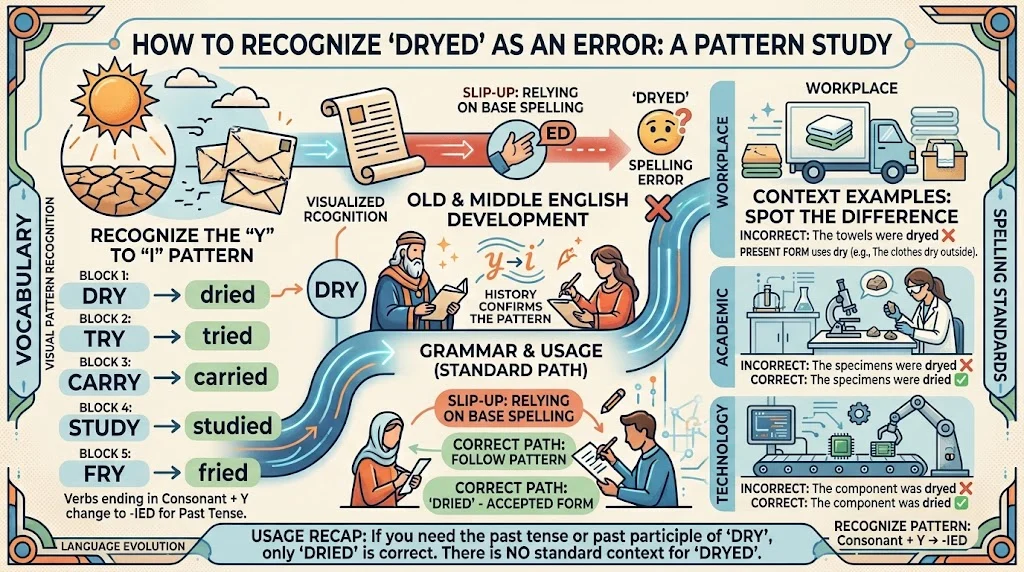
Because dryed is visually understandable, it can slip into writing when someone relies on the base spelling of the verb.
Compare these forms:
Dry becomes dried.
Try becomes tried.
Carry becomes carried.
Study becomes studied.
Fry becomes fried.
These examples follow the same basic spelling pattern because the verbs end in a consonant followed by y.
The important distinction is between the base form and the changed past form.
Dry: The clothes dry outside.
Dried: The clothes dried outside.
The present form uses dry, while the completed past action uses dried.
Workplace Example
Incorrect:
“The towels were dryed before delivery.”
Correct:
“The towels were dried before delivery.”
Academic Example
Incorrect:
“The specimens were dryed before analysis.”
Correct:
“The specimens were dried before analysis.”
Technology Example
Incorrect:
“The component was dryed before assembly.”
Correct:
“The component was dried before assembly.”
Usage Recap
There is no standard context where dryed should replace dried. If you need the past tense or past participle of dry, dried is the form to choose.
When You Should NOT Use Dryed or Dried
There are several situations where writers can make mistakes with these forms.
1. Do not use Dryed as the Past Tense
If you mean that something became dry in the past, use dried.
“The clothes dried overnight.”
Not:
“The clothes dryed overnight.”
2. Do not Use Dryed in Formal Writing
Even if readers understand what you mean, dryed looks like a spelling error in standard English.
Use dried in reports, essays, applications, articles, and professional documents.
3. Do Not Use Dried When You Need the Present Form
Dried is a past form. If the action happens now or regularly, use dry or dries depending on the subject.
“The towels dry quickly.”
“The machine dries the material.”
Not:
“The machine dried the material every morning.”
unless you specifically mean that this happened in the past.
4. Do Not Confuse Dried With Drying
Dried describes a completed action or resulting condition.
Drying describes an action in progress.
“The clothes are drying.”
“The clothes are dried.”
These sentences communicate different ideas.
5. Do Not Replace Dry With Dried After Certain Helping Verbs
After words such as will, can, should, and may, the base verb is generally required.
“The clothes will dry soon.”
Not:
“The clothes will dried soon.”
6. Do Not Treat Dryed as a British or American Variant
Dried is the standard spelling in both major varieties of English.
The distinction isn’t comparable to spelling differences such as colour and color or travelled and traveled.
7. Do Not Choose a Spelling Based Only on Pronunciation
Dried may sound different from what a learner expects when first encountering it. English spelling often requires attention to the written form rather than simply adding letters based on pronunciation.
Common Mistakes and Decision Rules
| Correct Sentence | Incorrect Sentence | Explanation |
|---|---|---|
| The clothes dried quickly. | The clothes dryed quickly. | Dried is the correct past tense of dry. |
| She dried her hands. | She dryed her hands. | The final y changes to i before ed. |
| The paint had dried. | The paint had dryed. | Dried is the correct past participle. |
| The samples were dried before testing. | The samples were dryed before testing. | Dried is required in the passive construction. |
| The towels will dry outside. | The towels will dried outside. | After will, use the base form dry. |
| The towels are drying outside. | The towels are dried outside. | Drying indicates an action in progress. |
| The machine dries the material. | The machine dried the material every day. | Dries is appropriate for a present routine. |
Decision Rule Box
If you mean the completed action of making something dry or becoming dry, use dried. If you are tempted to write dryed as the past form of dry, choose dried instead.
This rule handles the vast majority of situations involving the two spellings.
Why Does Dry Become Dried?
The spelling change follows a common English rule.
When a verb ends in a consonant followed by y, the y usually changes to i before an ending such as ed.
For example:
| Base Verb | Past Form |
|---|---|
| dry | dried |
| try | tried |
| carry | carried |
| study | studied |
| worry | worried |
| hurry | hurried |
| copy | copied |
This pattern explains why dry becomes dried instead of dryed.
There is an important contrast, however. When a verb ends in a vowel followed by y, the y usually remains.
For example:
| Base Verb | Past Form |
|---|---|
| play | played |
| enjoy | enjoyed |
| stay | stayed |
| employ | employed |
In dry, the letter immediately before y is r, which is a consonant. Therefore, the y changes to i before ed.
Dryed or Dried in Modern Technology and AI Tools
Modern writing tools make this spelling distinction easier to manage, but automated correction isn’t a substitute for understanding the rule.
Spell checkers, grammar software, word processors, search engines, and AI writing tools will generally identify dryed as a nonstandard spelling and recommend dried.
For example, if someone types:
“The clothes were dryed overnight.”
a modern writing assistant may suggest:
“The clothes were dried overnight.”
This matters because spelling errors can reduce credibility even when the intended meaning remains obvious. Professional documents, online educational content, product instructions, and technical material all benefit from consistent standard spelling.
AI tools can also explain why the correction is needed. The most useful explanation is that dry follows the consonant plus y spelling pattern, so its past form is dried.
Etymology and Language History
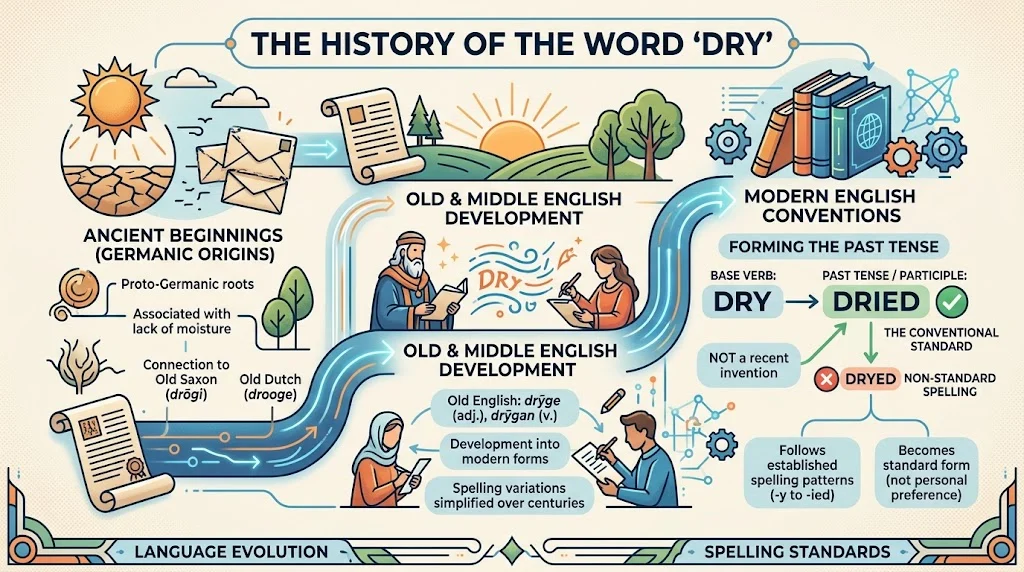
The word dry has a long history in English. It is related to older Germanic forms associated with the idea of lacking moisture. Over centuries, the word developed into the modern English adjective and verb we use today.
The past form dried follows the established English spelling pattern rather than being a recent invention.
The spelling is therefore not a matter of personal preference. Dried is the conventional form that has become standard in modern English.
An expert style principle worth remembering is:
When English changes a consonant followed by y into a past form, the spelling pattern matters more than the appearance of the base word.
Case Study 1: Student Writing
Consider an illustrative classroom exercise involving 100 sentences containing past tense verbs ending in y. Students who simply added ed to the visible base form frequently produced forms such as dryed, studyed, and carryed. After learning the consonant plus y rule, the students could systematically convert those verbs to dried, studied, and carried.
The concrete result is a reduction in spelling errors because students learn a reusable pattern rather than memorizing individual words.
Case Study 2: Workplace Editing
Consider an illustrative workplace proofreading task involving a technical document containing repeated references to materials being dried before testing. Replacing every occurrence of dryed with dried produces consistent standard English throughout the document.
The practical result is improved editorial consistency and fewer distracting spelling errors for readers.
These examples demonstrate an important lesson: learning the rule is more efficient than treating dried as an isolated spelling fact.
Error Prevention Checklist
Always Use Dried When
- You mean something became dry in the past.
- You mean someone removed moisture from something.
- You need the past tense of dry.
- You need the past participle of dry.
- You are writing an academic, professional, or formal document.
- You are describing a completed drying process.
Never Use Dryed When
- You are using standard modern English.
- You are writing a formal document.
- You are describing a completed past action.
- You are forming the past participle of dry.
- You are preparing educational or professional content.
- You are correcting a spelling mistake involving the past form of dry.
The easiest memory trick is to associate dry with dried, just as try becomes tried and study becomes studied.
Related Grammar Confusions You Should Master
Learning dried is useful, but it also opens the door to several related English spelling and grammar patterns.
Try or Tried: Learn why the y changes before ed.
Study or Studied: Understand the same consonant plus y pattern.
Carry or Carried: See how regular verbs change when they end in y.
Play or Played: Compare a vowel before y with a consonant before y.
Lay or Laid: Distinguish an irregular past form from a regular spelling pattern.
Lie or Lay: Understand how different verb forms change meaning.
Rise or Rose: Recognize irregular verb formation.
Stop or Stopped: Learn when a final consonant is doubled.
Plan or Planned: Understand consonant doubling before ed.
Bake or Baked: Compare verbs ending in silent e with verbs ending in y.
These related patterns make English spelling easier because they show how individual words fit into larger systems.
FAQs
Is dryed or dried correct?
Dried is correct because it is the standard past tense and past participle of dry, while dryed is a nonstandard spelling.
Why is dried spelled with an i instead of dryed?
Dry ends with a consonant followed by y, so the y changes to i before the past tense ending ed.
Is dryed ever correct in English?
Dryed is not the standard spelling of the past tense of dry, so it should be avoided in normal English writing.
What is the past tense of dry?
The past tense of dry is dried, as in “The clothes dried in the sun.”
What is the past participle of dry?
The past participle is dried, as in “The clothes have dried.”
Is dried a verb or an adjective?
Dried is primarily a past tense or past participle form of the verb dry, although it can also function adjectivally in expressions such as dried fruit.
Why do people spell dryed incorrectly?
People may assume that adding ed directly to dry produces the past tense, but English changes the final y to i in this spelling pattern.
Do British and American English both use dried?
Yes. Dried is the standard spelling in both British English and American English.
What is the difference between dried and drying?
Dried normally refers to a completed action or resulting condition, while drying describes an action that is currently happening or continuing.
How can I remember dried instead of dryed?
Remember that dry behaves like try and study, so the final y changes to i before ed: dry becomes dried.
Conclusion
When choosing between dryed and dried, the correct answer is straightforward: dried is the standard English spelling.
Dry is the base verb, while dried is its past tense and past participle. The spelling changes because the verb ends in a consonant followed by y. The y therefore changes to i before the ending ed.
Use dried in sentences such as “The clothes dried quickly,” “She dried her hands,” and “The samples were dried before testing.”
If you see dryed in formal or edited writing, it should normally be corrected to dried.
Once you understand the consonant plus y spelling pattern, this mistake becomes much easier to avoid. The same principle helps with words such as tried, carried, studied, worried, and hurried.
The simple rule is worth remembering: dry becomes dried, not dryed.
Discover More Related Articles:
- Fien or Fein | Stop Making This Common Spelling Mistake In 2026
- Licence or License | The Difference Every English Learner Should Know In 2026
- Useing or Using | Clear Up This Common English Confusion Today In 2026