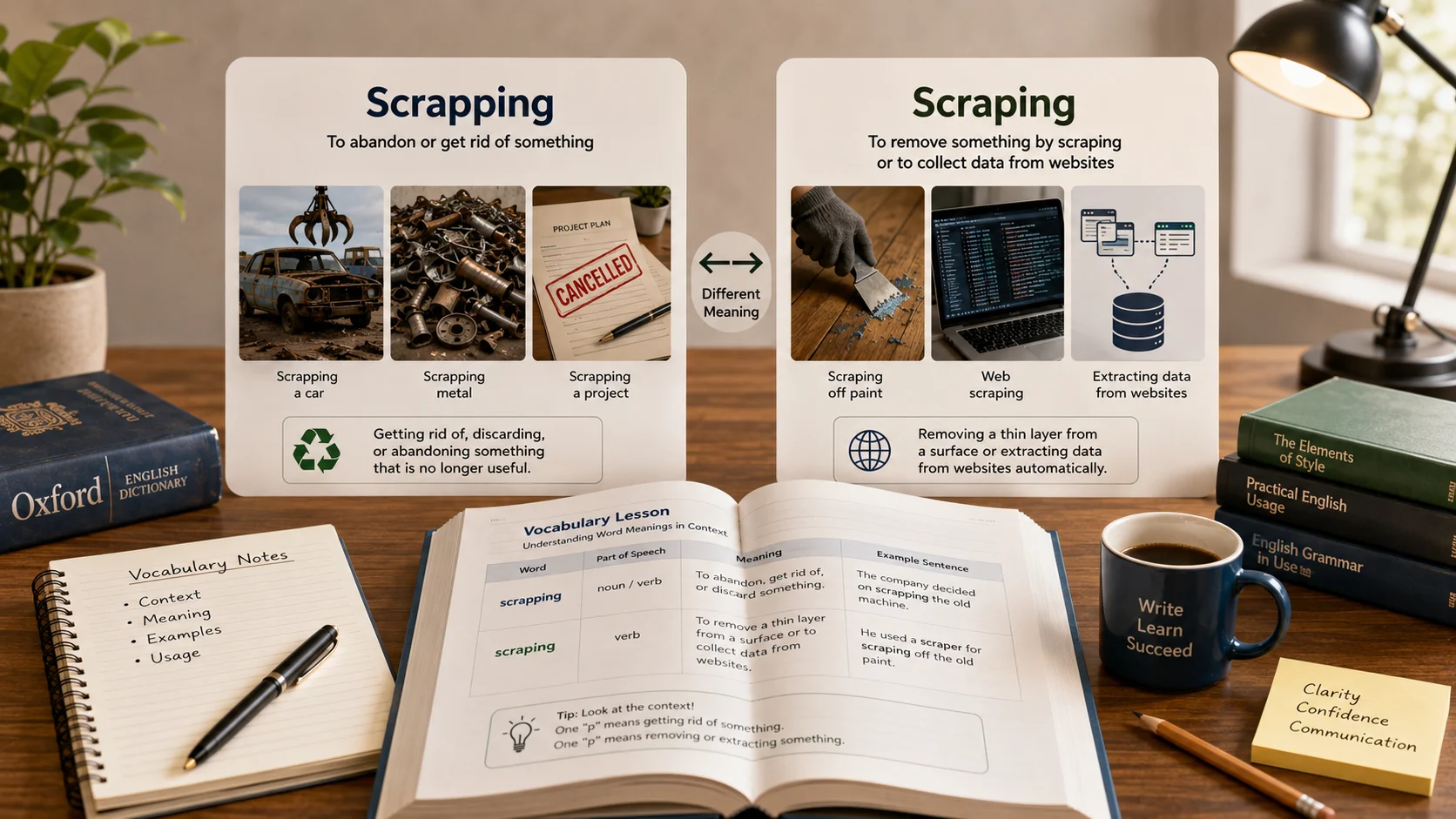
The difference between scrapping or scraping is simple but important. Scrapping means throwing away, canceling, or dismantling something, while scraping means removing material from a surface or collecting information from a source, such as a website. Choosing the correct word depends entirely on the action you want to describe.
A single letter can completely change the meaning of a word. Scrapping or scraping is a common English confusion because both forms are correct, but they describe different actions. Scraping usually means removing something from a surface, collecting information, or rubbing against something.
Scrapping means abandoning, discarding, or getting rid of something. Understanding this distinction makes your writing clearer and more professional. In this guide, we’ll explain scrapping vs scraping with simple examples and practical rules.
You’ll also learn when to use scraping, when scrapping is correct, and how scrapped or scraped changes the meaning. We’ll cover the scrapping meaning and scraping meaning in everyday English, so you can quickly decide scraping or scrapping fits your sentence. By the end, this common spelling confusion will be much easier to avoid.
Scrapping or Scraping | What’s the Difference?
Although these words look and sound similar, they belong to different meanings and are never interchangeable. One is associated with disposal or cancellation, while the other describes removal or collection.
| Feature | Scrapping | Scraping |
|---|---|---|
| Part of speech | Verb | Verb |
| Base word | Scrap | Scrape |
| Primary meaning | Discarding, canceling, or dismantling something | Removing material from a surface or collecting data |
| Common contexts | Manufacturing, business, transportation, project management | Cleaning, woodworking, cooking, programming, web technology |
| Can refer to technology | Yes, when abandoning a project or system | Yes, especially for web scraping and data extraction |
| Interchangeable | No | No |
Mini Recap
Scrapping focuses on getting rid of something that is no longer useful or wanted. Scraping focuses on removing material or gathering information. Although the spellings are similar, the meanings are entirely different. Selecting the correct word ensures your writing remains clear and professional.
Is Scrapping or Scraping a Grammar, Vocabulary or Usage Issue?
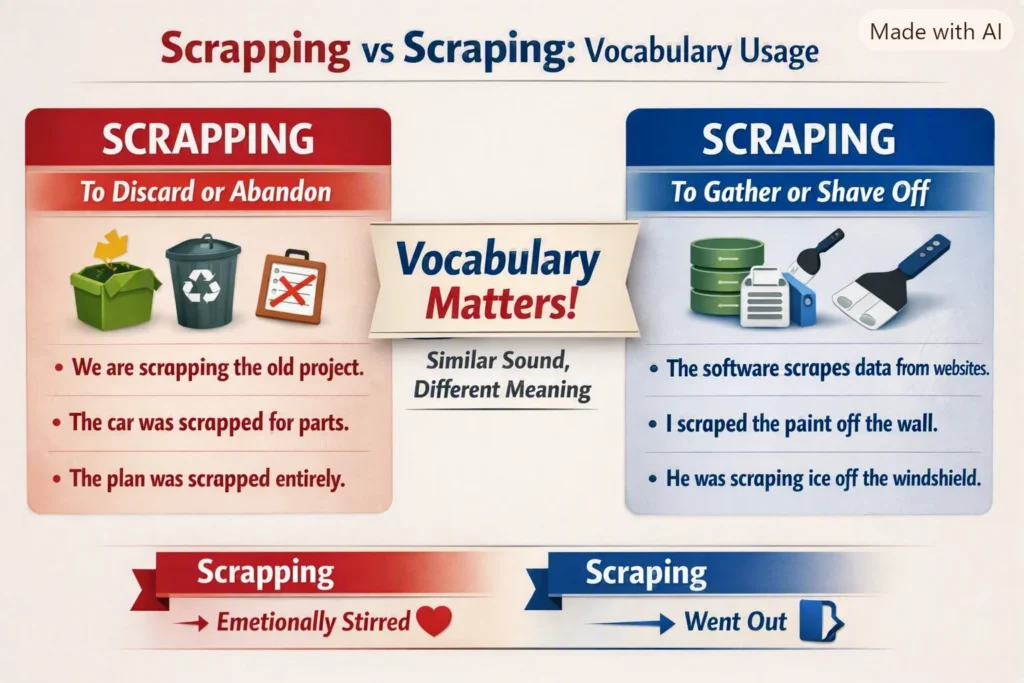
The confusion between these two words is primarily a vocabulary and usage issue, not a grammar mistake.
Grammar determines how words function within a sentence. Vocabulary determines which word expresses the intended meaning. Since scrapping and scraping represent different actions, replacing one with the other changes the meaning of an entire sentence.
In formal writing, the distinction matters even more. A business report stating that a company is scraping a project instead of scrapping a project completely changes the intended message. Likewise, a software engineer describing a program that scraps websites instead of scrapes websites may unintentionally suggest deleting websites rather than extracting information from them.
Academic writing also requires careful word selection. Professors, editors, and researchers expect precise vocabulary because even a small spelling difference can alter technical meaning.
In casual conversation, listeners may understand the intended idea from context, but written communication leaves less room for interpretation. Choosing the correct word improves clarity and credibility in every situation.
Formal Versus Informal Usage
Both words are accepted in formal and informal English because each represents a legitimate verb. The difference lies in meaning rather than formality.
Business documents frequently use scrapping when discussing canceled products, discontinued projects, or retired equipment.
Technical manuals, programming guides, and research papers commonly use scraping when referring to surface removal or automated data collection.
Academic Versus Casual Usage
Academic writing demands precision, making it important to distinguish between the two terms.
Casual conversations may tolerate occasional confusion, but professional writing should never substitute one for the other.
Understanding Scrapping
The verb scrapping comes from the noun scrap, meaning discarded material or something considered no longer useful.
When you scrap something, you intentionally remove it from use because it is outdated, damaged, ineffective, or unnecessary.
Businesses often scrap products that fail quality inspections. Governments may scrap proposed policies before implementation. Manufacturers regularly scrap defective components to maintain production standards.
Workplace Example
The company decided to scrap the outdated inventory management system after introducing a modern platform.
Academic Example
The research team scrapped the original experiment because the collected data contained significant errors.
Technology Example
The developers scrapped the first version of the application after discovering major security vulnerabilities.
More Examples of Scrapping
- The airline scrapped several aging aircraft.
- Engineers scrapped the original bridge design after reviewing safety concerns.
- The publisher scrapped the first manuscript before editing began.
- The factory scrapped damaged materials that failed inspection.
- Management scrapped the expansion plan due to rising costs.
- The startup scrapped its initial business model and adopted a different strategy.
- The museum scrapped plans for a temporary exhibition because funding was unavailable.
- The construction company scrapped defective steel beams before installation.
Common Situations Where Scrapping Is Appropriate
Scrapping is commonly used when discussing business decisions, manufacturing processes, transportation, engineering projects, government planning, and product development.
In every case, the idea remains the same. Something is being abandoned, canceled, dismantled, or thrown away because it is no longer suitable.
Usage Recap
Remember that scrapping always involves giving something up, throwing it away, canceling it, or dismantling it. If the action means abandoning or disposing of something, scrapping is the correct choice.
Understanding Scraping
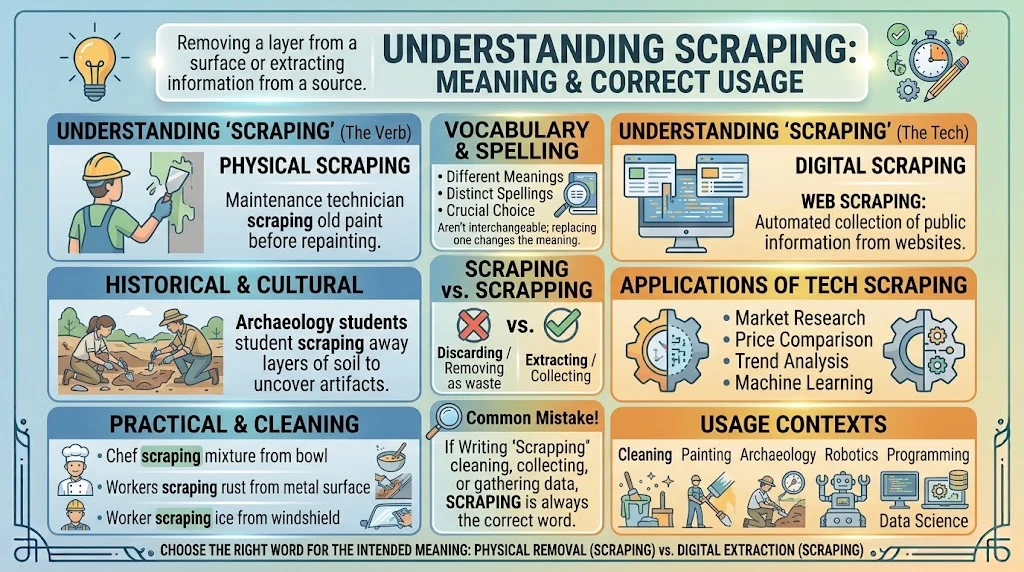
The verb scraping comes from scrape, meaning to remove a layer from a surface by rubbing or using a tool. Over time, the word gained additional meanings in technology, where it now describes collecting information from websites or digital sources.
Unlike scrapping, scraping focuses on removing or extracting rather than discarding.
Workplace Example
The maintenance technician spent the afternoon scraping old paint from the factory walls before repainting them.
Academic Example
The archaeology students carefully scraped away layers of soil to uncover fragile artifacts.
Technology Example
The software automatically scraped publicly available information from several websites for market analysis.
More Examples of Scraping
- She scraped ice from the windshield before driving.
- The chef scraped the mixture from the bowl into the baking pan.
- Workers scraped rust from the metal surface.
- The robot scraped dirt from the factory floor.
- Analysts scraped public financial information for research.
- The marketing team scraped customer reviews to identify common complaints.
- The data scientist scraped thousands of online articles for sentiment analysis.
- The gardener scraped moss from the stone pathway.
Scraping in Technology
Today, the term is especially common in computing.
Web scraping refers to the automated process of collecting publicly available information from websites. Businesses use web scraping for market research, price comparison, trend analysis, academic research, and machine learning.
Because this meaning has become widespread, many people mistakenly replace scraping with scrapping, especially when writing about software. However, these words are never interchangeable.
Common Situations Where Scraping Is Appropriate
Scraping appears in cleaning, construction, woodworking, painting, cooking, archaeology, manufacturing, robotics, artificial intelligence, programming, and data science.
Regardless of the context, the central idea remains consistent. Something is being removed, collected, or extracted rather than discarded.
Usage Recap
Use scraping whenever the action involves removing material from a surface or extracting information from another source. If the meaning is cleaning, collecting, or gathering data, scraping is always the correct word.
When You Should NOT Use Scrapping or Scraping
Even though both words are valid English verbs, they should never replace one another. Here are some of the most common situations where writers make mistakes.
| Situation | Correct Word | Why |
|---|---|---|
| Talking about canceling a project | Scrapping | The project is being abandoned. |
| Talking about removing paint | Scraping | Material is being removed from a surface. |
| Referring to collecting website data | Scraping | Data is extracted rather than discarded. |
| Describing throwing away damaged parts | Scrapping | The parts are being discarded. |
| Explaining cleaning ice from a windshield | Scraping | Ice is physically removed. |
| Discussing retiring old machinery | Scrapping | The equipment is taken out of service. |
| Writing about extracting prices from online stores | Scraping | Information is collected automatically. |
| Mentioning dismantling an old ship | Scrapping | The ship is broken down for disposal or recycling. |
A simple way to remember the difference is to focus on the outcome. If something is being abandoned or disposed of, use scrapping. If something is being removed or collected, use scraping.
Common Mistakes and Decision Rules
Many spelling mistakes happen because the words look almost identical. Reading your sentence carefully before publishing can prevent costly misunderstandings.
| Correct Sentence | Incorrect Sentence | Explanation |
|---|---|---|
| The company is scrapping its outdated software. | The company is scraping its outdated software. | The software is being abandoned, not collected. |
| The robot is scraping dirt from the floor. | The robot is scrapping dirt from the floor. | Dirt is being removed from a surface. |
| Developers are scraping public data for analysis. | Developers are scrapping public data for analysis. | The action involves collecting information. |
| The airline is scrapping several old aircraft. | The airline is scraping several old aircraft. | The aircraft are being retired. |
| She spent an hour scraping old paint from the wall. | She spent an hour scrapping old paint from the wall. | Paint is being removed. |
| Engineers recommended scrapping the original design. | Engineers recommended scraping the original design. | The design is being rejected. |
| The application scrapes weather information every hour. | The application scraps weather information every hour. | The software collects data automatically. |
| The manufacturer scrapped defective components. | The manufacturer scraped defective components. | The components were discarded. |
Decision Rule Box
| If your sentence means… | Use |
|---|---|
| Throw away, cancel, abandon, dismantle, or retire something | Scrapping |
| Remove material from a surface or collect information | Scraping |
| A person who removes material | Scraper |
| A tool used for removing material | Scraper |
This rule works in almost every context. Ask yourself something is being discarded or extracted. The answer will immediately tell you which word belongs in your sentence.
Scrapping or Scraping in Modern Technology and AI Tools
Technology has introduced new meanings for scraping, making it one of the most frequently used terms in software development and artificial intelligence.
Web scraping refers to software that automatically gathers publicly available information from websites. Businesses use it for competitor research, price monitoring, market analysis, machine learning, and academic studies. Data scientists often scrape thousands of web pages to build large datasets for analysis.
By contrast, scrapping appears in technology when a product, application, or project is permanently discontinued. A software company might scrap an unfinished feature after customer testing reveals significant usability problems. Hardware manufacturers may also scrap defective electronic components during quality control.
Because both words frequently appear in technical writing, confusing them can completely change the meaning of documentation or project reports.
Etymology
The word scrap entered English centuries ago to describe small discarded pieces of material. Over time, the verb scrap developed the meaning of throwing away, canceling, or dismantling something.
The word scrape has an even older history and originally referred to rubbing or removing material from a surface with a sharp edge or rough object. As computing evolved, its meaning expanded to include extracting digital information from websites and databases.
Although the two words share similar spellings, they evolved independently and continue to represent different actions.
Precision in vocabulary is not simply about spelling correctly. It is about choosing the word that communicates the exact action you intend.
Case Study One: Manufacturing Quality Control
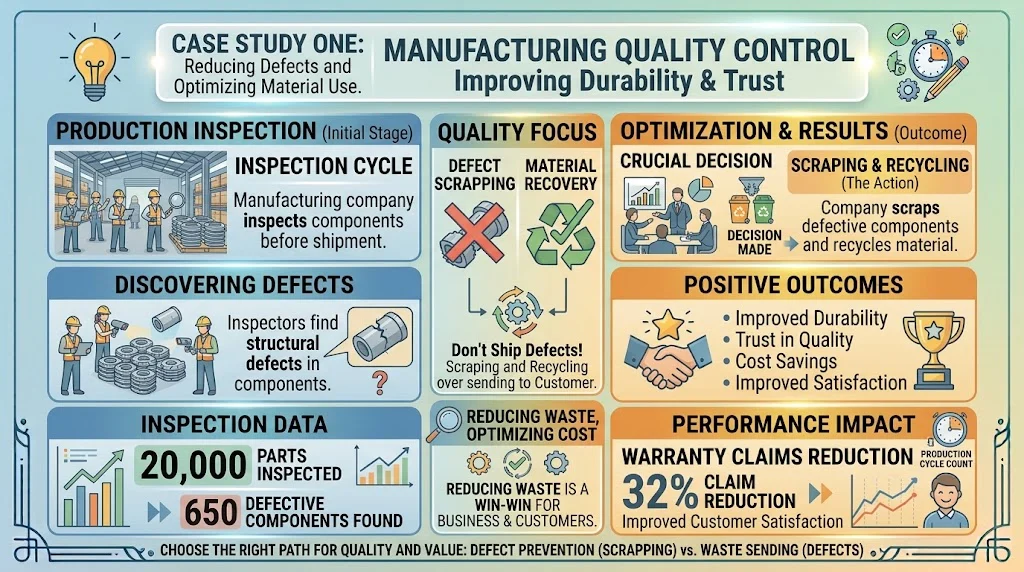
A manufacturing company inspected 20,000 metal components before shipment. During inspection, engineers discovered that 650 parts contained structural defects. Instead of sending them to customers, the company scrapped the defective components and recycled the material.
The decision reduced warranty claims by 32 percent during the following production cycle and improved customer satisfaction.
Case Study Two: Ecommerce Market Research
An online retail company wanted to monitor competitor prices across hundreds of products every day. Instead of checking each website manually, developers built a web scraping system that automatically collected publicly available pricing information.
The automated process reduced research time from 18 hours per week to less than 45 minutes, allowing analysts to focus on pricing strategy rather than manual data collection.
Error Prevention Checklist
Use this checklist whenever you are unsure to write scrapping or scraping.
| Always Use | Never Use |
|---|---|
| Scrapping when talking about canceling a project. | Scrapping when removing paint, dirt, or ice from a surface. |
| Scrapping when something is being discarded or dismantled. | Scrapping when collecting information from websites. |
| Scrapping when referring to retired vehicles, machines, or equipment. | Scrapping when describing data extraction or web automation. |
| Scraping when removing material from a surface. | Scraping when you mean abandoning a business plan. |
| Scraping when extracting publicly available online data. | Scraping when discussing throwing away defective products. |
| Scraping when describing cleaning, cooking, construction, or woodworking tasks. | Scraping when referring to canceling a proposal or project. |
A quick review before publishing can help you avoid one of the most common vocabulary mistakes in English writing.
Related Grammar Confusions You Should Master
These commonly confused word pairs create similar challenges because they look or sound alike but have different meanings.
| Grammar Confusion | Main Difference |
|---|---|
| Affect or Effect | Action versus result |
| Complement or Compliment | Complete versus praise |
| Advice or Advise | Noun versus verb |
| Stationary or Stationery | Motionless versus writing materials |
| Principal or Principle | Person versus rule |
| Lose or Loose | Misplace versus not tight |
| Than or Then | Comparison versus time |
| Accept or Except | Receive versus exclude |
| Farther or Further | Physical distance versus additional extent |
| Discreet or Discrete | Careful versus separate |
Learning these distinctions will strengthen your writing and reduce avoidable vocabulary errors.
FAQs
Is it scrapping or scraping a website?
The correct expression is scraping a website because the action involves collecting publicly available information rather than discarding anything.
What does scrapping mean in business?
In business, scrapping means canceling, abandoning, or permanently removing a product, project, or asset from use.
Can scrapping and scraping be used interchangeably?
No. They have completely different meanings, so replacing one with the other changes the message of the sentence.
What is web scraping?
Web scraping is the automated process of extracting publicly available information from websites for analysis, research, or business purposes.
Why do people confuse scrapping and scraping?
The words differ by only one letter and sound similar when spoken, making them easy to confuse in writing.
Is scraping a technical term?
Yes. In computing, scraping is an established term used for collecting information from websites or digital sources.
What is the easiest way to remember the difference?
Think of scrapping as throwing something away and scraping as removing or collecting something.
Which word should I use when removing paint from a wall?
Use scraping because the action involves removing material from a surface rather than discarding the wall itself.
Does scrapping always mean recycling?
No. Scrapping can involve recycling, but it more generally means abandoning, canceling, or disposing of something.
Is web scraping legal?
Legality depends on local laws, website terms of service, and how the collected data is used, so it varies by situation.
What is the correct spelling of scrapping?
Scrapping is the correct spelling when you mean cutting, removing, or getting rid of something. It is the present participle of scrap, as in “They are scrapping the old plan.” Don’t confuse it with scraping, which means rubbing or removing something from a surface.
Conclusion
Understanding scrapping or scraping is easier once you focus on the meaning rather than the spelling. Scrapping is the correct choice when something is being abandoned, canceled, dismantled, or discarded. Scraping is the correct word when material is removed from a surface or information is extracted from another source, especially in technology and data analysis.
Although the two words differ by only one letter, using the wrong one can completely change the meaning of a sentence. You are writing a business report, an academic paper, software documentation, or everyday emails, selecting the correct term improves clarity, professionalism, and credibility. The next time you hesitate, simply remember this rule: discard means scrapping, while remove or collect means scraping.
Discover More Related Articles:
- Sowing or Sewing | What Is the Difference & When Should You Use Each In 2026
- Canon or Cannon | Understanding the Difference & Using Each Word Correctly In 2026
- Majorca or Mallorca | Why Does the Island Have Two Names In 2026