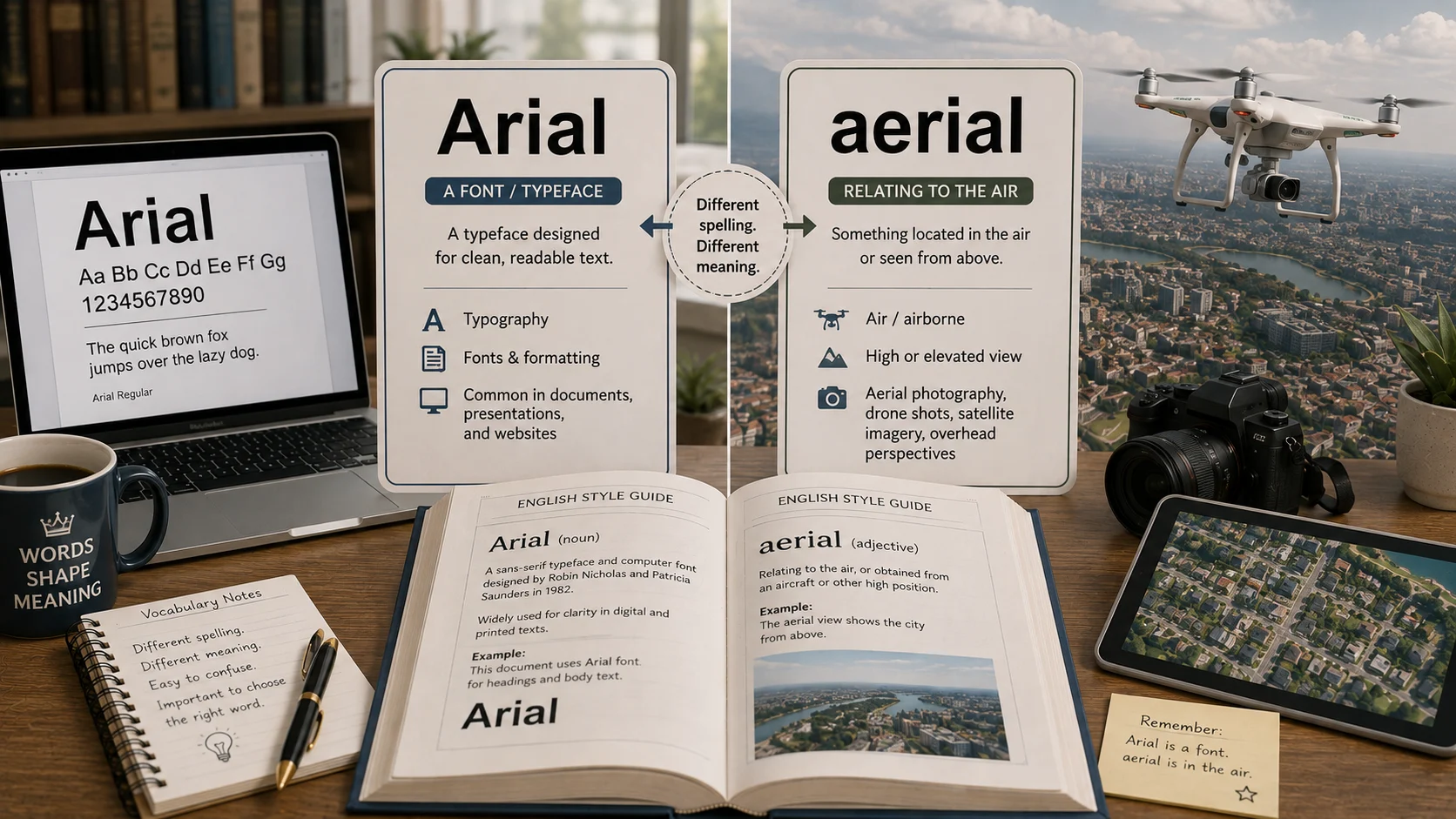
Arial and aerial are two completely different English words. Arial is the name of a widely used sans serif typeface, while aerial is an adjective or noun connected with the air, aircraft, or something viewed from above. They are not interchangeable, and confusing them can create obvious errors in professional writing, editing, design instructions, and technical communication.
Have you ever confused arial or aerial while writing an email, completing an assignment, or describing something you see in the sky? Although these words look and sound similar, they have different meanings and cannot always be used interchangeably. Arial is the name of a widely used sans-serif font found in documents, presentations, and digital designs. In contrast, aerial is an adjective or noun associated with the air, things above the ground, or views captured from a height. Understanding this distinction helps you choose the right word and avoid unnecessary spelling and vocabulary mistakes.
In this guide, we’ll explore the meanings of Arial and aerial, explain their differences with clear examples, and show you how to use each term correctly in everyday and professional writing. you’re formatting a document or describing an overhead photograph, learning when to use each word will make your communication clearer and more accurate.
Arial or Aerial | What’s the Difference?
The difference between Arial and aerial is primarily a matter of meaning, not grammar. Although the words look and sound somewhat similar, they belong to entirely different vocabulary categories.
Arial is a proper noun used for a specific typeface. It is normally written with a capital A because it is the name of a font. Writers may encounter it in style guides, document specifications, publishing instructions, presentations, websites, and office documents.
Aerial is a standard English word with several related meanings. As an adjective, it describes something associated with the air or located above the ground. For example, an aerial photograph is a photograph taken from above, usually from an aircraft or another elevated position. Aerial can also refer to something relating to aircraft or activity in the air.
As a noun, aerial can refer to an antenna, particularly in British English. For example, someone might say that a television aerial needs replacing.
| Word | Part of Speech | Meaning | Example |
|---|---|---|---|
| Arial | Proper noun | A specific sans serif typeface | The report should be formatted in Arial. |
| aerial | Adjective | Relating to air or something above the ground | The researchers examined an aerial photograph. |
| aerial | Noun | An antenna, especially in British English | The television aerial was damaged. |
The distinction becomes straightforward once you connect each spelling with its meaning.
Arial refers to a font.
Aerial relates to the air, aircraft, or something above the ground.
Aerial can also mean an antenna in British English.
They should therefore never be treated as alternative spellings of the same word.
Is Arial or Aerial a Grammar, Vocabulary or Usage Issue?
The confusion between Arial and aerial is mainly a vocabulary and usage issue rather than a grammatical one.
Grammar determines how a word functions within a sentence. Vocabulary determines which word communicates the intended meaning. In this case, both words can be grammatically correct, but choosing the wrong one changes the meaning completely.
Consider these two sentences:
The document should use Arial.
The survey used an aerial photograph.
Both sentences are grammatically correct. Replacing Arial with aerial in the first sentence, however, would produce an incorrect meaning because aerial does not name the typeface.
Likewise, replacing aerial with Arial in the second sentence would make the sentence inaccurate because Arial does not describe something viewed from above.
Are Arial and aerial interchangeable?
No. They are not interchangeable.
Arial is a font name. Aerial describes a relationship with air or something located above the ground, and it can also function as a noun meaning antenna.
Is Arial formal or informal?
Arial itself is neither particularly formal nor informal. It is a font name. Its appropriateness depends on the document, publication, brand guidelines, or formatting requirements.
Is aerial formal or casual?
Aerial is a standard English word suitable for professional, academic, technical, journalistic, and everyday writing. Terms such as aerial photography and aerial survey are especially common in technical contexts.
When to Use Arial
Use Arial when you are referring specifically to the typeface.
This distinction matters greatly to writers, editors, designers, and publishing professionals because formatting instructions often appear alongside editorial instructions. A sentence such as “Please submit the manuscript in Arial” is referring to typography, not anything related to aircraft or air.
Workplace example
Please prepare the final report in Arial, 11 point, before sending it to the client.
Here, Arial identifies the typeface used for the report.
An editor might also write:
Use Arial for the captions and body text according to the client’s formatting requirements.
Again, the word refers exclusively to typography.
Academic example
Students should submit their assignments in Arial with consistent heading styles.
In this context, Arial describes the font used in the assignment.
A university formatting guide might specify Arial because the institution wants documents to have consistent visual presentation.
Technology example
The application allows users to select Arial from the font menu.
This sentence concerns a digital interface and typography. Arial is the name of one selectable typeface.
The same principle applies to word processors, presentation software, website editors, design applications, and content management systems.
Usage recap
Use Arial when the subject is typography, fonts, formatting, documents, design, or text appearance.
If you can replace the word with the Arial typeface, Arial is almost certainly the correct choice.
When to Use Aerial
Use aerial when you are describing something connected with the air, aircraft, height, or a view from above.
The word appears frequently in professional and technical writing. Common expressions include aerial photography, aerial survey, aerial view, aerial footage, aerial inspection, and aerial mapping.
Workplace example
The engineering team reviewed aerial photographs of the construction site.
Here, aerial means that the photographs were taken from above.
Another example is:
The company commissioned an aerial survey of the property.
The survey was conducted from an elevated position, typically using an aircraft, drone, or similar technology.
Academic example
Researchers used aerial imagery to study changes in land use.
Aerial describes imagery obtained from above.
This usage is common in geography, environmental science, archaeology, urban planning, agriculture, and related academic disciplines.
Technology example
The mapping platform processes aerial images captured by drones.
Here, aerial refers to images obtained from the air.
Modern technology has made this usage even more common because drones, satellites, aircraft, and advanced imaging systems are widely used to collect information about landscapes and infrastructure.
Usage recap
Use aerial when discussing the air, aircraft, elevated views, aerial photography, aerial imagery, aerial surveys, or antennas.
If the meaning involves something being in the air or seen from above, aerial is usually the appropriate word.
When You Should NOT Use Arial or Aerial
Writers and editors can avoid most mistakes by checking the intended meaning before choosing the spelling.
| Situation | Correct Word | Reason |
|---|---|---|
| Naming a font | Arial | Arial is a typeface name. |
| Describing a photograph taken from above | aerial | The photograph is captured from an elevated position. |
| Describing an aircraft related activity | aerial | The word relates to activity in the air. |
| Describing a view from above | aerial | Aerial can describe an elevated perspective. |
| Referring to a British television antenna | aerial | Aerial can function as a noun meaning antenna. |
| Giving document formatting instructions | Arial | The instruction concerns typography. |
| Describing drone photography | aerial | The imagery is captured from the air. |
| Describing a font as aerial | Incorrect | Aerial is not the name of the typeface. |
Do not use Arial merely because it sounds similar to aerial. Similarly, do not write aerial when you are referring to the font.
A sentence such as “Please write the article in aerial” is incorrect if the intended meaning is the Arial typeface.
Likewise, “The photographer captured an Arial view of the city” is incorrect if the intended meaning is a view from above.
Common Mistakes and Decision Rules
The most common errors occur when writers rely on sound instead of meaning. Since Arial and aerial have similar pronunciations in many varieties of English, proofreading software or speech based drafting can sometimes contribute to the confusion.
| Correct sentence | Incorrect sentence | Explanation |
|---|---|---|
| Please format the article in Arial. | Please format the article in aerial. | Arial is the name of the font. |
| We analyzed an aerial photograph. | We analyzed an Arial photograph. | Aerial describes a photograph taken from above. |
| The aerial survey covered the entire region. | The Arial survey covered the entire region. | Aerial describes the type of survey. |
| Select Arial from the font menu. | Select aerial from the font menu. | Arial is a typeface available in software. |
| The city was visible in the aerial footage. | The city was visible in the Arial footage. | Aerial describes footage captured from above. |
| The television aerial needs repair. | The television Arial needs repair. | Aerial can mean antenna in British English. |
Decision Rule
If you mean the font, use Arial.
If you mean something connected with the air, above the ground, or an elevated view, use aerial.
If you mean an antenna in British English, use aerial.
This rule is more reliable than trying to remember how the two words sound.
Arial or Aerial in Modern Technology and AI Tools
The distinction is particularly relevant in modern digital workflows.
Writing applications, document editors, presentation platforms, design software, and publishing systems commonly include Arial as a selectable font. A writer may therefore encounter instructions such as “Use Arial for the body text” or “Change the heading font to Arial.”
Aerial, meanwhile, has become increasingly common in technology related writing because drones, satellites, mapping systems, computer vision, and geographic information systems produce aerial imagery.
Artificial intelligence also processes large quantities of aerial data. AI systems can analyze aerial photographs to identify buildings, roads, vegetation, land use patterns, and infrastructure.
This creates two completely different technical contexts:
| Technology context | Correct word | Example |
|---|---|---|
| Font selection | Arial | The editor selected Arial for the document. |
| Document formatting | Arial | The template uses Arial throughout. |
| Drone photography | aerial | The system analyzes aerial images. |
| Geographic mapping | aerial | The software processes aerial imagery. |
| Computer vision | aerial | AI detects objects in aerial photographs. |
| Antenna technology | aerial | The aerial receives television signals. |
For technical writers and editors, context is therefore the safest guide.
Arial or Aerial | Etymology and Word History
The two words have different histories, which helps explain why they should not be confused.
Aerial comes from the Latin word aerius, meaning relating to air, and entered English through French and scholarly usage. Its meanings developed around air, the atmosphere, and things situated above the earth.
Arial, in contrast, is a proper name associated with a typeface. The font was developed by Robin Nicholas and Patricia Saunders and introduced by Monotype in the early 1980s. Its widespread availability helped make Arial a familiar font name in computing and document production.
An important editorial principle follows from this distinction: similar spelling does not necessarily indicate similar meaning or origin.
An expert style explanation
A useful editorial principle is: “Choose the word according to meaning, not pronunciation.”
That rule applies especially well to Arial and aerial because their visual and phonetic similarity can hide the fact that they perform completely different jobs in English.
Two Practical Editing Case Studies
Case Study 1: A Formatting Instruction
Imagine an editor preparing a corporate report for publication. The style sheet specifies that the body text must use Arial.
During proofreading, the editor notices this sentence:
The final manuscript should be submitted in aerial.
The sentence is understandable from context, but the spelling is wrong. Replacing aerial with Arial restores the intended meaning and makes the formatting instruction precise.
The concrete result is a corrected style instruction that can be followed consistently by the production team.
Case Study 2: A Research Report
Consider an academic report discussing photographs collected by drones. The draft contains this sentence:
The researchers compared Arial images from three locations.
The surrounding discussion clearly concerns images captured from above. The editor changes Arial to aerial.
The concrete result is a sentence that accurately identifies the source and nature of the images. The correction also prevents readers from mistakenly interpreting Arial as a technical imaging term.
These examples demonstrate why proofreading requires semantic awareness. A spell checker may recognize both forms as legitimate English words, but only the writer or editor can determine which meaning belongs in context.
Error Prevention Checklist
Always use Arial when
You are naming the Arial typeface.
You are discussing font selection.
You are giving document formatting instructions involving that typeface.
You are referring to typography in software or publishing.
You are comparing Arial with other fonts.
Never use aerial when
You mean the Arial font.
You are naming a typeface.
You are instructing someone to format text in Arial.
You are describing a font choice in a style sheet.
At the same time, remember that aerial is completely correct when the subject involves air, aircraft, elevated views, aerial photography, aerial mapping, or an antenna.
Why Writers and Editors Confuse Arial and Aerial
The confusion is understandable because the two words are visually similar and may sound almost identical in ordinary speech.
There is also a practical reason for the mistake. Modern writers frequently dictate text, copy content between applications, and rely on automatic correction tools. When two legitimate words have different meanings, automated spelling systems may not always identify a contextual substitution as an error.
This is why professional proofreading goes beyond checking a word is spelled correctly. Editors must also determine the correct word has been selected.
A document can contain no obvious spelling errors and still contain a vocabulary error.
That distinction is especially important for professional writers, technical authors, journalists, academic researchers, and copy editors.
Related Grammar Confusions You Should Master
Writers who frequently confuse Arial and aerial may also benefit from reviewing other commonly confused English words.
affect or effect concerns different grammatical functions and meanings.
advice or advise distinguishes a noun from a verb.
complement or compliment separates completion or suitability from praise.
principal or principle distinguishes a person or primary item from a rule or belief.
stationary or stationery separates being still from writing materials.
your or you’re distinguishes possession from a contraction.
lose or loose separates failure to keep something from something that is not tight.
than or then distinguishes comparison from time or sequence.
accept or except separates receiving or agreeing from exclusion.
farther or further involves distinctions between physical distance and broader figurative or additional meanings.
Learning these pairs strengthens editorial accuracy because the same fundamental principle applies: choose words according to meaning and grammatical function rather than appearance or sound.
FAQs
Is Arial or aerial the correct spelling for a font?
Arial is correct because it is the name of a typeface, while aerial refers to air, elevated positions, or an antenna.
What is the difference between Arial and aerial?
Arial is a font name, whereas aerial is an English word describing something related to air or something viewed from above.
Should I write Arial font or aerial font?
Write Arial font when referring to the typeface, although simply writing Arial is often sufficient because Arial already identifies the font.
Is aerial a type of font?
No, aerial is not the name of the Arial typeface and should not be used when discussing font selection.
What does aerial mean in English?
Aerial commonly means relating to the air or something above the ground, and it can also mean an antenna in British English.
Is Arial capitalized in professional writing?
Yes, Arial is normally capitalized because it is a proper name for a specific typeface.
Can aerial mean antenna?
Yes, particularly in British English, aerial can be used as a noun meaning an antenna used to receive signals.
Why do writers confuse Arial and aerial?
They are easy to confuse because their spelling and pronunciation are similar, even though their meanings and uses are completely different.
How can editors remember Arial versus aerial?
Associate Arial with typography and fonts, while associating aerial with air, aircraft, elevated views, and antennas.
Conclusion
The difference between Arial and aerial is simple once you focus on meaning. Arial is a proper noun that identifies a specific typeface. Aerial is a standard English word describing something associated with air, aircraft, an elevated position, or, in British English, an antenna.
For writers and editors, the safest approach is to ignore pronunciation and examine the context. If the sentence concerns fonts, typography, or document formatting, choose Arial. If it concerns air, aircraft, photography from above, mapping, or an antenna, choose aerial.
This small distinction can make a significant difference in professional writing because both forms are legitimate words. The challenge is not spelling either word correctly. The challenge is selecting the correct word for the meaning you intend.
Discover More Related Articles:
- Artic or Arctic | What Is the Difference and Which Spelling Is Correct In 2026
- Hitmonlee or Hitmonchan | Which Pokémon Should You Choose In 2026
- Let’s or Lets | What’s the Difference & When to Use Each Correctly In 2026