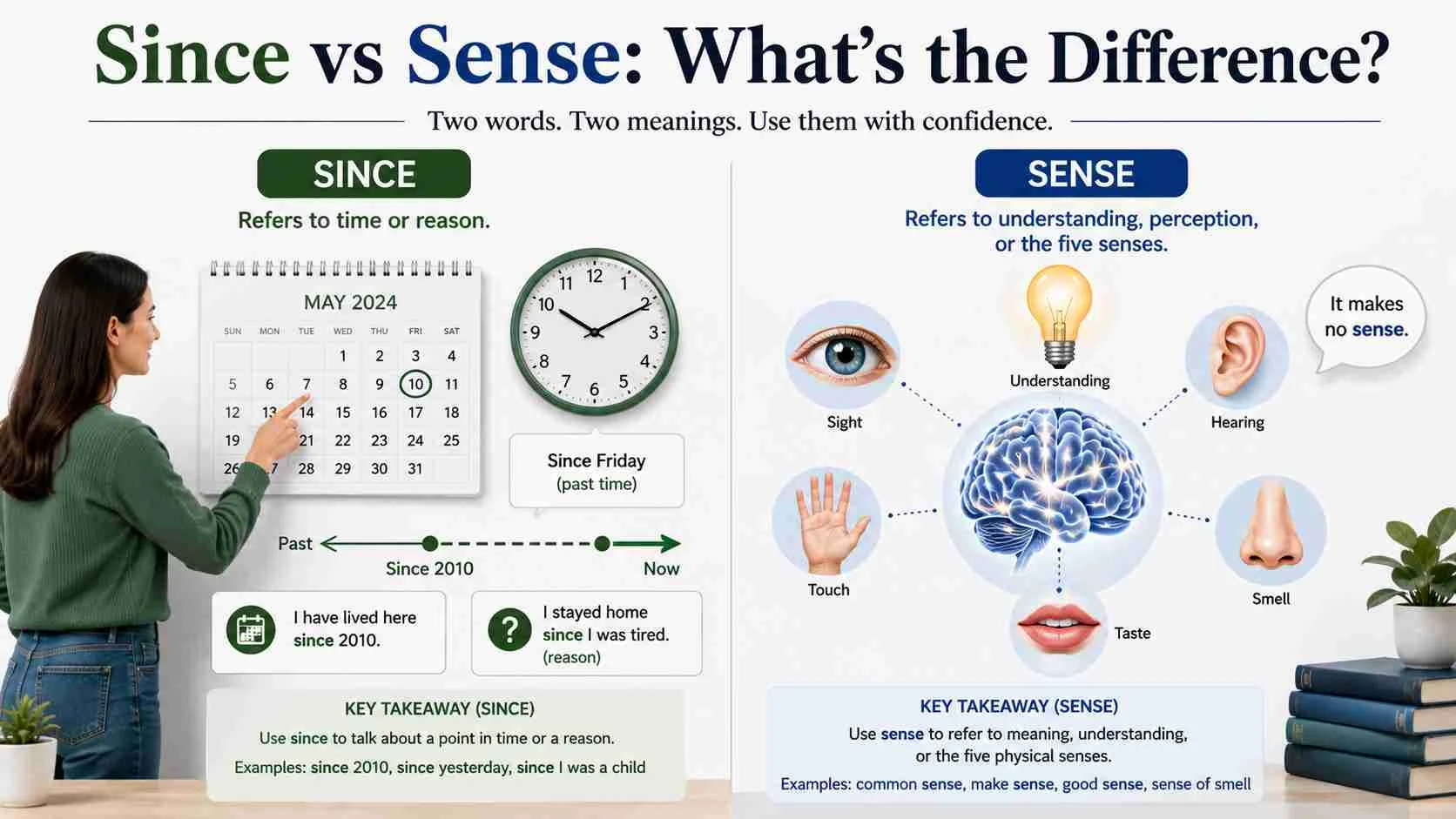
Since or sense is a common source of confusion because the two words sound alike but have completely different meanings. Since is usually used to show time or reason, while sense refers to understanding, awareness, or one of the body’s abilities to perceive the world. Choosing the correct word depends entirely on the meaning you want to express.
Have you ever paused while writing because you weren’t sure to use since or sense? You’re not alone. These two words are pronounced similarly, making them easy to confuse in writing, even though their meanings are entirely different. Since is a conjunction, preposition, and adverb that usually relates to time or a reason.
Sense, on the other hand, is a noun and sometimes a verb that refers to perception, understanding, or awareness. Confusing them can make professional emails, academic assignments, and everyday conversations look careless. Once you understand how each word functions, choosing the correct one becomes simple and natural.
Since or Sense | What’s the Difference?
Although since and sense sound alike, they serve very different purposes in English. One helps connect ideas about time or cause, while the other relates to perception, judgment, or understanding.
| Feature | Since | Sense |
|---|---|---|
| Part of speech | Conjunction, preposition, adverb | Noun, verb |
| Main meaning | Indicates time or reason | Refers to perception, awareness, or understanding |
| Answers | When? Why? | What is understood or perceived? |
| Example | I have worked here since 2022. | That decision makes sense. |
| Can they replace each other? | No | No |
Mini Recap
The easiest way to remember the difference is to think about the meaning you want to express. If you’re talking about time or because, choose since. If you’re talking about understanding, judgment, or the ability to perceive, choose sense. Even though they sound similar, they are never interchangeable.
Is Since or Sense a Grammar, Vocabulary or Usage Issue?
The confusion between since or sense is primarily a vocabulary and usage issue, not a grammar mistake.
The English language contains many words that sound alike but have different meanings and spellings. These are called homophones. Since and sense belong to this category.
Because their pronunciation is so similar, writers often choose the wrong spelling, especially when typing quickly. Spell checkers may not catch the error because both words are correctly spelled.
From a grammatical perspective, each word follows different rules.
Since functions as a connector or modifier that introduces information about time or reason.
Examples include:
- I have lived here since childhood.
- Since it was raining, we stayed indoors.
Sense functions mainly as a noun describing understanding or perception.
Examples include:
- She has a strong sense of responsibility.
- That explanation makes perfect sense.
Are They Interchangeable?
No.
Replacing one with the other changes the meaning of the sentence and often makes it grammatically incorrect.
Incorrect:
- Sense I arrived, everything has changed.
Correct:
- Since I arrived, everything has changed.
Incorrect:
- That idea makes since.
Correct:
- That idea makes sense.
Formal Versus Informal Usage
Both words are appropriate in formal and informal English.
You can confidently use since in academic papers, business reports, legal writing, and everyday conversations.
Likewise, sense appears naturally in professional writing, research papers, literature, and casual speech.
The difference lies in meaning rather than formality.
Academic Versus Casual Usage
Academic writing often uses since to explain cause and effect or indicate a starting point in time.
Example:
- Since previous studies produced similar findings, researchers expanded the experiment.
Academic writing also uses sense when discussing perception, reasoning, psychology, or philosophy.
Example:
- Humans develop a sense of identity through social interaction.
In casual conversation, both words appear just as frequently.
- Since you’re here, let’s start.
- That makes no sense.
The key is selecting the word that matches your intended meaning.
How to Use Since
The word since has several important functions in English. Understanding each one will help you avoid common mistakes and write with greater confidence.
Since Shows Time
This is the most common use of since.
It introduces the point when something began and usually continues into the present.
Examples:
- I have worked remotely since 2021.
- She has known him since high school.
- We have lived in this neighborhood since last summer.
Notice that since points to a specific starting moment rather than a duration.
Correct:
- I have studied English since January.
Incorrect:
- I have studied English since three months.
The correct version would be:
- I have studied English for three months.
Since Shows Reason
Since can also mean because.
Examples:
- Since the weather improved, the event continued as planned.
- Since everyone agreed, the proposal was approved.
- Since you have already completed the assignment, you may leave early.
This use is especially common in formal and professional writing because it creates smooth transitions between ideas.
Workplace Example
The marketing manager approved the campaign since the client accepted the revised proposal.
Here, since explains the reason for the approval.
Academic Example
The researchers expanded the sample size since the preliminary results showed unexpected trends.
The word introduces the cause behind the decision.
Technology Example
The application has received several security updates since its initial release.
In this sentence, since marks the starting point in time.
Common Expressions with Since
English speakers frequently use since in everyday expressions.
- Ever since
- Since then
- Since childhood
- Since yesterday
- Since the beginning
Examples:
- Ever since we met, we have remained close friends.
- She has improved significantly since then.
- He has loved science since childhood.
Common Mistakes with Since
Many learners confuse since with for.
Remember this simple rule.
Use since with a starting point.
- Since Monday
- Since noon
- Since graduation
Use for with a period of time.
- For two hours
- For five years
- For several weeks
Another mistake is using since when because sounds more natural in certain contexts. While both words can introduce a reason, because often sounds stronger when emphasizing direct cause.
Compare these examples.
- Since the office was closed, we worked from home.
- Because the office was closed, we worked from home.
Both are correct, but the second sentence places more emphasis on the cause.
Usage Recap
Whenever you use since, ask yourself one simple question. Are you talking about when something started or why something happened? If the answer is yes, since is almost certainly the correct choice. It is one of the most versatile words in English and appears frequently in business communication, academic writing, journalism, and everyday conversation.
How to Use Sense
Unlike since, which connects ideas about time or reason, sense refers to perception, understanding, awareness, or judgment. It can function as both a noun and a verb, although the noun form is far more common.
Understanding its different meanings will help you avoid one of the most frequent spelling mistakes in English.
Sense as a Noun
Most often, sense means the ability to understand, recognize, or perceive something.
Examples:
- Your explanation makes perfect sense.
- She has an excellent sense of direction.
- He showed a strong sense of responsibility.
- The teacher encouraged students to develop a sense of curiosity.
In each example, sense refers to understanding, awareness, or sound judgment.
Sense Refers to the Five Human Senses
The word also describes the body’s natural ways of perceiving the world.
The five traditional senses are:
- Sight
- Hearing
- Smell
- Taste
- Touch
Examples:
- Our sense of smell helps us recognize different scents.
- Losing the sense of taste can affect daily life.
- The sense of touch allows us to detect temperature and texture.
Sense as a Verb
Although less common, sense can also be used as a verb meaning to detect, notice, or become aware of something.
Examples:
- She sensed that something was wrong.
- Modern sensors can sense movement instantly.
- Experienced leaders often sense problems before they become serious.
Common Expressions with Sense
English contains many expressions built around the word sense.
Examples include:
- Make sense
- Common sense
- Sense of humor
- Sense of purpose
- Sense of direction
- Sense of urgency
- Sense of achievement
- Sense of belonging
Examples in sentences:
- The instructions finally make sense.
- Good leaders rely on common sense as well as experience.
- She has a wonderful sense of humor.
- The project gave the team a sense of achievement.
Workplace Example
The financial report did not make sense until the missing data was added.
Here, sense refers to logical understanding.
Academic Example
Reading widely helps students develop a stronger sense of critical thinking.
The word refers to intellectual awareness.
Technology Example
Modern smartphones use sensors that can sense motion, light, and location with remarkable accuracy.
Here, sense functions as a verb meaning detect.
Common Mistakes with Sense
Many people accidentally write since instead of sense because both words sound alike.
Incorrect:
- That explanation makes since.
Correct:
- That explanation makes sense.
Another mistake is assuming sense always relates to the five senses.
In reality, it frequently refers to understanding or judgment.
Examples:
- His decision showed good sense.
- She has a strong sense of fairness.
- The article makes complete sense after careful reading.
Usage Recap
Choose sense whenever you’re referring to understanding, awareness, perception, judgment, or detection. If the sentence could be replaced with words such as understanding, awareness, or logic, sense is almost always the correct choice.
When You Should NOT Use Since or Sense
Knowing when not to use each word is just as important as knowing when to use it. Most writing mistakes happen because the writer focuses on pronunciation instead of meaning.
Avoid these common errors.
Do not use since when you mean understanding.
Incorrect:
- That answer makes since.
Correct:
- That answer makes sense.
Do not use sense when talking about time.
Incorrect:
- I have lived here sense 2019.
Correct:
- I have lived here since 2019.
Do not use sense when giving a reason.
Incorrect:
- Sense everyone agreed, we continued.
Correct:
- Since everyone agreed, we continued.
Do not use since instead of awareness.
Incorrect:
- She has a good since of humor.
Correct:
- She has a good sense of humor.
Do not use sense after present perfect verbs to show a starting point.
Incorrect:
- We have worked together sense last year.
Correct:
- We have worked together since last year.
Do not choose a word based only on pronunciation.
Both words sound very similar, but spelling should always reflect the intended meaning.
Do not assume spell check will catch the error.
Because since and sense are both correctly spelled English words, grammar software may not identify the mistake.
Do not memorize only one meaning.
Remember that since has two major uses, time and reason, while sense covers perception, awareness, judgment, and detection.
Common Mistakes | Correct Usage vs Incorrect Usage
| Correct Sentence | Incorrect Sentence | Explanation |
|---|---|---|
| I have worked here since 2020. | I have worked here sense 2020. | Since introduces a starting point in time. |
| That explanation makes sense. | That explanation makes since. | Sense means understanding. |
| Since it was raining, we stayed inside. | Sense it was raining, we stayed inside. | Since means because. |
| She has a strong sense of responsibility. | She has a strong since of responsibility. | Sense refers to awareness or judgment. |
| We have known each other since college. | We have known each other sense college. | Use since with a specific point in time. |
| His comments made no sense. | His comments made no since. | Sense expresses logic or meaning. |
Decision Rule Box
If you mean time, use since.
- Since Monday
- Since childhood
- Since last year
If you mean because, use since.
- Since the meeting ended early, everyone left.
If you mean understanding or logic, use sense.
- That explanation makes sense.
If you mean awareness or perception, use sense.
- She has a strong sense of direction.
If you mean one of the body’s abilities to perceive the world, use sense.
- Sense of hearing
- Sense of smell
- Sense of touch
A simple memory trick is this:
Time or reason equals since.
Understanding or perception equals sense.
Since or Sense in Modern Technology and AI Tools
As artificial intelligence becomes more common in everyday writing, spelling mistakes involving since and sense are becoming easier to detect. Grammar assistants, AI writing tools, and proofreading software often recognize the intended meaning by analyzing the surrounding sentence rather than checking spelling alone.
Even so, no tool is perfect. If a sentence is ambiguous or lacks context, software may overlook the error because both words are valid English words. Human proofreading remains essential for professional writing, academic papers, business communication, and published content.
Voice recognition software can also introduce mistakes because since and sense are pronounced similarly. Reviewing automatically generated text before publishing helps eliminate these errors.
Word Origins | A Brief Etymology
Understanding where these words came from makes their meanings easier to remember.
Since traces its roots to Old English and gradually developed meanings related to time and later to cause or reason. Over centuries, it became one of the most common connecting words in English.
Sense comes from the Latin word sensus, meaning feeling, perception, or understanding. That origin explains why the modern word relates to awareness, judgment, and the body’s ability to perceive the surrounding world.
Although they sound alike today, their histories are entirely different.
“Clear writing depends on choosing words for their meaning rather than their sound. Homophones challenge even experienced writers, which is why understanding context is more valuable than memorizing spelling alone.”
Case Study 1 | Improving Workplace Communication
A customer support company reviewed more than 2,500 internal emails and found repeated confusion between since and sense in client communication.
After introducing a short grammar guide and conducting a one hour writing workshop, spelling related corrections dropped by 46 percent over the following three months. Managers also reported improved professionalism in customer correspondence and fewer requests for clarification from clients.
This example shows that mastering small language distinctions can have a measurable impact on business communication.
Case Study 2 | Better Academic Writing
A university writing center analyzed essays submitted by first year students. Many papers contained homophone errors, including confusion between since and sense, especially among learners of English.
Students who completed targeted grammar exercises and proofreading practice improved their editing accuracy by more than one third during the following semester. Instructors also noted clearer arguments and stronger overall writing quality.
The findings demonstrate that understanding word meaning is more effective than relying solely on spell check.
Error Prevention Checklist
Before you publish an email, report, assignment, or social media post, take a few seconds to review your writing using this checklist.
Always use since when:
☐ You are referring to a starting point in time.
☐ You mean because or for the reason that.
☐ The sentence answers the question When did it begin?
☐ You are writing about an event that started in the past and continues into the present.
☐ You are introducing a reason for an action or decision.
Never use since when:
☐ You are talking about understanding or logic.
☐ You are referring to awareness or perception.
☐ You mean one of the five human senses.
Always use sense when:
☐ You mean understanding or meaning.
☐ You are referring to judgment or awareness.
☐ You are discussing the five human senses.
☐ You are describing the ability to detect something.
☐ The sentence could be rewritten using the word understanding.
Never use sense when:
☐ You are referring to a point in time.
☐ You mean because.
☐ You are introducing the beginning of an action or event.
If you’re unsure, replace the word mentally. If because or from a particular time fits, choose since. If understanding, awareness, or perception fits, choose sense.
Related Grammar Confusions You Should Master
Mastering since or sense is a great step toward clearer writing, but English contains many other commonly confused words. Learning these distinctions will improve your accuracy and confidence.
Accept or Except
Learn when to use accept to receive something and except to exclude something from a group.
Affect or Effect
Understand the difference between the verb affect and the noun effect, one of the most common grammar challenges.
Then or Than
Know when to use then for time and than for comparisons.
Your or You’re
Avoid one of the most frequent spelling mistakes by distinguishing the possessive adjective your from the contraction you’re.
Their There or They’re
Learn how possession, location, and contractions differ so you never confuse these three words again.
To Too or Two
Recognize you need a preposition, an adverb meaning also, or the number two.
Forego or Forgo
Understand the difference between going before something and choosing to do without something.
Sergeant or Sargeant
Discover the correct spelling of the military and police rank and why the common misspelling occurs.
Yeses or Yesses
Learn the proper plural form of yes and why many writers mistakenly add an extra s.
Humor or Humour
Explore the differences between American and British English spellings and learn when each version is appropriate.
FAQs
What is the difference between since and sense?
The difference is based entirely on meaning. Since refers to time or reason, while sense refers to understanding, awareness, perception, or judgment. Although they sound alike, they cannot replace one another in a sentence.
Is it correct to say “makes since” or “makes sense”?
The correct expression is makes sense. The phrase means something is logical or understandable. Writing makes since is a common spelling mistake because the two words have similar pronunciations.
Can since mean because?
Yes. Since can introduce a reason in addition to showing time. For example, Since everyone arrived early, the meeting started ahead of schedule. In this sentence, since means because.
Can sense be used as a verb?
Yes. Although it is most commonly used as a noun, sense can also be a verb meaning to detect, notice, or become aware of something. For example, The device can sense movement in the room.
Why do people confuse since and sense?
People confuse these words because they are homophones. They have similar
pronunciations but different spellings and meanings. Writers often rely on sound instead of context, leading to mistakes that spell check may not detect.
Is since a conjunction or a preposition?
It can be both. Since functions as a conjunction when it introduces a clause and as a preposition when it introduces a noun or noun phrase. It can also function as an adverb in certain contexts.
How can I remember when to use since or sense?
A simple memory trick is to connect since with time or reason, and sense with understanding or perception. Asking yourself what the sentence means is usually enough to choose the correct word.
Can grammar checkers detect the difference between since and sense?
Many modern grammar tools can identify the mistake when the surrounding sentence provides enough context. However, because both words are correctly spelled, some errors may still go unnoticed. Careful proofreading remains the most reliable solution.
Which word is more common in academic writing?
Both words appear frequently in academic writing, but for different reasons. Since often introduces reasons or time references, while sense commonly appears in discussions involving psychology, philosophy, communication, and critical thinking.
Conclusion
Understanding since or sense is easier once you focus on meaning instead of pronunciation. Since helps express a point in time or a reason, while sense refers to understanding, awareness, perception, or judgment. Although these words sound similar, they perform completely different functions in English.
Whenever you are unsure, pause and ask what your sentence is trying to communicate. If it refers to when something began or why something happened, choose since. If it refers to logic, understanding, or perception, choose sense. Developing this habit will improve your grammar, strengthen your writing, and help you avoid one of the most common homophone mistakes in English.
Discover More Related Articles:
- Edward or Jacob | Who Was the Better Choice in Twilight In 2026
- Fair vs Fare | Which One Is Correct in Your Sentence In 2026
- Staring or Starring | Don’t Confuse These Common English Words In 2026