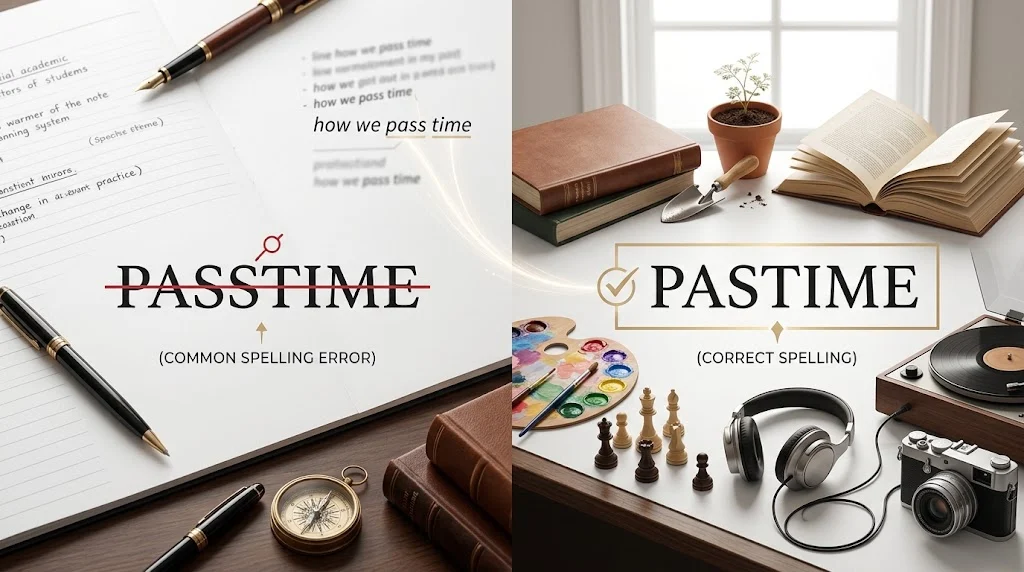
Passtime or pastime is a common spelling confusion, but only pastime is the standard English word. Pastime is a noun meaning an activity someone enjoys during free time, such as reading, gardening, or playing chess. Passtime is generally considered a misspelling, so it should not be used in standard English writing.
The confusion between passtime or pastime usually comes from the way the word sounds when spoken. English contains many words in which doubled consonants appear naturally, so it can feel reasonable to write passtime with two t’s. However, standard dictionaries recognize pastime as the correct spelling.
A pastime is something you do for enjoyment when you are not occupied with work, school, or other responsibilities. Reading novels, collecting stamps, watching films, painting, cooking, hiking, and playing music can all be pastimes. The word is therefore useful in everyday conversation as well as professional, academic, and descriptive writing.
The incorrect spelling passtime can cause real mistakes because it may appear in school assignments, websites, resumes, blogs, social media posts, or professional documents. Although readers will usually understand what the writer means, the spelling can make otherwise polished writing look careless.
The good news is that this is a simple vocabulary and spelling issue once you understand the word’s origin and meaning. The key point is straightforward: pastime is the standard spelling, while passtime is not the accepted spelling in standard modern English.
Passtime or Pastime| What’s the Difference?
The two forms are not equal alternatives in standard English. Pastime is the correct noun, while passtime is normally treated as a spelling error.
| Word | Part of Speech | Status | Meaning | Example |
|---|---|---|---|---|
| Pastime | Noun | Correct standard English | An activity enjoyed during free time | Reading is her favorite pastime. |
| Passtime | Noun | Incorrect standard spelling | Usually intended to mean pastime | Passtime should be corrected to pastime. |
The important difference is therefore not a difference in meaning. In ordinary modern English, passtime does not represent a separate meaning from pastime. It is generally an incorrect spelling of the established word.
Mini recap: Pastime is the correct spelling.
It is a noun for an enjoyable activity during free time.
Passtime is normally a misspelling.
Use pastime in academic, professional, and everyday writing.
Is Passtime or Pastime a Grammar, Vocabulary or Usage Issue?
The confusion is primarily a spelling and vocabulary issue, rather than a grammatical distinction between two valid words.
Pastime functions as a noun. You can use it as the subject or object of a sentence, or after a possessive expression. For example, “Gardening is a relaxing pastime” uses pastime as a noun describing an activity.
The word is suitable in both formal and informal contexts. You might say, “Photography is my favorite pastime” in casual conversation, while a formal article might state, “Outdoor recreation became an increasingly popular pastime among urban residents.”
The word is also appropriate in academic writing when the subject involves leisure, culture, history, sociology, psychology, or recreation. There is no rule requiring a simpler alternative in formal contexts.
Passtime, by contrast, should not be selected as a stylistic alternative. It is not a formal version, an informal version, or a regional spelling. If you are writing standard English, pastime is the form to use.
How to Use Pastime Correctly
Pastime is generally used to describe something that provides enjoyment or occupies a person during leisure time. It can refer to a single activity or a broader recreational interest.
A common construction is favorite pastime. For example, “Swimming is his favorite pastime.” You can also use possessive structures such as “One of Maya’s favorite pastimes is gardening.”
The plural form is pastimes. This simply adds the standard plural ending to the correct noun.
Workplace example
In workplace communication, pastime can describe an employee’s interests outside working hours.
“Her favorite pastime is landscape photography.”
This sentence is natural and grammatically correct. It could appear in an employee profile, professional biography, interview article, or workplace newsletter.
Academic example
Academic writing can use pastime when discussing historical or cultural habits.
“Chess became a popular pastime among educated Europeans.”
Here, pastime describes a recreational activity and fits naturally into historical analysis.
Technology example
Pastime can also appear in discussions about digital entertainment.
“For many users, mobile gaming has become a popular pastime.”
The word remains correct regardless of the activity is traditional or technology based.
Usage recap: Use pastime when referring to an enjoyable leisure activity. It works in casual conversation, professional writing, academic prose, and technology related contexts. Its plural form is pastimes.
Passtime: Why You Should Avoid This Spelling
The form passtime looks logical because English has many words containing doubled consonants. Writers may also associate it with words such as passbook, passcode, or passing. That visual association can make the spelling seem more familiar than it actually is.
However, spelling should be based on the established word rather than on what appears visually logical.
If you write “Reading is my favorite passtime,” the intended meaning is clear, but the spelling is incorrect. A proofreading tool may identify it as an error, and a teacher, editor, recruiter, or professional reader may notice it immediately.
The correct sentence is:
“Reading is my favorite pastime.”
Remember that the word contains only one s and one t in the middle: pastime.
When You Should NOT Use Passtime or Pastime
There are several situations in which writers commonly make mistakes with this word.
- Do not write passtime simply because the word sounds as though it contains two t’s.
- Do not treat passtime as an accepted British English or American English alternative. The standard word is pastime.
- Do not add an unnecessary second t when typing quickly.
- Do not use passtime in academic assignments, examinations, reports, or essays.
- Do not use passtime in professional profiles, resumes, biographies, or business content.
- Do not assume spell check approval is unnecessary. A misspelling can sometimes survive casual proofreading if the surrounding sentence is understandable.
- Do not confuse pastime with the verb phrase “pass time,” which has a different grammatical structure.
That final point is especially important. Pastime is one noun. Pass time consists of a verb and a noun and means to spend time doing something, usually while waiting.
For example:
“Reading is a relaxing pastime.”
“I read to pass time while waiting for the train.”
These sentences are related in meaning, but their grammar is different.
Common Mistakes and Decision Rules
| Correct sentence | Incorrect sentence | Explanation |
|---|---|---|
| Reading is my favorite pastime. | Reading is my favorite passtime. | Pastime is the standard spelling of the noun. |
| Gardening is a peaceful pastime. | Gardening is a peaceful passtime. | Passtime incorrectly adds an extra t. |
| Chess became a popular pastime. | Chess became a popular passtime. | Use pastime when referring to a leisure activity. |
| She has several enjoyable pastimes. | She has several enjoyable passtimes. | The correct plural form is pastimes. |
| I read to pass time. | I read to pastime. | Pass time is a verb phrase, while pastime is a noun. |
Decision Rule Box
If you mean an enjoyable activity done during free time, use “pastime.”
If you mean spending time while waiting or occupying yourself, use “pass time.”
If you are tempted to write “passtime” as one word, change it to “pastime.”
The action versus person or tool rule sometimes used for other word pairs does not apply here. Pastime is specifically a noun for a leisure activity, while pass time is a verb phrase.
Pastime vs Pass Time: An Important Related Distinction
One of the most useful ways to avoid spelling mistakes is to distinguish pastime from pass time.
Pastime is a noun:
“Gardening is a rewarding pastime.”
Pass time is a verb phrase:
“She listens to podcasts to pass time.”
The noun pastime identifies an activity itself. The phrase pass time describes what someone does with time.
This distinction explains why “I enjoy painting as a pastime” is correct, while “I enjoy painting to pass time” has a slightly different grammatical function.
There is also an important spelling clue. When pass functions as the verb, it keeps its normal spelling. When pastime functions as the established noun, it is written as one word.
Passtime or Pastime in Modern Technology and AI Tools
Digital technology has introduced countless new pastimes. People now spend leisure time playing online games, watching streaming content, creating digital art, editing videos, learning languages, listening to podcasts, and interacting with artificial intelligence tools.
For example:
“Creating digital illustrations has become a popular pastime.”
“Many people use AI tools to pass time by experimenting with creative prompts.”
Modern technology does not change the spelling of pastime. The activity involves a chessboard, a smartphone, a laptop, or an AI platform, the standard noun remains pastime.
AI writing assistants can also help identify obvious spelling errors, but writers should still understand the distinction themselves. Automated correction is useful for proofreading, yet vocabulary knowledge remains important because context determines pastime or pass time is appropriate.
The Etymology of Pastime
The history of pastime helps explain why the word looks the way it does.
Pastime developed from the idea of passing time, meaning occupying time through an activity. Over time, the expression became established as the single noun pastime.
The word therefore has a transparent connection with the concept of spending time. That historical relationship also explains why writers sometimes incorrectly reconstruct it as passtime.
English spelling does not always preserve the most obvious modern pronunciation or word formation. Once a compound becomes established, its conventional spelling must be learned and followed.
An Expert Perspective on Correct Usage
A useful editorial principle is:
“When a word has an established standard spelling, familiarity with its sound should never replace familiarity with its written form.”
In the case of pastime, the meaning is simple, but the spelling requires attention. Good writing depends on recognizing both meaning and conventional form.
Two Practical Case Studies
Case Study 1: Academic writing
Imagine a student writing an essay about leisure activities in nineteenth century society. The student writes:
“Reading newspapers was a common passtime.”
The meaning is understandable, but the spelling error weakens the sentence. Correcting it gives:
“Reading newspapers was a common pastime.”
The revision requires only one letter change, yet it makes the sentence suitable for polished academic writing.
Case Study 2: Professional website content
Consider a travel website describing activities visitors can enjoy.
Incorrect:
“Hiking is a popular passtime for visitors.”
Correct:
“Hiking is a popular pastime for visitors.”
The corrected version improves the credibility of the page and prevents a simple spelling error from distracting readers.
Error Prevention Checklist
Always use “pastime” when
[ ] You mean a recreational activity.
[ ] You are describing something enjoyed during free time.
[ ] You are writing an academic essay or report.
[ ] You are preparing professional website content.
[ ] You are referring to a hobby or leisure interest.
[ ] You need the plural form “pastimes.”
Never use “passtime” when
[ ] You are writing standard English.
[ ] You are referring to a hobby or leisure activity.
[ ] You are preparing formal or academic content.
[ ] You are writing a professional profile.
[ ] You are publishing an edited article.
[ ] You intend the noun meaning a leisure activity.
Related Grammar Confusions You Should Master
Understanding pastime is useful, but English contains many other spelling and usage pairs that create similar problems. Writers who want stronger accuracy should also learn the differences between everyday and every day, advice and advise, affect and effect, practice and practise, license and licence, lose and loose, compliment and complement, principal and principle, stationary and stationery, and then and than.
These pairs demonstrate an important principle: words can look or sound similar while performing different grammatical or semantic roles.
FAQs
Is pastime one word or two words?
Pastime is one word when it means a leisure activity, while pass time is two words when it means to occupy time.
Is passtime a correct English word?
Passtime is generally considered a misspelling of pastime and should be replaced with pastime in standard English writing.
What is the correct spelling, passtime or pastime?
The correct spelling is pastime, with one s and one t in the middle of the word.
What does pastime mean in English?
Pastime means an activity that someone enjoys during free time, such as reading, gardening, painting, or playing chess.
What is the difference between pastime and pass time?
Pastime is a noun naming a leisure activity, while pass time is a verb phrase describing the act of occupying time.
Can pastime be used in formal writing?
Yes, pastime is appropriate in formal, academic, professional, journalistic, and casual English when the context concerns leisure activities.
What is the plural of pastime?
The plural form is pastimes, as in “The museum offers several interesting pastimes for visitors.”
Why do people spell pastime as passtime?
The error often occurs because speakers associate the noun with the phrase pass time and assume that the compound should contain two t’s.
Is pastime American or British English?
Pastime is standard in both American and British English, so the spelling does not depend on the English variety.
Conclusion
The correct answer to passtime or pastime is clear: pastime is the standard English spelling. It is a noun that refers to an enjoyable activity performed during free time.
The incorrect form passtime should generally be avoided in all types of standard writing. It is especially important to use the correct spelling in academic essays, workplace communication, websites, professional biographies, and published content.
It is also useful to remember the related expression pass time. When you mean an activity itself, use pastime. When you mean occupying time, use pass time.
A simple memory rule can prevent the mistake: pastime has only one t in the middle. Once you learn that spelling, this common English confusion becomes much easier to avoid.
Discover More Related Articles:
- Neighbor or Neighbour | Which Version Is Right for Your Audience In 2026
- Plandid or Candid | Meaning, Differences, Usage & Examples In 2026
- Cowlick or Balding | How to Tell the Difference & When to Worry In 2026