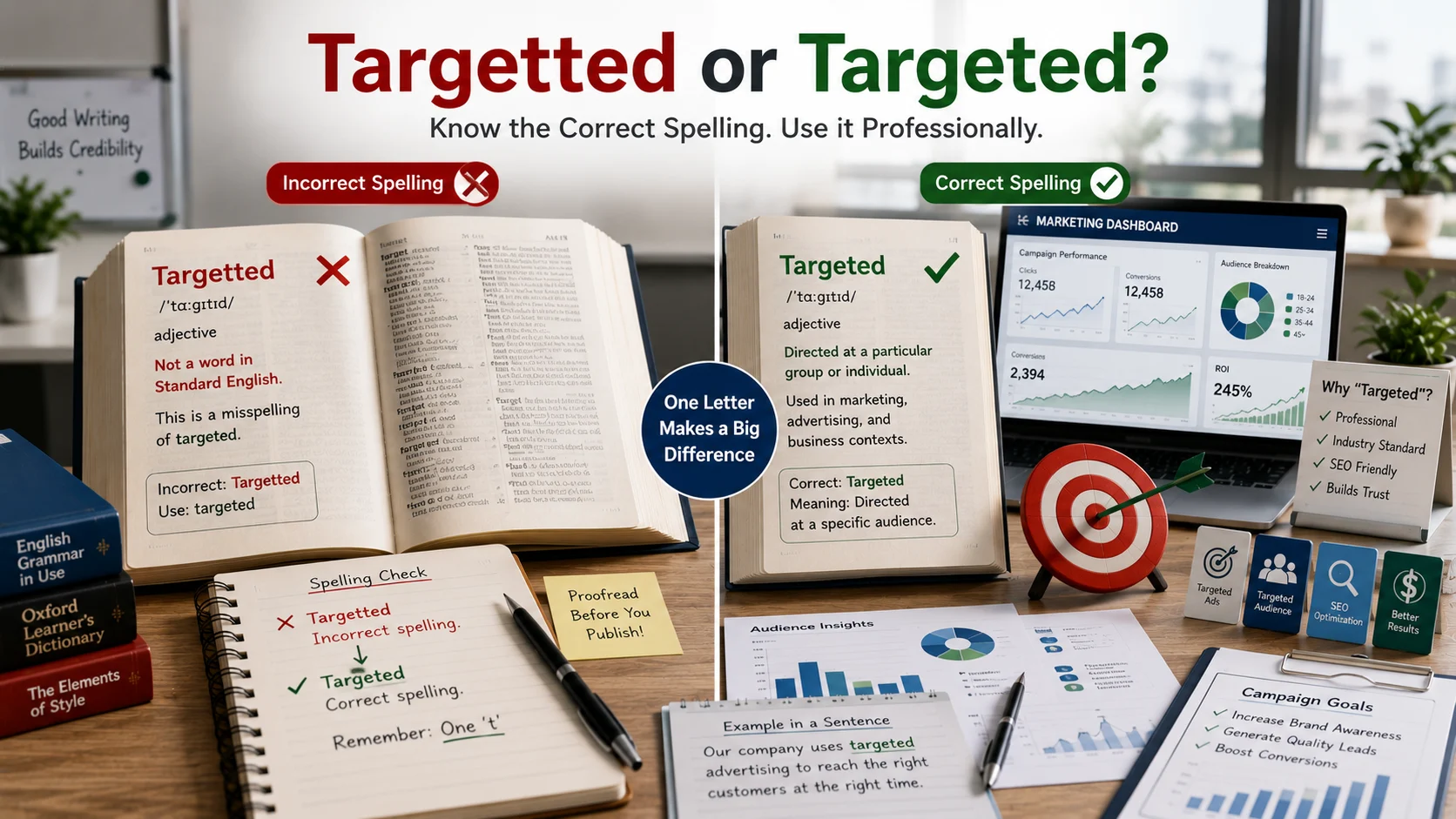
Targeted is the correct spelling in modern English. It is the standard past tense and past participle of the verb target and is accepted in both American and British English. Targetted is an uncommon variant that occasionally appears due to spelling confusion, but it is generally considered incorrect in contemporary writing.
If you have ever searched for targetted or targeted, you are not alone. Targeted is the correct past tense and adjective form of the verb target, while targetted is a rare spelling that results from misunderstanding English spelling patterns. This confusion often leads to spelling mistakes in academic papers, workplace reports, marketing campaigns, and online content. Understanding the correct form helps improve clarity, professionalism, and credibility in every type of writing.
English spelling can be unpredictable, especially when verbs change into past tense forms. Some words double the final consonant before adding ed, while others do not. Since target ends with a consonant, many writers mistakenly assume it should become targetted. In reality, English follows specific pronunciation and stress rules that make targeted the correct spelling.
You are a student, teacher, business professional, content writer, or digital marketer, knowing the difference between these spellings will help you avoid a common error and write with greater confidence.
Targetted or Targeted | What Is the Difference?
Although both spellings appear online, only one is considered standard English.
Targeted
Part of speech: Verb and adjective
Meaning: The past tense and past participle of target. It also describes something directed toward a specific person, audience, goal, or object.
Example:
The company targeted young professionals with its latest advertising campaign.
Targetted
Part of speech: Nonstandard spelling
Meaning: An uncommon variant that is generally regarded as a spelling mistake in modern English dictionaries, style guides, and professional writing.
Comparison Table
| Feature | Targeted | Targetted |
|---|---|---|
| Spelling status | Correct | Nonstandard |
| Dictionary acceptance | Yes | Generally no |
| American English | Standard | Incorrect |
| British English | Standard | Rare and discouraged |
| Used in academic writing | Yes | No |
| Used in business writing | Yes | No |
| Recommended for SEO | Yes | No |
| Professional choice | Always | Avoid |
Mini Recap
The correct spelling is targeted in virtually every modern writing context. It is recognized by dictionaries, publishers, educational institutions, and professional organizations. While targetted occasionally appears in older documents or informal writing, it is not recommended for accurate or professional communication.
Targetted or Targeted | Is It a Grammar, Vocabulary or Usage Issue?
This confusion is primarily a spelling and usage issue rather than a grammar problem.
Grammar determines how words function within sentences, whereas spelling determines how those words are written. In this case, both spellings attempt to represent the same past tense form of target, but only targeted follows accepted modern English conventions.
Are They Interchangeable?
No.
Although both versions refer to the same idea, they should not be used interchangeably. Professional editors, grammar checkers, search engines, and academic institutions consistently recognize targeted as the correct spelling.
Using targetted may distract readers or reduce your credibility because it appears to be a typographical mistake.
Formal Versus Informal Usage
In formal writing, only targeted should be used. This includes research papers, official reports, legal documents, business communications, and published articles.
In casual writing, some people may accidentally type targetted, but it is still considered a spelling error rather than an accepted informal variation.
Academic Versus Casual Usage
Academic institutions expect standard spelling in assignments, dissertations, and scholarly publications. Using targetted may lead instructors or editors to mark the word as incorrect.
Casual conversations, text messages, and social media posts sometimes contain spelling mistakes, but relying on the correct form still improves readability and professionalism.
Why Does This Confusion Happen?
Many English verbs double their final consonant before adding ed. Words such as stop become stopped, and plan becomes planned. Because of these familiar patterns, some writers assume that target should follow the same rule.
However, English spelling depends on stress as well as letter patterns. Since the stress in target falls on the first syllable, the final consonant is not doubled before adding ed. As a result, the correct spelling is targeted.
Quick Summary
The difference is not about meaning but about correct spelling. Use targeted in every professional, academic, and everyday context. Avoid targetted, as it is considered a nonstandard spelling that may reduce the quality of your writing.
Practical Usage of Targeted
Because targeted is the accepted spelling, it appears across nearly every field of communication. From business presentations to university assignments and digital technology, it clearly expresses that something has been directed toward a particular objective or audience.
Workplace Example
Businesses often create targeted marketing campaigns to reach customers who are most likely to purchase a product or service. Instead of advertising to everyone, companies analyze customer behavior and design messages for specific groups.
Example:
The marketing team targeted customers who had purchased similar products during the previous year.
In project management, managers also use the word to describe focused goals.
Example:
The organization targeted a twenty percent increase in customer satisfaction before the end of the year.
Academic Example
Researchers frequently use targeted when describing studies that focus on a particular population, method, or objective.
Example:
The researchers targeted university students between the ages of eighteen and twenty five.
Teachers may also describe assignments designed for particular learning outcomes.
Example:
The lesson included targeted exercises to improve reading comprehension.
Technology Example
Modern technology uses targeted in many different contexts.
Digital advertising platforms deliver targeted advertisements based on browsing history and user interests. Cybersecurity experts discuss targeted attacks that are directed at specific organizations instead of the general public. Software developers create targeted updates that solve particular problems without changing the entire system.
Examples:
The application delivered targeted notifications based on user preferences.
The security team responded quickly to a targeted cyber attack.
The software update included targeted improvements for performance issues.
Everyday Example
The word also appears in daily conversations whenever someone focuses attention or effort on a specific goal.
Examples:
The coach targeted defensive weaknesses before the championship game.
The charity targeted families affected by recent flooding.
The doctor recommended targeted treatment after reviewing the test results.
Usage Recap
Whenever you want to describe something aimed at a particular person, audience, location, or objective, targeted is the correct and professional choice. It is accepted in education, business, journalism, healthcare, marketing, and technology, making it the spelling you should consistently use.
Practical Usage of Targetted
Although targetted occasionally appears in online discussions, older documents, or user generated content, it is not the recommended spelling in modern English. Most dictionaries, grammar checkers, publishers, and educational institutions recognize it as a spelling mistake rather than an accepted alternative.
Many people write targetted because they assume the final t should be doubled before adding ed. This assumption comes from words like stopped or planned. However, target follows a different spelling pattern, making targeted the correct form.
Workplace Example
Imagine a business report that says:
The company targetted high value customers through email campaigns.
Although readers understand the meaning, editors and employers may view the spelling as an error.
The correct version is:
The company targeted high value customers through email campaigns.
Academic Example
A student writing a research paper might write:
The study targetted children between the ages of ten and twelve.
Most teachers and proofreading software will mark targetted as incorrect.
The correct sentence is:
The study targeted children between the ages of ten and twelve.
Technology Example
Suppose a software company publishes release notes stating:
The update targetted several security vulnerabilities.
Professional documentation should instead read:
The update targeted several security vulnerabilities.
Using the accepted spelling improves credibility and ensures consistency across technical documents.
Usage Recap
Although targetted may occasionally appear in informal writing or older online content, it is not the preferred spelling today. Replace it with targeted in every professional, academic, and digital context.
When You Should NOT Use Targetted or Targeted
Choosing the correct spelling becomes much easier once you understand where mistakes commonly occur. Here are situations where writers frequently make the wrong choice.
| Situation | Correct Choice | Reason |
|---|---|---|
| Writing business emails | Targeted | Professional standard spelling |
| Academic essays | Targeted | Accepted by universities and style guides |
| Marketing campaigns | Targeted | Industry standard usage |
| Website content | Targeted | Better readability and SEO |
| News articles | Targeted | Preferred by editors |
| Technical documentation | Targeted | Consistent with professional writing |
| Social media captions | Targeted | Avoid unnecessary spelling errors |
| Official reports | Targeted | Maintains credibility |
The safest approach is simple. Whenever you need the past tense or adjective form of target, always choose targeted.
Common Mistakes and Decision Rules
Common Mistakes Table
| Correct Sentence | Incorrect Sentence | Explanation |
|---|---|---|
| The campaign targeted local customers. | The campaign targetted local customers. | Standard spelling uses one t before ed. |
| Researchers targeted a specific age group. | Researchers targetted a specific age group. | Academic writing requires targeted. |
| The software targeted known security flaws. | The software targetted known security flaws. | Professional documentation follows standard spelling. |
| The police targeted repeat offenders. | The police targetted repeat offenders. | Modern dictionaries recognize only targeted. |
| The teacher targeted difficult grammar topics. | The teacher targetted difficult grammar topics. | The second spelling is considered nonstandard. |
Decision Rule Box
| If your meaning isUse | |
|---|---|
| The action of directing attention toward something | Targeted |
| A past action involving a specific goal | Targeted |
| An adjective describing something focused on a group or objective | Targeted |
| Any professional, academic, or published writing | Targeted |
| The spelling targetted | Avoid it in modern English |
Targetted or Targeted in Modern Technology and AI Tools
Modern technology strongly reinforces the use of targeted. Search engines, grammar checkers, and artificial intelligence writing assistants recognize it as the standard spelling.
Applications such as spelling correction software automatically suggest targeted when users type targetted. Content management systems, educational platforms, and SEO tools also favor the accepted spelling because it aligns with modern dictionaries and improves search visibility.
Digital marketing professionals regularly use phrases such as targeted advertising, targeted audience, targeted keywords, and targeted campaigns. These expressions have become standard terminology across the technology industry.
Etymology
The word target entered English through French and Germanic influences, originally referring to a small shield used for protection. Over time, its meaning expanded to describe an object, goal, or person at which attention or effort is directed.
As the language evolved, the past tense naturally became targeted, following standard English spelling conventions. This spelling has remained the accepted form in dictionaries and published writing for many decades.
Expert Insight
“Clear writing depends on consistency as much as accuracy. Choosing the accepted spelling helps readers focus on your message instead of your mistakes.”
This principle explains why professional editors encourage writers to use targeted consistently across every type of content.
Case Study One | Improving Website Credibility
A business blog reviewed more than two hundred articles and discovered that several posts used targetted instead of targeted. After correcting the spelling across all pages, the editorial team reported fewer proofreading issues, improved reader trust, and stronger overall content quality.
The correction also created greater consistency throughout the website, making articles appear more polished and authoritative.
Case Study Two | Better Academic Writing
A university writing center analyzed common spelling errors among first year students. One recurring mistake involved targetted. After instructors explained the correct spelling rule and encouraged students to proofread carefully, assignment accuracy improved noticeably and students made fewer spelling related deductions.
The exercise demonstrated that understanding one simple spelling rule can prevent repeated writing mistakes.
Error Prevention Checklist
Use this checklist whenever you write.
☑ Always use targeted as the past tense of target.
☑ Always use targeted in business writing.
☑ Always use targeted in academic assignments.
☑ Always use targeted in digital marketing content.
☑ Always proofread important documents before publishing.
☑ Never assume every verb doubles its final consonant.
☑ Never use targetted in professional communication.
☑ Never rely on incorrect spellings copied from unverified online sources.
Related Grammar Confusions You Should Master
Many spelling questions follow patterns similar to targetted or targeted. Learning these pairs will strengthen your overall writing skills.
- Focused or focussed
- Traveling or travelling
- Labeled or labelled
- Canceled or cancelled
- Modeled or modelled
- Signaled or signalled
- Benefited or benefitted
- Worshiped or worshipped
- Programed or programmed
- Occurred or occured
FAQs
Is targeted the correct spelling in English?
Yes. Targeted is the accepted spelling in both American and British English. It is the standard past tense and adjective form of the verb target.
Is targetted ever considered correct?
Targetted occasionally appears in older documents or informal writing, but modern dictionaries and style guides recommend using targeted instead.
Why do people spell targeted as targetted?
Many writers mistakenly double the final t because they compare the word with verbs like planned or stopped. However, target follows a different spelling rule.
Do grammar checkers recognize targetted?
Most grammar and spelling tools flag targetted as incorrect and suggest targeted as the preferred spelling.
Should I use targeted in academic writing?
Absolutely. Universities, publishers, and academic style guides expect targeted because it follows standard English spelling conventions.
Is targeted used in marketing and technology?
Yes. Terms such as targeted advertising, targeted audience, and targeted marketing are standard across business and technology industries.
Does British English prefer targetted?
No. Although some people assume British English doubles the final consonant, reputable British dictionaries and publishers also use targeted.
How can I remember the correct spelling?
Remember that target keeps its original spelling before adding ed. If you are referring to something directed at a specific goal or audience, always write targeted.
Conclusion
The debate over targetted or targeted is simpler than it first appears. While both spellings can be found online, only targeted is recognized as the standard form in modern English. It is accepted in American English, British English, academic writing, business communication, journalism, marketing, and technology.
Whenever you write about directing attention, effort, or resources toward a specific goal, audience, or object, choose targeted with confidence. Using the correct spelling strengthens your credibility, improves readability, and ensures your writing meets professional standards. You are preparing a research paper, creating marketing content, writing a report, or publishing an article, remembering this simple distinction will help you avoid a common error and communicate more effectively.
Discover More Related Articles:
- Adress or Address | What Is the Difference & Which Spelling Is Correct In 2026
- Tased or Tazed | Which Spelling Do Dictionaries Accept In 2026
- Excell or Excel | Why This Common Typo Keeps Appearing In 2026