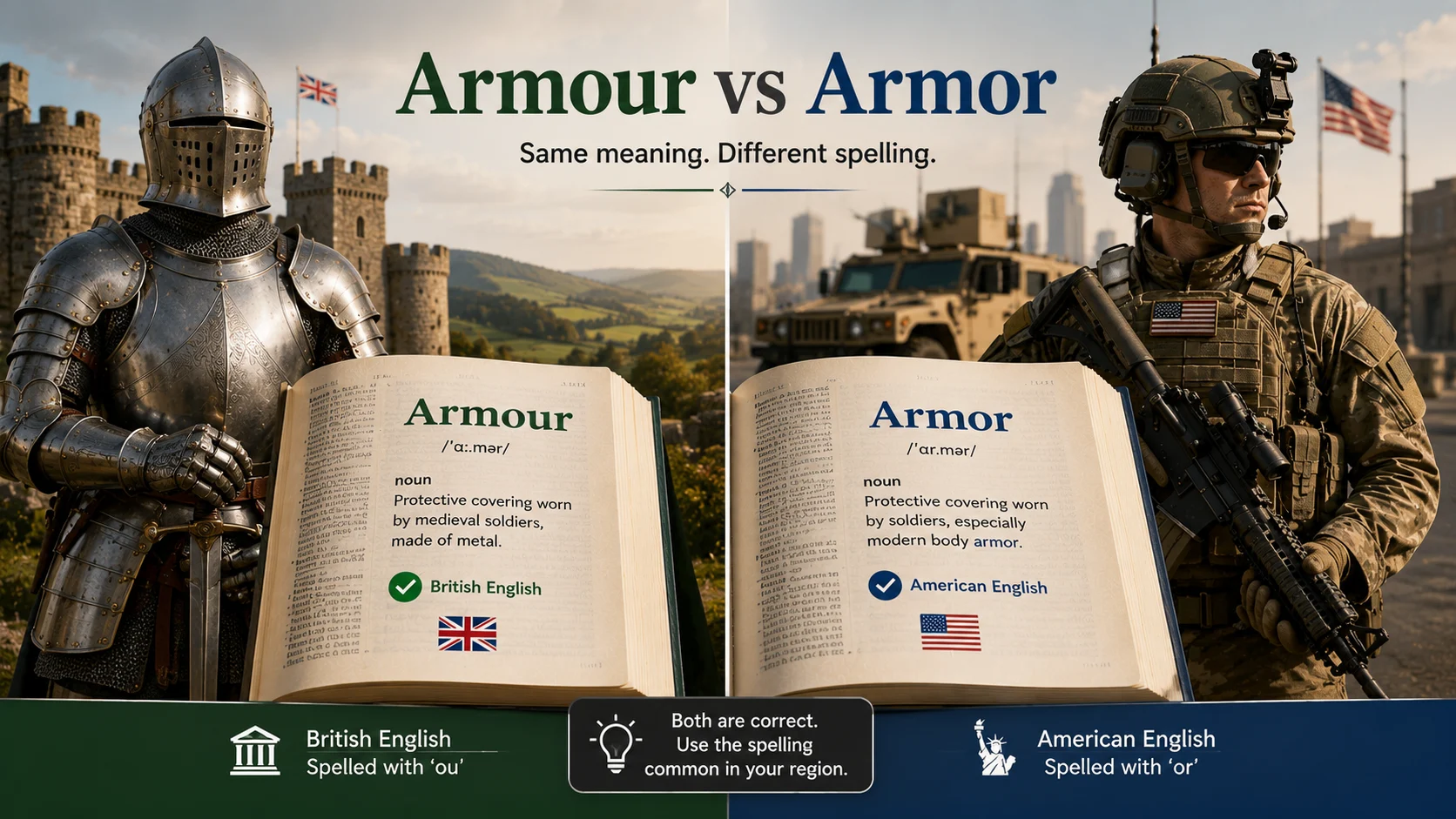
The terms armour or armor refer to protective equipment worn by people or used on vehicles to reduce damage from weapons or impacts. The only difference is spelling. Armour is the standard form in British English, while armor is the preferred spelling in American English. Both words have the same meaning and are correct within their respective language varieties.
Choosing between armour or armor can be confusing because both words describe the same protective covering but follow different English spelling conventions. Armour is the standard British English spelling, whereas armor is the accepted American English version.
Using the wrong spelling for your audience can make writing appear inconsistent, especially in academic papers, business documents, websites, and international publications. Understanding when each form is appropriate helps you communicate more professionally and maintain credibility.
Armour vs Armor | What’s the Difference?
At first glance, these two spellings seem like entirely different words. In reality, they represent the same noun and occasionally the same verb. The distinction comes from regional English rather than meaning or grammar.
Armour is the preferred spelling in countries that follow British English, including the United Kingdom, Canada in many formal contexts, Australia, New Zealand, and several Commonwealth nations.
Armor is the standard spelling in American English and appears in nearly all publications produced in the United States.
You are describing medieval knights, military vehicles, sports protection, or modern security equipment, the meaning remains unchanged. Your choice depends on the style guide and audience you are writing for.
| Feature | Armour | Armor |
|---|---|---|
| Preferred English | British English | American English |
| Part of Speech | Noun and Verb | Noun and Verb |
| Meaning | Protective covering against injury or attack | Protective covering against injury or attack |
| Common Regions | United Kingdom, Australia, New Zealand, and many Commonwealth countries | United States |
| Suitable for Academic Writing | Yes, when following British English style | Yes, when following American English style |
| Meaning Difference | None | None |
Both spellings are equally correct when used in the appropriate variety of English. Neither version is more modern or more accurate than the other. The important point is consistency. Once you choose one spelling, use it throughout your document instead of switching between both forms.
Is Armour or Armor a Grammar, Vocabulary or Usage Issue?
Many writers assume this is a grammar problem, but it is actually a matter of spelling preference based on regional English.
Grammar concerns how words function within a sentence. Vocabulary concerns the meanings of words. In this case, neither the grammar nor the meaning changes. Only the accepted spelling differs depending on where the English is used.
Are They Interchangeable?
Technically, yes. Anyone reading English will usually understand either spelling because both refer to the same concept.
However, they should not normally be mixed within the same article, report, or website. Consistency creates a more professional reading experience and follows accepted editorial standards.
For example, an American history textbook would normally use armor throughout, while a British museum publication would consistently use armour.
Formal and Informal Usage
Both spellings are suitable for formal and informal writing.
In formal writing, the spelling should match the chosen style guide.
A British university essay should use armour.
An American legal document should use armor.
In casual writing, readers are generally less concerned about the regional spelling, although consistency still improves clarity.
Academic and Professional Usage
Universities, publishers, and journals often require a specific style guide.
If your institution follows British English, write armour in every instance.
If it follows American English, use armor consistently.
Professional organizations also expect spelling to match the language standard adopted by the company or publication.
For example, an international defense company may publish separate documents for British and American audiences, changing only the spelling while keeping the content identical.
Why Consistency Matters
Imagine reading a research article that begins with armour but later switches repeatedly to armor. Although the meaning stays the same, the inconsistency can distract readers and suggest weak editing.
Editors and proofreaders pay close attention to this type of detail because consistent spelling reflects professionalism and attention to quality.
Quick Recap
The choice between armour and armor is not a grammar rule or a vocabulary difference. It is simply a regional spelling preference. Use armour for British English, armor for American English, and remain consistent throughout your writing.
Practical Usage of Armour
The word armour is the standard spelling in British English. It appears in books, newspapers, government publications, military documents, and educational materials across the United Kingdom and many Commonwealth countries. Discussing medieval history or modern defense technology, British writers consistently prefer this spelling.
Workplace Example
A British defense contractor may write:
“The new combat vehicle features reinforced armour for improved crew protection.”
This sentence follows British spelling conventions and would be expected in official reports, proposals, and technical manuals.
Academic Example
A university history paper might state:
“Medieval armour evolved significantly during the fifteenth century, offering greater protection while allowing increased mobility.”
Here, armour accurately reflects British academic writing standards.
Technology Example
A cybersecurity article published for a British audience could say:
“The software provides an additional layer of digital armour against evolving cyber threats.”
Although the word is used metaphorically, the British spelling remains appropriate.
More Examples of Armour in Sentences
- The museum displayed a complete suit of medieval armour.
- Soldiers inspected their body armour before the training exercise.
- Engineers developed lighter armour for military vehicles.
- The knight polished his armour before entering the tournament.
- Modern armour combines strength with flexibility.
Usage Recap
Use armour whenever your writing follows British English conventions. It is appropriate for professional documents, academic papers, news articles, technical manuals, and everyday communication intended for British or Commonwealth readers.
Practical Usage of Armor
Armor is the accepted American English spelling. It appears in nearly every publication produced in the United States, from school textbooks to military manuals and technology blogs.
American readers expect this spelling, making it the best choice for content targeting a United States audience.
Workplace Example
A United States engineering report may read:
“The vehicle’s composite armor significantly improves passenger safety during high impact situations.”
This spelling aligns with American business and technical writing.
Academic Example
An American history textbook might explain:
“Roman soldiers relied on durable armor to protect themselves during battle.”
Students in the United States are taught this spelling from an early age.
Technology Example
A gaming website could describe a character by writing:
“Players can upgrade their armor to survive stronger enemies.”
Many American developed games, software products, and online platforms consistently use armor.
More Examples of Armor in Sentences
- Firefighters wear protective armor in hazardous environments.
- Scientists tested new armor materials for military equipment.
- The tank’s armor resisted multiple impacts.
- The character collected legendary armor before the final battle.
- Modern body armor saves countless lives each year.
Usage Recap
Choose armor whenever you are writing for an American audience. It is the standard spelling in education, journalism, business communication, technical documentation, entertainment, and government publications throughout the United States.
When You Should NOT Use Armour or Armor
Although both spellings have the same meaning, they should not be used interchangeably without considering your audience. The following situations commonly lead to mistakes.
| Situation | Correct Choice | Why |
|---|---|---|
| Writing for a British publication | Armour | Matches British English spelling. |
| Writing for an American publication | Armor | Matches American English spelling. |
| Mixing both spellings in one article | Avoid | Creates inconsistency and may confuse readers. |
| Following a university style guide | Use the required spelling | Academic consistency is essential. |
| Editing company documents | Match the company language style | Maintains professionalism and brand consistency. |
| Publishing international content | Stay consistent throughout | Prevents reader confusion and improves readability. |
| Copying examples from different sources | Standardize one spelling | Ensures a polished and cohesive document. |
| Creating educational materials | Match the target audience | Supports learner expectations and language standards. |
Common Mistakes and Decision Rules
Many writers accidentally switch between the two spellings because they copy information from websites using different English varieties. Others assume one spelling is incorrect simply because it looks unfamiliar.
The easiest solution is to decide which variety of English you are using before you begin writing.
| Correct Sentence | Incorrect Sentence | Explanation |
|---|---|---|
| The knight polished his armour before battle. | The knight polished his armor before battle in a British publication. | British English prefers armour. |
| The soldier wore advanced armor during training. | The soldier wore advanced armour in an American report. | American English prefers armor. |
| The museum displayed ancient armour. | The museum displayed ancient armor in a British guidebook. | Use armour in British English. |
| Engineers tested stronger armor for military vehicles. | Engineers tested stronger armour in an American engineering journal. | Use armor in American English. |
| Keep one spelling throughout your article. | Alternate between armour and armor without reason. | Consistent spelling improves clarity and credibility. |
Decision Rule Box
If your audience uses British English, use armour.
If your audience uses American English, use armor.
If you choose one spelling, keep using the same spelling throughout your document.
Armour and Armor in Modern Technology and AI Tools
Modern software, grammar checkers, and AI writing tools automatically adapt spelling to the selected language setting.
For example, if you choose British English in your word processor, armor may be flagged as a spelling variation, while armour is accepted. Switching the language to American English reverses the recommendation.
Search engines also recognize both spellings as equivalent, but users often search using the spelling common in their country. Optimizing content for your intended audience can therefore improve relevance and user experience.
Etymology
The word comes from the Old French armure, meaning protective equipment or weapons. It later entered Middle English as armour. When American English spelling gradually became simplified during the nineteenth century, the form armor became the standard in the United States while armour remained the preferred spelling across Britain and many Commonwealth countries.
“Clear writing is not about choosing the only correct spelling. It is about choosing the correct spelling for your audience and using it consistently.”
Language Style Expert
Case Study One | British Museum Educational Content
A British museum updated its online exhibits using consistent British English spelling. Every reference to protective equipment used armour instead of alternating spellings. Visitors reported improved readability, and editors reduced proofreading corrections across new educational materials.
Case Study Two | American Defense Technology Blog
An American defense publication standardized all articles to use armor. The editorial team found that maintaining one spelling throughout every article improved consistency, strengthened brand identity, and reduced editing time before publication.
Related Grammar Confusions You Should Master
If you found armour or armor confusing, you’re not alone. English contains many word pairs that differ because of regional spelling, pronunciation, or usage. Learning these distinctions will strengthen your writing and help you communicate more confidently.
| Word Pair | Main Difference |
|---|---|
| Colour or Color | British versus American spelling |
| Honour or Honor | Regional spelling variation |
| Centre or Center | British versus American spelling |
| Defence or Defense | British versus American spelling and usage |
| Travelling or Traveling | Regional spelling convention |
| Jewellery or Jewelry | British versus American spelling |
| Licence or License | In British English, licence is the noun and license is the verb. In American English, license is used for both. |
| Theatre or Theater | Regional spelling preference |
| Catalogue or Catalog | British versus American spelling |
| Grey or Gray | Regional spelling choice |
Mastering these common variations will make your writing more consistent and ensure it matches the expectations of your intended audience.
FAQs
What is the difference between armour and armor?
There is no difference in meaning. Armour is the British English spelling, while armor is the American English spelling for protective equipment.
Is armour or armor correct in English?
Both spellings are correct. The appropriate choice depends on you are following British English or American English conventions.
Should I use armour in academic writing?
Yes, if your university or publisher follows British English. If the required style guide is American English, use armor instead.
Do search engines treat armour and armor differently?
Search engines understand both spellings, but using the version preferred by your target audience can improve relevance and user experience.
Why does American English use armor instead of armour?
American English simplified many spellings during the nineteenth century. Armor became the standard form, while British English retained armour.
Can I use both armour and armor in the same article?
It is best not to. Mixing regional spellings makes writing appear inconsistent and may confuse readers.
Is armour used outside the United Kingdom?
Yes. Australia, New Zealand, and many Commonwealth countries commonly use armour, although local style guides may vary.
Does armour only refer to medieval knights?
No. The word also refers to modern body protection, military vehicles, protective equipment, and even metaphorical forms of protection in literature and technology.
Conclusion
The debate over armour or armor is not about right versus wrong. Both spellings describe the same protective covering and carry exactly the same meaning. The only difference lies in the variety of English you are using.
Choose armour when writing in British English and armor when writing in American English. You are preparing an academic paper, a business report, a history article, or online content, consistency is the key to professional writing. Selecting the correct regional spelling demonstrates attention to detail, improves readability, and helps build trust with your readers.
Discover More Related Articles:
- Adress or Address | What Is the Difference & Which Spelling Is Correct In 2026
- Tased or Tazed | Which Spelling Do Dictionaries Accept In 2026
- Excell or Excel | Why This Common Typo Keeps Appearing In 2026