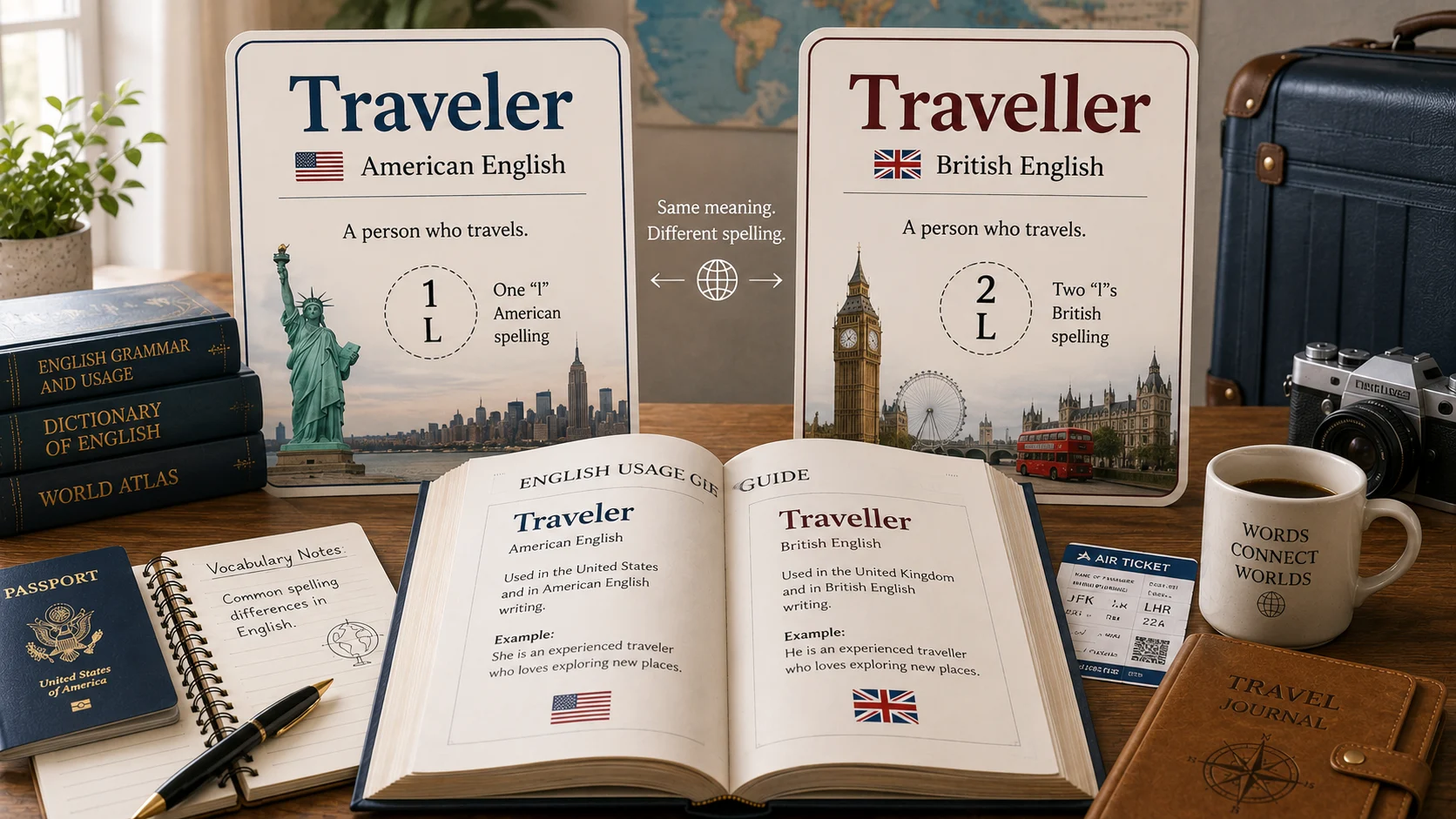
Traveler or traveller are both correct spellings for a person who travels, but the preferred form depends on the variety of English being used. Traveler is the standard spelling in American English, while traveller is preferred in British English and many other varieties influenced by British usage, including Australian and Canadian English.
Have you ever wondered to write traveler or traveller when describing someone who loves exploring new places? Both spellings are correct, but choosing the right one depends on your audience and the type of English you are using. This small spelling difference often confuses students, writers, bloggers, and travelers who want their content to look polished and professional. Understanding the distinction can help you avoid common spelling mistakes and communicate more confidently in everyday and formal writing.
The key difference is regional spelling: traveler is the standard American English spelling, while traveller is commonly used in British English, including British-style writing in many other countries. Both words have the same meaning and refer to a person who travels. Neither spelling is inherently more correct than the other; the important thing is to follow your target audience’s spelling conventions and remain consistent throughout your article, website, or document.
Traveler or Traveller | What’s the Difference?
The difference between traveler and traveller is primarily a matter of regional spelling, not meaning. Both words are nouns that describe someone who travels from one place to another. They can refer to tourists, commuters, business people, explorers, or anyone making a journey.
The only visible difference is the number of letters l before the suffix. American English generally uses one l, producing traveler. British English generally doubles the final consonant before adding the suffix, producing traveller.
| Word | Part of Speech | Meaning | Main English Variety | Example |
|---|---|---|---|---|
| Traveler | Noun | A person who travels | American English | The traveler arrived at the airport early. |
| Traveller | Noun | A person who travels | British English | The traveller arrived at the airport early. |
The meaning does not change between the two spellings.
Traveler is standard in American English.
Traveller is standard in British English.
Neither spelling is inherently more correct than the other.
The important point is consistency. Choose the spelling that matches the English variety used throughout your writing.
Is Traveler vs Traveller a Grammar, Vocabulary or Usage Issue?
The choice between traveler and traveller is mainly a spelling and usage issue, rather than a grammar problem. Both words belong to the same vocabulary family, perform the same grammatical function, and have the same meaning.
If you write for an American audience, traveler is normally the appropriate choice. American dictionaries, newspapers, websites, businesses, and educational materials commonly use the single l spelling.
If your audience follows British English, traveller is normally preferred. This spelling is common in British publications, travel guides, educational resources, and formal documents.
The two words are interchangeable in meaning, but they are not interchangeable in every style guide. A publication may have a specific house style requiring one spelling throughout its content.
Formal vs Casual Usage
There is no major difference in formality between traveler and traveller. Both are suitable for formal and informal writing.
For example, an American government document might use traveler, while a British government document might use traveller. Neither word becomes more formal simply because it contains one or two letters l.
Academic vs Casual Usage
Academic writing should follow the spelling conventions expected by its institution, instructor, publisher, or target readership.
An American student writing an essay would normally use traveler. A British student would normally use traveller.
The same principle applies to casual writing. A British speaker may naturally write, “The traveller missed the train,” while an American writer may write, “The traveler missed the train.”
Traveler | When Should You Use It?
Use traveler when you are writing in American English or specifically targeting readers who expect American spelling conventions.
The word works naturally in many contexts. You can use it to describe someone taking a vacation, attending a business meeting, crossing a country, or simply moving between locations.
Workplace Example
The business traveler booked a hotel near the conference center.
Here, traveler is appropriate because the sentence follows American English spelling.
Academic Example
The study examined how frequent travelers adapt to different cultural environments.
This spelling is also appropriate in American academic writing.
Technology Example
The travel app helps travelers compare flights and hotel prices.
Modern websites and applications aimed at American users commonly use traveler.
Usage Recap
Choose traveler when your content follows American English. It is especially appropriate for American websites, publications, academic papers, business documents, software interfaces, and marketing materials.
Traveller | When Should You Use It?
Use traveller when writing in British English or another variety of English that follows the British spelling pattern.
The word has exactly the same meaning as traveler. The additional l does not create a different definition or pronunciation.
Workplace Example
The business traveller booked a hotel near the conference centre.
The spelling fits British English conventions, including the British spelling centre.
Academic Example
The research explored how international travellers respond to cultural differences.
This form is suitable for British academic writing.
Technology Example
The travel application helps travellers find affordable accommodation.
A British English website or application may naturally use this spelling throughout its interface.
Usage Recap
Choose traveller when your content follows British English conventions. Consistency matters more than choosing one spelling universally.
Why Does American English Use Traveler?
The spelling pattern is connected to broader differences between American and British English.
American English often simplifies certain spellings that traditionally contain doubled consonants. This tendency can be seen in several related forms.
| American English | British English |
|---|---|
| Traveler | Traveller |
| Traveling | Travelling |
| Traveled | Travelled |
| Canceled | Cancelled |
| Signaled | Signalled |
These patterns are not identical in every word, but they demonstrate a broader spelling distinction between the two varieties.
This is why choosing traveler often means that related words should also follow American conventions. Switching randomly between forms can make otherwise polished writing appear inconsistent.
Why Does British English Use Traveller?
British English generally retains the doubled consonant in forms such as traveller, travelling, and travelled.
The reason is connected to British spelling conventions concerning suffixes added to words ending in certain consonant patterns. When a suffix is added, the final consonant may be doubled to preserve the pronunciation and follow established spelling conventions.
For learners, the easiest practical approach is not to memorize every historical rule. Instead, identify the English variety you are using and apply its standard spelling consistently.
When You Should NOT Use Traveler or Traveller
There are several situations in which choosing between these spellings can cause unnecessary inconsistency.
1. Do Not Mix American and British Spellings Randomly
If your article uses traveler, traveling, and traveled, suddenly using traveller can make the spelling system inconsistent.
2. Do Not Assume Traveller Is More Correct
The extra l does not make traveller grammatically superior. It is simply the preferred British spelling.
3. Do Not Assume Traveler Is Always Correct
American English is not the only standard form of English. British English publications generally prefer traveller.
4. Do Not Change the Spelling Based on Formality
Neither form is inherently more formal. Regional convention determines the spelling.
5. Do Not Mix English Varieties in Academic Work Without a Reason
If your university, instructor, publisher, or style guide specifies a variety of English, follow that convention consistently.
6. Do Not Change a Proper Brand or Publication Name
If a company, publication, product, or organization officially uses one spelling, preserve its established name.
7. Do Not Treat the Words as Different Vocabulary Items
Traveler and traveller have the same meaning. The distinction is spelling, not definition.
8. Do Not Alternate Between Them for Variety
Unlike synonyms, these two forms should not be alternated simply to make writing more varied. Choose one regional form and maintain it.
Common Mistakes and Decision Rules
The most common mistake is assuming that one spelling is universally correct. English has multiple established spelling standards, and traveler versus traveller is a classic example.
| Correct Sentence | Incorrect Sentence | Explanation |
|---|---|---|
| The traveler checked into the hotel. | The traveller checked into the hotel. | The first sentence follows American English. The second is not necessarily grammatically wrong, but it conflicts with an American spelling system. |
| The traveller arrived in London. | The traveler arrived in London. | British English normally uses traveller. |
| Many travelers use mobile apps. | Many travellers use mobile apps. | American English uses travelers. |
| Many travellers use mobile apps. | Many travelers use mobile apps. | British English normally uses travellers. |
| The traveler submitted the form. | The traveller submitted the form. | Use traveler in American English. |
| The traveller submitted the form. | The traveler submitted the form. | Use traveller in British English. |
Decision Rule Box
If you are writing in American English, use traveler.
If you are writing in British English, use traveller.
The choice is based on regional spelling convention, not on the person is a tourist, business traveler, student, or frequent traveler.
Traveler or Traveller in Related Words
Understanding the singular noun makes related forms easier to remember.
| American English | British English |
|---|---|
| Traveler | Traveller |
| Travelers | Travellers |
| Traveling | Travelling |
| Traveled | Travelled |
| Traveler’s | Traveller’s |
| Travelers’ | Travellers’ |
This pattern is particularly useful for content writers because travel related articles often contain several forms of the word.
For example, an American travel website might write:
Travelers can save money by booking flights early.
A British travel website might write:
Travellers can save money by booking flights early.
Both sentences communicate exactly the same idea.
Traveler and Traveller in Modern Technology and AI Tools
Modern technology has made spelling consistency even more important.
Travel websites, booking platforms, navigation applications, artificial intelligence systems, airline websites, and digital assistants frequently generate travel related content for international audiences. Because these systems can produce either American or British English, users may encounter both traveler and traveller online.
For content creators, the best practice is to establish the target English variety before generating large amounts of content.
If an American audience is the target, use traveler consistently across headings, body copy, metadata, image descriptions, and supporting pages.
If a British audience is the target, use traveller consistently across the same elements.
Search engines can understand both forms, so there is no SEO advantage to incorrectly replacing one with the other. Relevance, useful information, search intent, and consistent language are more important than forcing a particular spelling.
Traveler or Traveller | Etymology and Spelling History
The word traveler comes from travel, which developed from Middle English forms associated with labor, trouble, and journeying. Over time, the meaning became strongly associated with making a journey from one place to another.
The difference between traveler and traveller developed within broader differences between American and British spelling practices.
American English became increasingly standardized through dictionaries and publishing conventions that favored some simplified spellings. British English retained a number of traditional forms, including the doubled l in traveller.
An expert style principle can be summarized this way:
The correct spelling is the one that matches the English variety and style standard of your audience.
That principle is more useful than memorizing the spelling in isolation.
Case Study 1: American Travel Content
Imagine an American travel website publishing an article about international tourism. Its editors choose American English as the site’s language standard.
Using traveler, travelers, traveling, and traveled throughout the article creates a consistent editorial identity. Replacing these forms with British spellings would introduce unnecessary variation.
Case Study 2: British Travel Content
Now consider a British publication creating a guide for visitors to the United Kingdom. The editorial team uses British English throughout its content.
Using traveller, travellers, travelling, and travelled keeps the language aligned with the publication’s established spelling system.
In both cases, the result is clearer and more professional because the spelling matches the intended audience.
Author expertise: Written by a language and SEO content specialist focused on English usage, spelling variation, search intent, and reader friendly grammar education.
Error Prevention Checklist
Always Use Traveler When
- Your content follows American English.
- Your target readers are primarily American.
- Your organization uses American spelling.
- Your style guide specifies American English.
- Related forms use American spellings such as traveling and traveled.
Never Use Traveller When
- Your American English style guide requires traveler.
- Your publication consistently uses American spelling.
- You are changing the spelling merely for stylistic variety.
- You want to make the word sound more formal.
- You are replacing an established American spelling without an editorial reason.
The reverse applies to British English. If your content follows British conventions, use traveller and related British forms consistently.
Related Grammar Confusions You Should Master
Understanding traveler and traveller becomes easier when you also recognize other common spelling differences.
| Related Confusion | Main Difference |
|---|---|
| Color or Colour | American versus British spelling |
| Center or Centre | American versus British spelling |
| Theater or Theatre | American versus British preference |
| Favorite or Favourite | American versus British spelling |
| Traveling or Travelling | Related spelling of travel |
| Traveled or Travelled | Related past tense spelling |
| Canceled or Cancelled | American versus British spelling |
| Program or Programme | Different regional and contextual conventions |
| License or Licence | American and British usage differences |
| Practice or Practise | British distinction between noun and verb |
Learning these patterns can help writers maintain a consistent English variety across an entire article rather than correcting individual words in isolation.
FAQs
Is traveler or traveller correct?
Both are correct. Traveler is standard American English, while traveller is standard British English.
Which spelling is American, traveler or traveller?
American English uses traveler with one l.
Which spelling is British, traveler or traveller?
British English normally uses traveller with two l letters.
Does traveler mean something different from traveller?
No. Both words mean a person who travels.
Is traveller grammatically incorrect in American English?
No, but it is not the usual American spelling.
Is traveler wrong in British English?
It is generally not the preferred British spelling, where traveller is standard.
Should I use traveler or traveller for SEO?
Choose the spelling that matches your target audience and keep it consistent throughout the content.
Why does traveller have two l letters?
British spelling conventions generally retain the doubled consonant in traveller and related forms.
How do I remember traveler versus traveller?
Remember that American English uses traveler, while British English uses traveller.
Conclusion
The choice between traveler or traveller is straightforward once you identify the English variety you are using. Traveler is the standard American English spelling, while traveller is the standard British English spelling. Both describe a person who travels, and neither changes the meaning of the sentence.
For American audiences, choose traveler and use related forms such as traveling and traveled consistently. For British audiences, choose traveller alongside travelling and travelled.
The most important rule is consistency. Your spelling should match your audience, publication style, and chosen variety of English. Once that decision is made, there is no reason to alternate between traveler and traveller.
Discover More Related Articles:
- Fien or Fein | Stop Making This Common Spelling Mistake In 2026
- Licence or License | The Difference Every English Learner Should Know In 2026
- Useing or Using | Clear Up This Common English Confusion Today In 2026