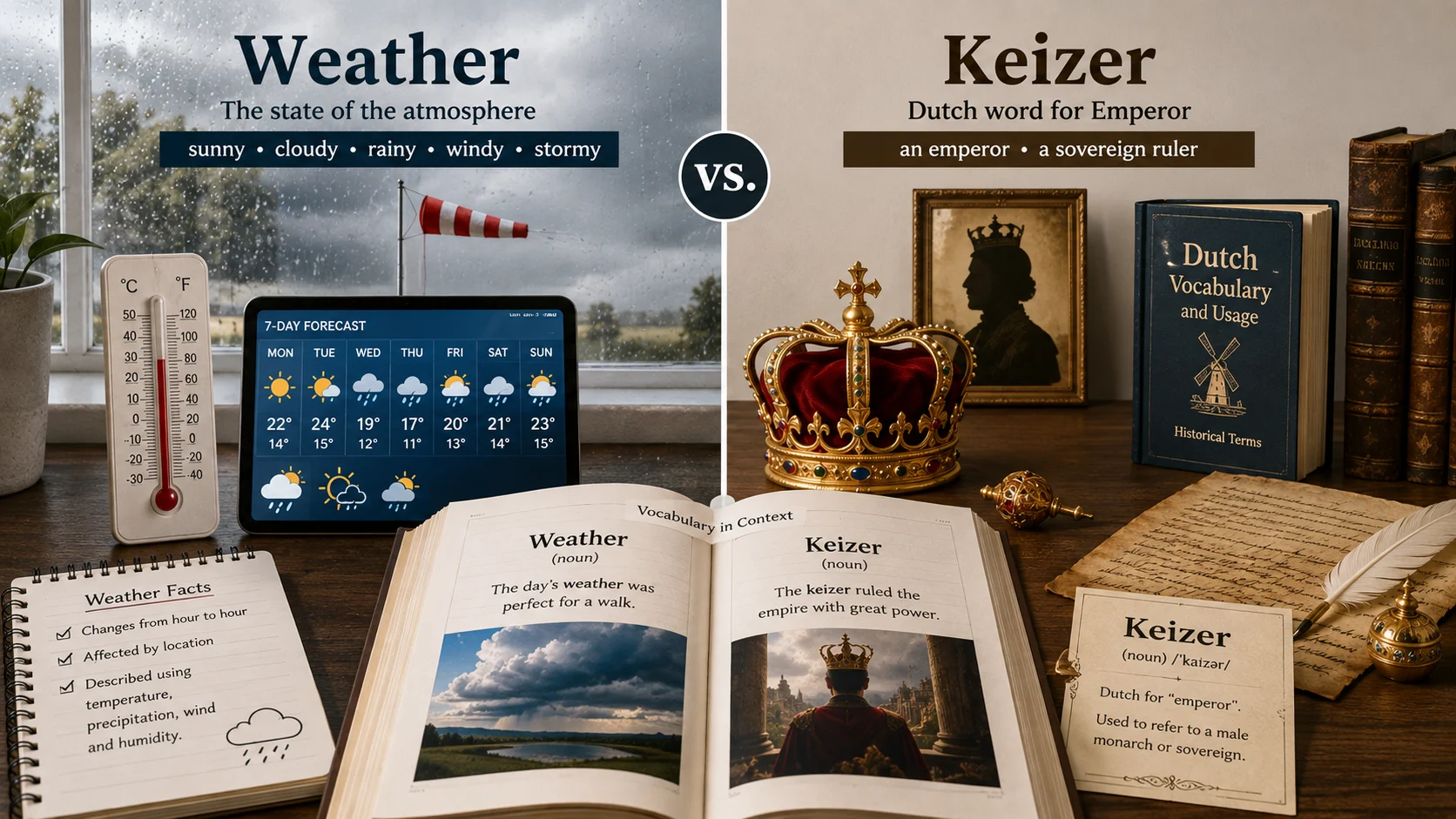
Weather refers to the atmospheric conditions at a particular place and time, while Keizer is generally a proper noun or a Dutch word. In Dutch, keizer means “emperor,” so the two terms have completely different meanings and grammatical functions. They are not interchangeable and choosing one depends entirely on the context of the sentence.
The question of weather or keizer can look like a spelling or vocabulary comparison, but these words do not represent two competing English forms of the same word. Weather is a standard English word used mainly as a noun and sometimes as a verb. It describes conditions such as temperature, rain, wind, clouds, and atmospheric changes.
Keizer, by contrast, has several possible uses. In Dutch, keizer is a noun meaning “emperor.” In English contexts, Keizer may appear as a surname, a place name, or part of a proper name. Dictionary.com, for example, lists Keizer as the name of a city in Oregon, while other dictionary sources identify Dutch keizer as “emperor.”
This distinction matters because replacing one with the other can completely change the meaning of a sentence. If you are talking about rain tomorrow, weather is the appropriate word. If you are referring to a person, location, family name, or the Dutch word for emperor, Keizer may be appropriate.
The two words therefore should not be treated like common spelling pairs such as weather and whether. Their difference is semantic, grammatical, and contextual rather than a simple matter of correct versus incorrect spelling.
Weather or Keizer | What’s the Difference?
The easiest way to understand the difference is to examine what each word represents.
Weather is an English common noun referring to atmospheric conditions. It can describe conditions are sunny, cloudy, rainy, windy, hot, cold, humid, or stormy. It can also function as a verb meaning to endure or survive something difficult.
Keizer is normally encountered as a proper noun in English or as a Dutch common noun. In Dutch, keizer means “emperor.” Cambridge Dictionary specifically gives keizer as a noun translated into English as “emperor.”
| Feature | Weather | Keizer |
|---|---|---|
| Language | English | Dutch or English proper name |
| Main meaning | Atmospheric conditions | Emperor in Dutch |
| Part of speech | Noun, sometimes verb | Noun or proper noun depending on context |
| Capitalization | Usually lowercase | Usually capitalized when a name or place |
| Example | The weather is pleasant today. | The Dutch word keizer means emperor. |
| English synonym | Climate conditions, atmospheric conditions | Emperor when used as Dutch vocabulary |
| Common use | Daily conversation, forecasts, science | Names, Dutch language, historical contexts |
| Interchangeable | No | No |
The key point is simple.
Weather belongs to ordinary English vocabulary.
Keizer does not function as an alternative spelling of weather.
When keizer is used in Dutch, it means emperor.
When Keizer appears in English with a capital letter, it may identify a person, family, place, organization, or another proper name.
Is Weather or Keizer a Grammar, Vocabulary or Usage Issue?
The distinction between weather or keizer is primarily a vocabulary and usage issue. It is not a normal grammar choice in which one form replaces another depending on sentence structure.
Grammar determines how words behave inside sentences. Vocabulary determines what words mean. Here, the meanings are fundamentally different.
Consider these sentences:
The weather is getting colder.
Here, weather is a noun referring to atmospheric conditions.
Keizer is a family name.
Here, Keizer is functioning as a proper noun.
The words cannot be substituted without changing the meaning.
Are Weather and Keizer Interchangeable?
No. They are not interchangeable in English.
You cannot write:
The Keizer is rainy today.
when you mean atmospheric conditions.
You also cannot write:
The weather was crowned emperor.
when you intended to use the Dutch word keizer.
The problem is therefore not that one word is formal and the other informal. They belong to different semantic categories.
Formal and Informal Usage
Weather is completely normal in formal and informal English.
It appears in scientific writing, weather forecasts, news reports, workplace communication, academic essays, and everyday conversation.
Keizer depends on its context. As a proper name, it should be capitalized. As Dutch vocabulary, keizer normally appears lowercase unless it begins a sentence or is part of a title or name.
Academic and Casual Usage
Academic writing might use weather when discussing meteorology, climate, environmental science, agriculture, geography, or atmospheric processes.
An academic discussion might use keizer when studying Dutch vocabulary, European history, linguistics, or the development of imperial titles.
Casual English conversation rarely requires keizer unless someone is discussing a name, location, Dutch language, or historical subject.
How to Use Weather Correctly
Weather has several useful applications in English. Its most common meaning concerns the atmosphere.
Workplace Example
The bad weather delayed several employees this morning.
Here, weather refers to conditions that affected transportation and attendance.
Another example is:
We may need to postpone the outdoor meeting because of the weather.
The word works naturally in professional communication because it identifies atmospheric conditions without requiring additional explanation.
Academic Example
Researchers recorded changes in weather patterns throughout the year.
In this context, weather relates to measurable atmospheric conditions.
It can appear in academic subjects such as geography, environmental science, agriculture, meteorology, and earth science.
Technology Example
The weather application predicts heavy rain this afternoon.
Modern technology frequently uses weather in applications, websites, sensors, dashboards, smart devices, and forecasting systems.
A weather application may display temperature, precipitation, wind speed, humidity, air pressure, and other atmospheric information.
Weather as a Verb
Weather can also function as a verb.
The old building has weathered several severe storms.
Here, weathered means endured or survived.
This use is different from the noun meaning atmospheric conditions, but both uses are standard English.
Weather Usage Recap
Use weather when discussing atmospheric conditions such as rain, heat, wind, snow, clouds, or temperature.
Use weather as a verb when you mean to endure, survive, or withstand something.
Do not replace it with Keizer.
How to Use Keizer Correctly
The word Keizer requires more attention to context because it can refer to different things.
In Dutch, keizer is a noun meaning emperor. Cambridge Dictionary gives this direct Dutch to English translation.
Workplace Example
Suppose someone named Keizer works at a company:
Ms. Keizer will lead the meeting today.
Here, Keizer is a surname. It is capitalized because it identifies a person.
It has nothing to do with atmospheric conditions.
Academic Example
A linguistics paper might state:
The Dutch noun keizer corresponds to the English word “emperor.”
This is an appropriate academic use because the writer is discussing Dutch vocabulary.
Historical writing may also encounter related forms derived from the same linguistic family. The Dutch term has an etymological connection to older forms ultimately associated with Latin Caesar.
Technology Example
A technology database might contain a person’s surname:
The software lists Keizer as the account administrator.
In this example, Keizer is a proper name stored as identifying information.
It would be incorrect to interpret it as a synonym for weather.
Keizer Usage Recap
Use Keizer when it is the correct name or when discussing the Dutch word.
Use lowercase keizer when discussing the Dutch common noun meaning emperor, subject to normal Dutch capitalization rules.
Use capitalized Keizer for a proper name or place when the specific name requires capitalization.
When You Should NOT Use Weather or Keizer
Understanding when not to use a word can prevent more mistakes than memorizing a definition.
| Situation | Correct Choice | Why |
|---|---|---|
| Talking about rain tomorrow | Weather | Rain is an atmospheric condition |
| Describing temperature | Weather | Temperature is part of weather |
| Discussing a Dutch emperor title | Keizer | Dutch keizer means emperor |
| Referring to a person named Keizer | Keizer | It is a proper name |
| Referring to a place called Keizer | Keizer | It is a place name |
| Writing a weather forecast | Weather | Forecasts describe atmospheric conditions |
| Translating Dutch keizer | Keizer | The source word means emperor |
| Describing a storm | Weather | Storms are weather phenomena |
There are several especially common misuse situations.
First, do not use Keizer when you mean rain or atmospheric conditions.
Second, do not use weather when translating the Dutch noun keizer.
Third, do not automatically lowercase Keizer when it is a person’s surname.
Fourth, do not assume that a similar pronunciation creates a shared meaning.
Fifth, do not treat Keizer as an alternative spelling of weather.
Sixth, do not substitute the words merely because both may appear in search results involving unrelated topics.
Seventh, do not confuse Keizer with Kaiser, another historically related form associated with the title emperor.
Common Mistakes and Decision Rules
| Correct sentence | Incorrect sentence | Explanation |
|---|---|---|
| The weather is beautiful today. | The Keizer is beautiful today. | Atmospheric conditions require weather |
| The weather forecast predicts rain. | The Keizer forecast predicts rain. | Forecasts commonly concern weather |
| The Dutch word keizer means emperor. | The Dutch word weather means emperor. | The Dutch noun keizer means emperor |
| Mr. Keizer joined the meeting. | Mr. weather joined the meeting. | Keizer can be a surname |
| The weather damaged the crops. | The Keizer damaged the crops. | Weather can affect crops |
| The historian translated keizer as emperor. | The historian translated weather as emperor. | The words have different meanings |
Decision Rule: If you mean atmospheric conditions, use weather. If you mean the Dutch word for emperor or a proper name such as Keizer, use Keizer.
This rule is more accurate for this particular word pair than the common action versus person rule sometimes used for other vocabulary comparisons.
Weather or Keizer in Modern Technology and AI Tools
Modern technology makes vocabulary confusion easier to encounter because search engines, translation systems, databases, and artificial intelligence tools process words across multiple languages.
A search for Keizer can return results relating to names, locations, Dutch vocabulary, historical terminology, and other proper nouns. Dictionary.com, for example, lists Keizer as a town in Oregon, while other sources document the Dutch meaning.
AI systems also need context to determine which meaning is intended. A sentence containing “Keizer” may require the system to recognize it is a surname, geographical reference, or foreign language term.
By comparison, weather has a much more stable everyday English meaning. A request such as “What will the weather be tomorrow?” clearly concerns atmospheric conditions.
This illustrates an important principle in modern language technology: spelling alone does not always determine meaning. Context, capitalization, language, and surrounding words all contribute to interpretation.
Etymology | Where Does Keizer Come From?
The Dutch word keizer has an interesting historical origin. Wiktionary traces it through Middle Dutch and Old Dutch forms to Proto Germanic kaisaraz, ultimately connected with Latin Caesar.
This historical development is related to the appearance of similar imperial titles across several European languages.
The German form Kaiser, for example, is historically related to the same broader linguistic development. The Dutch form is keizer.
This is completely separate from the history and meaning of English weather, which belongs to the vocabulary associated with atmospheric conditions.
Expert Style Explanation
In practical English usage, weather and Keizer should never be treated as competing spellings because their meanings and grammatical identities are fundamentally different.
The most reliable approach is to identify the intended meaning first and then select the word that expresses it.
Case Study One: Dutch Translation
Consider a translation exercise containing the Dutch sentence with keizer.
The correct English translation uses emperor, not weather. Cambridge Dictionary confirms the direct Dutch to English translation of keizer as “emperor.”
Result: The translation preserves the historical and lexical meaning of the source word.
Case Study Two: English Weather Report
Now consider the sentence:
Severe weather is expected tomorrow.
Replacing weather with Keizer destroys the intended meaning because the sentence is discussing atmospheric conditions.
Result: Keeping weather preserves the meaning and produces a natural English sentence.
These two examples demonstrate why context is more important than visual similarity when selecting vocabulary.
Error Prevention Checklist
Always Use Weather When
☑ You mean atmospheric conditions.
☑ You are discussing rain, wind, storms, clouds, heat, or cold.
☑ You are referring to a weather forecast.
☑ You are discussing weather related effects on people, travel, crops, or buildings.
☑ You mean the verb “to weather” in the sense of endure or survive.
Never Use Keizer When
☑ You mean atmospheric conditions.
☑ You are describing today’s temperature.
☑ You are discussing rainfall.
☑ You are writing a standard English weather forecast.
☑ You are describing a storm or other weather event.
Instead, use Keizer only when the context genuinely calls for that name or the Dutch vocabulary item.
Related Grammar Confusions You Should Master
If you’re studying confusing English words, several other comparisons are especially useful.
- Weather vs Whether: atmospheric conditions versus expressing alternatives or uncertainty.
- Affect vs Effect: influence as a verb versus result as a noun.
- Than vs Then: comparison versus sequence or time.
- Accept vs Except: receiving something versus excluding something.
- Your vs You’re: possession versus “you are.”
- Advice vs Advise: a noun meaning guidance versus a verb meaning to recommend.
- Lose vs Loose: failing to keep something versus not firmly attached.
- Principal vs Principle: a person or something primary versus a rule or belief.
- Stationary vs Stationery: not moving versus writing materials.
- Complement vs Compliment: something that completes versus praise.
These comparisons are more conventional English confusion pairs than weather and Keizer, because each pair contains words that English learners may actually encounter as alternatives in similar contexts.
FAQs
Is weather or Keizer correct?
Both can be correct, but they mean completely different things and cannot be substituted for one another.
What does weather mean?
Weather means the atmospheric conditions at a particular place and time, including temperature, rain, wind, clouds, and storms.
What does Keizer mean in Dutch?
The Dutch noun keizer means “emperor.”
Is Keizer an English word?
Keizer can appear in English as a proper name or place name, while keizer is a Dutch noun meaning emperor.
Is Keizer another spelling of weather?
No. Keizer is not an alternative spelling, synonym, or grammatical form of weather.
Should Keizer be capitalized?
Capitalize Keizer when it is a proper name, such as a surname or place name; lowercase keizer when discussing the Dutch common noun, subject to the conventions of the language.
What is the difference between weather and Keizer?
Weather concerns atmospheric conditions, while Keizer can refer to a proper name or the Dutch word for emperor.
Can I use Keizer in a weather sentence?
Only if Keizer is a person’s name, place name, or another proper reference in that particular sentence. It cannot replace the word weather.
Is Kaiser the same as Keizer?
They are historically related forms associated with the concept of emperor, but they belong to different languages and contexts.
Conclusion
The choice between weather or keizer becomes straightforward once you identify the intended meaning. Weather is the standard English word for atmospheric conditions and can also function as a verb meaning to endure or survive. Keizer, meanwhile, is used as a proper name in some English contexts and as the Dutch noun meaning “emperor.”
These words are therefore not interchangeable. They are not alternative spellings, pronunciation variants, or formal and informal versions of the same vocabulary item.
If you are talking about rain, temperature, wind, storms, or atmospheric conditions, choose weather. If you are referring to the Dutch word for emperor or a proper name such as Keizer, use Keizer.
The simplest rule is to focus on meaning rather than appearance. Once the intended meaning is clear, the correct word is usually obvious.
Discover more Related Articles:
- Coyote or Fox | What Is the Difference & When Should You Use Each In 2026
- Vulkan or DX12 | Which Graphics API Should You Choose In 2026
- Craigslist or Portland | Complete Guide to Using Craigslist Portland Safely & Effectively In 2026