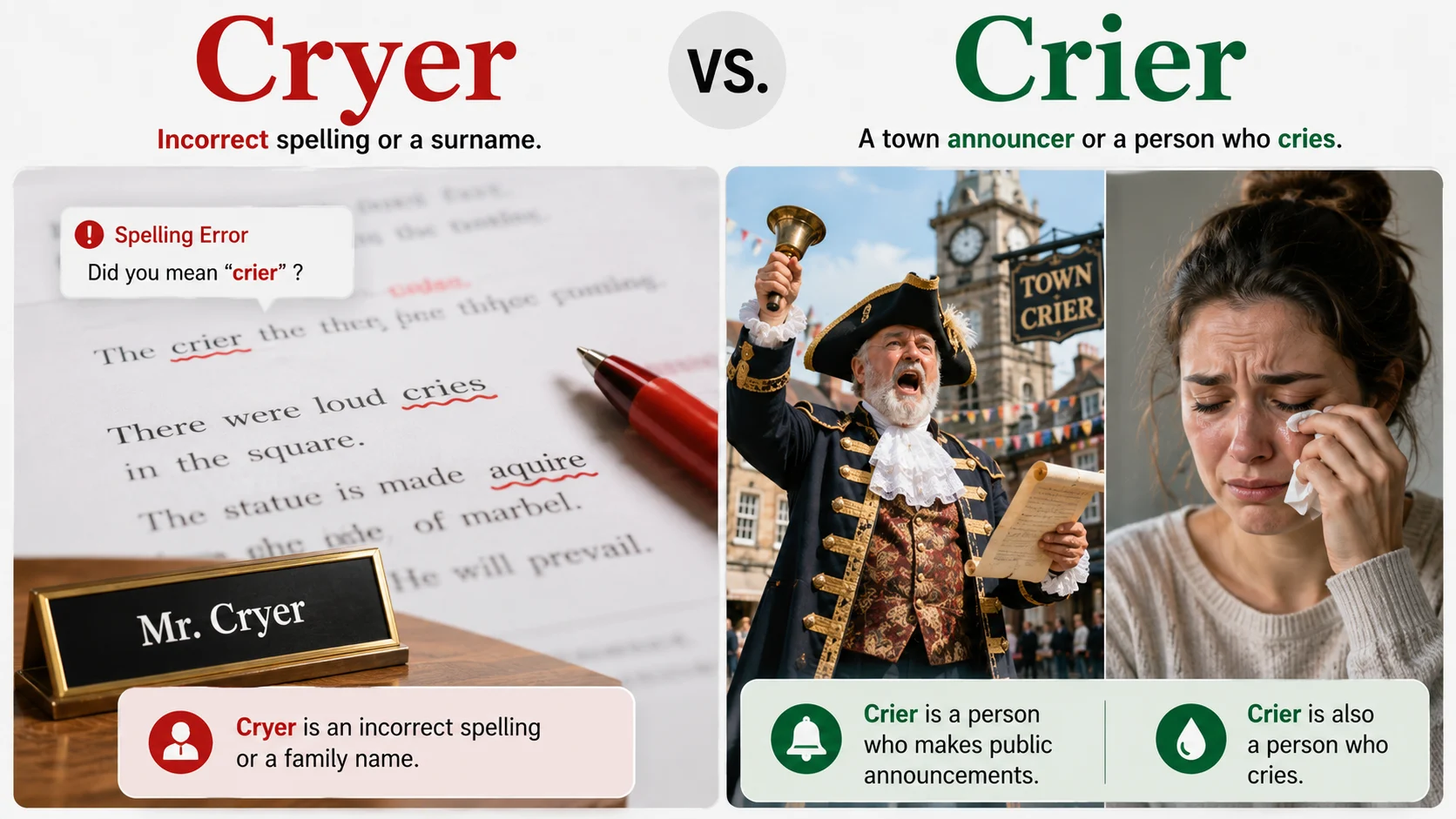
Crier or crier is a common spelling question because both words look similar, but only crier is recognized as the standard English spelling for a person who cries or someone who publicly announces messages. Cryer is generally considered a misspelling, although it occasionally appears as a surname.
Many English learners and even native speakers pause when deciding to write cryer or crier. The confusion comes from the way English forms words ending in er and ier, making both spellings seem believable at first glance.
In modern English, crier is the correct noun. It refers to a person who cries, someone who complains frequently, or a public official who makes announcements, such as a town crier. On the other hand, cryer is not accepted as the standard spelling of the word in dictionaries. Outside of being a family name, it is generally treated as a spelling mistake.
Understanding this distinction helps you write more accurately in school assignments, professional documents, emails, and online content. It also prevents avoidable spelling errors that can affect clarity and credibility.
Cryer vs Crier | What’s the Difference?
The difference is simple once you know the role each word plays in English.
Crier is the correct English noun. It refers to someone who cries, someone who complains habitually, or a person who publicly announces information.
Cryer is usually an incorrect spelling when you intend to refer to that noun. While it exists as a surname for some individuals, it should not replace crier in ordinary writing.
| Feature | Crier | Cryer |
|---|---|---|
| Part of speech | Noun | Usually a misspelling or surname |
| Standard English | Yes | No |
| Found in dictionaries | Yes | Not as the common noun |
| Appropriate for academic writing | Yes | No |
| Appropriate for professional writing | Yes | No |
| Common meaning | Person who cries or public announcer | Mainly a family name |
Quick Recap
If you are referring to someone who cries or announces public messages, always choose crier.
The spelling cryer is rarely correct unless it is part of a person’s legal name.
Remember that spell checkers and dictionaries recognize crier as the accepted English word.
Is Cryer vs Crier a Grammar, Vocabulary or Usage Issue?
This question is primarily a spelling and vocabulary issue rather than a grammar problem.
Grammar focuses on how words function together in sentences. In contrast, cryer and crier involve choosing the correct word form.
The two spellings are not interchangeable in standard English. Professional editors, teachers, and style guides consistently recommend crier whenever the common noun is intended.
In academic writing, using crier demonstrates correct spelling and attention to detail. Using cryer may be marked as an error unless you are referring to someone’s surname.
In casual conversations, readers may understand what you mean if you write cryer, but it still appears incorrect and may reduce the credibility of your writing.
Using Crier Correctly
The word crier has several accepted meanings depending on the context.
The most common meaning is a person who cries frequently.
Example
The baby was a loud crier during the first few months.
It can also describe someone who easily becomes emotional.
Example
She has always been a crier during emotional movies.
Historically, crier refers to an official who makes public announcements.
Example
The town crier rang a bell before reading the king’s message.
Workplace Example
The manager joked that nobody wanted to be known as the office crier after stressful meetings.
Academic Example
The literature professor explained that the village crier played an important role in spreading news before newspapers became common.
Technology Example
An artificial intelligence writing assistant correctly identified crier as the accepted dictionary spelling and flagged cryer as a possible spelling mistake.
Usage Recap
Use crier whenever you mean a person who cries, a frequent complainer, or a public announcer. It is the accepted spelling in dictionaries and professional writing.
Using Cryer Correctly
In everyday English, cryer should generally not be used as a common noun.
Its most legitimate use is as a surname.
For example, a person’s last name may be Cryer, and that spelling should always be respected because names follow their own spelling conventions.
Workplace Example
We welcomed Ms. Cryer as the newest member of the legal team.
Academic Example
Professor Cryer published an article on medieval history.
Technology Example
The employee database correctly stored the surname Cryer without marking it as a spelling error because it recognized it as a proper name.
Usage Recap
Outside of names, avoid using cryer. If you are referring to someone who cries or a public announcer, crier is almost always the correct choice.
When You Should NOT Use Cryer or Crier
Choosing the correct spelling becomes much easier when you know the situations where each word does not belong. Although the difference is straightforward, writers often make the same mistakes because the words look so similar.
Do not use cryer when you are referring to someone who cries. The accepted spelling is crier.
Do not use cryer in school assignments, business reports, articles, or professional emails unless it is part of a person’s surname.
Do not assume cryer is an alternative British spelling. Both American and British English use crier.
Do not replace crier with cryer simply because it looks more logical. English spelling does not always follow predictable patterns.
Do not change the spelling of a person’s surname from Cryer to Crier. Proper names should always be written exactly as the individual spells them.
Do not rely only on pronunciation when choosing between the two words. They sound the same, but only one is correct in standard English.
Do not ignore spell checker warnings when cryer appears in ordinary writing. Most writing tools flag it because it is not the standard noun.
Common Mistakes and How to Fix Them
| Correct Sentence | Incorrect Sentence | Explanation |
|---|---|---|
| She was a quiet crier as a child. | She was a quiet cryer as a child. | Crier is the correct noun. |
| The town crier announced the festival. | The town cryer announced the festival. | Public announcer is always crier. |
| He is not much of a crier. | He is not much of a cryer. | Standard English uses crier. |
| The article mentioned Professor Cryer. | The article mentioned Professor Crier. | Use Cryer only if it is the person’s surname. |
| The editor corrected the spelling to crier. | The editor corrected the spelling to cryer. | Dictionaries recognize crier as the correct noun. |
| Every crier has a different way of expressing emotions. | Every cryer has a different way of expressing emotions. | Crier is the accepted spelling. |
Decision Rule
Remember this simple rule whenever you are unsure.
If you mean a person who cries or someone who publicly announces information, use crier.
If you are writing someone’s family name that is spelled Cryer, keep that spelling exactly as written.
This single rule will help you avoid almost every mistake involving these words.
Crier and Cryer in Modern Technology and AI Tools
Modern writing software has made spelling mistakes easier to spot than ever before. Grammar checkers, spell checkers, and artificial intelligence writing assistants recognize crier as the standard English noun.
If you type cryer while writing an article, email, or assignment, many tools will recommend changing it to crier. This suggestion is based on dictionary usage rather than pronunciation.
However, advanced writing tools also recognize that Cryer can be a legitimate surname. Because of this, they usually leave proper names unchanged.
Even with AI assistance, writers should review suggestions carefully. Technology is helpful, but understanding the difference yourself leads to more confident writing.
Word History and Etymology
The word crier comes from the Old French verb meaning to cry out or to proclaim. It eventually entered Middle English and became the noun used for someone who cried aloud or publicly announced important news.
One of its best known historical uses appears in the phrase town crier, an official responsible for sharing news before newspapers, radio, and television existed.
The spelling cryer did not develop as a standard English noun. Instead, it survives mainly as a family name passed down through generations.
Understanding the history of the word explains why dictionaries consistently favor crier.
Expert Insight
“Correct spelling is not simply about following rules. It helps readers understand your meaning immediately and builds trust in your writing.”
This principle is especially true with commonly confused words such as crier and cryer, where one letter changes the word is considered standard English.
Case Study One
Student Essay Improvement
A university student submitted a history essay that referred to the village cryer throughout the paper.
The instructor corrected every occurrence to crier and explained that the historical role is always written with the accepted noun.
After making the corrections, the essay received higher marks for language accuracy and professionalism.
Case Study Two
Business Website Editing
A local history museum published an article describing the duties of a town cryer.
During an editorial review, every instance was changed to crier.
The revised article appeared more professional, aligned with dictionary standards, and eliminated reader confusion.
Error Prevention Checklist
Before publishing or submitting your writing, review these quick checks.
Always use crier when
- You mean a person who cries.
- You mean a frequent complainer.
- You refer to a town crier.
- You are writing an academic paper.
- You are writing business or professional content.
- You are following standard English spelling.
Never use cryer when
- You mean the common English noun.
- You are writing formal documents.
- You are completing school assignments.
- You are creating professional articles.
- You believe it is an alternative spelling of crier.
The only common exception is when Cryer is someone’s surname.
Related Grammar Confusions You Should Master
If you often confuse similar English words, these topics are also worth learning.
- Adviser or Advisor
- Affect or Effect
- Brought or Bought
- Stationary or Stationery
- Compliment or Complement
- Principal or Principle
- Lose or Loose
- Then or Than
- Farther or Further
- Who’s or Whose
Learning these distinctions improves both accuracy and confidence in everyday writing.
FAQs
Is cryer a real English word?
The spelling cryer exists primarily as a surname. It is not accepted as the standard English noun for a person who cries or makes public announcements. In ordinary writing, crier is the correct choice.
Which is correct, cryer or crier?
The correct spelling for the common noun is crier. Use it whenever you are referring to someone who cries or to a public announcer such as a town crier.
Why do people confuse cryer and crier?
The two words sound exactly alike, making them easy to confuse. Since English spelling often includes similar looking endings, many writers assume both spellings are acceptable even though only crier is standard.
Can cryer be used in academic writing?
Only if it is part of a person’s name. Otherwise, academic writing should always use crier because it follows dictionary standards and accepted spelling conventions.
Is cryer an American or British spelling?
No. Both American English and British English use crier as the correct noun. Cryer is not an alternative regional spelling.
What does town crier mean?
A town crier was an official responsible for announcing news, laws, and public notices before modern forms of communication became available. The title is always spelled crier.
Will grammar checkers detect cryer as a mistake?
Most modern grammar and spell checking tools identify cryer as a possible spelling mistake unless it appears as a proper surname.
How can I remember the correct spelling?
Think of the dictionary word crier whenever you mean someone who cries or announces public messages. Reserve Cryer only for personal names.
Conclusion
Understanding the difference between cryer or crier is easier than it first appears. Although both spellings look believable, crier is the only standard English noun used for a person who cries or for a public announcer. Cryer should generally be used only as a surname.
By remembering this simple distinction, you can avoid spelling mistakes in academic work, professional documents, emails, and everyday writing. When in doubt, choose crier unless you are referring to someone’s family name.
Discover More Related Articles:
- Humor or Humour| Everything You Need to Know About This Word In 2026
- Disfunction or Dysfunction | Which Spelling Sounds More Professional In 2026
- Later or Latter | End the Confusion Fast In 2026