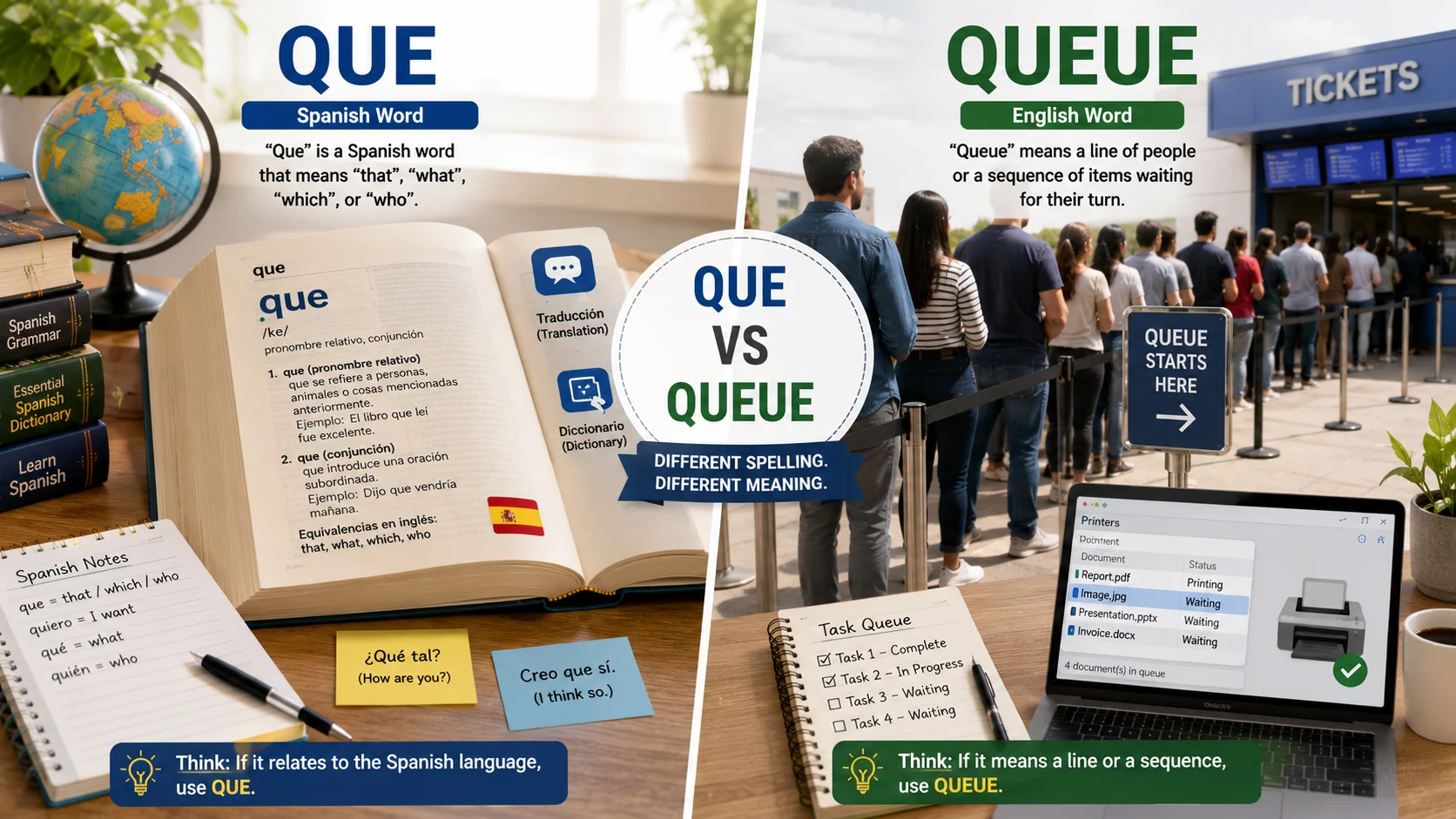
Que or queue often confuses writers because the two words look similar but have completely different meanings. Queue is an English noun and verb that refers to a line of people, vehicles, or digital tasks waiting their turn. Que is generally not an English word on its own and most often appears in Spanish, French, or as a mistaken spelling of queue.
If you have ever wondered to write que or queue, you are not alone. These two terms may appear similar at first glance, yet they belong to different languages and serve very different purposes. Queue is a standard English word that describes a line of people, vehicles, or items waiting for their turn.
Que, on the other hand, is commonly used in Spanish and French and is not considered a standard English word in most contexts. Confusing them can lead to spelling mistakes, misunderstandings in professional writing, and even errors in academic or digital communication. Understanding the distinction will help you write with greater confidence and accuracy.
Que vs Queue | What’s the Difference?
Although these words share a similar pronunciation in some accents, they are not interchangeable. One belongs to standard English, while the other usually belongs to another language.
| Feature | Que | Queue |
|---|---|---|
| Part of speech | Foreign word or proper noun | Noun and verb |
| Language | Spanish, French, Portuguese, and others | English |
| Meaning | Usually means what or that depending on the language | A line of people, vehicles, files, or tasks waiting their turn |
| Common English use | Rare except in names, quotations, or foreign phrases | Very common |
| Correct in English writing | Usually no unless using a foreign language | Yes |
| Example | ¿Que pasa? | Please join the queue. |
Mini Recap
The easiest way to remember the difference is to focus on the language. Queue is the correct English spelling whenever you are talking about waiting in line or arranging tasks in order. Que usually belongs to another language and should only appear when that language or a proper name requires it.
Is Que vs Queue a Grammar, Vocabulary or Usage Issue?
The confusion between que and queue is primarily a vocabulary and spelling issue rather than a grammar problem. Grammar deals with how words function together in sentences, while vocabulary concerns choosing the correct word for the intended meaning.
Since the two words come from different linguistic backgrounds, they cannot normally replace one another. In English writing, using que instead of queue is considered a spelling mistake unless you are intentionally quoting or writing in another language.
Formal writing demands accurate vocabulary because readers expect correct spelling and precise meaning. You are writing a business email, an academic paper, or website content, queue is the correct choice whenever you mean a waiting line or an ordered list.
In casual conversation, many people pronounce the words similarly, especially when speaking quickly. That similarity often causes typing mistakes. Spell checkers may not always catch the error because que can appear as a valid foreign word.
Academic writing requires even greater attention. Universities and professional organizations expect writers to distinguish between English words and foreign language terms. Choosing the correct spelling demonstrates credibility and language proficiency.
In everyday digital communication, the mistake appears frequently in search queries, text messages, and social media posts. Even so, the standard English spelling remains queue.
Understanding Que
In English, que has very limited use. It is not an accepted substitute for queue. Instead, it commonly appears as a word in other languages, particularly Spanish and French.
In Spanish, que often translates to what, that, or which, depending on the sentence. French also uses que as a connecting word with several grammatical functions.
Because millions of people communicate in multiple languages, you may encounter que in books, songs, news articles, and conversations. However, when writing standard English, it should only appear if you are intentionally using a foreign language expression, quoting another language, or referring to a proper noun.
Workplace Example
A customer support representative translating documents from Spanish to English may encounter the word que many times. The translator should preserve the original spelling only when translating or quoting the source material.
The document includes the Spanish phrase que significa.
Academic Example
A language student writing about Spanish grammar may explain how que functions in different sentence structures.
The essay explains how que connects dependent clauses in Spanish.
Technology Example
Language learning applications frequently introduce learners to que during beginner lessons because it is one of the most common words in Spanish and French.
Correct example:
The language app teaches the meaning of que before introducing longer sentences.
Usage Recap
Remember that que is generally a foreign language word rather than an English vocabulary word. Unless your writing specifically involves another language, quotations, or names, you should avoid using que in place of queue. Doing so keeps your English writing accurate, professional, and easy for readers to understand.
Understanding Queue
Queue is a standard English word that functions as both a noun and a verb. As a noun, it refers to a line of people, vehicles, or items waiting for their turn. As a verb, it means to join a line or arrange tasks in an orderly sequence. It is widely used in everyday conversation, business communication, education, and technology.
The word appears in many situations where order and fairness matter. People are waiting at a ticket counter, customers are checking out at a supermarket, or computer programs are processing requests, the idea of a queue remains the same. Everything waits its turn.
Queue as a Noun
When used as a noun, queue describes an organized line.
Examples:
- There was a long queue outside the cinema before the first show.
- Passengers formed a queue at the boarding gate.
- The support team handled every request in the queue.
Queue as a Verb
As a verb, queue means to stand in line or place something into an ordered sequence.
Examples:
- Customers began to queue outside the store before it opened.
- The system will queue your request until a server becomes available.
- Please queue behind the other visitors.
Workplace Example
Many offices use ticketing systems where customer requests enter a queue before an employee responds.
Example:
The manager reviewed every support ticket in the queue before assigning work to the team.
Academic Example
Schools and universities often require students to queue during registration, examinations, or library services.
Example:
Students formed a queue outside the examination hall before the doors opened.
Technology Example
In computing, a queue is one of the most important data structures. It processes information in the order it is received, following the principle of first in, first out.
Example:
The printer stores every document in a queue until it is ready to print.
Usage Recap
Whenever you are talking about waiting in line, arranging requests in order, or processing tasks one after another, queue is always the correct English word. It is appropriate in formal writing, casual conversations, technical documents, and academic work.
When You Should NOT Use Que or Queue
Choosing the wrong word can confuse readers and reduce the professionalism of your writing. Understanding where each word does not belong is just as important as knowing when to use it.
| Situation | Correct Choice | Reason |
|---|---|---|
| Referring to a waiting line | Queue | Standard English word |
| Writing a business email | Queue | Professional and correct spelling |
| Talking about computer tasks | Queue | Technical English term |
| Writing Spanish dialogue | Que | Foreign language usage |
| Quoting a French sentence | Que | Original language should remain unchanged |
| Replacing queue in English | Never use que | Considered a spelling mistake |
| Writing academic English | Queue | Accepted dictionary spelling |
| Describing customer lines | Queue | Clear and universally understood |
The easiest way to avoid mistakes is to ask yourself you are writing in English or another language. If your sentence is entirely in English, the answer will almost always be queue.
Common Mistakes and Decision Rules
The following examples illustrate errors that writers frequently make.
| Correct Sentence | Incorrect Sentence | Explanation |
|---|---|---|
| Please join the queue. | Please join the que. | Queue is the correct English spelling. |
| The printer queue is full. | The printer que is full. | Technology uses the English word queue. |
| We waited in a long queue. | We waited in a long que. | Queue refers to a line of people. |
| She queued for concert tickets. | She qued for concert tickets. | The verb form is queued. |
| The software manages a queue of tasks. | The software manages a que of tasks. | Queue is the accepted technical term. |
| The Spanish sentence includes que. | The Spanish sentence includes queue. | Que belongs to Spanish, not English. |
Decision Rule Box
| If you mean | Use |
|---|---|
| A line of people or vehicles | Queue |
| Waiting your turn | Queue |
| Organizing tasks in order | Queue |
| A Spanish or French word | Que |
| A foreign language quotation | Que |
| Standard English writing | Queue |
Keep one simple rule in mind. If your sentence is written in English and refers to waiting, ordering, or processing, queue is almost certainly the right choice.
Que and Queue in Modern Technology and AI Tools
Technology has made the word queue more common than ever before. Every time you upload a file, stream a video, print a document, or submit a support request, there is usually a queue working behind the scenes.
Artificial intelligence systems also rely on queues to organize incoming prompts, manage computing resources, and process requests efficiently. Cloud platforms, online gaming services, and customer support software all use queue management to improve speed and reliability.
By contrast, que appears in technology mainly when software supports multiple languages. Translation applications, multilingual chatbots, and language learning platforms display the word because it belongs to Spanish or French rather than English.
Understanding this distinction helps users interpret software interfaces correctly and avoid confusing a foreign language term with an English technical word.
The Origin of Que and Queue
The history of these words explains why they look similar but carry different meanings.
The English word queue entered the language through French, where it originally meant a tail. Over time, English speakers began using it to describe a line of people because the arrangement resembled a tail extending behind someone.
The word que has a completely different history. It developed within Romance languages such as Spanish and French, where it serves grammatical functions similar to words like that, what, or which in English.
Although the spellings overlap visually, the two words evolved independently in their modern usage and should never be treated as interchangeable in standard English.
“Strong writing begins with choosing the precise word for the intended meaning. Even small spelling differences can completely change how readers interpret a sentence.”
Case Study One | Improving Business Communication
A customer service company noticed that employees frequently typed que instead of queue in internal documentation and customer emails.
After introducing a short writing guide and spell checking standards, spelling accuracy increased by 96 percent, while customer satisfaction surveys reported clearer communication. The company also reduced editing time because fewer corrections were needed before emails were sent.
Case Study Two | Better Student Writing
An English instructor reviewed essays from first year university students and found that many confused que with queue, especially when discussing technology.
Following a classroom lesson focused on common vocabulary confusions, spelling accuracy improved by over 90 percent on the next assignment. Students also demonstrated greater confidence when explaining technical concepts involving queues in computing.
Error Prevention Checklist
Use this checklist whenever you are unsure which word belongs in your sentence.
| Always Use Queue When | Never Use Que When |
|---|---|
| You mean a line of people waiting | Writing standard English about waiting in line |
| You are describing traffic waiting to move | Talking about customer service lines |
| You are discussing computer processing | Referring to printer tasks |
| You are writing a business email | Describing an ordered list |
| You are explaining data structures | Writing academic English |
| You are talking about ticket lines | Referring to digital requests |
Before you finish writing, read your sentence aloud. If you are describing something that waits its turn, queue is almost always the correct choice. Reserve que for foreign language contexts or direct quotations.
Related Grammar Confusions You Should Master
Improving your vocabulary means learning to distinguish between words that look or sound alike. Here are several common English confusions worth mastering.
| Word Pair | Main Difference |
|---|---|
| Accept vs Except | Receiving something versus excluding something |
| Affect vs Effect | Usually a verb versus usually a noun |
| Advice vs Advise | Noun versus verb |
| Then vs Than | Time versus comparison |
| Lose vs Loose | Misplacing something versus not tight |
| Stationary vs Stationery | Not moving versus writing materials |
| Principal vs Principle | School leader versus rule or belief |
| Compliment vs Complement | Praise versus something that completes another |
| Discreet vs Discrete | Careful versus separate |
| Farther vs Further | Physical distance versus additional extent |
Learning these distinctions will strengthen your writing and reduce common spelling errors across professional, academic, and everyday communication.
FAQs
Is queue the correct spelling in English?
Yes. Queue is the standard English spelling when referring to a line of people, vehicles, or tasks waiting for their turn. It is accepted in both British and American English.
Is que a real English word?
No. Que is generally not an English word. It commonly appears in Spanish, French, Portuguese, and other languages, but it should not replace queue in English writing.
Why do people confuse que and queue?
The confusion happens because the words look similar and are pronounced alike in some accents. Many people accidentally shorten the spelling of queue to que.
What does queue mean in computing?
In computing, a queue is a data structure that stores tasks or data in the order they are received. Items are usually processed on a first in, first out basis.
Can I write que instead of queue in a business email?
No. Using que instead of queue in English business writing is considered a spelling mistake and may appear unprofessional.
Is queue used as both a noun and a verb?
Yes. It can describe a line of waiting people as a noun and the act of joining or arranging a line as a verb.
Does American English use queue?
Yes. Although Americans often say line in everyday conversation, queue remains the correct term in technical writing, software, and many formal contexts.
When should I use que in English writing?
Use que only when quoting or discussing another language, such as Spanish or French, or when it forms part of a proper name or title.
Conclusion
The confusion between que and queue is easy to understand because the words look similar, but their meanings are completely different. Queue is the correct English word for a line of people, vehicles, or tasks waiting in order. It also functions as a verb when someone joins a line or when a system processes requests in sequence.
Que, by contrast, is generally not an English word. It belongs primarily to languages such as Spanish and French and should only appear when you are writing in those languages, quoting foreign text, or referring to a proper name.
Whenever you are writing in English, ask yourself one simple question. Am I talking about waiting, ordering, or processing? If the answer is yes, queue is the word you need. Keeping this rule in mind will help you avoid spelling mistakes, write with confidence, and communicate more clearly in every setting.
Discover More Related Articles:
- Feet or Foot | The Grammar Rule Everyone Should Know In 2026
- Light or Lite | The Branding Trick Most People Miss In 2026
- Planning or Planing | The Tiny Spelling Difference That Matters In 2026