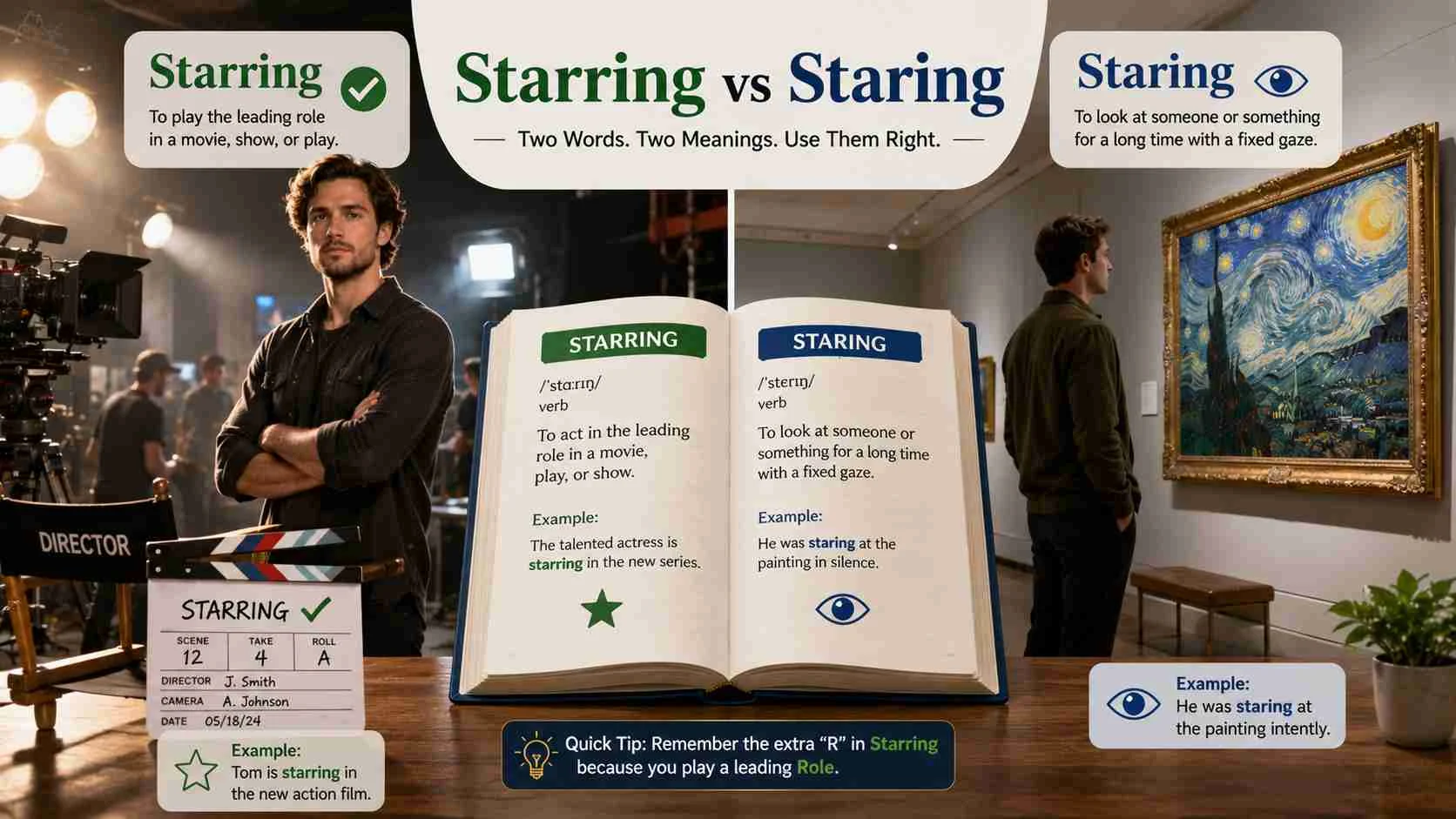
Starring or staring are commonly confused because they look and sound similar but they have completely different meanings. Starring refers to performing the leading role in a movie, television show or play, while staring means looking at someone or something with a fixed, steady gaze.
Many English learners and even native speakers mix up starring or staring because only one letter separates the two words. That tiny spelling difference changes the meaning entirely. Starring describes someone acting as the main performer in a film, television series, or stage production. Staring describes the act of looking intently at a person, object, or scene without looking away.
Using the wrong word can make your writing confusing, especially in emails, school assignments, entertainment reviews, and everyday conversations. Understanding when each word fits will help you write with greater accuracy and confidence.
Starring vs Staring | What Is the Difference?
Although these words are pronounced differently by many speakers, they are still easy to confuse because of their similar spelling. The easiest way to remember them is to think about the context. If the sentence is about acting or a leading role, the correct word is starring. If the sentence is about looking closely or fixing your eyes on something, the correct word is staring.
Both words are present participles ending in ing, but they come from different base verbs and describe entirely different actions.
| Feature | Starring | Staring |
|---|---|---|
| Part of speech | Verb | Verb |
| Base verb | Star | Stare |
| Meaning | Acting in the leading role | Looking fixedly at someone or something |
| Common context | Movies, television, theater | Eye contact, observation, attention |
| Example | She is starring in a new drama. | He kept staring at the painting. |
To summarize, starring belongs to the world of entertainment and performance. Staring belongs to the action of looking with focused attention. Even though the spellings are similar, their meanings never overlap. Choosing the correct word depends entirely on what the sentence is describing.
Is Starring vs Staring a Grammar, Vocabulary or Usage Issue?
The confusion between these words is primarily a vocabulary and usage issue, not a grammar problem. Each word has its own meaning, and neither can replace the other without changing the sentence completely.
In formal writing, using the correct word is especially important because readers expect precise language. A movie review, for example, should say an actor is starring in a film rather than staring in it. Likewise, a story describing someone’s gaze should use staring, not starring.
Academic writing follows the same principle. Essays, reports, and research papers should always choose the word that accurately reflects the intended meaning. Casual conversations may allow for spoken misunderstandings, but written English leaves little room for error.
Since these words describe different actions, they are never interchangeable. Replacing one with the other creates an incorrect sentence and may confuse your audience.
Using Starring Correctly
The word starring comes from the verb star, which means to perform as the main actor or featured performer in a production. It is commonly used in entertainment news, movie reviews, television guides, theater announcements, and promotional materials.
When you see starring, think of someone receiving the leading role or being prominently featured.
Workplace Example
The company invited a famous presenter who is starring in a popular educational video series for the annual conference.
Academic Example
The media studies class analyzed a documentary starring several award winning journalists to understand storytelling techniques.
Technology Example
The streaming platform promoted a science fiction series starring internationally recognized actors on its home page.
Everyday Examples
She is starring in her school’s annual musical this summer.
The advertisement features an athlete starring in a new fitness campaign.
Everyone was excited about the upcoming film starring their favorite actor.
The theater announced a comedy starring several well known performers.
The director confirmed that the award winning actress would be starring in the sequel.
Common Expressions with Starring
You will often see starring used in entertainment related phrases such as these.
| Expression | Meaning |
|---|---|
| Starring in a movie | Playing the leading role in a film |
| Starring on television | Appearing as a featured performer in a television program |
| Starring alongside | Acting together with another performer |
| Starring role | The main acting role in a production |
| Now starring | Currently appearing as the featured performer |
These expressions frequently appear in movie posters, television advertisements, entertainment magazines, streaming platforms, and news articles.
Usage Recap
Whenever your sentence talks about acting, performing, or being the featured person in a production, starring is the correct choice. If the topic involves films, television shows, theater, documentaries, or promotional material, this word almost always fits naturally.
Using Staring Correctly
The word staring comes from the verb stare, which means to look at someone or something for a long time with focused attention. The gaze may express curiosity, surprise, confusion, admiration, fear, or even rudeness depending on the situation.
Unlike starring, which belongs to the entertainment industry, staring is used in everyday communication whenever someone fixes their eyes on a person, object, or event.
Workplace Example
During the meeting, everyone was staring at the presentation screen while the manager explained the quarterly results.
Academic Example
The students spent several minutes staring at the historical map before discussing their observations.
Technology Example
Many people spend hours staring at computer monitors, which can lead to eye strain if they do not take regular breaks.
Everyday Examples
The little boy kept staring at the magician in amazement.
She was staring through the window, thinking about her future.
Everyone started staring when the loud noise echoed across the room.
The dog sat quietly, staring at its owner for a treat.
I caught myself staring at the beautiful sunset for several minutes.
Common Expressions with Staring
| Expression | Meaning |
|---|---|
| Staring at the screen | Looking continuously at a display |
| Staring into space | Looking without focusing on anything specific |
| Staring out the window | Looking through a window for an extended time |
| Staring in disbelief | Looking because of shock or surprise |
| Staring someone down | Looking at someone until they look away |
These expressions appear frequently in novels, news stories, workplace discussions, and everyday conversations.
Usage Recap
Whenever the sentence is about looking intently or keeping your eyes fixed on something, staring is the correct word. It has nothing to do with acting, movies, or television.
When You Should NOT Use Starring or Staring
Even experienced writers occasionally confuse these words because they differ by only one letter. The following situations highlight the most common mistakes.
- Do not use starring when talking about someone looking at another person.
- Do not use staring when describing the lead actor in a film.
- Never write staring in a movie if you mean acting in it.
- Avoid starring at the wall because the sentence is describing a gaze, not a performance.
- Do not replace one word with the other simply because they sound similar.
- Check entertainment articles carefully since this mistake changes the meaning completely.
- In academic writing, always verify whether the sentence is about acting or looking before choosing the word.
- Proofread headlines carefully because spelling errors involving these words are easy to overlook.
Common Mistakes and Decision Rules
| Correct Sentence | Incorrect Sentence | Explanation |
|---|---|---|
| She is starring in a new television series. | She is staring in a new television series. | Acting requires starring. |
| He kept staring at the painting. | He kept starring at the painting. | Looking requires staring. |
| The actor is starring in an action film. | The actor is staring in an action film. | A leading performer is starring. |
| Everyone was staring at the fireworks. | Everyone was starring at the fireworks. | Watching something carefully is staring. |
| The famous actress is starring in the sequel. | The famous actress is staring in the sequel. | Entertainment uses starring. |
| The child was staring at the puppy. | The child was starring at the puppy. | A fixed gaze uses staring. |
Decision Rule Box
| If you mean | Use |
|---|---|
| Acting in a movie, show, or play | Starring |
| Looking fixedly at someone or something | Staring |
A quick memory trick can also help. Think of star as a movie star. If someone is the main performer, choose starring. If the sentence is about someone’s eyes, choose staring.
Starring and Staring in Modern Technology and AI Tools
Modern writing tools, grammar checkers, and AI assistants have become much better at detecting context based spelling mistakes. Programs such as grammar correction software can usually identify when starring has been used instead of staring, or the other way around.
However, no tool is perfect. If both words are correctly spelled, some applications may miss the mistake because it is a context error rather than a spelling error. That is why careful proofreading remains essential, especially when writing articles, reports, emails, or entertainment content.
AI writing assistants also rely on sentence context to recommend the correct word. The clearer your sentence is, the more accurate their suggestions will be.
Word Origins
The word star originally referred to the bright celestial objects in the night sky. Over time, the term came to describe outstanding performers who shined brightly in the entertainment world. From this meaning, the verb star developed, leading to starring.
The word stare comes from an older English verb meaning to gaze fixedly or with wide open eyes. Its meaning has remained remarkably consistent for centuries, giving us the present form staring that we use today.
Understanding these origins makes it easier to remember that one word belongs to performers while the other relates to eyesight.
“Clear writing depends on choosing words that match your intended meaning, not simply words that look or sound similar.”
Real World Case Studies
Case Study One
A film review website accidentally published an article stating that a famous actor was staring in a blockbuster movie. Readers quickly pointed out the mistake in the comments section. After correcting the headline to starring, reader engagement improved, and the article appeared far more professional.
Case Study Two
A university student submitted an English assignment describing a child starring at a painting in a museum. The instructor corrected the sentence to staring and explained that the original wording unintentionally suggested the child was acting in a movie. The lesson helped the student avoid repeating the mistake in future writing.
Error Prevention Checklist
| Always use | Never use |
|---|---|
| Starring when talking about acting in a film, show, or play. | Starring when someone is simply looking at something. |
| Starring when referring to the leading performer. | Staring for actors or performers. |
| Staring when describing a fixed gaze. | Staring to describe appearing in entertainment. |
| Staring when discussing eye contact or observation. | Either word without checking the sentence context first. |
A simple habit of asking yourself whether the sentence is about acting or looking can prevent almost every mistake involving these commonly confused words.
Related Grammar Confusions You Should Master
Mastering commonly confused English words can dramatically improve your writing accuracy. Once you understand the difference between starring and staring, these related word pairs become much easier to use correctly.
| Word Pair | Main Difference |
|---|---|
| Brought vs Bought | One means carried, the other means purchased. |
| Later vs Latter | One refers to time, the other refers to the second of two choices. |
| Affect vs Effect | One is usually a verb, the other is usually a noun. |
| Stationary vs Stationery | One means not moving, the other refers to writing supplies. |
| Then vs Than | One relates to time, the other is used for comparison. |
| Lose vs Loose | One means to misplace or fail to win, the other means not tight. |
| Accept vs Except | One means to receive, the other means to exclude. |
| Principal vs Principle | One is a person or main item, the other is a rule or belief. |
| Complement vs Compliment | One completes something, the other expresses praise. |
| Farther vs Further | One generally refers to physical distance, the other often refers to additional extent or degree. |
Learning these distinctions strengthens your grammar, expands your vocabulary, and helps you avoid mistakes that can confuse readers.
FAQs
What is the difference between starring and staring?
Starring means acting as the main performer in a production, while staring means looking at someone or something with a fixed gaze. They have completely different meanings.
Is starring or staring correct in a movie sentence?
If you are talking about an actor appearing in a film, starring is always the correct word because it refers to performing a leading role.
Can starring and staring be used interchangeably?
No. These words describe different actions, so replacing one with the other changes the meaning of the sentence completely.
Why do people confuse starring and staring?
The words are very similar in spelling and pronunciation, which makes them easy to mix up during writing or typing.
Is staring considered rude?
It can be. Looking at someone for a long time without a reason is often viewed as impolite in many cultures.
What part of speech are starring and staring?
Both are present participle verb forms ending in ing, but they come from different base verbs with different meanings.
How can I remember the difference between starring and staring?
Think of a movie star when you see starring. Think of someone’s eyes when you see staring.
Do grammar checkers always catch this mistake?
Not always. Because both words are correctly spelled, some tools miss the error unless they understand the sentence context.
Conclusion
Understanding the difference between starring or staring is simpler once you focus on the meaning of each word. Starring always relates to acting or performing as the featured person in a movie, television show, or stage production. Staring always refers to looking steadily or intently at someone or something.
Although the words look similar, they are never interchangeable. Choosing the correct one depends entirely on the context of your sentence. By remembering that a star performs while a person who stares uses their eyes, you can avoid one of the most common vocabulary mistakes in English.
With regular reading, careful proofreading, and consistent practice, selecting the correct word will soon become second nature.
Discover More Related Articles:
- Koran or Quran | Why Modern English Favors One Form In 2026
- Grammar or Grammer | The English Mistake Even Smart Writers Make In 2026
- Crown or Colony | Why These Words Are Never Interchangeable In 2026