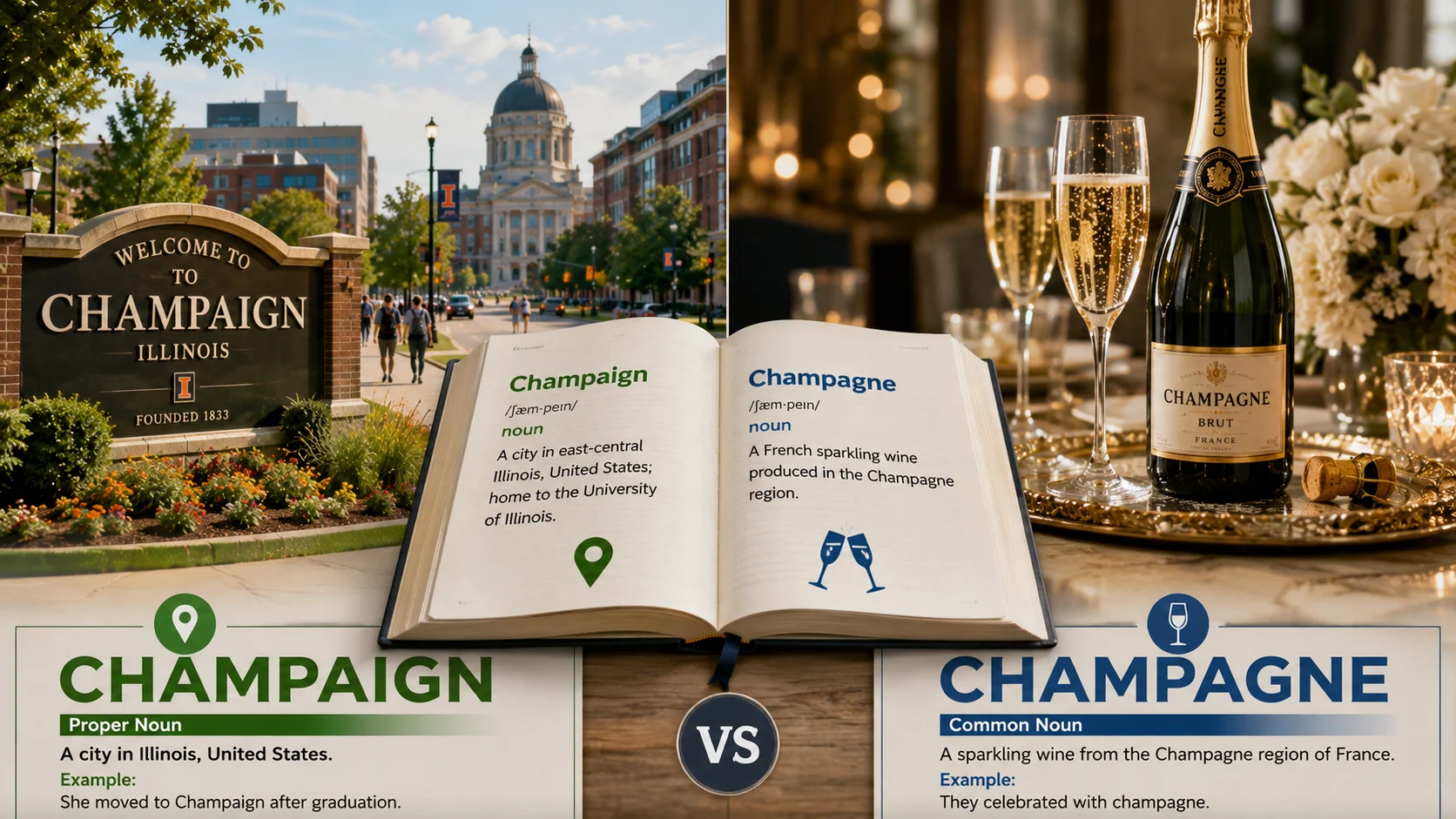
Champaign or champagne are not interchangeable because they refer to completely different things. Champaign is a proper noun that usually names places, while champagne is a sparkling wine produced under strict rules in the Champagne region of France. Understanding this distinction helps you avoid spelling mistakes and factual errors in both everyday and professional writing.
The confusion between champaign or champagne is surprisingly common because the two words differ by only one letter. Despite their similar appearance, they have entirely different meanings and uses. Champaign is a proper noun that commonly refers to a city or geographic location, while champagne is a noun describing a famous sparkling wine made in France under protected production standards.
Mixing them up can lead to embarrassing mistakes in travel writing, academic papers, restaurant menus, business communication, and even search engine content. Once you understand how each word functions, choosing the correct one becomes simple.
Many writers rely on spell checkers to catch mistakes, yet proper nouns and product names often slip through unnoticed. That is why learning the meaning, grammar, and context of these two words is more valuable than simply memorizing their spelling.
Champaign vs Champagne | What’s the Difference?
Although the words look almost identical, they belong to different categories and should never replace one another.
Champaign
- Part of speech: Proper noun
- Meaning: A place name, most commonly referring to Champaign, Illinois, in the United States.
Champagne
- Part of speech: Common noun
- Meaning: A sparkling wine produced in the Champagne region of France according to strict production regulations.
Comparison Table
| Feature | Champaign | Champagne |
|---|---|---|
| Part of speech | Proper noun | Common noun |
| Meaning | Geographic place name | Sparkling wine from France |
| Capitalization | Always capitalized | Usually lowercase unless beginning a sentence |
| Common context | Travel, geography, education, business | Food, beverages, celebrations |
| Example | She moved to Champaign after graduation. | They celebrated with champagne. |
| Can replace the other? | No | No |
Mini Recap
The easiest way to remember the difference is to focus on the meaning rather than the spelling. Champaign is always a location, while champagne is always a beverage. Since one is a proper noun and the other is a common noun, they also follow different capitalization rules. If your sentence is about travel, cities, or addresses, you almost certainly need Champaign. If it is about celebrations or drinks, champagne is the correct choice.
Champaign or Champagne | Is It a Grammar, Vocabulary or Usage Issue?
This confusion is primarily a vocabulary and usage issue rather than a grammar problem. English grammar rules remain the same regardless of which word you choose. The challenge comes from selecting the correct word for the intended meaning.
These words are not interchangeable because they represent different concepts. Replacing one with the other changes the meaning of an entire sentence.
For example:
- We spent the weekend in Champaign.
- We celebrated with champagne.
Both sentences are grammatically correct, but swapping the words would produce inaccurate or confusing statements.
In formal writing, precision matters even more. Academic publications, travel guides, restaurant menus, and legal documents expect writers to distinguish between geographic names and protected product names accurately.
Casual conversations may tolerate occasional spelling mistakes, especially in text messages, but professional communication should always use the correct term. Search engines also recognize these as different entities, making proper usage important for clarity and SEO performance.
Using Champaign Correctly
Because Champaign is a proper noun, it always begins with a capital letter. Most people encounter it as the name of Champaign, Illinois, although it may appear in other geographic references.
Workplace Example
The regional sales conference will take place in Champaign next month.
Here, the word identifies a specific location where an event is being held.
Academic Example
Researchers from the University of Illinois in Champaign published the latest findings.
In educational writing, using the correct place name improves accuracy and credibility.
Technology Example
The mapping application quickly calculated the fastest route to Champaign.
Navigation software and location based services rely on the correct spelling of geographic names.
Usage Recap
Whenever you are referring to a city, address, university location, or destination, Champaign is the correct choice. Remember to capitalize it because it is a proper noun.
Using Champagne Correctly
Champagne refers to sparkling wine that originates from the Champagne region of France and meets strict production requirements. Although people sometimes use the word casually for any sparkling wine, its traditional meaning is much more specific.
Workplace Example
The company hosted a dinner where guests enjoyed champagne after the awards ceremony.
This example shows the beverage served during a business celebration.
Academic Example
Students studying international trade examined the protected designation of champagne in European law.
Academic discussions often mention the beverage in legal, cultural, or economic contexts.
Technology Example
An online shopping platform recommended premium champagne for holiday celebrations.
Food delivery applications and ecommerce websites frequently use the word in product listings.
Usage Recap
Choose champagne whenever your sentence discusses sparkling wine, celebrations, dining, luxury, hospitality, or French culinary traditions. Unlike Champaign, it is generally not capitalized unless it begins a sentence.
When You Should NOT Use Champaign or Champagne
Writers often confuse these words because of their nearly identical spelling. Paying attention to the context helps prevent common mistakes.
| Feature | Champaign | Champagne |
|---|---|---|
| Part of speech | Proper noun | Common noun |
| Meaning | Geographic place name | Sparkling wine from France |
| Capitalization | Always capitalized | Usually lowercase unless beginning a sentence |
| Common context | Travel, geography, education, business | Food, beverages, celebrations |
| Example | She moved to Champaign after graduation. | They celebrated with champagne. |
| Can replace the other? | No | No |
By asking yourself the sentence is about a place or a beverage, you can almost always identify the correct spelling immediately. This simple habit prevents factual errors, improves professional writing, and helps readers understand your meaning without confusion.
Common Mistakes and Decision Rules
Even experienced writers occasionally confuse Champaign and champagne because the words differ by only one letter. The following examples show the correct choice in real sentences and explain why the other option is incorrect.
| Correct Sentence | Incorrect Sentence | Explanation |
|---|---|---|
| We drove to Champaign for a business conference. | We drove to champagne for a business conference. | The sentence refers to a city, not a drink. |
| They celebrated their anniversary with champagne. | They celebrated their anniversary with Champaign. | The sentence is about sparkling wine. |
| My cousin studies in Champaign, Illinois. | My cousin studies in champagne, Illinois. | A place name must be capitalized and spelled correctly. |
| The restaurant serves premium champagne. | The restaurant serves premium Champaign. | Restaurants serve beverages, not cities. |
| Our meeting will be held in Champaign next Friday. | Our meeting will be held in champagne next Friday. | The meeting location is a city. |
| She ordered a bottle of champagne for the celebration. | She ordered a bottle of Champaign for the celebration. | A bottle contains sparkling wine. |
| The train arrived in Champaign on schedule. | The train arrived in champagne on schedule. | Transportation arrives at a location. |
| The couple toasted with champagne after the ceremony. | The couple toasted with Champaign after the ceremony. | Toasting involves a beverage. |
Decision Rule Box
| If your sentence means | Use |
|---|---|
| A city or geographic location | Champaign |
| Sparkling wine from France | Champagne |
A simple memory trick can help. If people can travel there, choose Champaign. If people can pour it into a glass, choose champagne.
Champaign or Champagne in Modern Technology and AI Tools
Modern writing tools such as grammar checkers, search engines, and AI assistants can usually recognize the difference between these words, but they are not perfect. If your sentence lacks enough context, software may overlook the mistake because both spellings are legitimate words.
For example, an AI writing tool may not flag “We celebrated in champagne” if it assumes you are referring to the beverage. Likewise, a navigation application expects Champaign as a destination, while an online food delivery service recognizes champagne as a product category. Reviewing the surrounding context is still the most reliable way to ensure accuracy.
Etymology
The word Champagne comes from the historic Champagne region of northeastern France, an area internationally known for producing sparkling wine using traditional methods. Over time, the name became closely associated with the beverage itself.
Champaign, on the other hand, developed as a geographic name. The city of Champaign in Illinois received its name during the nineteenth century, inspired by the surrounding landscape and historical naming traditions.
Although the spellings are similar, the words evolved independently and now represent completely different ideas.
Expert Insight
“Strong writing depends on choosing words for their precise meaning rather than their appearance. Small spelling differences often create major differences in interpretation.”
This principle is especially important for words such as Champaign and champagne, where one letter changes the entire meaning of a sentence.
Case Study One | Travel Website Accuracy
A travel blog published an article about attractions in Champaign, Illinois but accidentally used champagne throughout the page. Readers became confused because the article appeared to discuss wine instead of a destination.
After correcting every instance to Champaign, the article became clearer, user engagement improved, and the page ranked better for local travel related searches because search engines correctly understood its topic.
Case Study Two | Restaurant Menu Revision
A restaurant created an online menu advertising imported Champaign instead of champagne. Customers questioned the listing contained a typo or referred to a specialty product.
Once the spelling was corrected to champagne, customer confidence increased, online reviews became more positive, and fewer visitors contacted the restaurant for clarification.
Error Prevention Checklist
Before publishing any document, review these quick reminders.
| Always use | Never use |
|---|---|
| Champaign when referring to the city or another proper place name. | Champaign when talking about sparkling wine. |
| Champaign with a capital first letter. | champaign with a lowercase first letter when naming the city. |
| Champagne when referring to the French sparkling wine. | Champagne as the name of a city unless that is actually the place being discussed. |
| Champagne in food, hospitality, and celebration contexts. | Either word without checking whether the sentence discusses a place or a beverage. |
Related Grammar Confusions You Should Master
Expanding your vocabulary helps prevent similar mistakes in the future. Here are several commonly confused word pairs worth learning.
- Desert and dessert
- Principal and principle
- Stationary and stationery
- Complement and compliment
- Affect and effect
- Farther and further
- Then and than
- Breath and breathe
- Council and counsel
- Capital and capitol
Mastering these distinctions improves both writing accuracy and reader confidence.
FAQs
Is Champaign the same as champagne?
No. Champaign is a place name, while champagne is a sparkling wine produced in France. They have different meanings and should never replace one another.
Why do people confuse Champaign and champagne?
The confusion happens because the words differ by only one letter. Their pronunciation is also similar, making spelling mistakes common in writing.
Can I use champagne to refer to the city in Illinois?
No. The correct spelling for the city is Champaign with a capital first letter because it is a proper noun.
Does champagne always mean sparkling wine from France?
Traditionally, yes. The term refers to sparkling wine produced in the Champagne region of France under specific production standards.
Should Champaign always be capitalized?
Yes. Since Champaign is a proper noun, it should always begin with a capital letter whenever it names the city or another official location.
Can grammar checkers detect this mistake?
Many grammar tools recognize the difference, but they may miss errors if the sentence lacks enough context. A final manual review is always recommended.
Which word should I use in travel writing?
If you are describing a destination, address, or university location, use Champaign because it identifies a geographic place.
Which word belongs on a restaurant menu?
Restaurant menus should use champagne when referring to the sparkling wine. Using Champaign would be incorrect unless mentioning the city.
Conclusion
Understanding champaign or champagne is much easier once you focus on meaning instead of spelling. Champaign is a proper noun that identifies a place, most famously the city in Illinois. Champagne is the internationally recognized sparkling wine produced in the Champagne region of France. Because these words are never interchangeable, choosing the correct one depends entirely on context.
Whenever you write about travel, education, addresses, or geography, use Champaign. Whenever your topic involves celebrations, fine dining, or sparkling wine, use champagne. Remembering this simple distinction will help you write with greater precision, avoid common mistakes, and communicate confidently in both professional and everyday situations.
Discover More Related Articles:
- Hit or Miss | Meaning, Usage, Examples & When to Use It In 2026
- Or vs Nor | What Is the Difference & When Should You Use Each In 2026
- Seen or Saw | What’s the Difference & When Should You Use Each In 2026