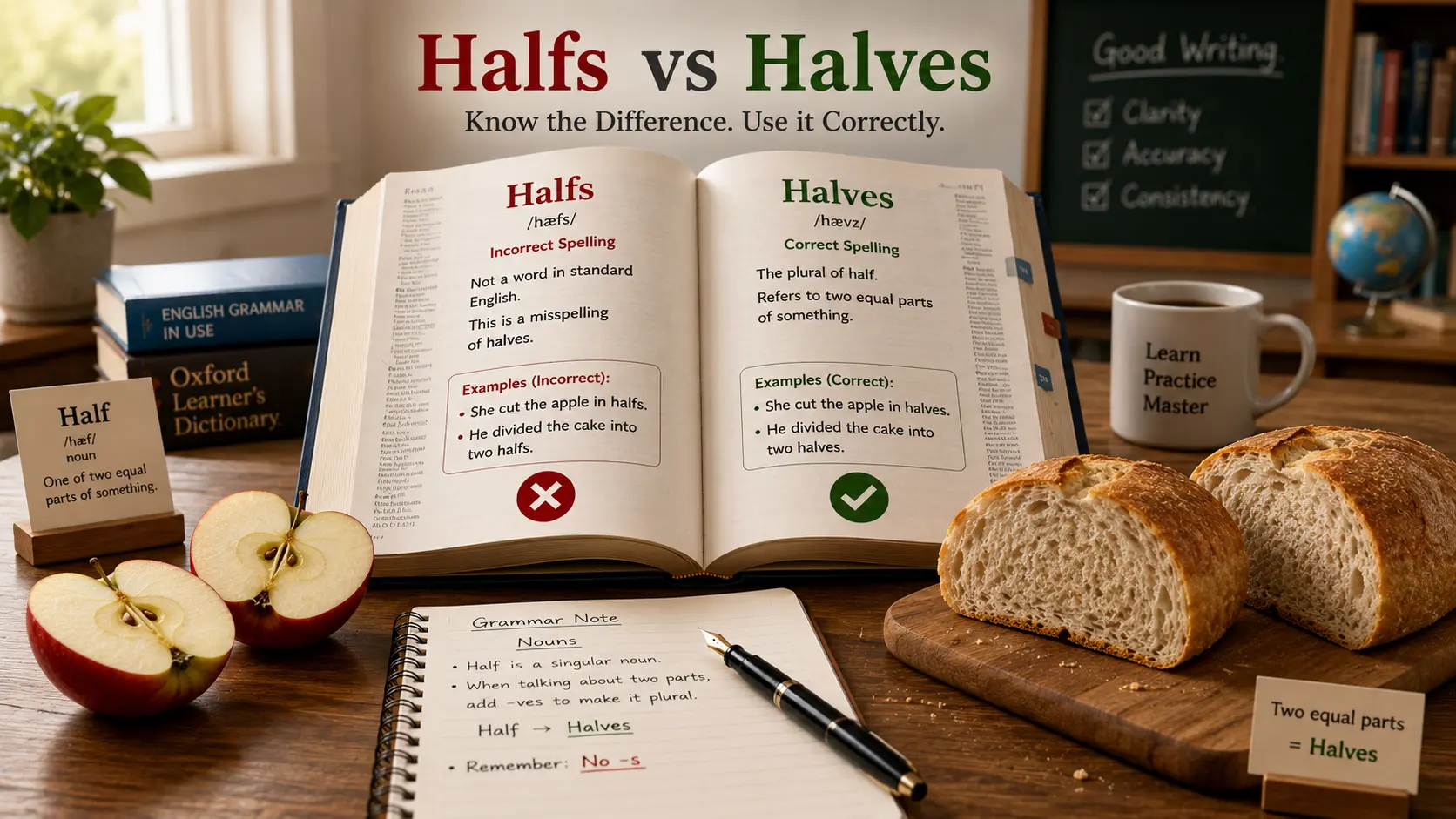
The correct plural form of halfs or halves is halves. It is the accepted English plural of half, while halfs is generally considered incorrect in standard English. Knowing the difference helps you avoid spelling mistakes in academic, professional, and everyday writing.
If you have ever wondered halfs or halves is the correct spelling, you are not alone. Many English learners and even native speakers hesitate when writing the plural form of half. Since English contains many irregular plural nouns, it is easy to assume that adding s creates the correct plural. In this case, however, that assumption leads to a common mistake.
Half is a singular noun that means one of two equal parts of something, while halves is its correct plural form. Understanding this distinction improves your grammar, strengthens your writing, and helps you communicate with confidence in school, the workplace, and digital communication.
English is filled with irregular plural nouns that do not follow the usual pattern of simply adding s. Words such as knife become knives, leaf becomes leaves, and wolf becomes wolves. The word half belongs to this same group, making halves the only standard plural accepted in modern English.
Halfs or Halves | What’s the Difference?
Although both words may appear in online searches, only one is considered correct in standard English.
Half is a singular noun that refers to one of two equal parts.
Halves is the plural noun used when referring to two or more equal parts.
Halfs is generally regarded as a spelling error and should not be used in formal writing, academic papers, business communication, or most everyday situations.
Comparison Table
| Feature | Half | Halves | Halfs |
|---|---|---|---|
| Part of Speech | Singular noun | Plural noun | Nonstandard spelling |
| Meaning | One of two equal parts | More than one equal part | Incorrect attempt at the plural of half |
| Standard English | Yes | Yes | No |
| Correct Grammatical Form | Singular | Plural | Incorrect |
| Accepted by Major Dictionaries | Yes | Yes | No |
| Suitable for Academic Writing | Yes | Yes | No |
| Suitable for Professional Writing | Yes | Yes | No |
| Suitable for Everyday Writing | Yes | Yes | No |
| Example | I ate half of the sandwich. | We shared the sandwich in two halves. | We shared the sandwich in two halfs. ✗ |
| Recommendation | Use when referring to one equal part. | Use when referring to two or more equal parts. | Avoid using this spelling. |
Mini Recap
The confusion comes from expecting every noun to form its plural by adding the letter s. English does not always work that way. Because half ends with the letters f, its plural changes to ves, creating halves. Using the correct form makes your writing more accurate and professional.
Halfs or Halves | Is It a Grammar, Vocabulary or Usage Issue?
The difference between these words is mainly a grammar and usage issue rather than a vocabulary issue.
Grammar determines how nouns change between singular and plural forms. Since half follows an irregular plural pattern, writers need to remember that the spelling changes instead of simply adding the letter s.
From a usage perspective, halves is the accepted choice in formal and informal English. Dictionaries, educational institutions, publishers, and style guides all recognize halves as the standard plural.
Are They Interchangeable?
No.
Although some people mistakenly type halfs, it should not replace halves in correct English. Using the wrong spelling can distract readers and reduce the credibility of your writing.
Formal Versus Informal Usage
| Context | Correct Form | Why? |
|---|---|---|
| Academic Essays | Halves | The standard plural form accepted in academic English. |
| Business Reports | Halves | Professional documents require correct grammar and spelling. |
| News Articles | Halves | Journalistic style guides use the standard plural. |
| Personal Emails | Halves | Ensures clear and grammatically correct communication. |
| Text Messages | Halves | Although informal, halves is still the correct spelling. |
| Social Media Posts | Halves | Using the correct plural improves credibility and readability. |
| Books and Publications | Halves | Editors and publishers follow standard English conventions. |
| Website Content | Halves | Correct grammar enhances professionalism and SEO quality. |
Even in casual conversation, most educated writers prefer halves because it reflects standard English conventions.
Academic Versus Casual Writing
In academic writing, using halves demonstrates proper grammatical knowledge and attention to detail. Teachers, editors, and examiners expect the correct plural form.
In casual writing, some spelling mistakes may be overlooked, but halves remains the preferred and widely accepted choice.
Using Halves Correctly
The word halves refers to two or more equal parts of something. It is commonly used in mathematics, cooking, sports, business, and everyday conversation.
Workplace Example
The manager divided the project into two halves so each team could focus on a different objective.
Academic Example
Students compared the two halves of the experiment before presenting their findings.
Technology Example
The software splits large files into smaller halves before processing them more efficiently.
Everyday Examples
The apple was cut into two halves.
Both halves of the bridge were inspected after the storm.
The coach praised both halves of the team’s performance.
The pizza was shared equally between two halves.
The researchers analyzed both halves of the collected data separately.
Usage Recap
| Remember | Explanation |
|---|---|
| Use halves as the plural of half | It is the correct plural form in all varieties of English. |
| Appropriate for formal writing | Yes. It is accepted in academic, professional, and official documents. |
| Appropriate for casual writing | Yes. It is the standard spelling in everyday communication. |
| Accepted by dictionaries | Yes. Major English dictionaries recognize halves as the correct plural. |
| Recommended by grammar experts | Yes. Style guides and grammar authorities consistently recommend halves. |
| Use in exams and assignments | Yes. It is the only grammatically correct plural form of half. |
Using Halfs Correctly
This section is intentionally short because halfs is not considered correct in standard English.
You should avoid using halfs in nearly every writing situation. It may occasionally appear in informal online discussions, typing mistakes, or very old texts, but it is not the accepted plural form of half.
Writers sometimes create halfs because they apply the regular plural rule by adding the letter s. Unfortunately, this does not work with irregular nouns like half.
Incorrect Examples
We ate two halfs of the sandwich.
The document was divided into three halfs.
Both halfs of the report were reviewed.
Each of these examples should use halves instead.
Corrected Examples
We ate two halves of the sandwich.
The document was divided into two halves.
Both halves of the report were reviewed.
Usage Recap
| Remember | Explanation |
|---|---|
| Use halfs in formal writing | No. It is not accepted in standard English. |
| Accepted by modern dictionaries | No. Major dictionaries recognize halves as the correct plural. |
| Recommended by grammar experts | No. Style guides and language experts advise against using halfs. |
| Replace halfs with halves | Always. Use halves whenever you need the plural form of half. |
| Suitable for academic writing | No. Using halfs may be marked as a spelling or grammar error. |
| Suitable for professional communication | No. Always choose halves in reports, emails, and business documents. |
When You Should NOT Use Halfs or Halves
Choosing the correct word is easier once you understand the role each form plays. The singular noun half refers to one of two equal parts, while halves is the only accepted plural. The word halfs should be avoided because it is not recognized as standard English. The following situations are among the most common sources of confusion.
- Do not use halfs when referring to two equal parts of an object.
- Do not write halfs in academic assignments or examinations.
- Never use halfs in business emails, reports, or presentations.
- Do not assume every noun becomes plural by adding the letter s.
- Do not replace halves with half when talking about more than one part.
- Avoid copying incorrect spellings from social media without checking a dictionary.
- Do not ignore spell check suggestions when writing professionally.
- Never use halfs in published articles, books, or marketing content.
Understanding these situations will help you avoid one of the most common irregular plural mistakes in English.
Common Mistakes and Decision Rules
The easiest way to remember the correct form is to compare common errors with their corrected versions.
| Correct Sentence | Incorrect Sentence | Explanation |
|---|---|---|
| The orange was cut into two halves. | The orange was cut into two halfs. | Halves is the correct plural of half. |
| Both halves of the project were completed. | Both halfs of the project were completed. | Standard English uses halves, not halfs. |
| The teacher compared the two halves of the essay. | The teacher compared the two halfs of the essay. | The plural changes f to ves. |
| We shared the cake in equal halves. | We shared the cake in equal halfs. | Halfs is not accepted in standard English. |
| The game had two exciting halves. | The game had two exciting halfs. | Sports and formal writing always use halves. |
| The report was divided into two halves. | The report was divided into two halfs. | Professional and academic writing requires halves. |
Decision Rule Box
| If You Mean | Use | Reason |
|---|---|---|
| One equal part | Half | Use the singular form when referring to a single part of something. |
| Two or more equal parts | Halves | Use the correct irregular plural form of half. |
| A plural formed by simply adding s | Never use halfs | Halfs is not accepted in standard English and should always be replaced with halves. |
| Formal or academic writing | Half or Halves | Choose the form based on the noun is singular or plural. |
| Professional or business writing | Half or Halves | Always use the standard English forms for clear and accurate communication. |
A simple memory trick is to remember that half belongs to the same family as knife, leaf, and wolf. Their plurals all change from f to ves.
Halfs or Halves in Modern Technology and AI Tools
Modern grammar checkers, search engines, and artificial intelligence writing tools almost always recognize halves as the correct plural. If you type halfs, most spelling checkers immediately recommend changing it to halves.
Large language models, proofreading software, and educational applications are trained on standard English usage. As a result, they consistently treat halves as the accepted spelling for formal writing. Using the correct form also improves readability and helps search engines better understand your content.
Etymology
The word half comes from the Old English word healf, meaning one of two equal parts. Over time, English developed a pattern where many nouns ending in the letter f changed to ves in their plural forms. This historical change gave us words such as halves, knives, wolves, and leaves.
Although English has simplified many spelling rules over the centuries, this irregular plural has remained unchanged, making halves the correct form today.
Expert Insight
Good grammar is not about memorizing countless rules. It is about recognizing patterns that make communication clear and consistent. Irregular plurals such as halves are examples of those patterns and should be learned as complete word forms.
This principle is widely reflected in modern dictionaries, educational style guides, and language teaching resources.
Case Study One | Academic Writing Success
A university writing center reviewed hundreds of first year student essays and found that irregular plural nouns were among the most common spelling mistakes. After introducing a short grammar workshop focused on words such as half, knife, and leaf, students made noticeably fewer spelling errors in later assignments. Their essays also required less editing before submission.
Key Result
Students improved grammatical accuracy by learning common irregular plural patterns instead of memorizing isolated words.
Case Study Two| Professional Content Editing
A digital marketing agency conducted a quality review of client blog posts before publication. Editors discovered several instances of halfs in educational articles. After replacing every incorrect spelling with halves, the articles appeared more polished and required fewer proofreading revisions. Clients also reported increased confidence in the published content because grammatical errors had been removed.
Key Result
Using standard English improved professionalism, reader trust, and overall content quality.
Error Prevention Checklist
| Always | Never |
|---|---|
| Use half for one equal part. | Never write halfs in standard English. |
| Use halves for two or more equal parts. | Never assume every noun forms its plural by simply adding s. |
| Check irregular plurals when proofreading. | Never ignore grammar or spell checker suggestions. |
| Follow dictionary approved spellings. | Never copy incorrect spellings from unreliable sources. |
| Use halves in academic and professional writing. | Never replace halves with half when referring to more than one equal part. |
| Learn common irregular plural patterns. | Never rely solely on pronunciation to determine spelling. |
| Review your writing before publishing. | Never use halfs in essays, reports, or official documents. |
Before submitting any document, quickly scan for irregular plurals. This simple habit can eliminate many common grammar mistakes.
Related Grammar Confusions You Should Master
Learning one irregular plural often makes other grammar topics easier to understand. Consider exploring these commonly confused words and expressions.
- Leaf or Leaves
- Knife or Knives
- Wolf or Wolves
- Life or Lives
- Wife or Wives
- Loaf or Loaves
- Shelf or Shelves
- Calf or Calves
- Thief or Thieves
- Foot or Feet
Mastering these word pairs will strengthen both your writing accuracy and your confidence in English.
FAQs
Is halves the correct plural of half?
Yes. Halves is the standard plural form of half and is accepted in dictionaries, grammar books, and professional writing.
Is halfs a real English word?
No. Halfs is generally considered a spelling mistake and should be replaced with halves in standard English.
Why does half become halves instead of halfs?
English has irregular plural rules for many nouns ending in f. The f changes to ves, just as knife becomes knives.
Can I use halfs in academic writing?
No. Schools, universities, and style guides expect you to use halves because it is the grammatically correct plural.
Do grammar checkers recognize halfs?
Most grammar and spelling tools flag halfs as an error and recommend changing it to halves.
Is halves used in British and American English?
Yes. Both British English and American English use halves as the correct plural of half.
What are some examples of halves in a sentence?
You can say, The apple was cut into two halves or The match consisted of two halves. Both are grammatically correct.
Are there other words that follow the same plural rule as half?
Yes. Words such as knife, leaf, wolf, wife, life, and shelf also change from f to ves in their plural forms.
Conclusion
Understanding halfs or halves is much simpler once you know the rule behind irregular plural nouns. Half is the singular form that refers to one equal part, while halves is the correct plural used whenever you are talking about two or more equal parts. Although halfs may seem logical because many English nouns simply add the letter s, it is not accepted in standard English.
You are writing an essay, preparing a business report, publishing online content, or sending a simple email, choosing halves demonstrates strong grammar and careful attention to detail. By recognizing common irregular plural patterns and practicing them regularly, you can avoid mistakes and write with greater clarity and confidence.
Discover More Related Articles:
- Starring or Staring | Why This Common Mistake Keeps Happening In 2026
- Send or Sent | The English Rule Made Surprisingly Easy In 2026
- Que or Queue | Why So Many People Get This Wrong In 2026