
Behaviour or behavior refers to the same concept, but the spelling depends mainly on the variety of English being used. “Behaviour” is the standard British spelling, while “behavior” is the standard American spelling. Neither is incorrect, but choosing the appropriate form matters in formal writing, education, publishing, business communication, and international contexts.D
Have you ever wondered behavior or behaviour is the correct spelling? You are not alone. The difference can be confusing because both forms are correct, but they belong to different varieties of English. Behavior is the standard spelling in American English, while behaviour is preferred in British English and is widely used in countries such as Australia. This is why searches for behaviour or behavior Australia and behavior or behaviour in Australia often appear when writers are unsure which form to choose.
The same pattern applies to behavioral or behavioural, with the spelling depending on the variety of English being used. The plural forms can also raise questions, such as behaviours or behaviors and behaviour or behaviours. In this guide, we explain each form clearly, with practical examples and reliable language guidance, so you can choose the right spelling confidently.
Behaviour vs Behavior| What’s the Difference?
Both behaviour and behavior are nouns. They refer to the way someone or something acts, responds, or conducts itself.
Behaviour is the preferred spelling in British English and is also widely used in Australian, New Zealand, and other varieties influenced by British English.
Behavior is the preferred spelling in American English.
The pronunciation and meaning are essentially identical. The only significant difference is the spelling.
| Feature | Behaviour | Behavior |
|---|---|---|
| Part of speech | Noun | Noun |
| Meaning | The way a person or thing acts | The way a person or thing acts |
| Primary variety | British English | American English |
| Common related forms | Behavioural, behaviourally | Behavioral, behaviorally |
| Formal usage | Standard in British style | Standard in American style |
| Example | His behaviour was professional. | His behavior was professional. |
Quick recap
Behaviour is the British spelling.
Behavior is the American spelling.
Both have the same meaning and grammatical function.
The correct choice depends on the English variety and style guide you are following.
Is Behaviour vs Behavior a Grammar, Vocabulary, or Usage Issue?
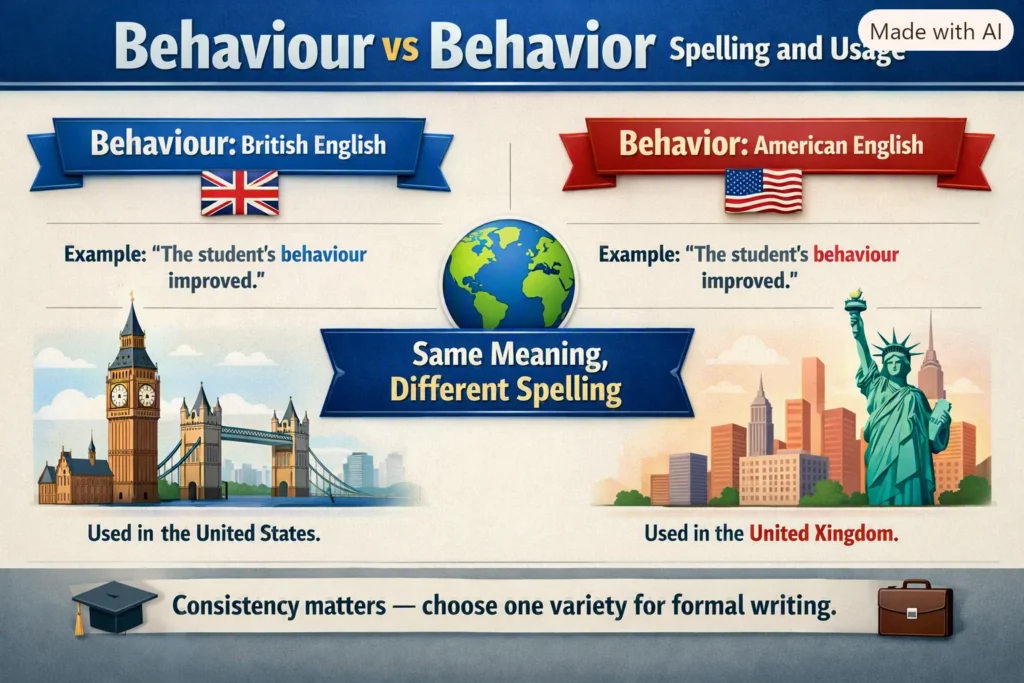
This is primarily a spelling and usage issue, not a difference in grammar or vocabulary.
The two words are interchangeable when the only concern is meaning. A British writer can say, “The student’s behaviour improved,” while an American writer can say, “The student’s behavior improved.” Both sentences communicate the same idea.
The important point is consistency. If an article is written in American English, using “behavior” throughout is usually preferable. If the article follows British English, “behaviour” should normally be used.
Formal and academic writing make consistency particularly important. A university department in the United Kingdom may expect British spelling, while an American university may follow an American style guide.
Casual communication is more flexible. Readers will generally understand either spelling, but the spelling can still signal the writer’s preferred variety of English.
For businesses operating internationally, the decision may depend on the intended audience. A company targeting readers in the United States may choose “behavior,” while a British organization may naturally use “behaviour.”
When to Use Behaviour
Use behaviour when your writing follows British English conventions.
This spelling is especially appropriate for British schools, universities, government organizations, publishers, newspapers, and businesses that use British English.
Workplace example
The manager praised her professional behaviour during the client meeting.
Here, “behaviour” is appropriate when the organization uses British English. The word describes how the employee acted during the meeting.
Academic example
Researchers examined children’s behaviour in different classroom environments.
Academic institutions that follow British English will normally prefer “behaviour.”
Technology example
The application monitors unusual user behaviour to identify potential security threats.
Technology companies using British English commonly retain the British spelling across interface documentation, reports, and technical articles.
Usage recap
Choose behaviour when writing for a British English audience.
It is also common in Australian and New Zealand English.
The spelling does not change the meaning or pronunciation.
When to Use Behavior
Use behavior when your writing follows American English conventions.
This form is extremely common in American education, psychology, business, technology, journalism, and everyday communication.
Workplace example
The supervisor discussed the employee’s behavior with the team.
The American spelling fits a document written according to American English conventions.
Academic example
The study investigated student behavior during online classes.
American academic publications generally use “behavior.”
Technology example
The software uses machine learning to identify unusual user behavior.
American technology companies and software documentation typically use “behavior” rather than “behaviour.”
Usage recap
Choose behavior when your audience uses American English.
It is the standard American spelling in formal and informal writing.
Use it consistently with other American spellings throughout the same document.
When You Should NOT Use Behaviour or Behavior
There are several situations in which choosing one spelling simply because it looks familiar can create inconsistency.
1. Do not mix regional spellings randomly
Avoid writing “customer behaviour” in one paragraph and “customer behavior” in another unless you are deliberately discussing different regional forms.
2. Do not change the spelling inside a quotation
If an American source says “behavior,” retain its original spelling when quoting it in a British English article unless your editorial policy specifically permits changes.
3. Do not choose based only on search volume
Search engines can understand both forms. Audience, regional style, and editorial consistency are more important than choosing a spelling simply because it appears more frequently.
4. Do not assume one spelling is more correct
“Behaviour” is not more correct than “behavior,” and “behavior” is not more correct than “behaviour.” They belong to different standard varieties of English.
5. Do not mix style guides
A document should normally follow one primary style. Switching between British and American conventions can make the content appear poorly edited.
6. Do not use the wrong regional form in official documents
If a university, employer, publisher, or government organization specifies British English, follow that preference.
7. Do not alter established product terminology without checking
Software products, academic papers, and technical systems may use a particular spelling consistently. Changing it can create terminology inconsistencies.
8. Do not confuse spelling with meaning
The difference between the two forms is not semantic. Both refer to actions, responses, or ways of conducting oneself.
Common Mistakes and Decision Rules
The most common mistake is treating the two spellings as separate words with different meanings.
| Correct sentence | Incorrect sentence | Explanation |
|---|---|---|
| Her behaviour was respectful. | Her behavior was respectful in a British English document. | British English normally uses behaviour. |
| His behavior changed after training. | His behaviour changed in an American English document. | American English normally uses behavior. |
| The study examines student behaviour. | The study switches between behaviour and behavior. | Academic writing should maintain consistent spelling. |
| The software tracks user behavior. | The software documentation randomly alternates between both forms. | Technical terminology should remain consistent. |
Decision Rule
If you are writing in British English, use “behaviour.”
If you are writing in American English, use “behavior.”
The simplest decision is to identify your audience first. Once you choose a regional variety, apply that spelling consistently throughout the article, report, website, or document.
Behaviour and Behavior in Modern Technology and AI Tools
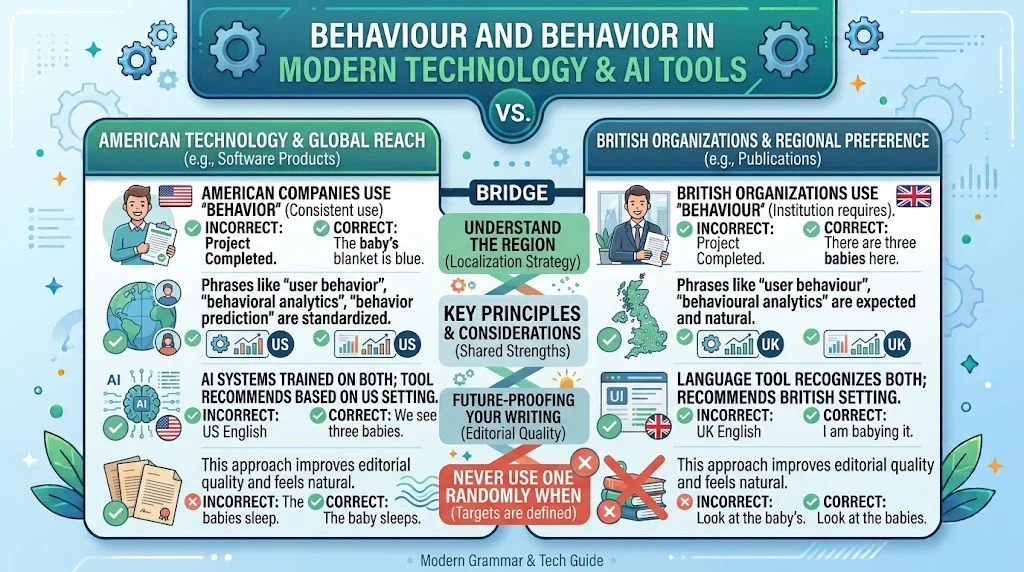
The distinction is particularly interesting in technology because software products are used internationally.
American technology companies often use behavior in phrases such as “user behavior,” “behavioral analytics,” and “behavior prediction.” British organizations may use “behaviour,” producing expressions such as “user behaviour” and “behavioural analytics.”
AI systems also encounter both forms because their training data can contain multiple varieties of English. A modern language tool may recognize both spellings as correct while still recommending one according to the selected regional setting.
For content creators, this means that spelling should be treated as part of a broader localization strategy. A website aimed at American readers should normally use American English consistently. A British audience should generally receive British English.
This approach also improves editorial quality. When terminology, punctuation, spelling, and vocabulary all follow the same regional convention, the content feels more natural to its intended audience.
Etymology: Why Do the Spellings Differ?
The word ultimately comes from Latin behavere, meaning to conduct or carry oneself, and entered English through French influence.
The British spelling developed with the our ending found in several English words influenced by French spelling traditions. American English later adopted many spelling simplifications associated with American language reform, including the replacement of our with or in words such as “color,” “honor,” “favor,” and “behavior.”
The pattern is therefore not unique to this word. Compare:
| British English | American English |
|---|---|
| behaviour | behavior |
| colour | color |
| honour | honor |
| favour | favor |
| labour | labor |
Expert style note
“Good spelling is not only about correctness. It is also about consistency, audience, and context.”
The practical lesson is simple: professional writing should make deliberate spelling choices rather than switching between regional conventions without a reason.
Two Practical Case Studies
Case Study 1: A British Academic Paper
Imagine a university student in England writing a research paper about classroom conduct. The student uses British English throughout the paper and writes “student behaviour,” “behavioural patterns,” and “changes in behaviour.”
The concrete result is stylistic consistency. The spelling aligns with the expected regional convention, and the related forms follow the same pattern.
If the student instead alternated randomly between “behaviour” and “behavior,” the meaning would remain understandable, but the paper could appear insufficiently edited.
Case Study 2: An American Technology Website
Consider an American software company publishing an article about customer analytics. Its headings use phrases such as “Understanding User Behavior” and “Predicting Customer Behavior.”
The concrete result is consistent American terminology across the page. If the company suddenly inserted “user behaviour” in one section, the meaning would not change, but the editorial voice would become inconsistent.
These examples demonstrate why spelling decisions matter even when readers understand both forms.
Error Prevention Checklist
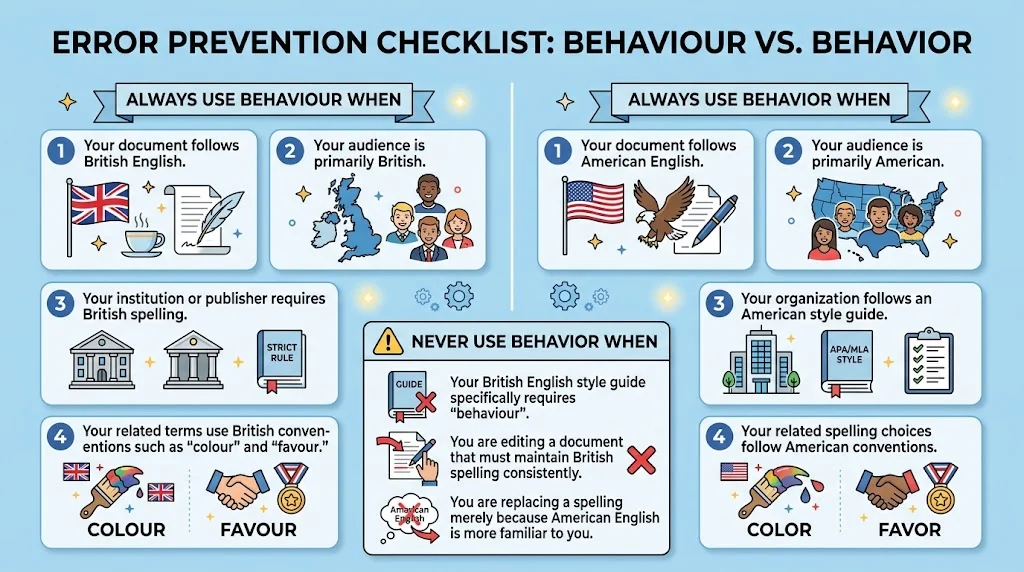
Always use Behaviour when
- Your document follows British English.
- Your audience is primarily British.
- Your institution or publisher requires British spelling.
- Your related terms use British conventions such as “colour” and “favour.”
Never use Behavior when
- Your British English style guide specifically requires “behaviour.”
- You are editing a document that must maintain British spelling consistently.
- You are replacing a spelling merely because American English is more familiar to you.
Always use Behavior when
- Your document follows American English.
- Your audience is primarily American.
- Your organization follows an American style guide.
- Your related spelling choices follow American conventions.
Related Grammar Confusions You Should Master
Understanding regional spelling is only one part of becoming a stronger English writer. Several other commonly confused forms deserve attention.
- Colour or color: British versus American spelling.
- Honour or honor: Another common British and American spelling distinction.
- Favourite or favorite: Regional spelling difference involving the same pattern.
- Licence or license: A particularly important British English distinction involving noun and verb usage.
- Practice or practise: A common distinction in British English that can depend on grammatical function.
- Centre or center: British and American spelling variants.
- Realise or realize: A spelling difference found across English varieties and style guides.
- Travelling or traveling: Different conventions for doubling the final consonant.
- Organisation or organization: A common regional and style based spelling difference.
- Programme or program: Different conventions that also depend on context.
Learning these patterns helps writers make regional spelling choices confidently rather than memorizing individual words in isolation.
FAQs
Is behaviour or behavior correct?
Both are correct. “Behaviour” is standard British English, while “behavior” is standard American English.
Which is British, behaviour or behavior?
“Behaviour” is the standard British spelling and is also widely used in Australian and New Zealand English.
Which is American, behaviour or behavior?
“Behavior” is the standard American English spelling.
Do behaviour and behavior have different meanings?
No. Both words have the same meaning and function as nouns describing how someone or something acts.
Should I use behaviour or behavior in academic writing?
Use the spelling required by your institution, publisher, or selected English variety, then apply it consistently.
Is behaviour more formal than behavior?
No. Neither spelling is inherently more formal. The difference is mainly regional.
Why does British English use behaviour?
The British form preserves the traditional “our” spelling pattern, while American English commonly uses the simplified “or” form.
Does Google understand both behaviour and behavior?
Yes. Search engines generally understand that the two spellings represent the same word, although regional relevance can influence results.
Which spelling should an international website use?
Choose the variety that matches your primary audience and maintain that spelling consistently across the website.
Conclusion
The choice between behaviour or behavior is straightforward once you identify your intended English variety. British English uses behaviour, while American English uses behavior. Both forms are grammatically correct, have the same meaning, and can be used in formal writing.
The most important rule is consistency. Decide your audience expects British or American English, follow the appropriate spelling throughout your content, and avoid switching between regional conventions without a clear reason.
For writers, editors, students, businesses, and website owners, this small spelling distinction is an easy opportunity to make content look more polished and professionally localized.
Discover More Related Articles:
- Dumby or Dummy | Which Form Belongs in Your Sentence In 2026
- Tomato or Tomatoe | Everything You Need to Know In 2026
- Cord or Chord | Meaning, Spelling, Usage & Easy Ways to Remember In 2026