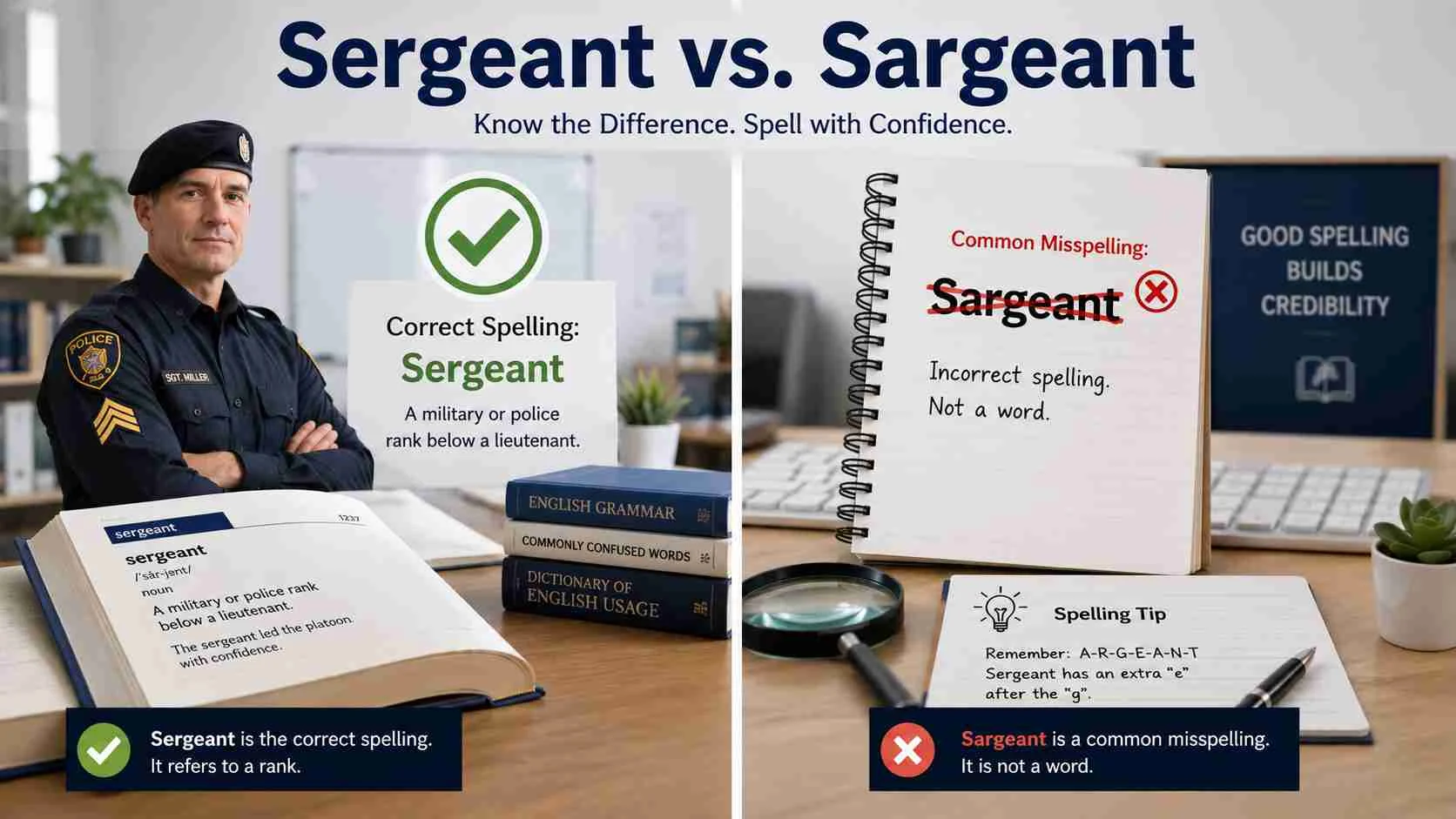
Sergeant or sargeant is a common spelling question, but only sergeant is correct in standard English. It refers to a military or police rank and appears in formal writing, official documents, and dictionaries. Sargeant is generally a misspelling, although it may exist as a family surname.
If you’ve ever searched for sergeant or sargeant, you’re not alone. Many English speakers pause when writing this word because its pronunciation does not perfectly match its spelling. While sergeant is the correct spelling recognized in modern English, sargeant is considered a spelling error in nearly every writing context. This confusion can lead to mistakes in school assignments, workplace communication, military references, professional documents, and even online content.
Understanding the difference is important because spelling affects credibility. You are writing about the armed forces, law enforcement, video games, historical topics, or fictional characters, using the correct spelling helps your writing appear accurate and trustworthy. In this guide, you’ll learn why the confusion exists, how to remember the correct spelling, and when each form should or should not be used.
Sergeant vs Sargeant | What’s the Difference?
At first glance, the two spellings seem almost identical. The only visible difference is the placement of the letters e and a, yet that small change completely affects correctness.
Sergeant is the accepted English spelling used worldwide in military organizations, police departments, official publications, dictionaries, educational materials, and professional writing.
Sargeant is not a standard English word. It is almost always an accidental misspelling caused by the way the word is pronounced. In rare situations, Sargeant may appear as a person’s surname, but that does not make it an alternative spelling of the military or police rank.
Comparison Table
| Feature | Sergeant | Sargeant |
|---|---|---|
| Correct English spelling | Yes | No |
| Part of speech | Noun | Misspelling in most contexts |
| Dictionary recognized | Yes | No, except as a surname |
| Used in military | Yes | No |
| Used in police ranks | Yes | No |
| Appropriate for academic writing | Yes | No |
| Appropriate for business writing | Yes | No |
| Recommended in formal English | Yes | No |
Quick Recap
Although the two spellings look similar, only one belongs in standard English. Sergeant is the correct spelling used in every professional and educational setting. Sargeant should generally be treated as a spelling mistake unless it is part of someone’s legal family name. Remembering this distinction will help you avoid one of the most common spelling errors involving military and police terminology.
Is Sergeant or Sargeant a Grammar, Vocabulary or Usage Issue?
This question is primarily a spelling and vocabulary issue, not a grammar issue.
Grammar deals with how words work together in sentences. In contrast, the confusion between sergeant and sargeant comes from choosing the correct spelling of a single word.
Since only sergeant is accepted in standard English, the two forms are not interchangeable. Replacing the correct spelling with sargeant creates a spelling mistake rather than a grammatical variation.
In formal writing such as academic essays, research papers, legal documents, business reports, military records, and official correspondence, only sergeant should be used.
In casual writing, some people accidentally type sargeant because it seems to match the pronunciation more closely. However, spell checkers, grammar checkers, and editors typically identify it as an error.
The safest approach is simple. Whenever you are referring to a military rank, police rank, or any official title, always write sergeant.
What Does Sergeant Mean?
A sergeant is a noun that refers to a rank in the military or law enforcement. The exact responsibilities vary depending on the organization, but a sergeant generally supervises personnel, maintains discipline, coordinates daily operations, and serves as a leader within a unit or department.
The word has been part of the English language for centuries and remains one of the most recognized military and police titles around the world.
In many armed forces, a sergeant acts as the bridge between commissioned officers and enlisted personnel. In police departments, a sergeant often supervises patrol officers, assigns duties, reviews reports, and responds to major incidents.
Because it is an official title, the spelling should always remain consistent in professional communication.
Workplace Examples
The sergeant reviewed the team’s operational report before approving the schedule.
Everyone waited for the sergeant to begin the morning briefing.
The training manager consulted the police sergeant before updating safety procedures.
Academic Examples
The history professor explained the responsibilities of a sergeant during the First World War.
Students researched how a sergeant contributes to military leadership.
The textbook included several examples describing the duties of a police sergeant.
Technology Examples
The video game allows players to earn the rank of sergeant after completing several missions.
The military simulation software accurately displays the responsibilities of a sergeant within the command structure.
The educational app teaches learners about military ranks, including sergeant, through interactive quizzes.
Usage Recap
Whenever you are referring to a military rank, a police supervisor, or an official title, sergeant is always the correct spelling. It is appropriate for formal writing, academic work, workplace communication, digital content, and everyday English. Using any other spelling may reduce the credibility and accuracy of your writing.
Why Do So Many People Spell It as Sargeant?
One reason this mistake is so common is that English spelling does not always reflect pronunciation. Most people pronounce sergeant in a way that sounds similar to “sarjent.” Because of that, many writers naturally assume the spelling should include the letters a followed by e, producing sargeant.
Another reason is simple typing habits. The brain often predicts spellings based on sound rather than memorized word forms. Since many English words follow more predictable spelling patterns, it is easy to apply the wrong pattern here.
Autocorrect tools have reduced this error, but it still appears frequently in emails, online discussions, social media posts, and search engine queries. This is exactly why the keyword sergeant or sargeant remains a popular search term. People want confirmation before using the word in an important document or conversation.
A helpful memory trick is to remember that dictionaries, military manuals, police departments, and official organizations all use the spelling sergeant. If you are writing about the rank, that is the spelling you should always choose.
Is Sargeant Ever Correct?
This is one of the most frequently asked questions about this spelling confusion, and the answer is straightforward.
In standard English, sargeant is not a correct spelling of the military or police rank. Every major dictionary, style guide, educational resource, and official organization uses sergeant instead.
There is, however, one important exception. Sargeant can be a surname. Some individuals, families, businesses, and organizations legally use Sargeant as a last name. In those cases, the spelling should never be changed because it identifies a specific person or entity.
For example:
- Correct: Officer Emily Sargeant received the community service award. (Surname)
- Incorrect: My brother was promoted to Sargeant last week. (Should be sergeant)
The key is understanding the context. If the word refers to a person’s official rank, use sergeant. If it appears as part of someone’s legal name, keep the original spelling.
Quick Recap
In almost every writing situation, sergeant is the correct choice. The only common exception is when Sargeant is someone’s surname. Never replace a person’s legal name with a different spelling, but always use sergeant when referring to the rank.
When You Should NOT Use Sergeant or Sargeant
Knowing when not to use these spellings can prevent embarrassing mistakes in professional and academic writing.
Do not use sargeant when referring to a military rank in essays, reports, resumes, or official documents.
Do not write sargeant in police reports, training manuals, or workplace communications.
Do not assume sargeant is an accepted British English variant. It is not.
Do not rely on pronunciation to determine spelling. English often contains words whose spelling differs from their spoken form.
Do not correct someone’s surname from Sargeant to Sergeant. Family names should always remain exactly as they are legally written.
Do not abbreviate the rank unless the style guide or organization specifically allows it.
Do not assume online forums or social media posts use the correct spelling. User generated content often contains spelling mistakes.
Do not ignore spell checker warnings when writing formal documents. Most modern writing tools correctly identify sargeant as an error.
Common Mistakes and How to Fix Them
| Correct Sentence | Incorrect Sentence | Explanation |
|---|---|---|
| My brother was promoted to sergeant. | My brother was promoted to sargeant. | Only sergeant is the correct rank. |
| The police sergeant interviewed the witness. | The police sargeant interviewed the witness. | Official titles require the standard spelling. |
| She hopes to become a sergeant next year. | She hopes to become a sargeant next year. | Promotion titles always use sergeant. |
| Officer Sargeant spoke at the event. | Officer Sergeant spoke at the event. | If it is the person’s surname, keep the legal spelling. |
| The history book describes a medieval sergeant. | The history book describes a medieval sargeant. | Historical references also use sergeant. |
| The game unlocks the rank of sergeant. | The game unlocks the rank of sargeant. | Games generally follow official military terminology. |
Decision Rule Box
If you mean the military or police rank, use sergeant.
If the word is someone’s legal surname, keep the spelling exactly as written, even if it is Sargeant.
If you are unsure, check you are referring to a title or a person’s name.
Sergeant and Sargeant in Modern Technology and AI Tools
Modern technology has made spelling mistakes easier to detect than ever before.
Most AI writing assistants, grammar checkers, and spell checking software automatically recognize sergeant as the correct spelling and suggest replacing sargeant unless it appears as a proper name.
Search engines also understand that many users accidentally type sargeant when searching for military information. As a result, they usually return results for sergeant while quietly correcting the query in the background.
Voice typing applications may occasionally introduce the wrong spelling because they interpret pronunciation rather than intended meaning. For that reason, it is always worth proofreading documents before submitting them.
You use AI writing tools, office software, or online editors, reviewing official titles manually remains a good habit.
Where Does the Word Sergeant Come From?
The history of sergeant helps explain why its spelling seems unusual today.
The word entered English through Old French, where sergent referred to a servant, attendant, or officer. It ultimately traces back to the Latin word serviens, meaning one who serves.
Over hundreds of years, pronunciation changed while much of the original spelling remained. This is one reason English learners often expect the word to be spelled differently from the way it sounds.
Although English spelling has evolved, sergeant has remained the accepted form in dictionaries, military organizations, and government publications.
Understanding this history makes the unusual spelling easier to remember.
Expert Insight
Accurate spelling is more than a matter of correctness. It signals professionalism, strengthens credibility, and helps readers trust the information they are reading.
This principle is especially important when writing about official titles, ranks, legal documents, and historical subjects, where even a small spelling mistake can reduce the perceived quality of the content.
Case Study 1 | Improving Professional Communication
A regional security company reviewed more than 300 employee training documents before publishing a new operations handbook.
Editors discovered that the word sargeant appeared repeatedly throughout older materials because different authors had copied previous documents without checking the spelling.
After correcting every instance to sergeant, the handbook became consistent with official law enforcement terminology. The organization also reported fewer employee questions about rank titles during onboarding because the documentation matched national training standards.
This example shows how a single spelling correction can improve clarity, professionalism, and reader confidence.
Case Study 2 | Better SEO Performance for Educational Content
An educational language website published an article answering the question “Sergeant or Sargeant: Which Spelling Is Correct?”
Instead of treating the two spellings as equal alternatives, the article clearly explained that sergeant is the accepted spelling while sargeant is usually a misspelling.
The page also included practical examples, comparison tables, FAQs, and search focused headings. Within several months, it attracted steady organic traffic from users searching for the spelling difference and achieved significantly higher engagement because readers found a direct, trustworthy answer without unnecessary complexity.
The lesson is clear. Addressing the user’s real question with accurate information often performs better than creating artificial distinctions that do not exist.
Error Prevention Checklist
Before using the word in your writing, ask yourself these questions.
Always Use Sergeant When
✔ You are referring to a military rank.
✔ You are referring to a police supervisor.
✔ You are writing an academic paper.
✔ You are creating workplace documents.
✔ You are writing news articles or historical content.
✔ You are following dictionary or style guide recommendations.
Never Use Sargeant When
✔ You mean the military or police rank.
✔ You are writing professional emails.
✔ You are completing school assignments.
✔ You are preparing official reports.
✔ You are creating educational content.
✔ You assume it is an accepted spelling variation.
The only exception is when Sargeant is a person’s legal surname.
FAQs
Is sergeant or sargeant the correct spelling?
The correct spelling is sergeant. It is the only spelling recognized by major English dictionaries and is used by military organizations, police departments, educational institutions, and government agencies. Sargeant is generally considered a misspelling unless it is part of someone’s legal surname.
Why do so many people spell sergeant as sargeant?
The confusion comes from pronunciation. Many people pronounce sergeant in a way that sounds similar to “sarjent,” leading them to assume the word should be spelled sargeant.
Is sargeant ever a correct English word?
In standard English vocabulary, sargeant is not a correct spelling for the military or police rank. However, it can be correct when it is a person’s surname or the official name of a business or organization. In those situations, the original spelling should always be preserved.
Do British English and American English spell sergeant differently?
No. Both British English and American English use the spelling sergeant. There is no regional variation that accepts sargeant as an alternative spelling for the rank.
Can I use sargeant in academic or professional writing?
No. Academic papers, business documents, resumes, official reports, and professional correspondence should always use sergeant when referring to the rank.
How can I remember the correct spelling of sergeant?
A simple way to remember it is to think of official organizations. Military manuals, police departments, dictionaries, and educational institutions all use sergeant.
Does spell check correct sargeant automatically?
Most modern spell checkers, grammar tools, and AI writing assistants recognize sargeant as a misspelling and recommend sergeant instead.
Why does Google show results for sargeant if it is incorrect?
Search engines recognize that many users accidentally search for sargeant. Instead of ignoring the query, they usually display results explaining that sergeant is the correct spelling.
Is sergeant always a noun?
Yes. In modern English, sergeant is primarily used as a noun referring to a military or police rank. It functions as an official title and should always be spelled correctly in formal writing.
Can AI writing tools distinguish between sergeant and sargeant?
Most reputable AI writing assistants and grammar checking tools correctly identify sergeant as the standard English spelling. They typically suggest replacing sargeant unless it appears as a person’s legal surname or proper name.
Conclusion
If you have ever wondered about sergeant or sargeant, the answer is simple. Sergeant is the only correct spelling for the military or police rank in modern English. It is recognized by dictionaries, style guides, educational institutions, and official organizations around the world.
Although sargeant often appears because of pronunciation or typing errors, it should not be used when referring to the rank. The only notable exception is when Sargeant is someone’s legal surname. Understanding this distinction helps you write with greater confidence, accuracy, and professionalism.
You are preparing an academic assignment, writing workplace documents, creating online content, or simply improving your English, choosing sergeant ensures your writing is clear, credible, and consistent with standard English usage. Remember this simple rule: if you are referring to the rank, always write sergeant.
Discover More Related Articles:
- Edward or Jacob | Who Was the Better Choice in Twilight In 2026
- Fair vs Fare | Which One Is Correct in Your Sentence In 2026
- Staring or Starring | Don’t Confuse These Common English Words In 2026