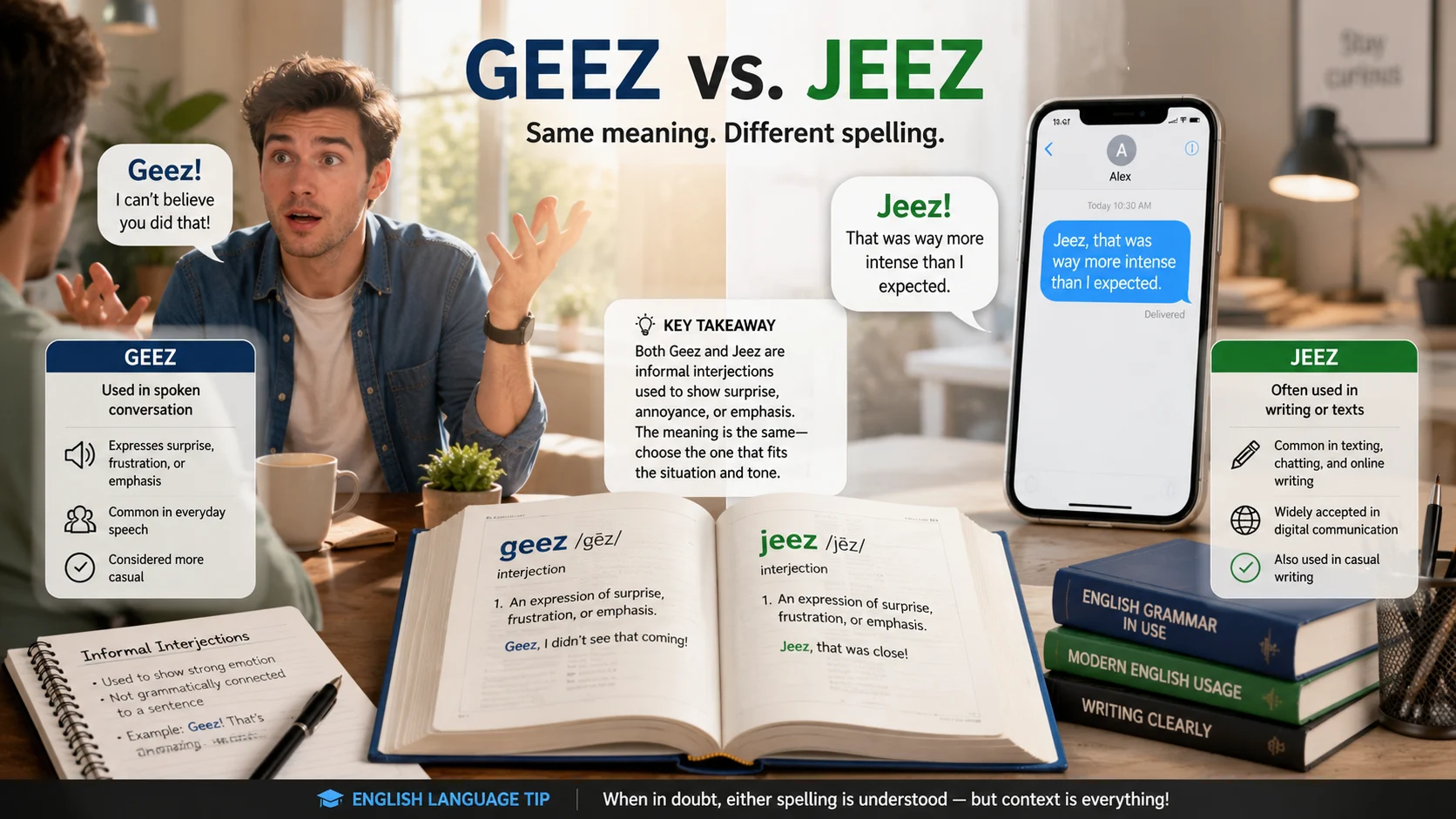
Geez or jeez can both appear as exclamations in English, but they are not identical in meaning or origin. Geez is often considered a mild substitute for the name Jesus and is commonly used to express surprise, frustration, or annoyance. Jeez is a modern spelling variation that represents the same spoken expression and is more common in informal writing.
Many English learners and even native speakers wonder about geez or jeez because the words sound exactly alike but appear with different spellings in books, online conversations, and social media.
This confusion can lead to inconsistent writing, especially when choosing the right form for casual or professional communication. Although both words function as interjections, understanding their history, tone, and preferred usage helps you write more naturally and avoid unnecessary mistakes.
You are writing a text message, creating social media content, or working on creative dialogue, knowing when each spelling is appropriate can improve both clarity and style. This guide explains the differences, practical usage, common mistakes, and the situations where one spelling may be a better choice than the other.
Geez vs Jeez | What Is the Difference?
Both Geez and Jeez are interjections. An interjection is a word or phrase used to express emotion rather than provide grammatical information. These expressions often communicate surprise, disappointment, frustration, excitement, or disbelief.
Although they sound identical, the two spellings have slightly different histories and usage patterns.
| Feature | Geez | Jeez |
|---|---|---|
| Part of speech | Interjection | Interjection |
| Pronunciation | Jeez | Jeez |
| Primary meaning | Mild expression of surprise or frustration | Mild expression of surprise or frustration |
| Origin | Euphemistic form related to Jesus | Modern spelling variation of Geez |
| Tone | Informal | Informal |
| Common in conversation | Yes | Yes |
| Common in digital writing | Less common | More common |
| Suitable for formal writing | No | No |
Mini Recap
Both spellings communicate the same emotion in everyday English.
The pronunciation does not change with the spelling.
Jeez appears more frequently in modern digital communication, while Geez has stronger historical roots.
Neither spelling is appropriate in formal academic or business writing.
Is Geez vs Jeez a Grammar, Vocabulary or Usage Issue?
The difference between Geez and Jeez is primarily a usage issue rather than a grammar issue. English grammar rules do not require one spelling over the other because both function as interjections instead of nouns, verbs, or adjectives.
From a vocabulary perspective, the words share the same meaning. The distinction comes from convention and style rather than definition.
In formal settings such as academic papers, research articles, business reports, and official correspondence, it is generally better to avoid both expressions because they are conversational and emotional.
In casual communication, either spelling is understandable. However, many modern publishers, entertainment websites, and social media users prefer Jeez, while Geez remains common in dictionaries and older publications.
The key point is consistency. Once you choose one spelling in a piece of writing, it is usually best to use that spelling throughout.
Using Geez Correctly
Geez has been used for many decades as a softened alternative to directly saying Jesus in moments of surprise or frustration. Because of this history, some style guides and dictionaries list Geez as the traditional spelling.
It is commonly heard in spoken English and appears in novels, dialogue, comics, and informal writing.
Workplace Example
“Geez, I did not realize the meeting started thirty minutes earlier.”
This sentence expresses surprise without sounding overly harsh, although it would still be too informal for an official business report.
Academic Example
A student might say,
“Geez, that physics exam was much harder than I expected.”
The expression is natural in conversation with classmates but should not appear in an academic essay.
Technology Example
While testing new software, someone might comment,
“Geez, this application takes forever to load.”
This conversational reaction is common in chats between coworkers or online discussion forums.
Additional Examples
“Geez, that was close.”
“Geez, I completely forgot your birthday.”
“Geez, I cannot believe we finished the project already.”
“Geez, that movie had an unexpected ending.”
Usage Recap
Geez works well in relaxed conversation, fictional dialogue, personal messages, and informal online discussions. Avoid it whenever your writing requires professionalism or neutrality.
Using Jeez Correctly
Jeez represents the same spoken expression but has become especially popular in modern informal writing. Many people naturally choose this spelling because it visually matches its pronunciation.
You will frequently see Jeez in text messages, online comments, blogs, entertainment articles, and social media posts.
Workplace Example
During an informal team chat, someone may write,
“Jeez, the server is still updating.”
This is acceptable in casual workplace messaging between familiar colleagues but should not appear in official documentation.
Academic Example
After leaving class, a student may tell friends,
“Jeez, that lecture covered a lot of material.”
Again, this belongs in conversation rather than academic writing.
Technology Example
Someone troubleshooting a computer issue might post,
“Jeez, this update created even more problems.”
This sounds natural in online technology communities where conversational language is common.
Additional Examples
“Jeez, that scared me.”
“Jeez, I almost missed my train.”
“Jeez, that game was intense.”
“Jeez, you finished already.”
Usage Recap
Jeez is widely accepted in modern informal communication, especially online. It reflects current conversational spelling and is often the preferred form in digital media, but it remains unsuitable for formal writing.
When You Should NOT Use Geez or Jeez
Although both expressions are widely understood, there are many situations where they are not the right choice. Since they are informal interjections, using them in professional or academic contexts can make your writing appear less polished.
| Situation | Why You Should Avoid Them | Better Alternative |
|---|---|---|
| Academic essays | They sound too conversational | Surprisingly, Remarkably |
| Research papers | They reduce academic tone | It is noteworthy that |
| Business emails | They may appear unprofessional | I was surprised to learn |
| Legal documents | Emotional language is inappropriate | Use precise factual wording |
| Official reports | Informal expressions weaken credibility | Use neutral language |
| Customer service responses | They may sound overly casual | I understand your concern |
| News articles | Journalistic writing requires objectivity | Describe the event directly |
| Professional presentations | Casual exclamations can distract the audience | Use formal transitions |
In everyday conversations, these words feel natural because they express genuine emotion. In formal writing, however, readers expect clear and objective language rather than emotional reactions.
Common Mistakes and Decision Rules
The most common mistake is believing that one spelling is grammatically correct while the other is incorrect. In reality, both are accepted spellings of the same informal exclamation. The better choice depends on consistency, audience, and writing style.
| Correct Sentence | Incorrect Sentence | Explanation |
|---|---|---|
| Jeez, I almost forgot my wallet. | Jeez is a formal English word. | It is an informal interjection only. |
| Geez, that surprised everyone. | Geez should appear in academic writing. | Academic writing should avoid conversational interjections. |
| Pick one spelling and stay consistent. | Switch between Geez and Jeez randomly. | Consistency improves readability. |
| Both spellings express emotion. | Geez and Jeez have completely different meanings. | Their meanings are essentially the same. |
| Use either spelling in casual dialogue. | Use either spelling in legal documents. | Formal documents require neutral language. |
| Jeez, that took a long time. | Jeez functions as a verb. | It is an interjection, not a verb. |
Decision Rule Box
| If your intention is | Use |
|---|---|
| Express surprise in casual writing | Geez or Jeez |
| Express frustration informally | Geez or Jeez |
| Write dialogue in fiction | Either spelling consistently |
| Write text messages or social media posts | Jeez is often more common |
| Write academic or professional documents | Neither expression |
| Maintain a formal tone | Replace both with neutral wording |
Unlike many English word pairs, this comparison is not about choosing between an action and a person or tool. Instead, the decision depends on the level of formality and the spelling style you want to maintain.
Geez and Jeez in Modern Technology and AI Tools
Digital communication has influenced the popularity of these spellings. Text messaging, online gaming, social media platforms, and discussion forums frequently use Jeez because many writers believe it reflects pronunciation more naturally.
Artificial intelligence writing assistants and grammar checkers generally recognize both spellings as acceptable informal interjections. However, they may recommend removing them when generating professional emails, academic papers, or business reports because they reduce formality.
Voice recognition software also treats both spellings as equivalent since they are pronounced the same way. The output becomes Geez or Jeez often depends on the software’s language model and dictionary preferences rather than grammar rules.
The Etymology of Geez and Jeez
The expression developed as a euphemism, which is a milder substitute for a stronger or more sensitive expression.
Historically, Geez appeared first as a softened replacement for saying Jesus during moments of surprise or frustration. Over time, everyday pronunciation influenced spelling, leading many writers to adopt Jeez because it more closely matches how the word sounds.
Today, dictionaries generally recognize both spellings, although usage patterns vary between publishers and style guides.
Expert Insight
Skilled writers choose words based not only on dictionary definitions but also on audience, context, and tone. Understanding the difference between acceptable language and appropriate language is what separates clear communication from effective communication.
This principle explains why both spellings can be correct while only one choice may fit a particular situation.
Case Study One | Improving Professional Communication
A marketing agency reviewed over five hundred internal emails written by new employees. Many contained conversational expressions such as Geez and Jeez when discussing project delays.
After introducing a workplace writing guide that encouraged neutral language in business communication, client satisfaction scores improved because messages appeared more professional and focused on solutions rather than emotional reactions.
Case Study Two | Increasing Reader Engagement
An online entertainment blog experimented with dialogue in celebrity news articles. One version used formal wording throughout, while another allowed conversational expressions like Jeez within quoted dialogue.
The conversational version generated noticeably higher reader engagement because the dialogue sounded more authentic and reflected natural spoken English. Editors still avoided these expressions in factual reporting to maintain credibility.
Error Prevention Checklist
| Always Use | Never Use |
|---|---|
| Geez or Jeez in casual conversations | Either spelling in research papers |
| One spelling consistently throughout a piece | Switching spellings without reason |
| These words to express surprise or frustration | These words as nouns or verbs |
| Neutral wording for business communication | Emotional interjections in legal writing |
| Formal alternatives in academic work | Informal expressions in official reports |
| Context appropriate language | Casual exclamations in customer policies |
Related Grammar Confusions You Should Master
Learning the difference between Geez and Jeez is only one step toward mastering everyday English. You should also understand these commonly confused word pairs.
| Common Confusion | Main Difference |
|---|---|
| Affect and Effect | Verb versus noun in most situations |
| Then and Than | Time versus comparison |
| Accept and Except | Receive versus exclude |
| Lose and Loose | Misplace versus not tight |
| Bring and Take | Direction of movement |
| Advice and Advise | Noun versus verb |
| Farther and Further | Physical distance versus broader extension |
| Everyday and Every Day | Adjective versus phrase |
| Compliment and Complement | Praise versus complete |
| Stationary and Stationery | Not moving versus writing materials |
FAQs
Is geez or jeez the correct spelling?
Both spellings are correct because they represent the same informal exclamation. The choice usually depends on personal preference, publisher style, or consistency within your writing.
What is the difference between geez and jeez?
There is almost no difference in meaning. Both express surprise, annoyance, or frustration, although Jeez is often considered the more modern spelling in casual writing.
Can I use geez in formal writing?
No. Geez is an informal interjection and should not appear in academic papers, business reports, legal documents, or other professional writing.
Why do people write jeez instead of geez?
Many writers prefer Jeez because it more closely matches the way the word is pronounced. It has become especially common in online conversations and social media.
Do dictionaries recognize both geez and jeez?
Yes. Most modern dictionaries recognize both spellings as acceptable informal interjections with the same general meaning.
Is geez considered offensive?
Generally, no. It is a mild euphemistic expression rather than a direct religious reference, although some people may still prefer to avoid using it for personal or cultural reasons.
Should I use geez or jeez in dialogue?
Either spelling works well in fictional dialogue, provided you use the same spelling consistently throughout the story or script.
Is jeez more common than geez today?
In many online platforms and informal digital communication, Jeez appears more frequently. However, Geez remains widely accepted and continues to appear in books, articles, and dictionaries.
Conclusion
Understanding geez or jeez is less about grammar and more about style, audience, and context. Both spellings represent the same informal expression of surprise, frustration, or disbelief, and both are widely recognized by English speakers. Geez has the longer historical background, while Jeez is often seen more frequently in modern digital communication.
The most important rule is to remain consistent within your writing and avoid either spelling in formal, academic, or professional documents. By choosing the appropriate expression for your audience, you can communicate naturally while maintaining the right tone.
Discover More Related Articles:
- Threw or Through | What Is the Difference & When Should You Use Each In 2026
- Unkempt or Unkept | What Is the Difference & Which Word Should You Use In 2026
- Neighbour or Neighbor | The Regional Difference Every Writer Should Know In 2026