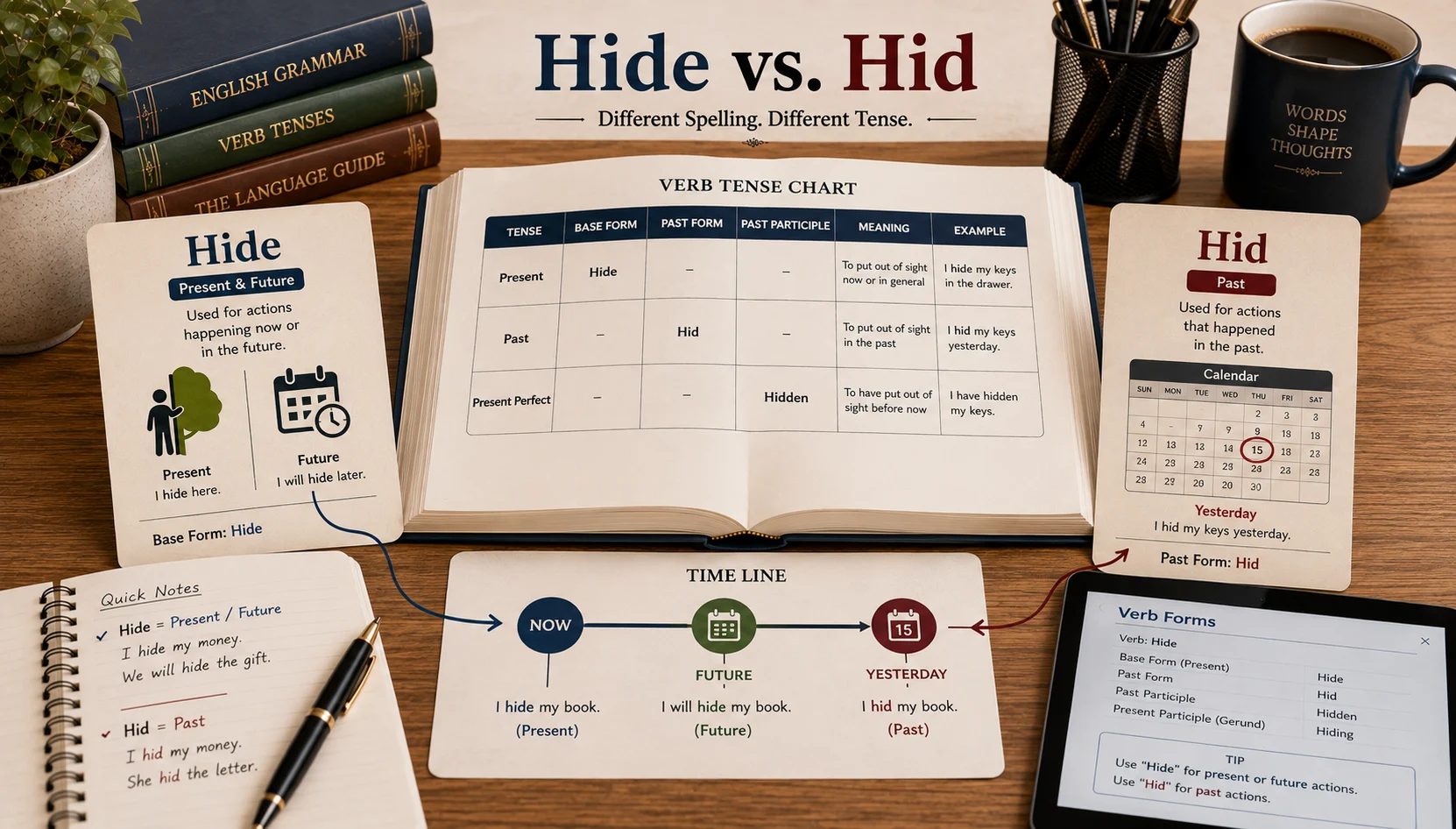
Hide or hid often causes confusion because both words come from the same verb but serve different grammatical purposes. Hide is the base form of the verb and is used for present and future actions, while hid is the simple past tense form used for actions that already happened. Choosing the correct form improves clarity, grammar and professional writing.
The question hide or hid is one of the most common grammar challenges for English learners and even native speakers. Since both words belong to the same verb, many people mistakenly think they can be used interchangeably. However, each word has a distinct role in English grammar.
Hide is the base form of the verb that describes the action of keeping someone or something out of sight. Hid is the simple past tense of the same verb and refers to an action completed in the past. Confusing these forms can lead to grammatical mistakes in academic writing, workplace communication, and everyday conversations.
Understanding the difference will help you write more naturally, speak with confidence, and avoid common English errors.
Hide vs Hid | What’s the Difference?
Although these words share the same meaning, they belong to different verb forms. The difference depends entirely on the time when the action happens.
| Feature | Hide | Hid |
|---|---|---|
| Part of speech | Verb | Verb |
| Verb form | Base form | Simple past tense |
| Time reference | Present or future | Past |
| Used after modal verbs | Yes | No |
| Used with did | Yes | No |
| Example | I hide my keys carefully. | I hid my keys yesterday. |
Both words describe the action of placing someone or something where it cannot easily be found. The difference lies in when the action occurs.
If the action happens now or in the future, use hide. If the action already happened, use hid.
This simple rule prevents most grammar mistakes involving these two forms.
Is Hide vs Hid a Grammar, Vocabulary or Usage Issue?
The confusion is primarily a grammar issue because it involves verb tense rather than vocabulary.
Many learners recognize both words but struggle to choose the correct tense while writing or speaking.
They are not interchangeable.
Using hide instead of hid changes the time reference of the sentence and makes the grammar incorrect.
Formal Writing
Academic papers, business reports, and professional emails require accurate verb tenses. Choosing the correct form demonstrates strong language skills.
Correct:
- Employees hide confidential documents securely.
- The employee hid the confidential documents before leaving.
Informal Conversation
In everyday speech, native speakers naturally switch between the forms according to time.
For example:
“I always hide my wallet in this drawer.”
“Yesterday I hid it somewhere else.”
Academic Usage
Teachers and examiners often test verb forms because they reflect grammatical accuracy.
Incorrect tense selection can lower writing scores even when the overall meaning is clear.
Mini Recap
Hide describes a present or future action.
Hid describes a completed action in the past.
The words have the same meaning but cannot replace one another.
Understanding Hide
Hide is the base form of the verb.
It describes the act of putting someone or something where it cannot easily be seen or found. Because it is the base form, it appears in several grammatical structures.
Present Simple
Use hide when talking about habits or repeated actions.
Examples:
I hide important documents in a locked drawer.
Children sometimes hide behind the sofa during games.
Birds hide in thick trees during storms.
Future Actions
The base form follows will.
Examples:
I will hide the gift until your birthday.
They will hide the equipment after the event.
The system will hide personal information automatically.
After Modal Verbs
Modal verbs always take the base form.
Examples:
You should hide your password.
We must hide sensitive files.
They can hide their location online.
After Did
Many learners make mistakes after did.
Correct:
Did you hide the money?
Incorrect:
Did you hid the money?
Because did already marks the past tense, the main verb stays in its base form.
Workplace Examples
Employees hide confidential records in secure cabinets.
Managers hide sensitive financial information until the report is approved.
The company may hide customer data from unauthorized users.
Academic Examples
Students hide rough notes before submitting the final assignment.
Researchers sometimes hide participant identities for privacy.
Teachers hide quiz answers until the examination begins.
Technology Examples
The application lets users hide private folders.
Modern software can hide personal information automatically.
Websites hide passwords with encrypted characters.
Usage Recap
Use hide for present actions, future actions, habits, instructions, modal verbs, and sentences containing did.
Whenever another word already indicates tense, the verb remains hide.
Understanding Hid
Hid is the simple past tense of hide.
It tells readers that the action happened and finished in the past.
Completed Past Actions
Examples:
I hid my passport before traveling.
She hid the birthday present yesterday.
They hid the evidence during the investigation.
Storytelling
Narratives often use hid because they describe past events.
Examples:
The rabbit hid beneath a large rock.
The child hid under the bed during the thunderstorm.
The treasure was hidden where no one expected it because the pirate hid the map first.
Workplace Examples
The accountant hid the archived files before the office renovation.
The manager hid confidential contracts in a secure cabinet.
The technician hid backup equipment during maintenance.
Academic Examples
The student hid extra notes before entering the examination hall.
Researchers hid participant names to protect privacy.
The professor hid answer sheets before grading began.
Technology Examples
The software hid unnecessary menu options.
The application automatically hid inactive notifications.
The website hid expired promotions after the campaign ended.
Common Grammar Reminder
Many learners incorrectly write:
“I have hid my keys.”
This is incorrect.
After have, has, or had, the correct form is hidden, not hid.
Correct:
I have hidden my keys.
She has hidden the documents.
They had hidden the evidence before the inspection.
Usage Recap
Use hid only when the action was completed in the past.
Do not use it after helping verbs such as did, have, has, had, will, can, should, or must.
This simple distinction makes your writing clearer and grammatically correct.
When You Should NOT Use Hide or Hid
Even though both words belong to the same verb, there are situations where using the wrong form creates grammatical errors. Understanding these common mistakes will help you write with greater accuracy.
| Situation | Correct Choice | Reason |
|---|---|---|
| After did | Hide | The auxiliary verb already shows the past tense. |
| After will | Hide | Future tense always takes the base verb. |
| After can, should, or must | Hide | Modal verbs require the base form. |
| After have, has, or had | Hidden | The present perfect uses the past participle, not hid. |
| For present habits | Hide | Use the base verb to describe regular actions. |
| For completed past events | Hid | Use the simple past tense. |
| In commands | Hide | Imperative sentences always use the base form. |
| In infinitive phrases | Hide | Use to hide, never to hid. |
Choosing the correct form depends on the sentence structure rather than the meaning of the word.
Whenever another helping verb appears, the base form hide is usually the correct choice.
Common Mistakes and Decision Rules
Many English learners repeat the same tense related mistakes. Reviewing these examples can help you recognize and avoid them.
| Correct Sentence | Incorrect Sentence | Explanation |
|---|---|---|
| I hide my passport in a safe place. | I hid my passport every day. | Daily habits require the present tense. |
| Yesterday I hid the documents. | Yesterday I hide the documents. | Completed past actions need hid. |
| Did you hide the keys? | Did you hid the keys? | After did, always use the base verb. |
| She will hide the surprise. | She will hid the surprise. | Future tense takes the base verb. |
| We have hidden the evidence. | We have hid the evidence. | Perfect tenses require hidden. |
| You should hide your password. | You should hid your password. | Modal verbs always take the base form. |
| The software hid the menu yesterday. | The software hide the menu yesterday. | A completed action in the past requires hid. |
| The teacher asked us to hide our notes. | The teacher asked us to hid our notes. | Infinitives always use the base form. |
Decision Rule Box
| If you mean... | Use… |
|---|---|
| A present action, future action, command, or action after a helping verb | Hide |
| A completed action that happened in the past | Hid |
This simple rule solves nearly every hide or hid grammar question.
Hide or Hid in Modern Technology and AI Tools
Modern software relies on precise language, making correct verb forms more important than ever. User interfaces commonly use hide because they describe an available action, such as “Hide Sidebar” or “Hide Notifications.”
Technical documentation also follows standard grammar rules. Developers may write, “The application will hide inactive elements,” while release notes describe completed updates with sentences like, “The latest version hid unnecessary options to improve navigation.”
Artificial intelligence writing assistants, grammar checkers, and machine translation systems distinguish between hide, hid, and hidden by analyzing sentence tense. Using the correct form helps these tools generate more accurate suggestions and clearer writing.
The Etymology of Hide and Hid
The verb hide comes from the Old English word hydan, which meant to conceal or keep out of sight. Over centuries, the spelling remained remarkably stable while its grammar followed the regular development of English verb forms.
The simple past tense hid developed naturally from this older verb and has remained the accepted past tense in both British and American English. The past participle later evolved into hidden, completing the three principal forms of the verb.
Understanding this history explains why hid is a past tense rather than a separate vocabulary word.
“Mastering verb tense is not about memorizing isolated words. It is about understanding how grammar reflects time and meaning.
This principle is one of the foundations of effective English writing and communication.
Case Study One | Improving Academic Writing
A university language instructor reviewed essays from one hundred intermediate English learners. One of the most common grammar mistakes involved confusing hide, hid, and hidden.
After a focused lesson on verb forms and sentence patterns, students reduced these errors by nearly sixty percent during the following assessment. Their overall grammar scores also improved because they became more aware of verb tense consistency.
Case Study Two | Enhancing Workplace Communication
A customer support team revised its internal documentation to standardize verb tense usage. Writers replaced incorrect phrases such as “The system hid the option automatically” in instructional sections with “The system will hide the option automatically.
The updated documentation became easier for new employees to understand, reducing clarification requests and improving training efficiency.
Error Prevention Checklist
Always Use Hide When
| Situation | Check |
|---|---|
| Talking about present actions | ✔ |
| Giving instructions | ✔ |
| Writing after did | ✔ |
| Writing after modal verbs | ✔ |
| Describing future actions | ✔ |
| Using the infinitive to hide | ✔ |
Never Use Hid When
| Situation | Check |
|---|---|
| After did | ✘ |
| After will | ✘ |
| After can, should, or must | ✘ |
| After have, has, or had | ✘ |
| In commands | ✘ |
| In infinitive phrases | ✘ |
Reviewing this checklist before submitting important writing can eliminate many common tense mistakes.
Related Grammar Confusions You Should Master
Expanding your understanding of English verbs and commonly confused words will strengthen both your writing and speaking skills.
| Grammar Topic | Why It Matters |
|---|---|
| Lie vs Lay | Distinguishes between resting and placing something. |
| Rise vs Raise | Separates movement from causing movement. |
| Gone vs Went | Explains past tense and past participle usage. |
| Begin vs Began | Clarifies present and past verb forms. |
| Choose vs Chose | Prevents common tense errors. |
| Break vs Broke | Improves correct past tense usage. |
| Wear vs Wore | Helps describe present and past actions accurately. |
| Speak vs Spoke | Strengthens verb tense consistency. |
| See vs Saw | Prevents confusion between present and past forms. |
| Drink vs Drank | Reinforces correct irregular verb patterns. |
Mastering these related grammar topics will make it much easier to recognize verb patterns and avoid similar mistakes in everyday English.
FAQs
Is it correct to say hide or hid?
Both are correct, but they are used in different tenses. Hide is the base form, while hid is the simple past tense.
When should I use hide instead of hid?
Use hide for present or future actions, after modal verbs, after did, and in commands or infinitive phrases.
Is hid the past tense of hide?
Yes. Hid is the simple past tense of hide and describes an action that was completed in the past.
Can I say did you hid?
No. The correct sentence is Did you hide? After did, the main verb always stays in its base form.
Is have hid grammatically correct?
No. The correct form is have hidden because perfect tenses require the past participle.
Why do people confuse hide and hid?
The confusion happens because both words come from the same verb, but each represents a different grammatical tense.
What is the difference between hid and hidden?
Hid is the simple past tense, while hidden is the past participle used with have, has, and had.
Can hide and hid be used interchangeably?
No. They cannot replace each other because each refers to a different time in the sentence.
Conclusion
Understanding hide or hid becomes much easier once you recognize that they represent different verb tenses rather than different meanings. Hide is the base form used for present actions, future actions, commands, and after helping verbs. Hid is the simple past tense that describes an action completed in the past.
Whenever you are unsure which form to choose, first identify when the action happens. If it is happening now or will happen later, use hide. If it already happened, use hid. Remember that perfect tenses require hidden, not hid. Following these simple rules will improve your grammar, make your writing more professional, and help you communicate with confidence in academic, workplace, and everyday situations.
Discover More Related Articles:
- Denny or Henry | Understanding the Difference Between These Two Names In 2026
- Monkeys or Monkies | Don’t Make This Common Spelling Mistake In 2026
- Dog or Cat | Which Pet Is Right for You In 2026