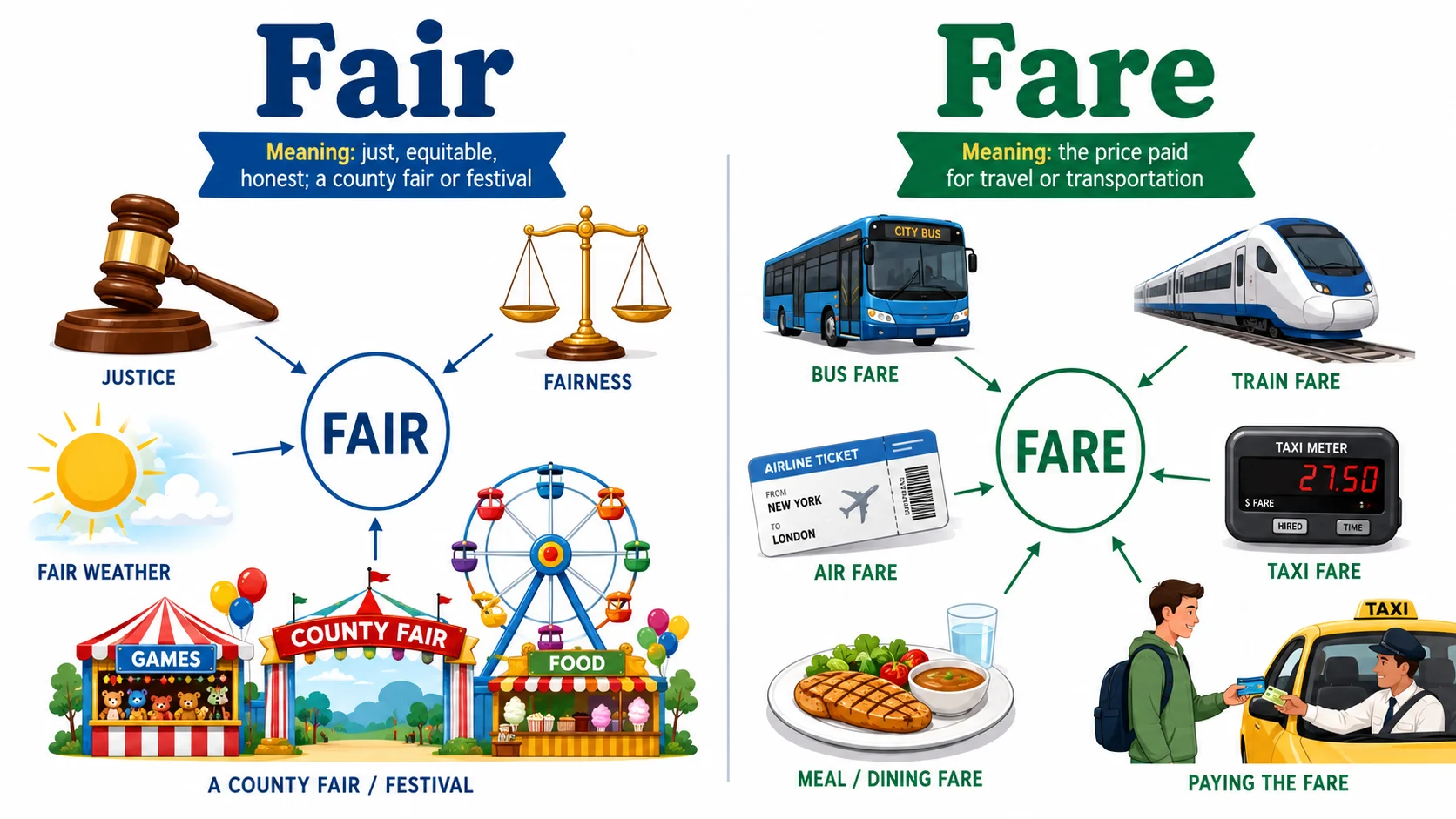
Although fair and fare are pronounced exactly the same, they have different meanings and serve different grammatical purposes. They are homophones, meaning they sound alike but have different spellings and definitions.
Fair is most often used as an adjective to describe something that is just, reasonable, honest, or attractive. It can also function as a noun to refer to a public exhibition, market, or festival.
Fare is primarily a noun that refers to the price paid for transportation, such as a bus, train, taxi, or airplane ticket. It can also describe the food and drink served or available in a particular place or during a journey. Less commonly, it appears as a verb meaning to perform or progress in a certain way.
Comparison Table
| Feature | Fair | Fare |
|---|---|---|
| Primary Part of Speech | Adjective | Noun |
| Secondary Part of Speech | Noun | Verb |
| Main Meaning | Just, honest, reasonable, attractive, or a public event | Cost of transportation or food served |
| Common Contexts | Justice, weather, appearance, competitions, festivals | Travel, transportation, restaurants, journeys |
| Example Sentence | The judge made a fair decision. | The bus fare increased this year. |
| Memory Tip | Think of fairness and equality. | Think of travel expenses and meals. |
Mini Recap
The easiest way to remember the difference is to focus on the context. If you’re talking about justice, equality, appearance, or an event, fair is almost always the correct choice. If you’re discussing transportation costs, travel, or meals served on a journey, fare is the word you need.
Is Fair vs Fare a Grammar, Vocabulary or Usage Issue?
The confusion between fair and fare is primarily a vocabulary and usage issue, not a grammar mistake. English contains many homophones that sound identical but have different spellings and meanings. Writers choose the correct word based on the intended meaning rather than grammatical rules alone.
Are They Interchangeable?
No. Although both words are pronounced the same, they are not interchangeable. Replacing one with the other changes the meaning of a sentence and often makes it incorrect.
For example:
✔ The taxi fare was expensive.
✘ The taxi fair was expensive.
Likewise:
✔ Everyone deserves a fair opportunity.
✘ Everyone deserves a fare opportunity.
Formal and Informal Usage
Both words appear in formal and informal English.
In formal writing, fair frequently appears in legal documents, business reports, academic papers, and ethical discussions because it relates to justice, equality, and impartiality.
Fare commonly appears in transportation policies, travel documents, restaurant menus, tourism guides, and business communications involving travel expenses.
In casual conversation, people use fair when discussing everyday situations such as weather, sports, games, or personal opinions. Fare appears naturally when talking about buses, trains, taxis, flights, or food.
Academic vs Everyday Writing
Academic writing often uses fair when discussing ethics, economics, law, psychology, or social equality.
Examples include:
- Researchers should ensure fair treatment of all participants.
- A fair grading policy benefits every student.
Meanwhile, fare is more common in transportation studies, tourism, hospitality, and economics.
Examples include:
- Rising fuel prices affected airline fares.
- Researchers examined changes in public transport fare structures.
Using Fair Correctly
The word fair is one of the most versatile words in English. Depending on the context, it can describe justice, equality, reasonable treatment, acceptable quality, pleasant weather, physical appearance, or even a large public event. Because it carries several meanings, understanding the surrounding sentence is essential.
In most cases, fair functions as an adjective. It answers questions such as What kind of? or How was it? Less commonly, it acts as a noun when referring to an exhibition, trade event, or festival.
Workplace Example
Professional communication often emphasizes fairness because employees expect equal treatment and transparent decision making.
- Every employee received a fair performance evaluation.
- The manager made a fair decision after reviewing all the evidence.
- Our company follows fair hiring practices for every applicant.
These examples focus on honesty, equality, and impartiality.
Academic Example
Educational settings frequently use fair when discussing grading policies, classroom rules, or research ethics.
- The professor used a fair grading system.
- Students appreciated the teacher’s fair assessment methods.
- Researchers ensured fair treatment of every participant.
Here, the word highlights equal treatment and unbiased judgment.
Technology Example
Technology companies also use fair in discussions about artificial intelligence, algorithms, and digital ethics.
Correct Examples
- Developers tested the AI model to ensure fair outcomes.
- The platform promotes fair access for all users.
- Engineers evaluated the recommendation system remained fair across different user groups.
As artificial intelligence becomes more common, fairness has become an important principle in responsible technology development.
Other Common Meanings of Fair
Besides justice and equality, fair appears in several everyday situations.
Weather
- We expect fair weather this weekend.
- The forecast predicts fair skies throughout the afternoon.
Appearance
- She has fair skin and light hair.
- The baby was born with fair hair.
Public Events
When used as a noun, fair refers to a large public gathering.
Examples include:
- We visited the county fair during the summer.
- The school organized a science fair.
- Thousands attended the annual book fair.
Usage Recap
Whenever your sentence involves justice, honesty, equality, reasonable treatment, pleasant weather, physical appearance, or a public exhibition, fair is almost certainly the correct choice. The surrounding context will usually make its meaning clear.
Using Fare Correctly
Unlike fair, the word fare has a much narrower range of meanings. It most commonly refers to the amount of money paid for transportation or the food served in a particular setting. It can also function as a verb meaning to perform or to get along, although this usage is less common in modern English.
Workplace Example
Many organizations discuss transportation expenses when employees travel for business.
Correct Examples
- The company reimbursed my taxi fare.
- Employees must submit train fare receipts.
- Business travel fares increased during the holiday season.
These examples all refer to transportation costs.
Academic Example
Students often encounter fare in economics, transportation planning, and urban studies.
Correct Examples
- Researchers studied changes in public transport fares.
- Reduced bus fares encouraged more students to use public transportation.
- The report examined how ticket fares affect commuter behavior.
Here, fare consistently means the price paid for travel.
Technology Example
Technology platforms increasingly integrate transportation services into their applications.
Correct Examples
- The app estimates your taxi fare before booking.
- Users can compare airline fares online.
- The navigation system calculates estimated ride fares in real time.
Digital travel services have made the word fare a familiar part of everyday technology.
Food and Dining
Another common meaning of fare relates to food, especially when describing the type of cuisine served in a restaurant or region.
Examples include:
- The restaurant serves traditional Italian fare.
- The hotel offers local fare prepared with fresh ingredients.
- Festival visitors enjoyed regional fare throughout the weekend.
In this context, fare refers to food rather than transportation.
Fare as a Verb
Although less common, fare can also be used as a verb meaning to perform or to succeed.
Examples include:
- How did your team fare in the competition?
- Small businesses fared well despite the economic slowdown.
- Students fared better after receiving additional support.
This usage often appears in newspapers, business reports, and formal writing.
Usage Recap
Choose fare whenever you’re referring to transportation costs, ticket prices, meals served in a particular setting, or describing how someone performed or succeeded. If your sentence is about travel or food rather than fairness or equality, fare is the appropriate word.
When You Should NOT Use Fair or Fare
Knowing the definitions is only part of the learning process. Many writing mistakes happen because people recognize the pronunciation but overlook the intended meaning. Before choosing either word, ask yourself what the sentence is actually describing.
Here are some of the most common situations where writers choose the wrong word.
1. Do Not Use Fair for Transportation Costs
Because fair is much more common in everyday English, some people mistakenly use it when discussing travel expenses.
Incorrect: The bus fair increased this month.
Correct: The bus fare increased this month.
If money is paid for a journey, fare is always the correct choice.
2. Do Not Use Fare When Talking About Justice
When discussing equality, honesty, or impartial treatment, fair is the only appropriate word.
Incorrect: Every employee deserves fare treatment.
Correct: Every employee deserves fair treatment.
Justice and equality always relate to fair, never fare.
3. Do Not Confuse a Festival with a Travel Fee
A county event, exhibition, or school competition is a fair, not a fare.
Incorrect: We visited the science fare yesterday.
Correct: We visited the science fair yesterday.
Remember that events and exhibitions are always fairs.
4. Do Not Describe Food Quality with Fair When You Mean Cuisine
When referring to the style or type of food served, use fare.
Incorrect: The restaurant serves traditional Mexican fair.
Correct: The restaurant serves traditional Mexican fare.
Here, fare means food or cuisine rather than justice.
5. Do Not Use Fare to Describe Equal Treatment
Whenever people receive honest or unbiased treatment, choose fair.
Incorrect: The competition was carefully judged to remain fare.
Correct: The competition was carefully judged to remain fair.
6. Do Not Replace the Verb Fare with Fair
As a verb, fare means to perform, succeed, or manage in a situation.
Incorrect: How did your team fair in the tournament?
Correct: How did your team fare in the tournament?
This is one of the most frequently searched mistakes because both words sound identical.
7. Do Not Use Fare for Weather
Weather forecasts often use fair to describe pleasant conditions.
Incorrect: Tomorrow will have fare skies.
Correct: Tomorrow will have fair skies.
8. Do Not Guess Based on Pronunciation
Since fair and fare are perfect homophones, pronunciation cannot help you choose the correct spelling.
Instead, identify the meaning first.
Ask yourself:
- Am I talking about justice, equality, appearance, weather, or an event? Choose fair.
- Am I talking about travel costs, food, or how someone performed? Choose fare.
Common Mistakes and How to Fix Them
The examples below illustrate some of the errors that learners make most often.
| Correct Sentence | Incorrect Sentence | Explanation |
|---|---|---|
| The taxi fare was expensive. | The taxi fair was expensive. | Transportation costs are called fares. |
| She received a fair opportunity. | She received a fare opportunity. | Equal treatment requires fair. |
| We visited the county fair. | We visited the county fare. | Public exhibitions are fairs. |
| The restaurant serves traditional local fare. | The restaurant serves traditional local fair. | Food and cuisine are referred to as fare. |
| The referee made a fair decision. | The referee made a fare decision. | Honest judgments are fair. |
| Airline fares continue to rise. | Airline fairs continue to rise. | Ticket prices are fares. |
| Students fared well on the exam. | Students faired well on the exam. | The verb is fare, with the past tense fared. |
| The weather should remain fair today. | The weather should remain fare today. | Pleasant weather is described as fair. |
Decision Rule Box
Use Fair when you mean:
- Justice or equality
- Honest or impartial treatment
- Reasonable decisions
- Attractive or light colored appearance
- Pleasant weather
- A public exhibition or festival
Use Fare when you mean:
- The price of transportation
- Airline, bus, train, or taxi tickets
- Food or cuisine served in a place
- How someone performed or succeeded
A Simple Memory Trick
Think of the letter E in fare as standing for expense and eating. If the sentence is about paying for travel or food, fare is usually the right choice.
Think of fair as relating to fairness. If the sentence is about honesty, equality, or justice, fair is almost always correct.
Fair and Fare in Modern Technology and AI Tools
Artificial intelligence has made writing assistance more accessible than ever. Grammar checkers, spell checkers, and AI writing tools can usually identify fair or fare fits a sentence by analyzing the surrounding context rather than pronunciation alone.
For example, if you write, The taxi fair was expensive, many writing tools will suggest changing fair to fare because the sentence refers to the cost of transportation.
Likewise, if you type, Everyone deserves fare treatment, an AI assistant will recognize that the discussion is about equality and recommend fair instead.
Even with advanced technology, automated tools are not perfect. They occasionally struggle with short sentences or phrases that provide little context. Understanding the meanings yourself remains the best way to avoid mistakes and communicate clearly.
Quick Tip
Use grammar and AI tools as a second opinion, not as a replacement for understanding word meanings. When you know the difference between fair and fare, you’ll be able to catch mistakes that software may overlook.
The Origin of Fair and Fare
Learning where words come from often makes them easier to remember.
The word fair traces its roots to Old English fæger, meaning beautiful, pleasing, or just. Over time, its meaning expanded to include honesty, equality, and impartial treatment. This is why the word appears in expressions such as fair play, fair chance, and fair decision.
The word fare comes from Old English faran, meaning to travel, journey, or go. As the language evolved, it became associated with the cost of traveling and, later, with the food provided during a journey or served in a particular place.
Although the two words now sound identical, their histories are completely different. Their separate origins explain why they have distinct meanings despite sharing the same pronunciation.
Expert Insight
“Choosing the correct word is not about memorizing spelling. It is about understanding meaning. When writers focus on the idea they want to express, selecting between homophones such as fair and fare becomes much more natural.”
This principle is widely used by editors, language teachers, and professional proofreaders because meaning always determines the correct word choice.
Case Study 1: Improving Business Communication
A customer service team at a regional transportation company reviewed several months of support emails and found that many customers accidentally wrote bus fair instead of bus fare. Although readers generally understood the intended meaning, the repeated error created an unprofessional impression in formal correspondence.
The company introduced a short language guide explaining common homophones used in transportation. After several weeks of staff training and updated templates, proofreading time decreased noticeably, and customer emails contained far fewer word choice errors. Employees also reported greater confidence when responding to customer inquiries.
Key Lesson
A clear understanding of commonly confused words improves professionalism and reduces editing time in workplace communication.
Case Study 2: Helping Students Reduce Writing Errors
A secondary school English teacher noticed that many students lost marks because they confused homophones in essays and exams. Instead of asking students to memorize spelling lists, the teacher encouraged them to identify the meaning of each sentence before choosing a word.
Students practiced with real world examples involving justice, travel, food, and public events. By focusing on context rather than pronunciation, they became more accurate in their writing and made fewer homophone mistakes in later assignments.
Key Lesson
Understanding context is more effective than memorizing isolated spellings. When learners connect each word with its meaning, correct usage becomes much easier.
Error Prevention Checklist
Before using fair or fare, take a moment to review this checklist.
Always Use Fair When
☑ You are describing justice or equality.
☑ You mean honest or impartial treatment.
☑ You are discussing reasonable decisions.
☑ You are referring to pleasant weather.
☑ You are describing someone with light skin or hair.
☑ You are talking about a festival, exhibition, or community event.
Always Use Fare When
☑ You mean the price of a bus, train, taxi, flight, or other transportation.
☑ You are discussing ticket prices or travel expenses.
☑ You are referring to food or cuisine served in a restaurant or region.
☑ You are using the verb meaning to perform, succeed, or manage.
Never Confuse Them Because
☑ They sound the same but have different meanings.
☑ Pronunciation cannot tell you which spelling is correct.
☑ The context of the sentence always determines the right choice.
☑ If you identify the idea first, selecting the correct word becomes much easier.
Related Grammar Confusions You Should Master
Learning the difference between fair and fare is an important step toward improving your English, but it is only one example of many commonly confused word pairs. These words often sound alike, look similar, or have related meanings, making them easy to mix up in both speech and writing.
Here are several other grammar and vocabulary distinctions worth mastering.
Affect vs Effect
These words are frequently confused because they are closely related. Affect is usually a verb meaning to influence something, while effect is most often a noun referring to a result or outcome.
Accept vs Except
Accept means to receive or agree to something. Except means excluding or leaving something out.
Then vs Than
Use then when referring to time or sequence. Use than when making comparisons.
Their vs There vs They’re
These three homophones have entirely different meanings. Their shows possession, there refers to a place, and they’re is the contraction of they are.
Your vs You’re
Your indicates ownership, while you’re is short for you are.
Principal vs Principle
Principal commonly refers to the head of a school or something that is most important. Principle means a rule, belief, or moral standard.
Complement vs Compliment
Complement means something that completes or enhances another thing. Compliment refers to praise or admiration.
Stationary vs Stationery
Stationary means not moving. Stationery refers to writing materials such as paper, envelopes, and notebooks.
Lose vs Loose
Lose means to misplace something or fail to win. Loose means not tight or firmly attached.
Advice vs Advise
Advice is a noun meaning guidance or recommendations. Advise is a verb meaning to give advice.
Why Learning These Word Pairs Matters
Many English errors are not grammar mistakes but vocabulary mistakes. Building a strong understanding of commonly confused words improves clarity, boosts confidence, and helps you communicate more effectively in academic, professional, and everyday situations.
FAQs
What is the difference between fair and fare?
Fair usually means just, honest, reasonable, attractive, or refers to a public exhibition or festival. Fare refers to the cost of transportation, food served in a particular place, or, as a verb, how someone performs or succeeds.
Is it bus fair or bus fare?
The correct expression is bus fare because it refers to the price paid for transportation.
Correct: The bus fare increased this year.
Is it county fair or county fare?
The correct term is county fair because it refers to a public event or exhibition.
Is fair and fare a grammar mistake?
Not exactly. Confusing these words is primarily a vocabulary or word choice mistake rather than a grammar error. They are homophones with different meanings and spellings.
Can fair and fare ever be used interchangeably?
No. Although they sound identical, they have different meanings. Substituting one for the other changes the meaning of the sentence and often makes it incorrect.
What part of speech is fair?
Fair most commonly functions as an adjective. It can also be used as a noun when referring to an exhibition, festival, or public event.
What part of speech is fare?
Fare is most commonly a noun meaning transportation cost or food. It can also function as a verb meaning to perform or get along.
Why do people confuse fair and fare?
People confuse these words because they are perfect homophones. Since they are pronounced the same, writers often rely on sound rather than meaning when choosing the spelling.
How can I remember the difference between fair and fare?
A simple memory trick is to connect fair with fairness and fare with travel expenses or food. Thinking about the meaning before writing makes it much easier to choose the correct word.
Conclusion
Understanding the difference between fair or fare becomes much easier once you focus on meaning instead of pronunciation. Although these words sound exactly alike, they belong in completely different contexts. Fair relates to justice, equality, reasonable treatment, pleasant weather, appearance, or public events. Fare refers to transportation costs, food, or how someone performs in a particular situation.
Whenever you are uncertain, pause for a moment and ask yourself what your sentence is describing. If the idea involves honesty or equal treatment, fair is the right choice. If it involves travel costs, meals, or performance, choose fare. This simple habit will help you avoid one of the most common English vocabulary mistakes and improve the clarity of your writing in every setting.