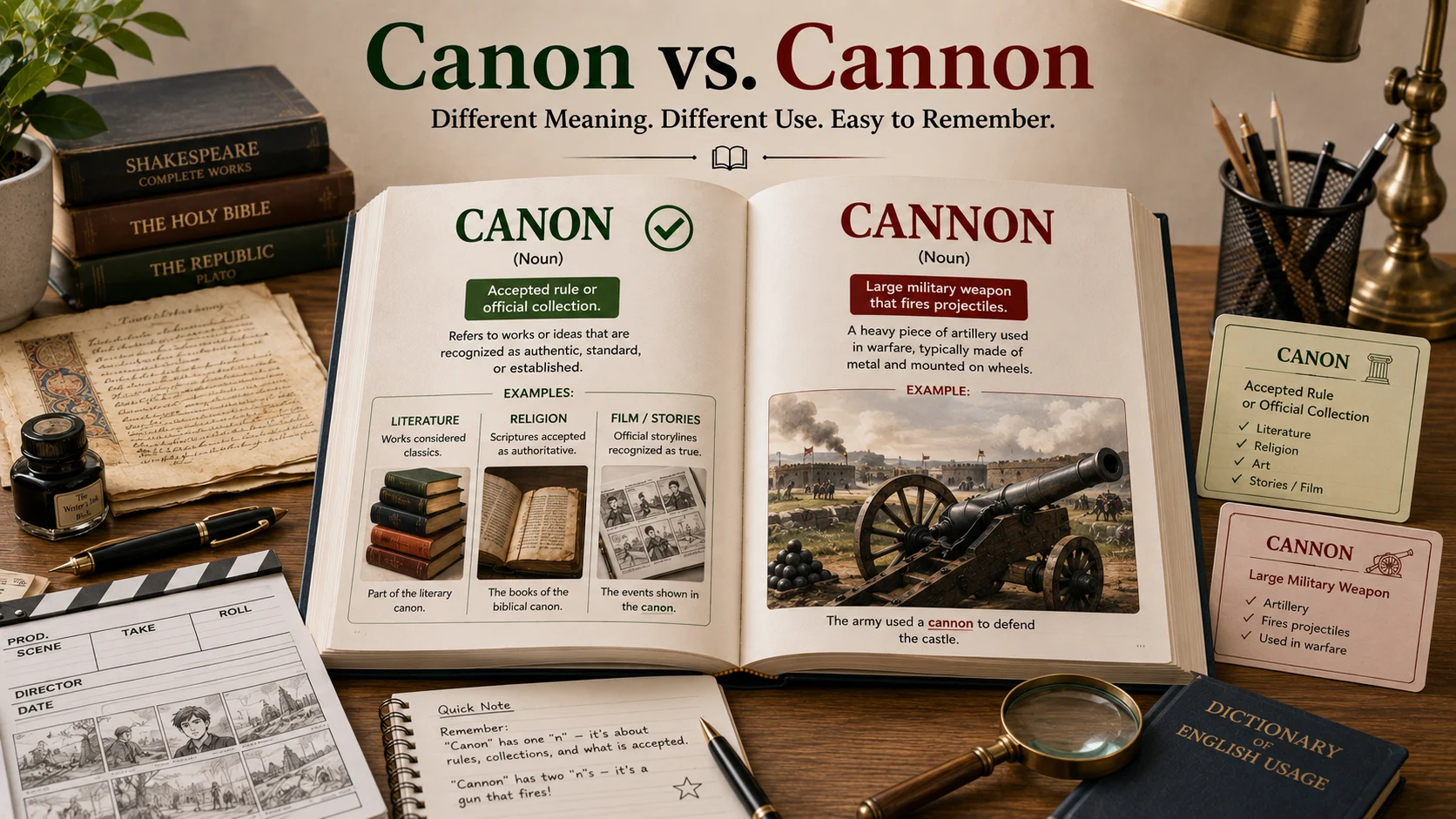
Canon or cannon can be confusing because the two words sound exactly alike but have completely different meanings. Canon refers to an accepted rule, collection of works, or official standard, while cannon is a large weapon designed to fire heavy projectiles. Choosing the wrong word can change the meaning of a sentence and create unnecessary confusion.
Many English words sound alike while carrying entirely different meanings, and canon or cannon is one of the most commonly confused pairs. Although they share the same pronunciation, they belong to different parts of vocabulary and are used in completely different contexts.
A canon is generally an accepted rule, principle, or collection of works recognized as authentic or authoritative. A cannon, on the other hand, is a powerful artillery weapon used throughout military history. Mixing these words can lead to mistakes in academic writing, historical discussions, entertainment reviews, and even everyday conversations. Learning the distinction ensures your writing remains clear, accurate, and professional.
Canon vs Cannon| What’s the Difference?
At first glance, these words appear almost identical. Their pronunciation is the same, but their meanings have no connection. One belongs to the world of literature, religion, music, and storytelling, while the other belongs to warfare and military history.
| Feature | Canon | Cannon |
|---|---|---|
| Part of Speech | Noun | Noun |
| Meaning | An accepted rule, principle, or collection of authentic works | A large artillery weapon that fires heavy projectiles |
| Common Contexts | Literature, religion, film, music, education | Military history, warfare, museums, games |
| Pronunciation | Same as cannon | Same as canon |
| Can They Replace Each Other? | No | No |
| Example | Shakespeare is part of the English literary canon. | The army fired a cannon across the battlefield. |
Both words are pronounced the same, making them classic homophones. Their spellings differ by only one letter, but their meanings are entirely unrelated. Remember that canon is connected with accepted authority or official collections, while cannon always refers to a weapon.
Is Canon or Cannon a Grammar, Vocabulary or Usage Issue?
The confusion between these words is primarily a vocabulary and usage issue rather than a grammar problem. Grammar concerns sentence structure, while vocabulary focuses on choosing the correct word.
These words are not interchangeable because they describe completely different ideas. Replacing one with the other changes the meaning of a sentence immediately.
In formal writing, using the correct term is especially important. Academic papers, literary criticism, religious studies, and media discussions often use canon to refer to official texts or recognized works. Historical documents and military reports, however, require cannon when discussing artillery.
In casual conversation, people may not notice the spelling difference because both words sound identical. Once written down, however, the mistake becomes obvious and can reduce the credibility of your writing.
You are writing a university essay, a novel review, a gaming article, or a historical report, selecting the correct word demonstrates precision and strong language skills.
Understanding Canon
The word canon refers to something officially accepted, recognized, or considered authoritative. Its exact meaning depends on the context, but the central idea remains the same. It represents accepted standards, authentic works, or established principles.
In literature, the literary canon consists of books considered significant because of their lasting cultural or educational value.
In religion, a canon refers to officially recognized sacred writings accepted by a religious tradition.
In entertainment, particularly films, television, comics, and video games, canon describes events or characters that officially belong to the storyline.
Workplace Example
During the meeting, the editor explained that the company’s style guide had become part of its editorial canon for all future publications.
Academic Example
Students spent the semester studying the Western literary canon, beginning with ancient Greek classics and ending with modern masterpieces.
Technology Example
Fans debated the newest expansion was officially canon within the game’s storyline.
More Examples
The professor introduced several influential works from the philosophical canon.
Only documents included in the official canon were accepted for historical analysis.
The museum highlighted artists who shaped the national artistic canon.
Researchers questioned the newly discovered manuscript should become part of the historical canon.
The television series confirmed that the final episode remained canon despite earlier rumors.
Usage Recap
Use canon whenever you are discussing accepted rules, official collections, recognized works, authentic storylines, or established standards. It commonly appears in literature, religion, education, history, media, and entertainment.
Understanding Cannon
The word cannon refers to a large firearm designed to launch heavy projectiles over long distances. Cannons have played an important role in military history for centuries and continue to appear in museums, history books, documentaries, games, and historical fiction.
Modern armies rely more on advanced artillery systems, but the traditional cannon remains an important historical symbol.
Workplace Example
The museum curator supervised the restoration of a nineteenth century cannon before the public exhibition opened.
Academic Example
History students analyzed how the invention of the cannon transformed warfare during the medieval period.
Technology Example
The game allows players to upgrade each cannon for greater firing range and improved accuracy.
More Examples
The old fortress displayed a restored cannon overlooking the harbor.
Soldiers loaded the cannon before the ceremonial salute.
The documentary explained how each cannon was manufactured using cast bronze.
Children admired the enormous cannon displayed outside the military museum.
Engineers studied historical cannon designs to understand early artillery technology.
Usage Recap
Use cannon only when referring to a large artillery weapon or something directly related to heavy military firearms. It belongs in discussions about history, warfare, museums, military engineering, historical fiction, and strategy games.
When You Should NOT Use Canon or Cannon
Even though these words sound identical, they should never replace one another. Understanding the situations where each word is inappropriate will help you avoid embarrassing writing mistakes.
| Incorrect Situation | Correct Choice | Why |
|---|---|---|
| Referring to a military weapon as canon | Cannon | A weapon is always called a cannon. |
| Describing official books as cannon | Canon | Collections of accepted works use canon. |
| Talking about a film storyline using cannon | Canon | Storylines officially accepted by creators are canon. |
| Mentioning battlefield artillery as canon | Cannon | Artillery refers to heavy weapons. |
| Writing about religious scriptures as cannon | Canon | Official religious texts belong to a canon. |
| Calling a museum weapon a canon | Cannon | Museums display historical cannons. |
| Referring to literary classics as cannon | Canon | Literature uses the term literary canon. |
| Discussing war history with canon instead of cannon | Cannon | Military history requires the weapon spelling. |
A simple memory trick can help. Think of the extra n in cannon as representing the additional power of a weapon. Canon stays shorter because it refers to accepted rules or recognized collections rather than physical objects.
Common Mistakes and Decision Rules
The following examples illustrate mistakes many writers make when using these homophones.
| Correct Sentence | Incorrect Sentence | Explanation |
|---|---|---|
| Harry Potter is part of modern literary canon. | Harry Potter is part of modern literary cannon. | Literary collections use canon. |
| The soldiers loaded the cannon before sunrise. | The soldiers loaded the canon before sunrise. | Weapons are called cannons. |
| This episode is considered official canon. | This episode is considered official cannon. | Story continuity uses canon. |
| The castle still displays an ancient cannon. | The castle still displays an ancient canon. | Historical artillery requires cannon. |
| Scholars debated the biblical canon. | Scholars debated the biblical cannon. | Religious texts belong to a canon. |
| The pirate ship fired a cannon. | The pirate ship fired a canon. | Ships fire cannons, not canons. |
Decision Rule Box
| If you mean… | Use… |
|---|---|
| An accepted rule, official collection, authentic storyline, or recognized body of work | Canon |
| A large military weapon that fires projectiles | Cannon |
Whenever you are unsure, ask yourself you are talking about authority or artillery. Authority points to canon, while artillery points to cannon.
Canon and Cannon in Modern Technology and AI Tools
Modern technology has introduced new situations where these words frequently appear.
Artificial intelligence writing assistants often use canon when discussing fictional universes, official documentation, knowledge bases, and established datasets. Entertainment platforms also use canon to distinguish official stories from fan created material.
Meanwhile, cannon appears in military simulation software, engineering applications, educational history programs, and strategy games. Developers use the word when describing historical artillery, game weapons, or mechanical equipment.
Spell checking software may not always detect the mistake because both words are correctly spelled English nouns. That makes understanding their meanings even more important than relying on automatic correction tools.
The Origins of Canon and Cannon
Although these words sound alike today, they come from different historical roots.
Canon originates from the Greek word kanon, meaning a measuring rod or rule. Over time, it came to represent standards, accepted principles, and official collections in literature, religion, and the arts.
Cannon comes from the Italian word cannone, meaning a large tube. As artillery technology developed across Europe, the word became associated with large guns capable of launching heavy projectiles over long distances.
Their shared pronunciation is simply the result of changes in English pronunciation over centuries rather than a shared meaning.
“Precise vocabulary strengthens credibility because every correctly chosen word communicates exactly what the writer intends.”
Case Study One| Academic Writing Improvement
A university history department reviewed one hundred student essays about classical literature. Nearly one quarter of the papers mistakenly used cannon instead of canon when discussing recognized literary works.
After instructors introduced a short vocabulary lesson with practical examples, spelling accuracy improved dramatically in the following semester. Students also demonstrated greater confidence when discussing literary criticism and historical texts.
Case Study Two | Entertainment Website Editing
An entertainment news website published several articles reviewing a popular television series. Editors noticed repeated misuse of cannon when referring to official story continuity.
After updating the editorial style guide and providing writer training, these vocabulary errors virtually disappeared. Reader feedback also reflected greater trust in the site’s professional editing standards.
Error Prevention Checklist
Always Use Canon When
| Situation | ✓ |
|---|---|
| Referring to accepted rules | ✓ |
| Discussing literary classics | ✓ |
| Talking about official religious texts | ✓ |
| Describing authentic film or game storylines | ✓ |
| Referring to recognized artistic works | ✓ |
| Mentioning established principles or standards | ✓ |
Never Use Cannon When
| Situation | ✗ |
|---|---|
| Talking about literature | ✗ |
| Discussing religion | ✗ |
| Referring to official story continuity | ✗ |
| Describing accepted rules | ✗ |
| Mentioning artistic collections | ✗ |
| Writing about academic canons | ✗ |
By remembering that canon represents accepted authority while cannon represents military artillery, you can confidently choose the correct word every time.
Related Grammar Confusions You Should Master
Expanding your vocabulary is one of the best ways to avoid common writing mistakes. If you often confuse canon and cannon, you may also benefit from learning these similar word pairs.
| Commonly Confused WordsMain Difference | |
|---|---|
| Complement vs Compliment | One completes something while the other expresses praise. |
| Affect vs Effect | One is usually a verb while the other is usually a noun. |
| Principal vs Principle | One is a person or main item while the other is a rule or belief. |
| Stationary vs Stationery | One means not moving while the other refers to writing materials. |
| Then vs Than | One relates to time while the other is used for comparison. |
| Farther vs Further | One usually refers to physical distance while the other often means additional. |
| Historic vs Historical | One describes something important while the other refers to anything from the past. |
| Elicit vs Illicit | One means to draw out while the other means illegal. |
| Discreet vs Discrete | One means careful while the other means separate or distinct. |
| Who’s vs Whose | One is a contraction while the other shows possession. |
Mastering these commonly confused words will improve your grammar, strengthen your writing, and help you communicate with greater confidence in both academic and professional settings.
FAQs
What is the difference between canon and cannon?
Canon refers to an accepted rule, official collection, or authentic storyline, whereas cannon is a large artillery weapon. They sound the same but have completely different meanings.
Is canon or cannon used for movies and television series?
Official story events in movies, television shows, comics, and games are described as canon. The spelling cannon is never correct in this context.
Why do people confuse canon and cannon?
The words are pronounced exactly alike, making them homophones. Their similar spelling also causes many writers to choose the wrong word.
Is the Bible canon or cannon?
The correct term is biblical canon because it refers to the officially recognized collection of sacred books. Cannon has no religious meaning.
Can cannon ever mean an official rule?
No. Cannon only refers to a large weapon or artillery piece. Official rules, standards, or recognized works always use canon.
How can I remember the difference between canon and cannon?
Think of canon as relating to accepted authority and official collections. Remember the extra n in cannon as representing the added power of a military weapon.
Is literary canon a grammar term?
No. A literary canon is a collection of works considered important or influential in literature. It is a vocabulary term rather than a grammar rule.
Can spell check detect the difference between canon and cannon?
Not always. Since both are correctly spelled English words, spell checkers may not identify the mistake unless the software understands the context.
Conclusion
Understanding the difference between canon and cannon is easier once you remember that they belong to completely different areas of the English language. Canon refers to accepted rules, official collections, authentic works, or recognized storylines, while cannon refers to a powerful artillery weapon. Although they sound identical, their meanings are unrelated, making them classic homophones.
You are writing about literature, religion, films, history, military technology, or video games, selecting the correct spelling improves clarity and credibility. A simple habit of checking the context before writing can prevent mistakes and ensure your communication remains accurate. As your vocabulary grows, distinguishing between commonly confused words like these becomes second nature, making your writing more polished and professional.
Discover More Related Articles:
- Denny or Henry | Understanding the Difference Between These Two Names In 2026
- Monkeys or Monkies | Don’t Make This Common Spelling Mistake In 2026
- Dog or Cat | Which Pet Is Right for You In 2026