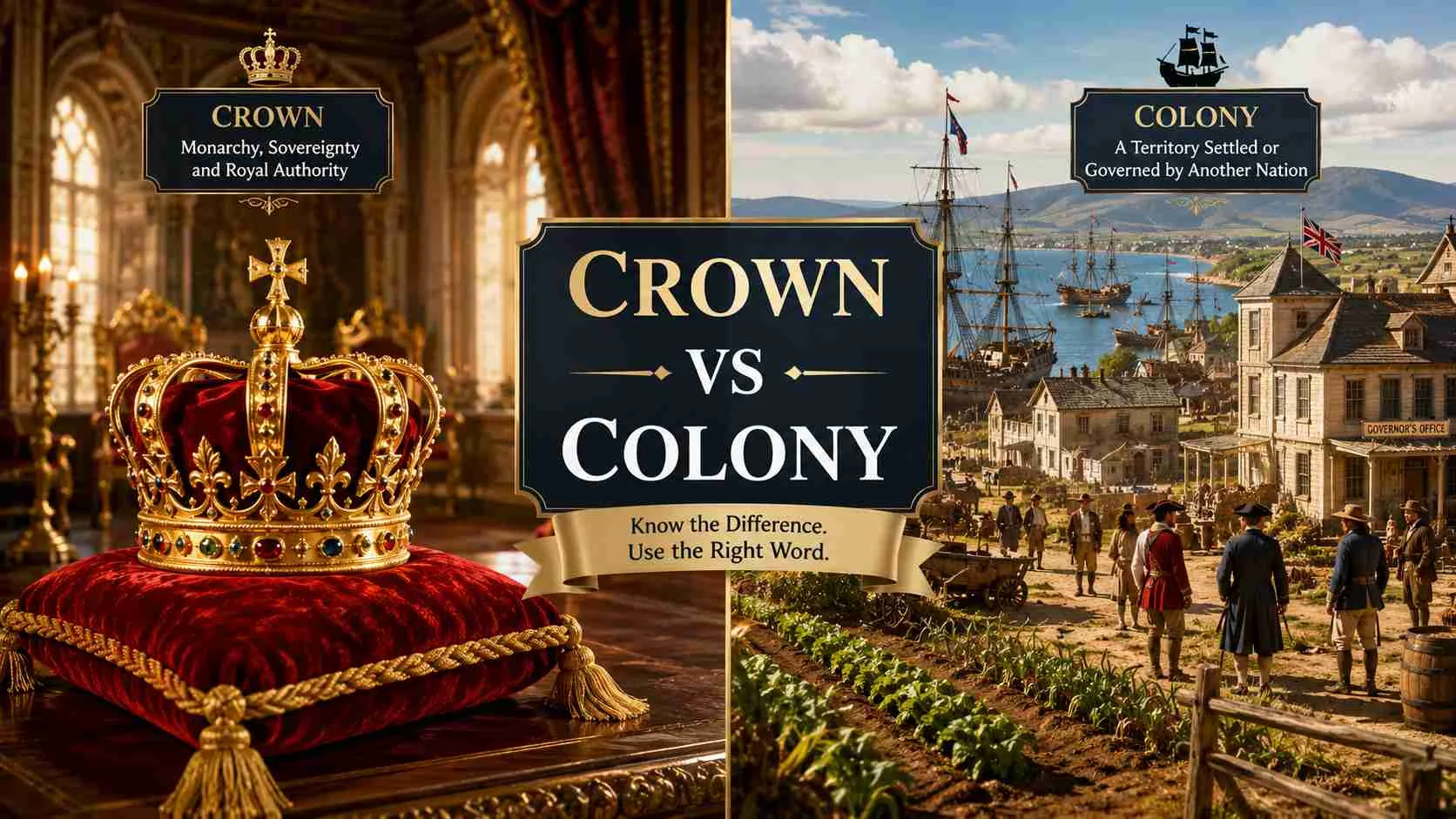
A crown or colony comparison is about understanding two distinct historical and political terms that are often linked but never interchangeable. A crown represents the authority of a monarch or monarchy, while a colony is a territory governed or settled by another country. Knowing the difference helps readers avoid historical and contextual mistakes.
The phrase crown or colony may seem confusing because both terms frequently appear together in discussions of history, empires, and government. However, they describe very different concepts. A crown symbolizes the ruling authority of a king or queen and often represents the monarchy itself. A colony is a territory that is controlled, governed, or settled by another nation.
Confusing these terms can lead to misunderstandings in academic writing, history lessons, legal discussions, and even modern political conversations. Although the Crown may govern a colony, the two words never refer to the same thing. Understanding their unique meanings makes historical events easier to interpret and improves the accuracy of your writing.
You are a student, researcher, teacher, or simply curious about historical terminology, this guide explains each term in clear language with practical examples and expert insights.
Crown vs Colony | What’s the Difference?
Both words are nouns, but they refer to completely different ideas.
| Feature | Crown | Colony |
|---|---|---|
| Part of Speech | Noun | Noun |
| Primary Meaning | The authority of a monarch or the monarchy itself | A territory settled or governed by another country |
| Symbolism | Royal power, sovereignty, and leadership | Expansion, settlement, and foreign administration |
| Common Context | Monarchy, law, government, ceremonies | History, geography, politics, colonization |
| Can They Replace Each Other? | No | No |
| Example | The Crown approved the new legislation. | The colony depended on trade with its ruling nation. |
The simplest way to remember the difference is that the Crown governs, while the colony is governed. One represents authority, and the other represents a place under that authority.
In many historical documents, the two words appear together because colonies were often ruled in the name of the Crown. Even so, each term keeps its own distinct meaning and should never be substituted for the other.
Is Crown or Colony a Grammar, Vocabulary or Usage Issue?
The comparison between crown or colony is primarily a vocabulary and historical usage issue, not a grammar problem.
Grammar focuses on sentence structure and word arrangement. Vocabulary concerns the meanings of words. Since crown and colony have separate definitions, using the wrong one changes the meaning of an entire sentence rather than creating a grammatical error.
The terms are not interchangeable in formal writing, academic research, or everyday conversation. Choosing the incorrect word can misrepresent historical facts or political relationships.
In formal academic writing, historians carefully distinguish between the authority of the Crown and the territories known as colonies. Casual conversations may use simplified language, but the distinction remains important.
Understanding this difference strengthens writing accuracy and prevents confusion when discussing monarchies, empires, colonial history, or constitutional law.
Understanding the Word Crown
A crown is a noun that refers either to the decorative headpiece worn by a monarch or, more commonly in government and legal contexts, the institution of the monarchy itself.
Rather than referring only to a physical object, the word often represents the legal authority exercised by a king or queen. In constitutional monarchies, official decisions may be described as actions taken by the Crown.
Workplace Example
A museum curator explained that the historical artifacts remained the property of the Crown under national heritage laws.
Academic Example
The professor discussed how the Crown influenced political decisions throughout the eighteenth century.
Technology Example
A digital archive preserved thousands of official Crown documents for historians around the world.
These examples demonstrate that Crown often functions as a symbol of governmental authority instead of referring only to royal jewelry.
Usage Recap
Use Crown whenever you are referring to monarchy, royal authority, sovereign power, constitutional institutions, or the ceremonial symbol of a reigning monarch. It is never used to describe land or settlements.
Understanding the Word Colony
A colony is a noun referring to a territory established, settled, or governed by another nation. The word can also describe groups of living organisms, such as ant colonies or bacterial colonies, depending on the subject.
In history, a colony usually refers to land administered by a foreign government while maintaining political or economic ties with the ruling country.
Workplace Example
The documentary production team researched life in a British colony before writing the script.
Academic Example
Students compared the economic development of each colony during the colonial period.
Technology Example
An educational history application displayed an interactive map showing every colony within the British Empire.
These examples show that colony always refers to a place, community, or organized group rather than a governing authority.
Usage Recap
Use colony whenever you are discussing territories, settlements, historical expansion, colonial administration, or biological communities. It should never replace Crown when referring to monarchy or sovereign authority.
When You Should NOT Use Crown or Colony
Using these terms incorrectly can completely change the meaning of a sentence. Keep these common mistakes in mind.
| Incorrect Situation | Correct Choice | Reason |
|---|---|---|
| Referring to a territory | Colony | A Crown is not a place. |
| Referring to a monarch’s authority | Crown | A colony has no sovereign authority. |
| Describing British royal government | Crown | The monarchy is represented by the Crown. |
| Talking about overseas settlements | Colony | Settlements are colonies, not crowns. |
| Explaining constitutional powers | Crown | Constitutional authority belongs to the Crown. |
| Discussing colonial expansion | Colony | Expansion creates colonies rather than crowns. |
| Naming royal property | Crown | Royal assets belong to the Crown. |
| Describing dependent territories | Colony | Dependent territories are colonies. |
These practical distinctions help eliminate confusion in both educational and professional writing.
Common Mistakes and Decision Rules
Even though crown and colony are closely connected in history, they should never replace one another. One represents authority, while the other represents territory. The following examples show how to choose the correct word.
| Correct Sentence | Incorrect Sentence | Explanation |
|---|---|---|
| The Crown approved the treaty. | The colony approved the treaty. | A colony does not exercise royal authority. |
| The colony exported valuable goods to Europe. | The Crown exported valuable goods to Europe. | Goods are exported from territories, not from the monarchy itself. |
| Officials acted on behalf of the Crown. | Officials acted on behalf of the colony. | Government representatives often serve the Crown. |
| The colony gained greater self government over time. | The Crown gained greater self government over time. | Self government applies to territories, not monarchies. |
| Historians studied life in the colony. | Historians studied life in the Crown. | A colony is a place where people live. |
| The Crown appointed a governor. | The colony appointed a governor on behalf of the Crown. | In many historical cases, the monarch or government made appointments. |
| The colony followed laws issued by the Crown. | The Crown followed laws issued by the colony. | Authority flows from the ruling government to the territory. |
| Several colonies formed an alliance. | Several Crowns formed an alliance. | Colonies can cooperate, while Crown refers to royal authority. |
Decision Rule Box
If you mean royal authority, monarchy or sovereign government, use Crown.
If you mean a territory, settlement or dependent region governed by another nation, use Colony.
This simple distinction will help you avoid nearly every mistake involving these two terms.
Crown and Colony in Modern Technology and AI Tools
Modern technology has made historical research easier than ever. Search engines, digital archives, and AI writing assistants frequently reference the Crown and colonies when explaining historical events or constitutional systems.
AI tools generally recognize the difference correctly because each term belongs to a distinct historical concept. However, users should still review generated content carefully, especially when discussing colonial history or legal matters.
Digital history databases often classify documents according to they concern the Crown, colonial governments, trade policies, or imperial administration. Using the correct terminology also improves search results when researching historical records.
As AI becomes more common in education, understanding accurate vocabulary remains essential. The better your word choice, the more precise your research and writing will be.
The Origins of the Words
Learning where these words come from makes their meanings easier to remember.
The word crown comes from the Latin word corona, meaning a garland or circular ornament worn on the head. Over time, the word came to symbolize the authority and legal power of a monarch rather than only the physical object.
The word colony comes from the Latin word colonia, meaning a settlement established by people living away from their original homeland. The term later became closely associated with territories governed by foreign powers.
Although both words frequently appear together in discussions of empires, they developed from entirely different historical ideas.
Expert Insight
“Historical accuracy begins with precise language. Distinguishing political authority from territorial administration helps readers understand the true structure of past governments.”
This principle explains why historians consistently separate references to the Crown from references to colonies. Precise vocabulary creates clearer historical understanding.
Case Study One | Understanding British North America
A university history class examined documents from eighteenth century British North America. Many students initially believed that the terms Crown and colony referred to the same thing because they appeared together in official records.
After reviewing constitutional documents, students discovered that the Crown represented the monarchy, while each colony functioned as a separate territory under that authority. Assessment scores improved significantly because students no longer confused the governing institution with the governed land.
This example shows how a simple vocabulary distinction can improve historical interpretation.
Case Study Two | Improving Museum Exhibit Descriptions
A regional museum updated its educational displays about colonial history. Earlier exhibit labels occasionally used Crown and colony as though they were interchangeable.
Editors revised every description to distinguish between royal authority and territorial administration. Visitor surveys later showed that readers found the exhibits easier to understand, especially school groups studying imperial history.
Accurate terminology created a clearer learning experience without making the material more complicated.
Error Prevention Checklist
Use this checklist whenever you write about history, monarchy, or colonial government.
Always use Crown when
- Referring to a monarch or monarchy.
- Discussing sovereign authority.
- Explaining constitutional powers.
- Describing royal government.
- Mentioning official actions taken by the monarchy.
- Referring to royal institutions or legal authority.
Never use Crown when
- Talking about settlements.
- Describing overseas territories.
- Referring to communities established abroad.
- Explaining colonial expansion.
- Naming dependent territories.
Always use Colony when
- Referring to a territory governed by another nation.
- Discussing settlement and expansion.
- Explaining colonial administration.
- Writing about historical overseas possessions.
- Referring to biological communities such as ant or bacterial colonies.
Never use Colony when
- Referring to royal authority.
- Describing constitutional monarchy.
- Discussing sovereign power.
- Explaining actions taken by a monarch.
- Talking about royal institutions.
Related Grammar and Vocabulary Confusions You Should Master
Expanding your vocabulary helps you avoid similar misunderstandings. These related comparisons are also worth learning.
| Word Pair | Why People Confuse Them |
|---|---|
| Kingdom and Empire | Both describe large political entities but have different structures. |
| Monarch and King | One is a general title, while the other is a specific royal rank. |
| Empire and Commonwealth | Both involve multiple territories but differ politically. |
| State and Nation | Often used interchangeably despite having different meanings. |
| Government and Parliament | One governs, while the other legislates. |
| Capital and Capitol | Similar spelling but completely different meanings. |
| Principal and Principle | A common spelling confusion with distinct definitions. |
| Historic and Historical | Closely related words that differ in usage and emphasis. |
| Immigrate and Emigrate | The direction of movement changes the meaning. |
| Affect and Effect | Frequently confused because of their similar pronunciation and different grammatical functions. |
Mastering these distinctions will strengthen both your writing and your understanding of history.
FAQs
What is the difference between a Crown and a colony?
A Crown represents the monarchy or the legal authority of a sovereign ruler. A colony is a territory that is governed or settled by another country. The Crown exercises authority, while a colony exists under that authority.
Can Crown and colony be used interchangeably?
No. These words have entirely different meanings. Replacing one with the other changes the meaning of a sentence and creates historical inaccuracies.
Why do Crown and colony often appear together in history books?
They frequently appear together because many colonies were governed in the name of the Crown. This historical relationship does not make the two terms synonymous.
Is Crown a legal term as well as a royal symbol?
Yes. In many constitutional monarchies, the Crown is a legal concept representing the authority of the state and the monarch rather than only the physical royal headpiece.
What does colony mean in world history?
In history, a colony is a territory established or controlled by another nation for political, economic, or strategic purposes. Colonies often had local administrations but remained under the authority of the ruling country.
Can colony have meanings outside history?
Yes. The word colony is also used in biology to describe groups of organisms living together, such as ant colonies, bee colonies, or bacterial colonies.
How can I remember the difference between Crown and colony?
A simple memory tip is that the Crown rules, while the colony is ruled. One represents authority, and the other represents a place or territory.
Is Crown always capitalized?
It depends on context. When referring to a specific monarchy or legal institution, such as the British Crown, it is commonly capitalized. When referring to a physical royal headpiece in general, lowercase is often appropriate unless it begins a sentence.
Why is using the correct term important in academic writing?
Accurate terminology improves clarity, demonstrates historical understanding, and prevents readers from misunderstanding the relationship between monarchies and the territories they governed.
Conclusion
Understanding crown or colony becomes much easier once you recognize that the two terms describe completely different concepts. A Crown represents the authority of a monarch or the institution of the monarchy, while a colony refers to a territory governed or settled by another country.
Although the words often appear together in discussions of colonial history, constitutional government, and the British Empire, they are never interchangeable. Choosing the correct term makes your writing more accurate, improves historical understanding, and prevents readers from confusing political authority with territorial administration.
Whenever you encounter these words, remember one simple idea. The Crown governs. The colony is governed. That distinction will help you use both terms confidently in academic writing, professional communication, and everyday discussions of history.
Discover More Related Articles:
- Protestor or Protester | The Spelling Debate You Didn’t Know About In 2026
- Halves or Halfs | The Grammar Trick You’ll Never Forget In 2026
- Plushy or Plushie | Why Everyone Says It Differently In 2026