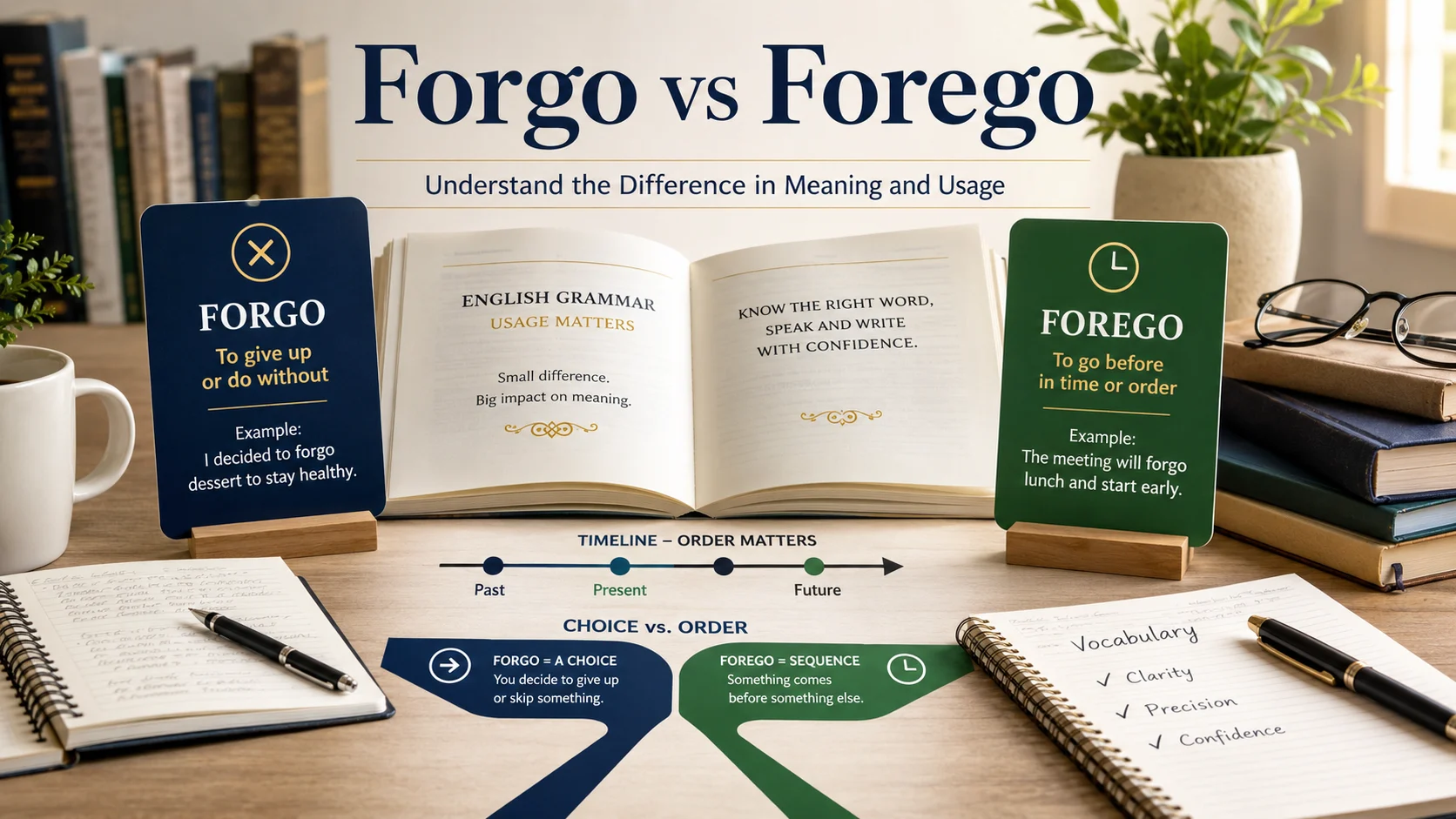
Forgo or forego refers to two commonly confused English words that look almost identical but have different meanings. Forgo means to choose not to do or have something, while forego means to come before something in time or order. Understanding this difference prevents mistakes in professional writing, academic work, and everyday communication.
The confusion between forgo or forego happens because both words share similar spelling and pronunciation, but they serve different purposes in English. Many writers use them interchangeably, especially in formal sentences, business documents, and online content. However, choosing the wrong word can change the meaning of an entire sentence.
The word forgo is a verb that means to give up, avoid, or willingly decide not to take part in something. For example, someone may forgo a vacation to save money. The word forego is also a verb, but it means to come before something else or to precede another event. For example, a short introduction may forego a presentation.
Although these terms look nearly identical, they are not interchangeable. The difference between them depends on you are describing a decision to skip something or explaining that something happens earlier in sequence.
This guide explains the meaning, history, grammar rules, examples, and practical usage of forgo and forego so you can confidently choose the correct word in any situation.
Forgo vs Forego | What’s the Difference?
Both forgo and forego are verbs, but their meanings are completely different. The main difference is related to action and sequence.
Forgo describes a voluntary choice to avoid, sacrifice, or give up something. It focuses on a decision made by a person or group.
Forego describes something that comes before another thing. It focuses on timing, order, or position.
| Word | Part of Speech | Meaning | Main Idea | Example |
|---|---|---|---|---|
| Forgo | Verb | To choose not to have or do something | Giving something up voluntarily | She decided to forgo dessert after dinner. |
| Forego | Verb | To come before something else | Happening earlier in time or order | The ceremony will forego the official announcement. |
The easiest way to remember the difference is to focus on the purpose of the word.
Forgo is about sacrifice, refusal, or avoiding something.
Forego is about something happening first.
In modern English, forgo is used much more frequently than forego because people often discuss choices, restrictions, and decisions.
Is Forgo vs Forego a Grammar, Vocabulary or Usage Issue?
The difference between forgo vs forego is mainly a vocabulary and usage issue rather than a grammar problem. Both words are grammatically correct verbs, but they communicate different ideas.
They are not interchangeable in standard English. Replacing one with the other can create confusion because the meaning changes completely.
In formal writing, such as academic papers, business reports, legal documents, and professional communication, using the correct term is especially important. A sentence about avoiding an action requires forgo, while a sentence about something happening earlier requires forego.
In casual conversation, many people confuse these words because they sound similar. However, professional writers, editors, and language experts maintain the distinction because precision matters.
For example:
Correct:
The company decided to forgo expansion this year.
Incorrect meaning:
The company decided to forego expansion this year.
The second sentence suggests that expansion happened before something else, not that the company cancelled or avoided it.
How to Use Forgo Correctly
The verb forgo means to voluntarily give up something, avoid something, or decide not to experience something. It usually involves a choice, sacrifice, or personal decision.
People often use forgo when discussing money, opportunities, comfort, habits, or benefits.
Workplace Example
A company may decide to forgo hiring new employees because of budget limitations.
This means the company chooses not to hire additional workers.
Another example:
The manager decided to forgo the traditional meeting format and use an online system instead.
The manager intentionally avoided the usual method.
Academic Example
Students sometimes forgo social activities during exam periods to focus on studying.
The students choose to sacrifice leisure time for academic success.
Another example:
Researchers may forgo certain methods when they are not suitable for the study.
The researchers decide not to use those methods.
Technology Example
Many users forgo expensive software subscriptions by choosing free alternatives.
They intentionally avoid paying for premium tools.
Another example:
Developers may forgo unnecessary features to create a simpler application.
They choose not to include those features.
Forgo Usage Recap
Use forgo when someone intentionally gives up, avoids, skips, or refuses something.
Common patterns include:
forgo a benefit
forgo an opportunity
forgo a purchase
forgo a meal
forgo a habit
forgo a decision
If the sentence involves a choice not to do something, forgo is usually the correct option.
How to Use Forego Correctly
The verb forego means to come before something else. It describes an earlier event, action, statement, or condition.
Although forego is a correct English word, it is less common than forgo. It is often found in formal writing, historical contexts, and descriptions involving sequence.
Workplace Example
The introduction will forego the main discussion during the conference.
This means the introduction comes before the main discussion.
Another example:
A brief explanation will forego the detailed report.
The explanation appears earlier than the report.
Academic Example
A literature review may forego the research findings section in a formal academic paper.
The literature review appears before the findings.
Another example:
The opening chapter foregoes the conclusion by establishing the background first.
The opening section comes earlier in the structure.
Technology Example
A warning message may forego the installation process in software applications.
The warning appears before installation begins.
Another example:
A setup guide often foregoes advanced instructions by presenting basic steps first.
The basic steps come earlier.
Forego Usage Recap
Use forego when you mean something happens before another thing.
Common patterns include:
forego an event
forego a discussion
forego a chapter
forego a statement
forego an announcement
If the meaning involves order, sequence, or something coming first, choose forego.
When You Should NOT Use Forgo or Forego
Many writers misuse these words because they focus on spelling instead of meaning. Avoid these common mistakes:
- Do not use forgo when describing something that happens earlier.
Incorrect:
The introduction forgoes the conclusion.
Correct:
The introduction foregoes the conclusion.
- Do not use forego when describing a sacrifice or decision.
Incorrect:
She decided to forego coffee to save money.
Correct:
She decided to forgo coffee to save money.
- Do not use forgo as a replacement for forget.
Incorrect:
I forgo my password.
Correct:
I forgot my password.
- Do not use forego when talking about avoiding an activity.
Incorrect:
The athlete chose to forego training.
Correct:
The athlete chose to forgo training.
- Do not assume the extra letter in forego always means a stronger version of forgo.
The extra letter changes the meaning completely.
- Do not rely only on pronunciation.
Both words can sound similar, but their definitions are different.
- Do not replace these words without checking context.
Professional writing requires accuracy, especially when describing actions, plans, and sequences.
- Do not use forego in everyday situations where forgo is intended.
Most daily decisions involve giving something up, so forgo is usually the correct choice.
Common Mistakes and Decision Rules for Forgo or Forego
The biggest challenge with forgo or forego is that both words look almost identical, but their meanings depend entirely on context. Writers often choose the wrong word because they focus on spelling rather than the purpose of the sentence.
A simple way to avoid mistakes is to ask one question:
Are you talking about giving something up, or are you talking about something coming before another thing?
If the meaning involves a choice, sacrifice, or refusal, use forgo.
If the meaning involves order, sequence, or something happening earlier, use forego.
| Correct Sentence | Incorrect Sentence | Explanation |
|---|---|---|
| She decided to forgo the expensive dinner. | She decided to forego the expensive dinner. | The meaning is giving up a choice, so forgo is correct. |
| The introduction will forego the main presentation. | The introduction will forgo the main presentation. | The introduction comes before the presentation, so forego is correct. |
| The athlete chose to forgo unhealthy foods. | The athlete chose to forego unhealthy foods. | The athlete is avoiding something voluntarily. |
| The opening chapter will forego the final conclusion. | The opening chapter will forgo the final conclusion. | The chapter appears before the conclusion. |
| Many students forgo entertainment during exams. | Many students forego entertainment during exams. | Students sacrifice entertainment for study. |
| The announcement will forego the official ceremony. | The announcement will forgo the official ceremony. | The announcement happens earlier than the ceremony. |
| The company decided to forgo immediate expansion. | The company decided to forego immediate expansion. | The company chooses not to expand. |
| The background section will forego the research findings. | The background section will forgo the research findings. | The background section appears before findings. |
Decision Rule Box
If you mean the action of giving something up, use forgo.
Example:
The customer decided to forgo the additional service.
If you mean something comes before another event or thing, use forego.
Example:
The introduction will forego the main discussion.
A quick memory trick:
Forgo = Give up
Forego = Go before
This simple association helps prevent most spelling and usage errors.
Forgo and Forego in Modern Technology and AI Tools
Modern technology has increased the use of both words, especially in software documentation, artificial intelligence discussions, and digital communication.
The word forgo frequently appears when companies or users make decisions about technology choices. Businesses may forgo expensive solutions, users may forgo premium subscriptions, and developers may forgo unnecessary features to improve performance.
Examples:
A startup may forgo advanced software tools to reduce operational costs.
A developer may forgo extra animations to improve application speed.
The word forego appears less often but still has a role in technical writing when describing structure or sequence.
Examples:
A security warning may forego the installation process.
A setup guide may forego advanced instructions by presenting basic steps first.
In AI generated content, grammar tools, and automated writing platforms, confusion between forgo and forego can occur because artificial intelligence systems sometimes identify spelling patterns without fully understanding context. Human review remains important when accuracy and meaning matter.
Etymology and History of Forgo and Forego
The history of these words explains why they look similar today.
The word forgo comes from Old English roots meaning to pass by, give up, or refrain from taking something. Over time, its meaning developed into the modern idea of voluntarily avoiding or sacrificing something.
The word forego comes from the combination of the prefix “fore,” meaning before, and the older word “go.” Its original meaning was to go before or precede something.
Although both words share the same historical connection with movement, their meanings separated over centuries. Today, forgo relates to choice and sacrifice, while forego relates to order and sequence.
Language expert style explanation:
“Precision in vocabulary depends not only on spelling but also on understanding the purpose a word serves within a sentence.”
This principle explains why choosing between similar words requires attention to meaning rather than appearance.
Real World Case Studies: How Correct Usage Matters
Case Study 1 | Business Communication
A global company preparing a financial report wrote that it would “forego expansion opportunities” when it actually meant the company would not pursue expansion.
The intended meaning was about avoiding a business decision, so the correct word was forgo.
After editing the report, the company changed the wording to “forgo expansion opportunities.” This improved clarity because investors understood that the company was making a strategic choice rather than describing the order of events.
Case Study 2 | Academic Publishing
A research paper incorrectly used “forgo” when describing the structure of its chapters. The sentence suggested that the introduction was avoiding the conclusion instead of appearing before it.
After revision, the researchers replaced it with forego because the sentence referred to sequence.
The correction improved the academic readability of the paper and removed ambiguity for readers.
Error Prevention Checklist
Always use forgo when:
✓ You mean giving something up voluntarily.
✓ You describe avoiding an activity or opportunity.
✓ You discuss personal choices or sacrifices.
✓ You talk about refusing a benefit.
✓ You describe skipping something intentionally.
✓ You explain a decision not to participate.
Never use forego when:
✓ You mean someone is giving something up.
✓ You describe avoiding a habit.
✓ You discuss sacrificing comfort or money.
✓ You explain a personal choice.
✓ You mean skipping an activity.
✓ You are describing a refusal or rejection.
Always use forego when:
✓ You mean something happens before another thing.
✓ You describe sequence or order.
✓ You explain that one event comes first.
✓ You discuss the structure of writing, presentations, or processes.
Never use forgo when:
✓ You describe timing.
✓ You explain a sequence.
✓ You mean “to come before.”
Related Grammar Confusions You Should Master
Understanding similar word pairs improves overall English accuracy. These related topics are especially useful:
- Affect vs Effect: Difference between influence and result.
- Accept vs Except: Difference between receiving something and excluding something.
- Advice vs Advise: Difference between a noun and a verb.
- Than vs Then: Difference between comparison and time sequence.
- Lose vs Loose: Difference between misplacing something and being free.
- Further vs Farther: Difference between figurative and physical distance.
- Bring vs Take: Difference between movement toward and away from a point.
- Borrow vs Lend: Difference between receiving and giving temporarily.
- Later vs Latter: Difference between time and the second option.
- Complement vs Compliment: Difference between completion and praise.
FAQs
What is the difference between forgo and forego?
Forgo means to give something up, while forego means something comes before another thing.
Is forgo or forego more commonly used?
Forgo is more common because people frequently discuss choices and sacrifices.
Can forgo and forego be used interchangeably?
No, they have different meanings and should not replace each other.
Does forgo mean the same as give up?
Yes, forgo usually means voluntarily giving up something.
Does forego mean before?
Yes, forego means to come before something else.
How do I remember forgo vs forego?
Remember forgo means give up, while forego means go before.
Is forego a formal word?
Yes, forego is often used in formal writing about sequence or structure.
Which word should I use for avoiding something?
Use forgo when you mean avoiding or refusing something.
Conclusion
The difference between forgo or forego becomes easier to understand when you focus on the meaning behind each word instead of their similar spelling. Forgo is used when someone willingly gives up, avoids, or chooses not to take part in something, while forego is used when something comes before another event, action, or idea in a sequence.
Although these words are often confused, they are not interchangeable. Using the wrong term can create confusion, especially in professional documents, academic writing, and formal communication. Remembering the simple rule “forgo means give up, while forego means go before” can help you make the correct choice every time.
By understanding their meanings, grammar roles, and real world examples, you can use both words confidently and improve the accuracy and clarity of your English writing.
Discover More Related Articles:
- Threw or Through | What Is the Difference & When Should You Use Each In 2026
- Unkempt or Unkept | What Is the Difference & Which Word Should You Use In 2026
- Neighbour or Neighbor | The Regional Difference Every Writer Should Know In 2026