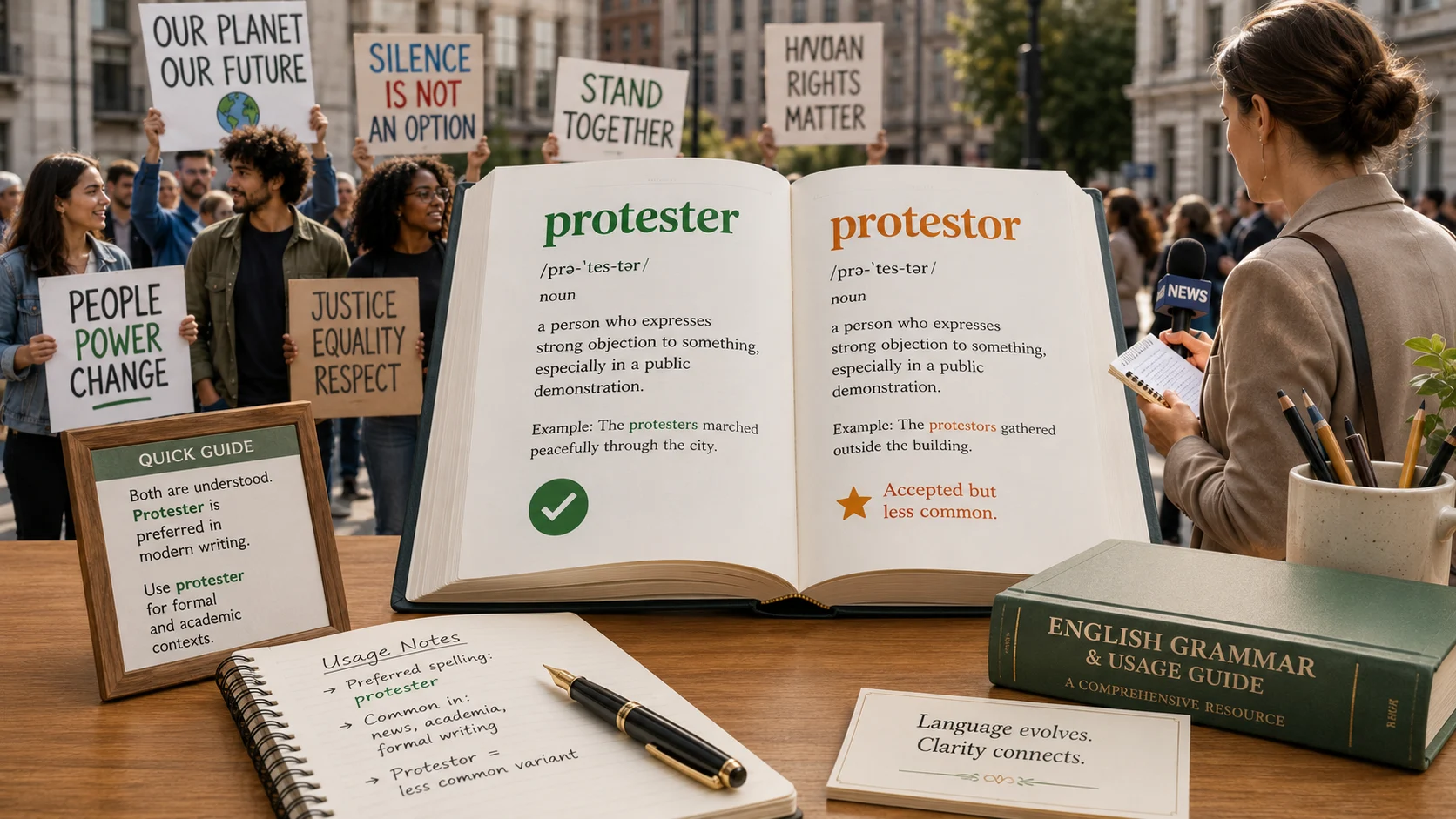
The terms protestor or protester both refer to a person who publicly expresses opposition to an idea, policy, or action. While both spellings are accepted in English, protester is the preferred and more widely used form in modern writing, journalism, academic publications and style guides. Protestor appears less often and is generally considered a less common variant.
If you’ve ever paused while writing protestor or protester, you’re certainly not alone. Both words describe a person who takes part in a protest, yet many writers wonder one spelling is more accurate than the other. This uncertainty often leads to inconsistent writing in news articles, academic papers, business reports, and even social media posts.
The confusion exists because both spellings have appeared in English for many years. However, language evolves, and modern usage patterns have made one version considerably more common than the other. Choosing the right spelling improves clarity, maintains professionalism, and helps your writing match the expectations of readers and editors.
In this guide, you’ll discover the difference between these two words, learn when each should be used, understand why dictionaries accept both forms, and gain practical tips that make choosing the correct spelling effortless.
Protestor vs Protester | What’s the Difference?
Although both words describe someone who participates in a protest, they differ mainly in frequency rather than meaning.
| Feature | Protester | Protestor |
|---|---|---|
| Part of speech | Noun | Noun |
| Meaning | A person who takes part in a protest | A person who takes part in a protest |
| Accepted spelling | Yes | Yes |
| Modern usage | Very common | Less common |
| Preferred by journalists | Yes | Sometimes |
| Common in academic writing | Yes | Rarely |
| Recommended for everyday writing | Yes | Usually not |
Both words communicate exactly the same idea. The difference lies in usage preference rather than definition. Most dictionaries recognize each spelling, but modern English overwhelmingly favors protester.
If your goal is clear, natural writing that aligns with current publishing standards, protester is almost always the safer choice.
Is Protestor or Protester a Grammar, Vocabulary or Usage Issue?
This question is not about grammar because neither spelling changes the sentence structure. It is also not a vocabulary issue since both words share the same meaning.
Instead, this is primarily a usage issue.
English contains many words with more than one accepted spelling. Over time, writers naturally begin favoring one version over another. As newspapers, universities, publishers, and professional organizations consistently choose one form, that spelling gradually becomes the standard.
That is exactly what has happened here.
Are They Interchangeable?
Technically, yes.
Practically, not always.
Most readers expect to see protester because it appears far more frequently in modern English. Using protestor is unlikely to be considered incorrect, but it may seem unusual or dated depending on the audience.
Formal Writing
In formal writing, consistency matters.
Academic papers, legal documents, government publications, and major newspapers generally prefer protester because it reflects current standard usage.
Informal Writing
Casual conversations, blogs, online forums, and personal messages may contain either spelling. Even so, protester remains the version most readers encounter every day.
Academic Writing
Universities encourage consistency and adherence to recognized style guides. Since most style guides lean toward protester, students should generally choose that spelling throughout their assignments.
Understanding the Word Protester
The noun protester refers to a person who publicly objects to a law, decision, event, policy, or action.
The word comes from the verb protest, which means to express disagreement or opposition.
Today, protester appears regularly in newspapers, research papers, documentaries, history books, and official reports.
Workplace Example
Employees organized a peaceful gathering, and every protester remained respectful throughout the demonstration.
This sentence sounds natural because the spelling matches current professional writing standards.
Academic Example
The historian analyzed how each protester influenced public opinion during the civil rights movement.
Academic writing favors this spelling because it aligns with contemporary language usage.
Technology Example
The news application identified every protester visible in the published photographs using image recognition software.
Technology companies, software documentation, and media organizations typically use this spelling.
Additional Examples
The protester carried a sign supporting environmental protection.
Every protester gathered outside the city hall before the march began.
Police officers spoke calmly with each protester during the demonstration.
Journalists interviewed several protesters after the event concluded.
Thousands of protesters attended the peaceful rally.
Usage Recap
The safest choice for modern English is protester.
It appears most often in newspapers, educational materials, professional documents, and digital content. If you are unsure which spelling to use, choosing protester is rarely a mistake.
Understanding the Word Protestor
The noun protestor carries exactly the same meaning as protester.
It describes someone participating in a protest or expressing public opposition.
Although dictionaries continue to recognize this spelling, it appears much less frequently in current English.
Some publications still use it because of historical editorial preferences or regional style decisions. Others simply retain it for consistency across older documents.
Workplace Example
The company statement referred to every protestor involved in the demonstration.
Although understandable, many editors would replace this spelling with protester before publication.
Academic Example
The archive preserved letters written by each protestor during the movement.
This sentence is grammatically correct, although modern academic publishers often prefer the alternative spelling.
Technology Example
The database recorded every protestor appearing in historical newspaper articles.
Again, the meaning remains perfectly clear even though modern writers usually select the more common spelling.
Additional Examples
Every protestor remained peaceful throughout the event.
The photographer captured each protestor holding a handmade sign.
Officials listened carefully to every protestor who wished to speak.
Several protestors marched through the downtown area.
Each protestor expressed concerns about the proposed policy.
Usage Recap
Protestor is not wrong.
However, because it appears less often in modern English, many readers perceive it as uncommon. Unless you are following a publication that specifically prefers this spelling, protester is generally the stronger choice.
Why Is Protester More Common Today?
Language naturally shifts toward forms that readers recognize more easily.
Large collections of published books, newspapers, magazines, and online articles consistently show that protester has become the dominant spelling across English speaking countries.
There are several reasons for this trend.
First, many English nouns describing people end with er because they are formed directly from verbs.
Consider these familiar examples.
Teacher comes from teach.
Writer comes from write.
Runner comes from run.
Speaker comes from speak.
Reader comes from read.
Likewise, protester comes directly from protest, making the formation feel familiar to English speakers.
Second, major news organizations have standardized their editorial practices over many years. Journalists often follow style guides that encourage consistency, and protester has become the preferred choice.
Third, search engines, educational resources, and digital writing tools increasingly reflect common language usage. As more people encounter protester, they naturally adopt the same spelling.
Why Do Dictionaries Accept Both Spellings?
Many English words have more than one accepted spelling because language develops gradually rather than changing overnight.
Dictionary editors describe how people actually use language instead of creating strict rules from scratch.
Since both spellings have appeared in published English for generations, dictionaries continue recognizing each one.
However, dictionaries also indicate usage frequency. They often identify protester as the preferred or more common spelling because modern evidence strongly supports that conclusion.
Understanding this distinction helps explain why neither spelling is technically incorrect while one remains clearly more popular.
Regional Differences
Interestingly, the preference for protester extends across several major varieties of English.
American English overwhelmingly favors protester.
British English also uses protester more frequently, although protestor occasionally appears in older publications.
Canadian English generally follows the same pattern.
Australian English likewise shows a clear preference for protester.
This widespread agreement makes the choice easier for international writers. Regardless of your audience, protester will almost always feel familiar and natural.
Which Spelling Should You Choose?
If your goal is accurate, modern, professional writing, the answer is straightforward.
Choose protester for school assignments, business communication, journalism, academic papers, websites, blog articles, and professional reports.
Reserve protestor only if you are quoting historical documents, following an organization’s established editorial style, or preserving the original wording of a source.
For nearly every everyday writing situation, protester remains the preferred choice because it reflects current English usage, matches reader expectations, and aligns with leading dictionaries and style guides.
When You Should NOT Use Protestor or Protester
Although both words describe a person who participates in a protest, there are situations where neither word is the best choice. Selecting the wrong term can make your writing less precise or even change the intended meaning.
Do not use either spelling in the following situations.
First, avoid using either word when referring to the act of expressing disagreement. In that case, the correct word is protest.
Second, do not use either term for a written objection submitted during a legal or business process. The noun protest is more appropriate.
Third, avoid calling someone a protester if they simply disagree with an idea privately. A protester publicly demonstrates opposition.
Fourth, do not use these words for someone attending a public meeting without participating in the protest itself.
Fifth, avoid using them when referring to a lawyer, advocate, or spokesperson unless that individual is actively taking part in a protest.
Sixth, do not use either spelling to describe online criticism that does not involve organized public action. Depending on the context, terms such as commenter, critic, or campaign supporter may be more accurate.
Finally, avoid switching between protester and protestor within the same document. Consistency is an important mark of professional writing.
Common Mistakes and Decision Rules
The following examples illustrate mistakes that frequently appear in everyday writing.
| Correct Sentence | Incorrect Sentence | Explanation |
|---|---|---|
| The protesters gathered peacefully outside the courthouse. | The protests gathered peacefully outside the courthouse. | Protests are events, not people. |
| Every protester carried a sign. | Every protest carried a sign. | A protest cannot carry anything because it is an event. |
| Journalists interviewed several protesters after the rally. | Journalists interviewed several protest after the rally. | The noun referring to people is required. |
| The protest attracted thousands of protesters. | The protest attracted thousands of protest. | The second noun refers to participants. |
| Most style guides recommend protester. | Most style guides recommend protestor for all situations. | Protestor is accepted but much less common. |
Decision Rule Box
If you mean the public demonstration itself, use protest.
If you mean the person taking part in the demonstration, use protester.
Use protestor only when following a publication or organization that specifically prefers that spelling.
This simple rule will help you make the correct choice almost every time.
Protestor or Protester in Modern Technology and AI Tools
Modern technology has influenced how language evolves, and spelling preferences are no exception.
Artificial intelligence writing assistants, grammar checkers, and search engines analyze enormous collections of published content. Because protester appears much more frequently in books, newspapers, academic journals, and trusted websites, these tools often recommend it over protestor.
Search engines also recognize protester as the dominant spelling. As a result, articles using this form generally align more closely with current search behavior and reader expectations.
Content creators, editors, and marketers therefore benefit from using protester in most digital publications. It improves consistency and matches the language readers are accustomed to seeing.
The Etymology Behind the Words
The verb protest entered English through Latin and French, carrying the idea of declaring or affirming something publicly.
As English developed, nouns describing people were commonly formed by adding the ending er to verbs. This pattern produced familiar words such as teacher, writer, speaker, reader, and painter.
The spelling protestor also emerged and remained acceptable, but it never became as widespread as protester. Over time, publishers, journalists, and educators increasingly favored the er ending, making it the standard form used today.
Expert Perspective
Language specialists generally agree that both spellings are legitimate, yet usage matters just as much as dictionary acceptance.
“Good writing reflects both correctness and current usage. When one accepted spelling becomes overwhelmingly preferred, choosing it improves clarity and consistency for readers.”
This principle explains why experienced editors usually recommend protester unless there is a compelling reason to preserve the alternative spelling.
Case Study One | Newsroom Style Consistency
A regional news organization reviewed several years of archived articles while updating its editorial handbook.
Editors discovered that writers had alternated between protester and protestor, creating inconsistent headlines and search results.
After standardizing every article to protester, the publication achieved more consistent branding and improved readability across its digital archive. The editorial team also reported fewer proofreading corrections during publication.
Case Study Two | University Writing Center
A university writing center examined hundreds of student essays discussing historical protests.
Many students alternated between the two spellings within the same paper.
Writing tutors advised students to use protester consistently because it matched current academic conventions. After introducing this guidance, instructors reported noticeably fewer spelling consistency issues during grading.
Error Prevention Checklist
Before publishing your writing, review these points.
✔ Always use protester in academic writing.
✔ Always use protester in business communication.
✔ Always use protester in news articles.
✔ Always use protester in blog posts and website content.
✔ Always remain consistent throughout the document.
✔ Never switch between both spellings without a reason.
✔ Never assume protestor is the preferred modern form.
✔ Never confuse protest with the noun referring to a person.
Related Grammar Confusions You Should Master
Improving your English becomes much easier when you understand similar word pairs. Consider exploring these commonly confused terms.
Affect or Effect
Understanding the difference between a verb and a noun prevents many writing mistakes.
Compliment or Complement
These similar sounding words have completely different meanings.
Principal or Principle
One refers to a person or something primary, while the other refers to a rule or belief.
Stationary or Stationery
One describes something that does not move, while the other refers to writing materials.
Advice or Advise
The spelling changes according to the word functions as a noun or a verb.
Practice or Practise
British English distinguishes between these spellings depending on grammatical function.
Historic or Historical
Both relate to history, but they are not interchangeable.
Ensure or Insure
Although closely related, each serves a different purpose in writing.
Lay or Lie
These verbs often confuse even experienced writers because their forms change differently.
Farther or Further
Choosing the correct word depends on you are discussing physical distance or a broader idea.
FAQs
Is protestor or protester the correct spelling?
Both spellings are accepted in English dictionaries. However, protester is the preferred spelling in modern English because it appears much more frequently in newspapers, academic writing, professional publications, and online content.
Why is protester more common than protestor?
The ending er follows a familiar English pattern used to create nouns from verbs. Since writers, editors, and publishers consistently prefer protester, it has become the dominant spelling in current usage.
Do dictionaries recognize protestor as a real word?
Yes. Major dictionaries continue to include protestor as an accepted variant. Even so, they generally indicate that protester is the more common and widely preferred form.
Should I use protestor in academic writing?
Most universities and academic style guides recommend using protester because it reflects contemporary English usage. Consistency throughout your document is also important.
Is protestor used in British English?
Yes. British English recognizes both spellings, but protester remains the version most commonly used by newspapers, publishers, and educational institutions.
Do grammar checkers correct protestor to protester?
Many grammar and writing tools suggest protester because it is the spelling found most often in modern published English. The recommendation is based on usage rather than correctness alone.
Can I use both spellings in the same article?
It is better not to. Even though both are correct, switching between them can make your writing appear inconsistent. Choose one spelling and use it throughout the entire document.
Which spelling is better for SEO?
For most online content, protester is the stronger choice because it matches common search behavior and modern language usage. It also aligns with the spelling readers expect to see.
Conclusion
The debate over protestor or protester is less about right and wrong than about modern usage. Both spellings refer to a person who takes part in a public protest, and both are recognized by respected dictionaries. Nevertheless, language naturally favors one form over time, and in today’s English that form is protester.
You are writing a research paper, news article, business report, blog post, or social media update, choosing protester will help your writing feel current, professional, and consistent. Reserve protestor only when following a specific editorial preference or preserving historical wording.
Remember this simple guideline. If you are referring to the event, use protest. If you are referring to the person participating in that event, use protester. Following this rule will help you write with confidence in almost every situation.
Discover More Related Articles:
- Sergeant or Sargeant | The Mistake Even Native Speakers Make In 2026
- Since or Sense | The Mistake That Quietly Hurts Your Writing In 2026
- Lended or Lent | Which Word Is Correct & When Should You Use It In 2026