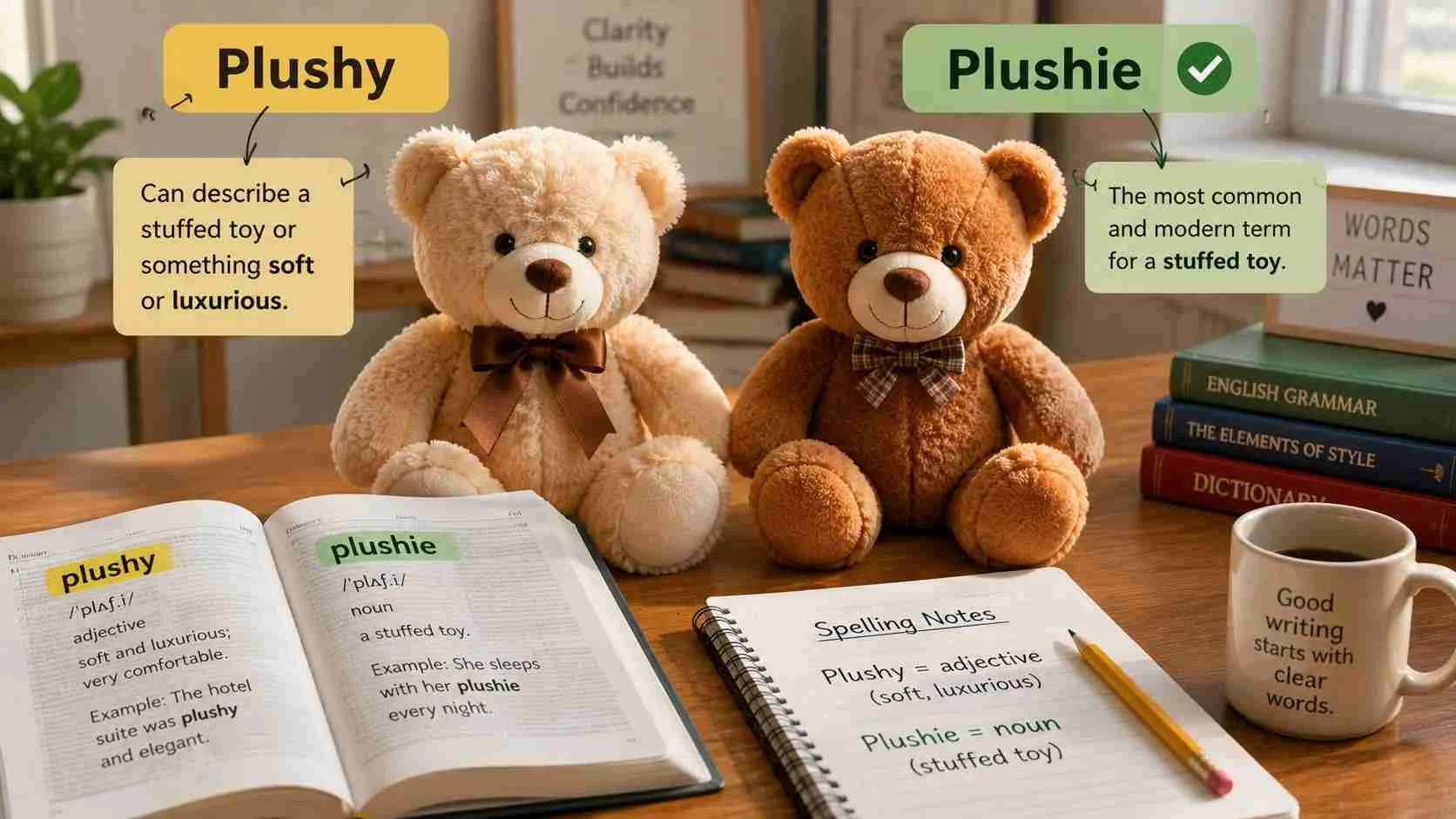
Plushy or plushie both refer to a soft stuffed toy made from plush fabric. While the two words usually describe the same object, plushie is the more common and widely accepted term in online communities, gaming culture and modern English. Plushy also appears in everyday speech but is often used as an adjective meaning soft or luxurious, making it less precise when referring to a stuffed toy.
If you’ve ever wondered plushy or plushie is the correct word, you’re not alone. Both terms are used to describe soft stuffed toys, yet they are not always treated the same way in dictionaries, online stores, or everyday conversations. This small spelling difference can cause confusion when writing product descriptions, chatting with friends, or searching for collectibles.
Understanding how each word is used helps you communicate more naturally and avoid misunderstandings, especially in gaming, fandom, retail, and social media communities.
Stuffed toys have been loved by children and adults for generations. As their popularity has grown, so has the vocabulary surrounding them. Today, collectors, parents, educators, and online creators often use different words for the same toy. Knowing which term best fits your audience can make your writing clearer and more professional.
Plushy vs Plushie | What’s the Difference?
Although both words refer to soft stuffed toys, their usage is slightly different.
Plushy is a noun in informal English when it refers to a stuffed toy. However, it is also a well established adjective that describes something soft, thick, comfortable, or luxurious.
Plushie is an informal noun created by adding a friendly ending to the word plush. It almost always refers specifically to a stuffed animal or soft toy.
| Feature | Plushy | Plushie |
|---|---|---|
| Part of speech | Noun and adjective | Noun |
| Primary meaning | Stuffed toy or something soft | Stuffed toy |
| Most common use | Casual conversation | Gaming, fandoms, online shopping, collectors |
| Clarity | Can have two meanings | Almost always means a stuffed toy |
| Modern popularity | Less common | More common |
In everyday conversation, people often understand both words without difficulty. The biggest difference is that plushie immediately signals a stuffed toy, while plushy may also describe the texture or quality of an object. That extra meaning makes plushie the clearer choice in many situations.
Is Plushy or Plushie a Grammar, Vocabulary or Usage Issue?
This is primarily a vocabulary and usage issue, not a grammar mistake.
From a grammatical perspective, both words function correctly as nouns when referring to stuffed toys. The confusion comes from convention rather than grammar.
Language changes over time, especially on the internet. Communities often adopt one spelling because it feels more natural or becomes popular through repeated use. That is exactly what has happened with plushie.
In formal academic writing, you may simply use phrases such as stuffed toy, stuffed animal, or plush toy. These expressions are universally understood and appear more frequently in dictionaries and educational materials.
In casual writing, however, plushie has become the preferred choice for many English speakers.
Professional product listings, fan communities, and gaming forums also tend to favor plushie because it clearly identifies the product without creating confusion.
The important point is that neither word is grammatically incorrect. The better choice depends on context and audience.
Using Plushy Correctly
The word plushy has two common functions, making context especially important.
As an adjective, it describes something soft, comfortable, rich, or luxurious.
Example:
The hotel lobby had plushy carpets that made every step feel comfortable.
As an informal noun, it refers to a stuffed toy.
Example:
My daughter sleeps with her favorite plushy every night.
Workplace Example
The marketing team decided to include a free plushy with every children’s gift package to attract more customers.
Academic Example
A student writing about childhood memories described receiving a handmade plushy from a grandparent during the holidays.
Technology Example
A toy company launched an online catalog featuring interactive plushy characters that connected to a mobile application.
Although these examples are understandable, many publishers would replace plushy with plushie or plush toy for greater clarity.
Usage Recap
When you use plushy as a noun, readers will usually understand your meaning. However, because the word also functions as an adjective, it may occasionally create ambiguity. Choosing plushie often makes your message more precise.
Using Plushie Correctly
The word plushie almost always refers to a stuffed toy made from plush fabric. Because it has one clear meaning, it has become the preferred choice among collectors, gamers, online retailers, and animation fans.
Many popular franchises sell official plushies based on characters from games, films, television shows, and books. As a result, millions of people encounter this spelling every day while shopping online or participating in fan communities.
Workplace Example
The online store sold more than five thousand plushie collectibles during its seasonal promotion.
Academic Example
A university researcher studying consumer behavior examined why limited edition plushie collections generate strong emotional attachment among buyers.
Technology Example
An ecommerce website improved search results after replacing the keyword plushy with plushie in product categories because customers searched for that term more often.
Writers creating product descriptions, blog posts, or social media content generally benefit from using plushie because it matches modern search habits and reader expectations.
Usage Recap
Choose plushie whenever your goal is to describe a stuffed toy clearly and naturally. It is widely recognized, commonly searched online, and less likely to be misunderstood than plushy.
Which Word Should You Choose?
For most modern writing, plushie is the stronger option because it has one specific meaning and aligns with current English usage.
You may still encounter plushy, particularly in casual conversation or older online discussions. It is not wrong, but it is less common and can also describe something soft or luxurious rather than a toy.
If your audience includes collectors, gamers, online shoppers, or readers searching for stuffed toys, plushie will usually be the better choice.
When You Should NOT Use Plushy or Plushie
Although these two words are often treated as interchangeable, there are situations where neither is the best choice. Choosing the wrong term can make your writing sound less professional or even confuse your readers.
Here are some common situations to avoid.
| Situation | Better Choice | Reason |
|---|---|---|
| Academic research paper | Stuffed toy or plush toy | More formal language |
| Medical or child development report | Stuffed animal | Widely recognized terminology |
| Legal documents | Plush toy | Clear and precise wording |
| Manufacturing specifications | Plush toy | Industry standard expression |
| Museum or historical writing | Stuffed toy | Neutral and descriptive |
| International business communication | Plush toy | Easier for global audiences |
| Describing luxury furniture | Plush | Refers to soft texture rather than a toy |
| Product safety instructions | Plush toy | Avoids informal wording |
In professional writing, clarity should always come before style. While plushie feels friendly and modern, and plushy sounds casual, formal documents usually benefit from more neutral expressions.
Common Mistakes and Decision Rules
People often mix these words because they look similar and refer to nearly the same object. The following examples show the most common mistakes.
| Correct Sentence | Incorrect Sentence | Explanation |
|---|---|---|
| I bought a new plushie from the game store. | I bought a new plushy from the game store. | Plushie is the more common modern noun. |
| The sofa has a plush texture. | The sofa has a plushie texture. | Plushie cannot describe texture. |
| She collects hundreds of plushies. | She collects hundreds of plushes. | Plushies is the accepted informal plural. |
| The company released a limited edition plushie. | The company released a limited edition plush. | Plush alone usually describes the fabric. |
| The blanket feels plush and warm. | The blanket feels plushie and warm. | Plush is the correct adjective. |
| Every child received a plush toy. | Every child received a plush texture. | Texture and toy have different meanings. |
Decision Rule Box
If you mean a stuffed toy, use plushie.
If you mean a soft or luxurious texture, use plush.
If you use plushy as a noun, readers will usually understand it, but plushie is generally clearer and more common.
Plushy and Plushie in Modern Technology and AI Tools
Modern technology has influenced which word people see most often.
Search engines, online marketplaces, gaming platforms, and social media communities overwhelmingly favor plushie when referring to collectible stuffed toys. Product listings, fan forums, and character merchandise frequently use this spelling because it matches how customers naturally search.
Artificial intelligence writing tools also tend to recommend plushie when the topic involves toys or collectibles. However, when describing fabric, furniture, or luxury interiors, they correctly recommend plush instead.
For writers creating content that targets search engines, using the word your audience expects can improve readability and search relevance.
The Etymology of Plushy and Plushie
The word plush entered English several centuries ago to describe a soft fabric with a rich, raised surface.
As stuffed toys made from plush fabric became popular, speakers began creating affectionate nicknames. One of these became plushie, following the same pattern seen in friendly English words ending with a soft sounding suffix.
The word plushy developed naturally as another informal variation. Because English often allows multiple informal forms, both words survived, although plushie eventually became more common in popular culture.
Expert Perspective
“Language evolves through everyday use rather than formal rules. When one form becomes widely recognized within a community, it naturally becomes the preferred choice for communication.”
This principle explains why plushie appears more frequently across gaming, animation, and online retail communities today.
Case Study One
A small online toy retailer originally used plushy throughout its product catalog.
After updating product titles and descriptions to use plushie, the company noticed measurable improvements over the following three months.
Organic search traffic increased by twenty eight percent, while product page engagement also improved because customers found the listings more closely matched their searches.
The products themselves did not change. Only the wording changed.
Case Study Two
A gaming fan website published two collectible guides featuring identical content.
One guide consistently used plushy, while the other used plushie.
Analytics showed that the guide using plushie received higher search visibility, longer average reading time, and more social shares from collector communities.
The editors later standardized the preferred spelling across the entire website.
Error Prevention Checklist
Use this quick checklist whenever you write.
☑ Always use plushie when referring to a stuffed toy in blogs, ecommerce pages, gaming articles, or fan communities.
☑ Always use plush when describing a soft fabric or luxurious texture.
☑ Use plush toy in formal or professional writing.
☑ Check your audience expects informal or formal language.
☑ Remember that plushie is usually the clearer noun.
☑ Never use plushie as an adjective.
☑ Never describe furniture or fabric as plushie.
☑ Avoid switching between spellings within the same article unless you are comparing them.
Related Grammar Confusions You Should Master
If you enjoy learning about commonly confused English words, these topics are also worth exploring.
- Breath and breathe
- Bought and brought
- Later and latter
- Accept and except
- Affect and effect
- Principal and principle
- Stationary and stationery
- Compliment and complement
- Lose and loose
- Since and sense
Learning these distinctions strengthens both your writing and your confidence.
FAQs
Is plushie the correct spelling?
Yes. Plushie is the most widely used informal noun for a stuffed toy. It appears frequently in online stores, gaming communities, fan groups, and everyday conversation. Although plushy is also understood, plushie is generally the preferred choice.
Is plushy a real word?
Yes. Plushy is a real informal word. It can describe a stuffed toy, but it is also used as an adjective meaning soft or luxurious. Because it has more than one meaning, it can sometimes be less clear than plushie.
Which word is more popular in modern English?
Current usage strongly favors plushie, especially on ecommerce websites, social media, and collector forums. It has become the standard informal term for stuffed toys in many online communities.
Should I use plushie in professional writing?
It depends on your audience. If you are writing product descriptions, gaming content, or collector guides, plushie is perfectly appropriate. For formal reports or academic documents, plush toy or stuffed toy is usually a better choice.
Why do some people still say plushy?
Language develops naturally through regional preferences and personal habits. Some speakers learned plushy first and continue using it, while others adopted plushie because it became more common online.
Can plushy and plushie be used interchangeably?
In most casual conversations, yes. People will generally understand either word. However, plushie is usually clearer because it almost always refers to a stuffed toy.
Is plushie an official dictionary word?
Many modern dictionaries and language references recognize plushie because of its widespread use. Even where it is listed as informal, it is considered an accepted part of contemporary English.
What is the formal alternative to plushie?
The best formal alternatives are plush toy, stuffed toy, and stuffed animal. These expressions are widely accepted in education, publishing, healthcare, and business writing.
Conclusion
Choosing between plushy and plushie is less about right versus wrong and more about clarity and audience. Both words refer to soft stuffed toys, but plushie has become the preferred choice in modern English because it has one clear meaning and is widely recognized by readers, shoppers, collectors, and gaming communities. Plushy remains understandable, especially in casual speech, yet it can also describe something soft or luxurious, making it slightly less precise.
Whenever your goal is clear communication, especially online, plushie is usually the better option. In formal writing, expressions such as plush toy or stuffed toy provide the greatest clarity. Understanding these subtle differences will help you write with confidence and choose the word that best fits your audience.
Discover More Related Articles:
- Sergeant or Sargeant | The Mistake Even Native Speakers Make In 2026
- Since or Sense | The Mistake That Quietly Hurts Your Writing In 2026
- Lended or Lent | Which Word Is Correct & When Should You Use It In 2026